Nome Alaska — Retro Vintage History
What’s with the Three Lucky Swedes? The Three Lucky Swedes struck gold on Anvil Creek on September 22, 1898 — the strike that set off the last great American gold rush. The prospectors — Jafet Lindeberg, Erik Lindblom, and John Brynteson — were working a few miles above the Bering Sea beach on the Seward Peninsula. Two were Swedish; Lindeberg was Norwegian; the nickname stuck anyway, and the “Three Lucky Swedes” entered Alaska legend. The tent city that sprang up on the shore below — briefly called Anvil City — became Nome. Within two years the luckiest beach in the north held one of the largest cities on the Pacific coast above Seattle, out at the edge of the continent, facing Siberia.
Wear the HistoryWhere you’re from. Where you love. Where you explored. Where you belong.
The Iñupiat were here first, and they are here still. The coast around Sitŋasuaq — the Iñupiaq name for the Nome area — had been fished and hunted for centuries before any prospector arrived, part of a network of Seward Peninsula communities living by salmon, seal, walrus, and caribou. Roughly half of Nome’s people today are Alaska Native, and the town remains a hub for the surrounding Iñupiat villages of the region. Whatever gold built here, the deeper story of this coast is continuity — a homeland that long predates the stampede and outlasts it.
QUICK FACTS — NOME, ALASKA
Gold was discovered on Anvil Creek near Nome on September 22, 1898, by Jafet Lindeberg, Erik Lindblom, and John Brynteson — the “Three Lucky Swedes.”
In 1899 gold was found in Nome’s beach sand; the tide line could not be claimed, so the ground was free to anyone.
Wyatt Earp ran the Dexter Saloon on Front Street from 1899 to 1901 and left with an estimated $80,000.
In 1925, twenty dog teams relayed lifesaving serum 674 miles from Nenana to Nome in 127 hours.
Local legend holds that the name Nome began as a mapmaker’s misreading of a chart annotation, “? Name.”
The four White Alice antennas on Anvil Mountain carried Cold War military communications from the late 1950s until 1979 — and still stand.
Little Diomede Island, west of Nome, lies 2.4 miles from Russia’s Big Diomede, across the International Date Line.
The Port of Nome is being expanded into the first deep-draft Arctic port in the United States, with construction underway in 2026.
The rush itself broke every rule of gold country. In the summer of 1899, gold turned up in the black sand of Nome’s own beach — and a beach below the tide line could not be staked as a claim. The ground was free to anyone with a shovel, a pan, and a strong back. Word reached Seattle, and steamers unloaded tens of thousands of stampeders onto the sand. The 1900 census counted 12,488 people, with summer estimates running far higher — for a moment, Nome was the largest city in Alaska. Tents, saloons, and false-front stores ran for miles along the shore.

Front Street collected characters. Wyatt Earp — the Tombstone lawman — arrived in 1899 and ran the Dexter Saloon for two years as a businessman rather than a marshal; biographers estimate he left Nome with about $80,000, more than his lawman years ever paid him. The rush also drew a subtler kind of prospector: in 1900, political boss Alexander McKenzie and federal judge Arthur H. Noyes worked a scheme to seize the richest claims — including the Swedes’ — through the court itself, until a federal appeals panel shut it down and jailed McKenzie. Rex Beach turned the affair into his 1906 novel The Spoilers. Nome incorporated as a city on April 9, 1901; storms and fires — the worst in 1913 and 1934 — later took most of the original gold-rush buildings, though St. Joseph’s Church of 1901 still stands.
In January 1925, diphtheria broke out in Nome, and the nearest serum sat 674 miles away in Nenana. Twenty mushers and their dog teams ran it west in relay — 127 hours through interior cold that fell below minus forty. Leonhard Seppala and his lead dog Togo drove the longest and most dangerous leg, roughly 260 miles including a shortcut across the shifting sea ice of Norton Sound; Gunnar Kaasen and Balto brought the serum the final 55 miles into town through an eighty-mile-an-hour blizzard, arriving at 5:30 on the morning of February 2. The epidemic was stopped. The Great Race of Mercy made national heroes of the mushers and both dogs — and Alaskans will tell you Togo’s run was the harder one.
The twentieth century kept finding uses for the edge of the map. Roald Amundsen’s airship Norge, first across the North Pole in 1926, was bound for Nome when weather forced it down at nearby Teller; a bronze bust of the explorer stands on Front Street today. During World War II, Lend-Lease aircraft bound for the Soviet Union staged through Nome on their way across the Bering Strait. From the late 1950s until 1979 the four giant White Alice antennas on Anvil Mountain carried Cold War military communications, and they still stand against the tundra sky. In 1959 the federal government closed the school on King Island, and that Iñupiat community was forced to relocate permanently to Nome — a loss still carried within living memory. And in March 1973, the first Iditarod Trail Sled Dog Race finished on Front Street; every March since, dog teams have run roughly a thousand miles from Anchorage to the burled wooden arch the town raises over the street — an arch so beloved that when rot felled the old one in 2024, a new two-ton burled spruce was flown in for 2025 — and Nome’s population briefly doubles for race week.
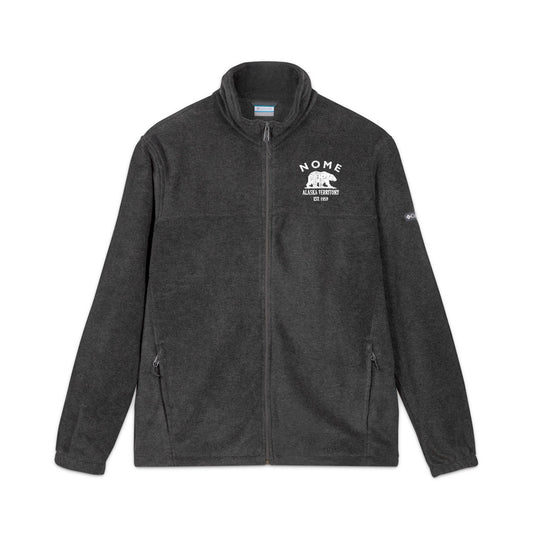
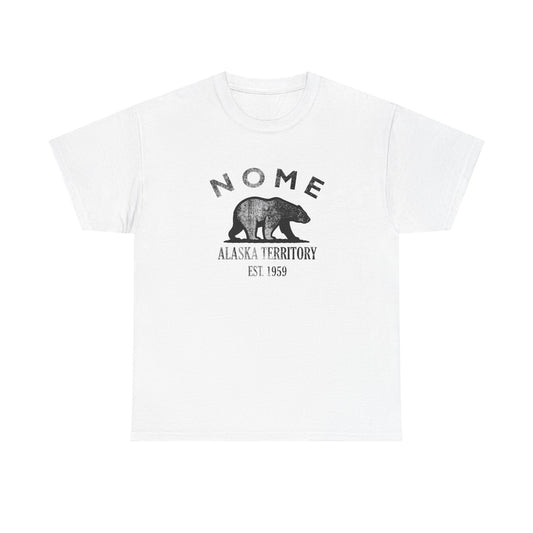
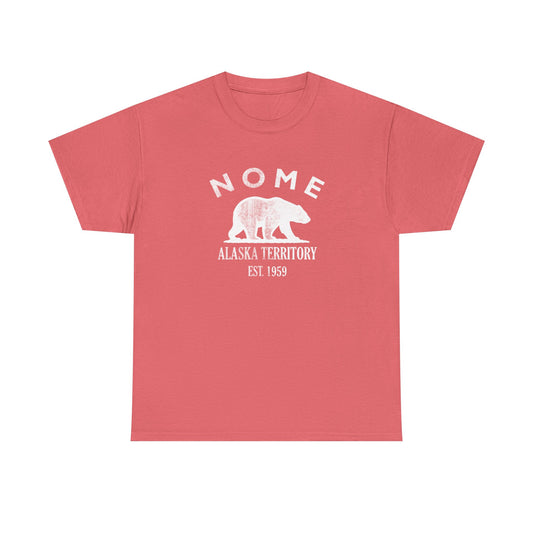
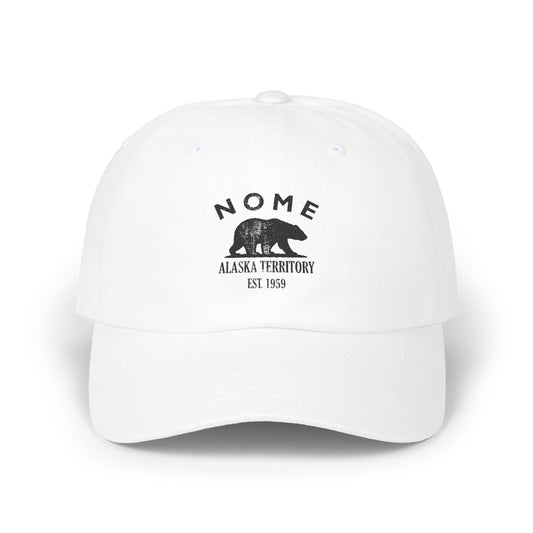
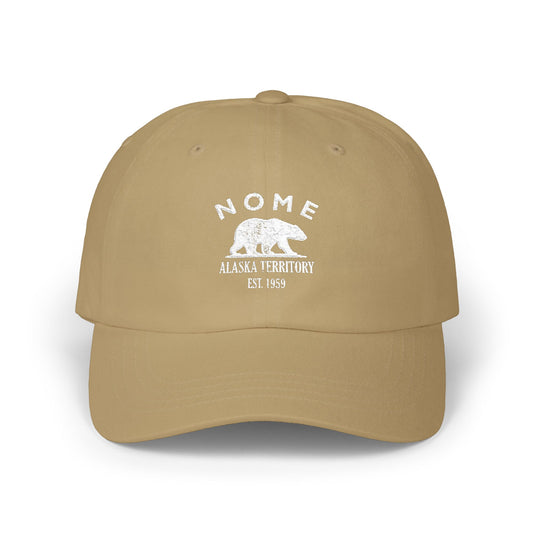
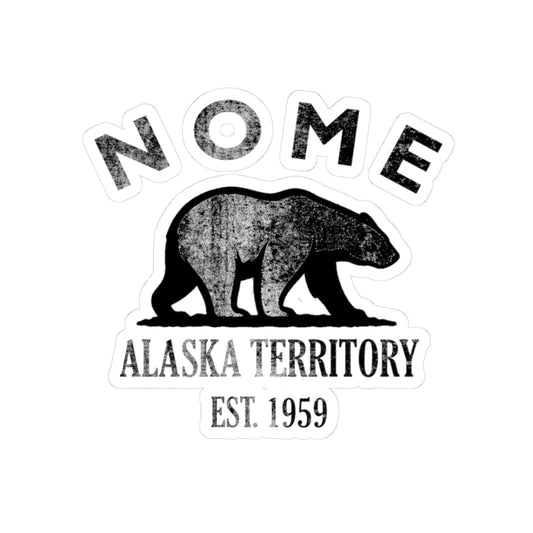
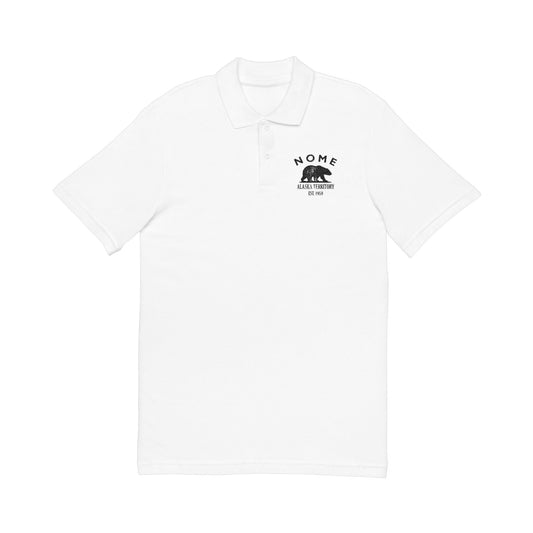
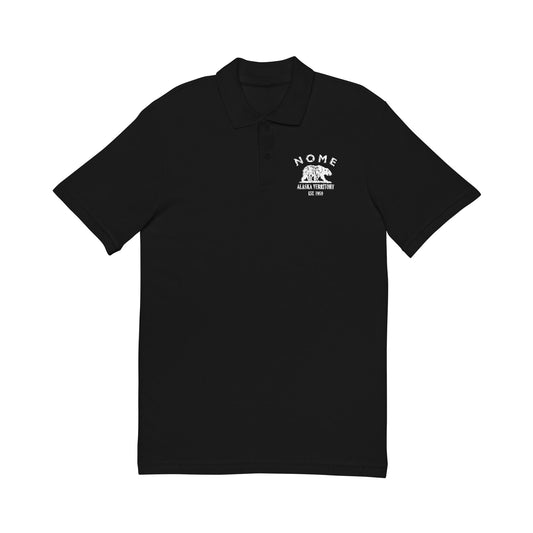
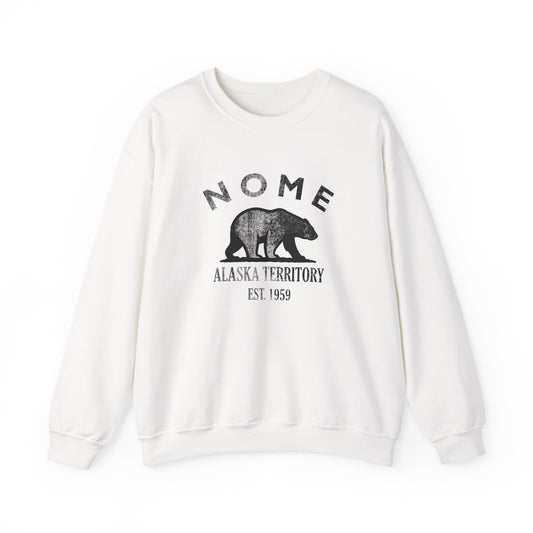
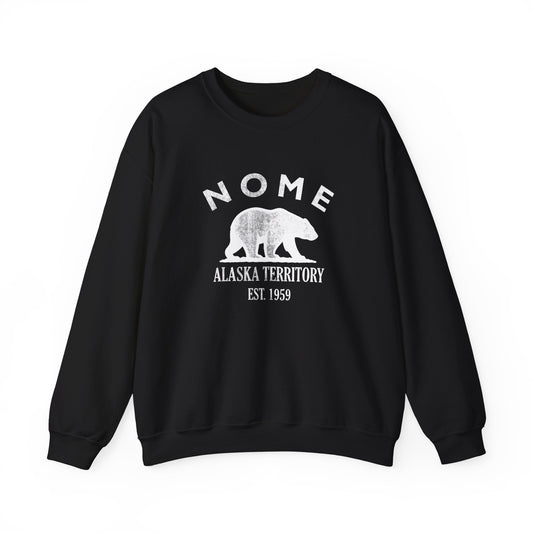
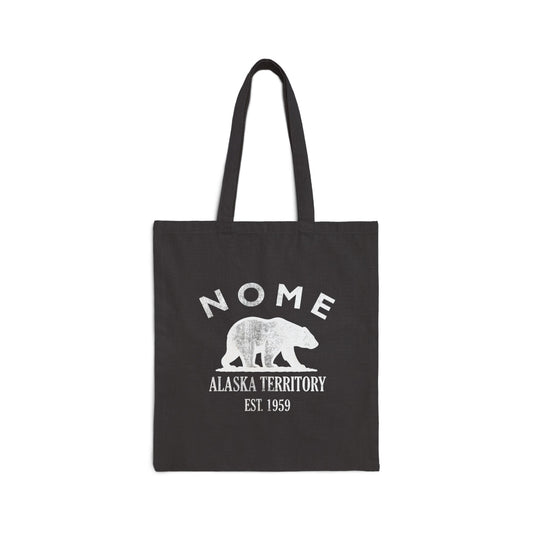
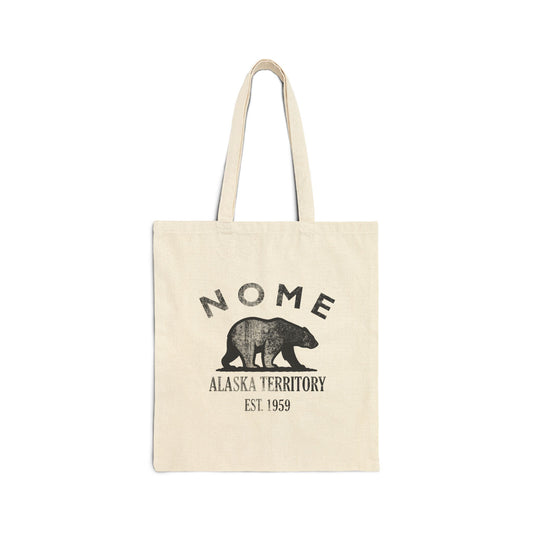
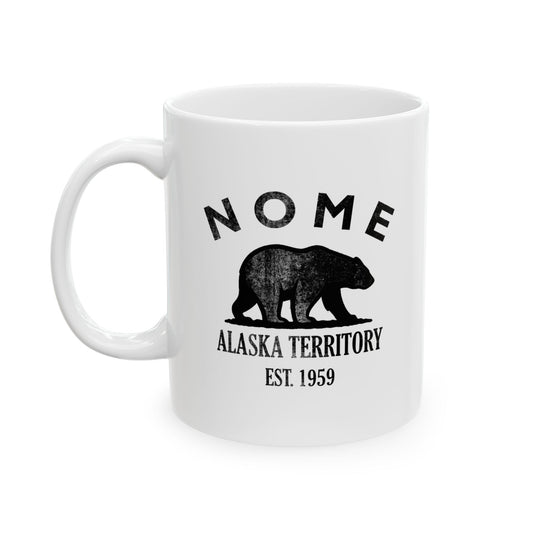
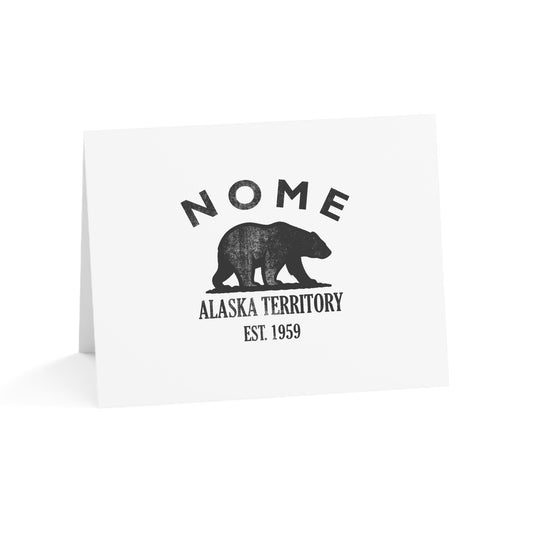
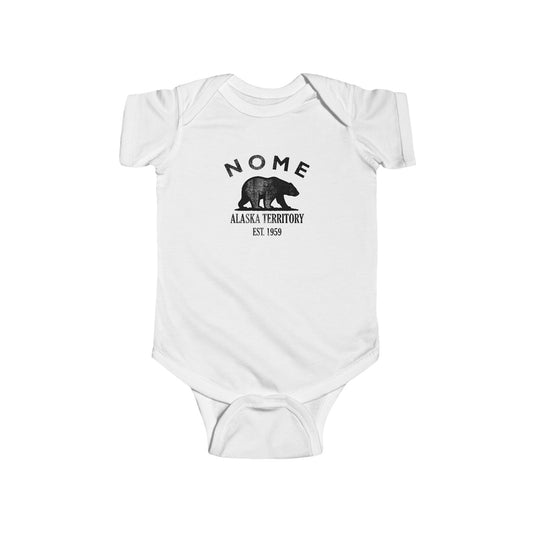
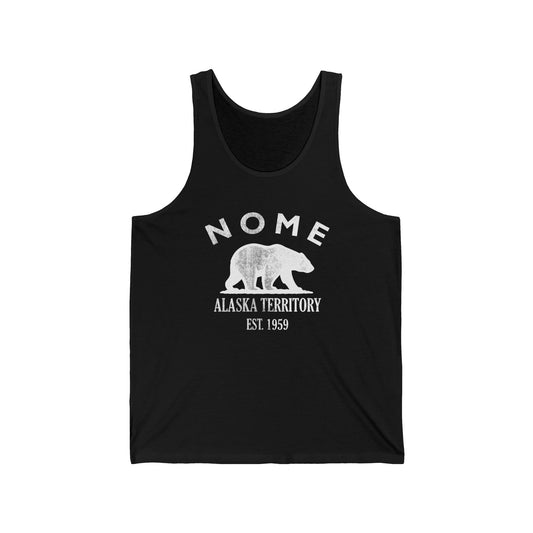
Our Nome logo carries Alaska’s distressed bear over “1959,” the year of statehood — the shared retro emblem of every Merlin Classics Alaska town. Printed in worn black-and-white that recalls a crate stamp or an outfitter’s mark, the bear is the state in shorthand: rugged, patient, at home in hard country. What makes this one Nome is everything around it — the beach that paid in gold, the dog teams, the Bering Sea at the door, and Siberia over the horizon.
Today Nome is a town of about 3,700 with no road to the rest of Alaska — you fly in or you sail. Gold dredges rust on the tundra, beach permits still let visitors pan the sand, muskox graze the peninsula, and the aurora rolls overhead from September into March. And the next chapter is underway: the Port of Nome is being expanded into the first deep-draft Arctic port in the United States, a gateway to the opening Arctic. Its story runs from the Iñupiat homeland through the last great gold rush, the Serum Run, and the race that still finishes here. Wear it for where you’re from, where you explored, or where you’re still headed. There’s no place like Nome.

Nome Alaska — Travel Guide
Visiting Nome Alaska Today
Nome sits on the Bering Sea coast of the Seward Peninsula, 539 miles northwest of Anchorage and 161 miles from Russia across the Bering Strait. Air access only — no road connects Nome to the rest of Alaska. The town of roughly 3,700 briefly doubles every March when the Iditarod finishes on Front Street. Summer brings long subarctic daylight, salmon, and muskox on the tundra; winter brings the aurora overhead and Bering Sea ice along the coast.
Gold Rush, Sled Dogs, and Bering Sea Stops in Nome Alaska
For visitors searching for things to do in Nome Alaska:
- Walk Front Street, where the annual thousand-mile sled dog race from Anchorage has finished under a burled wooden arch since 1973 — a brand-new arch went up for 2025, and race week in March is the town’s biggest event of the year.
- Visit the Carrie M. McLain Memorial Museum for collections from the 1898 Anvil Creek gold rush, the 1925 Serum Run, and the Iñupiat communities of the Seward Peninsula.
- Drive the three gravel highways — Nome-Council, Kougarok, and Nome-Teller — for wide tundra views, seabirds, summer wildflowers, and muskox sightings before the roads simply end.
- See the abandoned gold dredges standing on the tundra outside town, massive relics of the 1920s–30s deep-dredging era.
- Visit Anvil Creek, the September 1898 discovery site a few miles north of town.
- Look up at the four White Alice antennas on Anvil Mountain, the Cold War communications site in service until 1979, accidentally photogenic against the Arctic sky.
- Stop at St. Joseph’s Church, completed in 1901 — one of the few structures to survive the town’s early disasters.
- Try recreational beach gold panning in summer — the same sands that started it all still give up color, and visitor panning is permitted on the public beach.
- Watch for the aurora borealis on clear nights from September through March — Nome’s long winter darkness makes it one of Alaska’s best northern-lights towns.
Why People Visit Nome Alaska
Nome combines gold-rush history, sled-dog tradition, Bering Strait geography, and open tundra in a way no other town can. Visitors come for race week in March, for the beach where the last great American gold rush ended, for muskox and wildflowers in the long summer light, for the aurora, and for the plain fact that the road runs out here. Remote, resilient, unforgettable.
Wear the History
Where you’re from. Where you love. Where you explored. Where you belong.
Kindred Cities
A warm welcome to visitors from Longyearbyen, Norway (velkommen) and Dawson City, Canada — fellow outposts at the far edge of the map.
Nome belongs to the small fellowship of towns at the world’s frontier. Longyearbyen, on Svalbard, is about the northernmost settlement on earth, polar bears and endless winter night; Dawson City sprang from the Klondike gold rush and kept its frontier face; Nome rose on its own 1899 gold strike on the Bering Sea, roadless to this day and famous as the finish line of the Iditarod. End-of-the-earth towns, gold and ice in their bones.
Nome welcomes anyone drawn to the edge of things: gold still in the beach sand, the Bering Sea at the doorstep, no road in or out, and the sled-dog teams of the Iditarod pounding down Front Street each March. Come and visit us soon.
When you plan the trip, the Nome Convention & Visitors Bureau is the place to start.
Wear the HistoryWhere you’re from. Where you love. Where you explored. Where you belong.

For deeper reading on the Nome history described here — the 1898 Anvil Creek discovery, the 1899 beach gold, the 1925 Serum Run, and the Iñupiat communities of the Seward Peninsula — it may be useful to consult (1) the Carrie M. McLain Memorial Museum in Nome, which holds primary gold-rush, Serum Run, and Iñupiat collections, (2) the Alaska State Library and Historical Collections in Juneau for territorial-era records, (3) the University of Alaska Fairbanks Rasmuson Library, the largest archive of Alaskan historical materials, (4) the Smithsonian Arctic Studies Center for Iñupiat archaeology and ethnography, and (5) the Bering Land Bridge National Preserve for the deep history of the region. For local and family research, the Nome Public Library and the Alaska Native Language Center at UAF hold regional and Iñupiaq materials; for travel planning, the Nome Convention and Visitors Bureau is the natural first stop. The figures and moments named on this page — the Three Lucky Swedes at Anvil Creek, Wyatt Earp on Front Street, the mushers and dogs of 1925, the White Alice era — recur across all of these collections as the shared grammar of Bering Sea coast history.
Shop the Nome Alaska collection
View full collection-
Nome Alaska Vintage Retro Premium Crewneck Sweatshirt - Black Logo
Regular price $48.00 USDRegular price -
Nome Alaska Vintage Retro Premium Crewneck Sweatshirt - White Logo
Regular price $48.00 USDRegular price -
Nome Alaska Vintage Retro Unisex Heavy Cotton Hoodie - White Logo
Regular price $56.00 USDRegular price -
Nome Alaska Vintage Retro Unisex Heavy Cotton Hoodie - Black Logo
Regular price $56.00 USDRegular price -
Nome Alaska Vintage Retro Womens Fitted Ringspun Cotton Tee - Black Logo
Regular price $28.00 USDRegular price -
-
Nome Alaska Vintage Retro Unisex Embroidered Fleece Jacket - White Logo
Regular price $98.00 USDRegular price -
Nome Alaska Vintage Retro Unisex Heavy Cotton Tee - Black Logo
Regular price $22.00 USDRegular price -
Nome Alaska Vintage Retro Unisex Heavy Cotton Tee - White Logo
Regular price $22.00 USDRegular price -
Nome Alaska Vintage Retro Embroidered Cotton Cap - Black Logo
Regular price $32.00 USDRegular price -
Nome Alaska Vintage Retro Embroidered Cotton Cap - White Logo
Regular price $32.00 USDRegular price -
Nome Alaska Vintage Retro Back Printed Art Series Cotton Tee - Black Logo
Regular price $32.00 USDRegular price -
Nome Alaska Vintage Retro Giclée Print Art Series Poster
Regular price From $38.00 USDRegular price -
Nome Alaska Vintage Retro Vinyl Sticker - Black Logo
Regular price From $6.00 USDRegular price -
Nome Alaska Vintage Retro Unisex Embroidered Cotton Polo - Black Logo
Regular price $48.00 USDRegular price -
Nome Alaska Vintage Retro Unisex Heavy Crewneck Sweatshirt - Black Logo
Regular price $44.00 USDRegular price -
Nome Alaska Vintage Retro Unisex Heavy Crewneck Sweatshirt - White Logo
Regular price $44.00 USDRegular price -
Nome Alaska Vintage Retro Cotton Canvas Tote Bag - White Logo
Regular price $25.00 USDRegular price -
Nome Alaska Vintage Retro Cotton Canvas Tote Bag - Black Logo
Regular price $25.00 USDRegular price -
Nome Alaska Vintage Retro Ceramic Mug - Black Logo
Regular price From $16.00 USDRegular price -
Nome Alaska Vintage Retro Thank You Card Set - Black Logo
Regular price From $25.00 USDRegular price -
Nome Alaska Vintage Retro Cotton Jersey Baby Bodysuit - Black Logo
Regular price $26.00 USDRegular price -
Nome Alaska Vintage Retro Unisex Cotton Jersey Tank Top - White Logo
Regular price $28.00 USDRegular price