Groton Connecticut — Retro Vintage History
What's with the fish plant that became a penicillin plant? On one half-mile of the Thames, a single stretch of waterfront froze America's fish — then brewed the cure that reached wounded men in Korea. Same dock, same buildings, two futures a generation apart.
And that's only half of it. This one patch of ground has lived four industrial lives. It built steel cargo ships in the First World War. It became one of the most advanced fish plants in America in 1927. It launched submarines in the Second World War — the boats that made Groton the Submarine Capital of the World. And in 1946 it started brewing penicillin by the ton. Ships, fish, submarines, medicine — the same riverbank, reinvented again and again.
The fish chapter is the one almost nobody remembers. In 1927, Atlantic Coast Fisheries bought the old Groton Iron Works yard and turned its cavernous steel sheds into something startlingly modern: a plant that filleted haddock, froze each fillet solid on aluminum plates, and wrapped it in crisp new Cellophane — individually quick-frozen seafood a full generation before it reached the average American grocer. Fortune magazine marveled at an operation built for ten million fillets a year, its lines run in part by rows of women at automatic wrapping machines. It was ahead of its time in the most literal sense: the fish were landed up in Boston, too far to stay competitive, and the Depression left shoppers wanting the cheapest food, not the finest. Barely four years after it opened, the plant went quiet. The future had arrived too early to survive.
But the buildings stood. In 1946 Pfizer bought the yard for under a million dollars and filled those same halls with towering fermentation tanks. Groton went on to brew penicillin by the ton — enough to supply most of the United States and half the world — and helped drive the price of the miracle drug from twenty dollars a dose down to under two cents. The antibiotics perfected here traveled with medics to the front-line MASH tents of Korea, and then reached everyone else. Today that rocky point on Eastern Point holds a gleaming research campus where nearly every one of the company's medicines is shaped, in part. From a fish dock to a cure that circled the globe — the same half-mile of Thames riverbank.
Wear the HistoryWhere you're from. Where you love. Where you explored. Where you belong.
The Submarine Capital of the World — where the first nuclear submarine slid into the Thames in 1954. Groton, Connecticut sits on the east bank of the Thames River, on a deep-water harbor that has been building and berthing ships for three centuries. It is the place where the world's first nuclear-powered submarine, the Nautilus, was launched in 1954 — and where she still floats today, open to anyone who wants to walk her decks at the Submarine Force Museum. Groton has earned the title Submarine Capital of the World for a simple reason: the boats that disappear beneath the world's oceans have been built and based here for generations. But the town's salt runs deeper than steel — back to a 1705 shipbuilding-and-whaling village, and to the hallowed ground of Fort Griswold.
The Pequot people lived along these coves and rivers long before the colonists — their presence at the Gungywamp site inland reaches back thousands of years. Groton was settled as part of New London and incorporated as its own town in 1705, growing into one of New England's busy Thames-River shipbuilding and whaling ports. On September 6, 1781, that prosperity made it a target: a British force under the turncoat Benedict Arnold raided the Thames, and at Fort Griswold roughly 165 Connecticut militia under Colonel William Ledyard made an outnumbered last stand. They were overwhelmed, and most of the defenders fell. The town never forgot them — in 1830 it raised a 135-foot granite obelisk, the Groton Monument, over the battlefield to the dead. A U.S. Navy yard followed on the Thames in 1868, and in the twentieth century Groton became the cradle of the American submarine.
QUICK FACTS — GROTON, CT
Groton was settled as part of New London and incorporated as its own town in 1705.
On September 6, 1781, roughly 165 militia under Colonel William Ledyard made an outnumbered last stand at Fort Griswold; most fell.
The 135-foot granite Groton Monument, raised in 1830, still stands over the battlefield.
A U.S. Navy yard opened on the Thames in 1868 — the root of today's submarine base.
Groton's shipyard delivered 74 submarines to the Navy in the Second World War — the Submarine Capital of the World.
The Nautilus, the world's first nuclear-powered submarine, launched into the Thames on January 21, 1954.
One riverbank lived four lives: WWI cargo ships, a 1927 frozen-fish plant, WWII submarines, and penicillin by the ton from 1946.
Avery Point Light, finished in 1943, was the last lighthouse built in Connecticut — kept dark until May 1944 by wartime blackout.
Today the deep harbor that drew the shipwrights and the Navy still defines Groton. The Submarine Force Museum berths the Nautilus on the Thames; Fort Griswold Battlefield State Park keeps the monument and the memory; and the coast opens out at Bluff Point, Eastern Point Beach, and Avery Point, where the last lighthouse built in Connecticut still stands above Long Island Sound. Groton is Connecticut's hard-edged maritime soul — monuments, harbors, and the deep water that made all of it possible.
What's with Gungywamp? Tucked in the woods inland from the harbor is one of the strangest-looking places in Connecticut — a hundred-acre site of stone chambers, old foundations, and a double ring of laid stones called Gungywamp, now a State Archaeological Preserve. Because the chambers are low and stone-roofed, and because one of them catches a shaft of sunlight through a small opening at the equinox, the site has drawn a century of romantic theories — Irish monks, Norse voyagers, ancient astronomers. The archaeology tells a quieter story: Native people used this land for thousands of years, and the stone structures themselves are colonial-era — root cellars that worked like early refrigerators, and a double stone circle that was almost certainly a mill for grinding bark or grain. The equinox light through the chamber window is real, and genuinely lovely; the lost civilization is not. Gungywamp is Groton's reminder that the most interesting history is usually the true one.

Groton's stories run to the water. The town took its name from Groton, the Suffolk manor of John Winthrop, who led the founding of the Massachusetts Bay Colony; the river it sits on, the Thames, is named for London's — though locals say it plainly, "Thaymes," not the English way. They'll tell you Groton built more than seventy submarines for the fleet in a single world war, and that for decades the new boats slid down the ways straight into the Thames, the way the Nautilus did in 1954. Down at Fort Griswold every September, the town still gathers to remember the men who fell in 1781. The harbor that made Groton a target in the Revolution is the same deep water that made it the Submarine Capital of the World — the whole story turns on that one stretch of river.
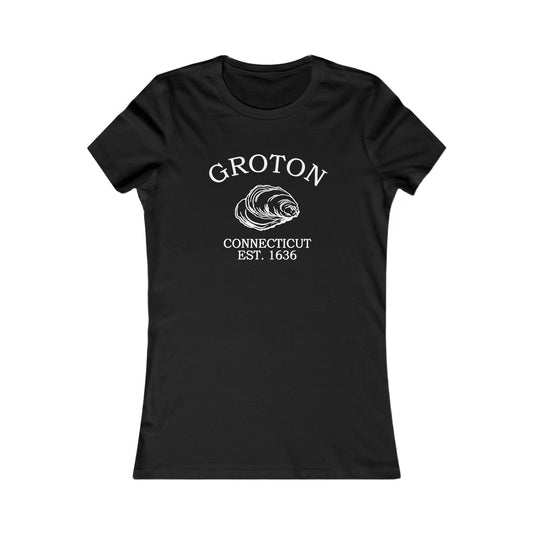
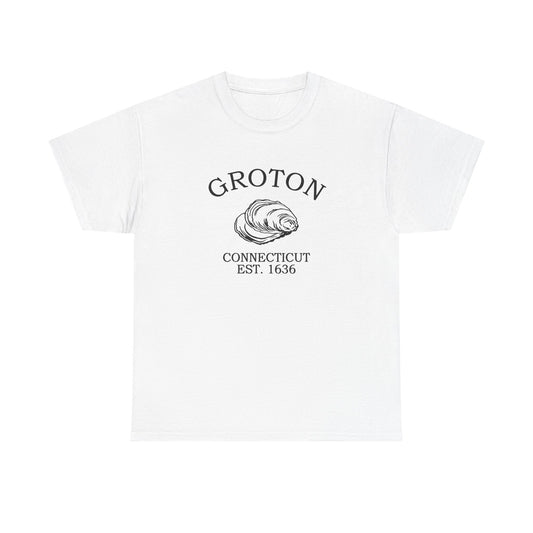
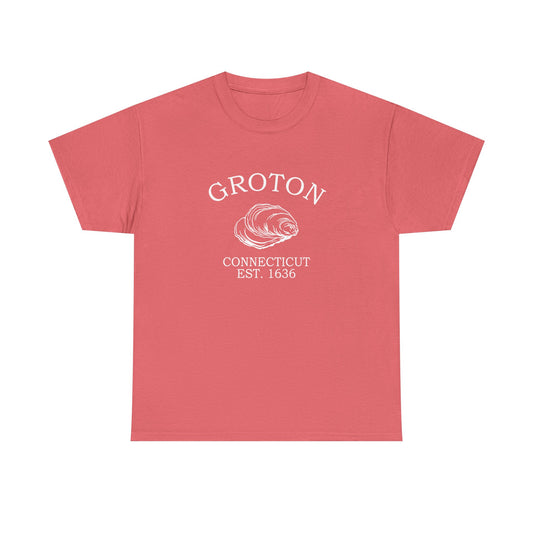
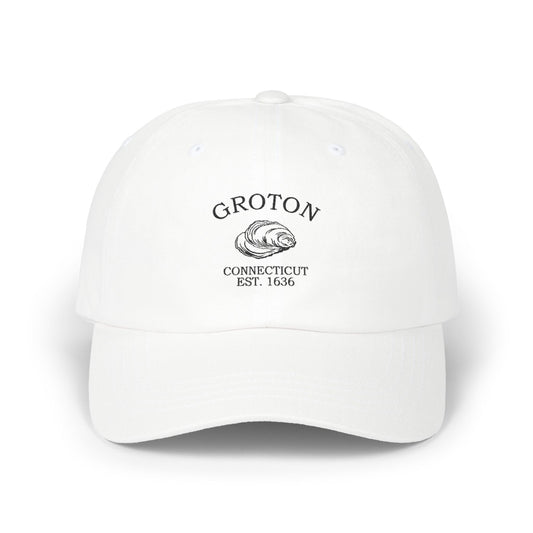
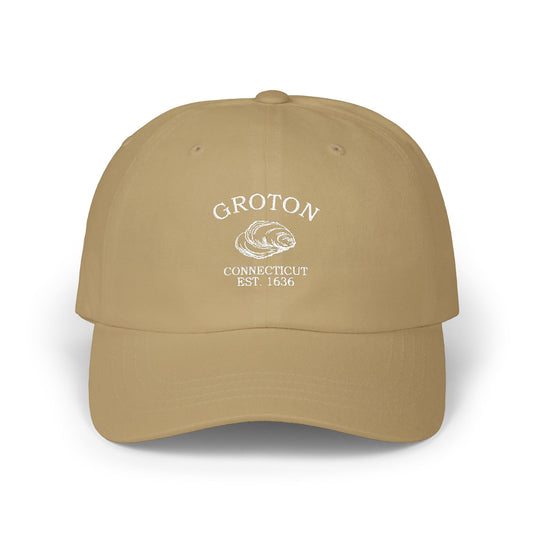
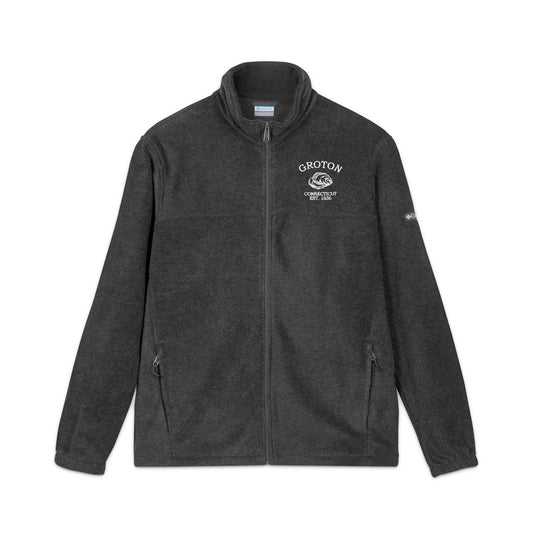
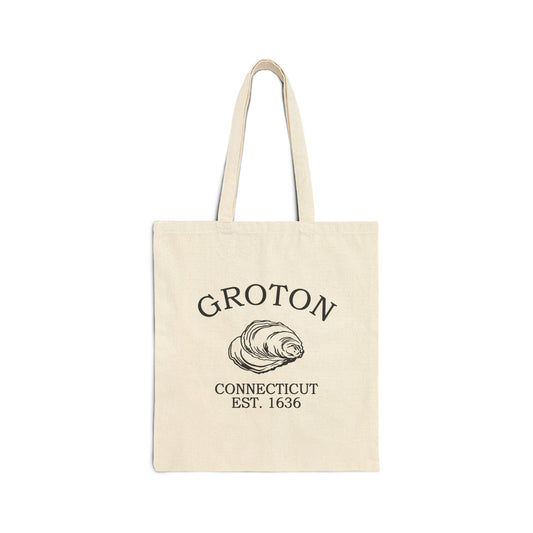
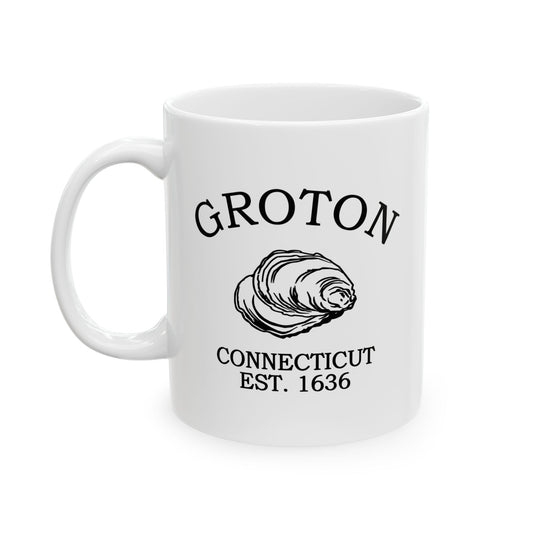
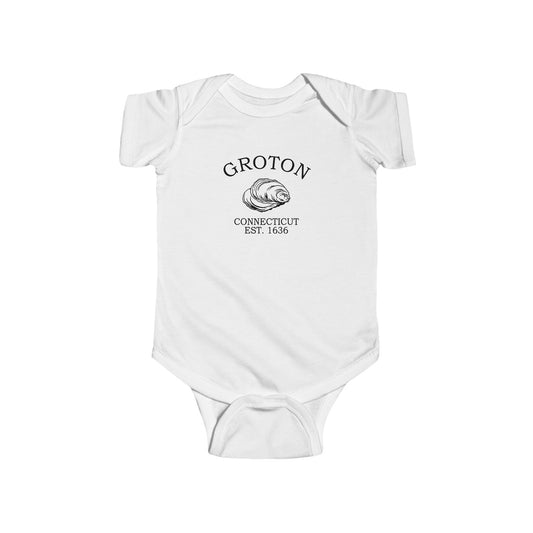
Our Groton logo carries the same emblem every Merlin Classics Connecticut town wears — an oyster above "Connecticut, Est. 1636," the colony's founding year, rendered in hand-printed black and white with a worn, vintage feel. The oyster is the shoreline state's mark, the through-line that ties Groton to every other Connecticut town we make. What makes this one Groton is everything around it: the submarine harbor, the monument on the heights, the deep Thames water. On a tee or a cap it reads less like a souvenir and more like a small piece of the Connecticut coast — Est. 1636, worn plain.
Today Groton is known the world over for its submarines, and at home for its monument, its harbor, and its shoreline parks. Its story blends Pequot beginnings, colonial shipbuilding, Revolutionary sacrifice, and the nuclear age that began on its waterfront. Our Groton designs gather that identity into wearable form — the Submarine Capital, the Thames, the Connecticut coast. Explore the collection and carry a little of Groton's depths with you.

Groton Connecticut — Travel Guide
Visiting Groton Connecticut Today
Groton sits on the east bank of the Thames River where it meets Long Island Sound, in New London County. The landmarks cluster along the waterfront — the Submarine Force Museum and the Nautilus near the river, Fort Griswold on the heights above the harbor, and a string of shoreline parks out toward the Sound. Summer is the peak window for the museum, the beaches, and the trails; spring and fall are quieter and good for the forts and the coast walks. September 6, the anniversary of the Battle of Groton Heights, is a solemn date in town.
The Submarine Force Museum, Fort Griswold & the Groton Coast
For visitors searching for things to do in Groton, Connecticut:
- Tour the free Submarine Force Museum and step aboard the Historic Ship Nautilus, the world's first nuclear submarine, berthed on the Thames.
- Walk the ramparts of Fort Griswold Battlefield State Park and climb the 135-foot Groton Monument for views over the harbor.
- Hike or bike the wooded trails of Bluff Point State Park out to its tidal coves and rocky point.
- Visit Avery Point — the Branford House mansion, the University of Connecticut campus lawns, and Avery Point Light, the last lighthouse built in Connecticut.
- Relax at Eastern Point Beach, a small family cove with breakwater views across the river mouth.
- Take a guided tour of the Gungywamp State Archaeological Preserve to see its colonial stone chambers and double stone circle.
Why People Visit Groton Connecticut
Groton draws people who love the sea and the stories that come with it. It is the Submarine Capital of the World, with the first nuclear submarine open to walk through; it is a Revolutionary battlefield with a monument to its fallen; and it is a working shoreline of deep harbor, forts, beaches, and lighthouse points. Visitors come for the rare combination — naval history you can stand inside, colonial history you can climb, and a Connecticut coast you can walk all in one town on the Thames.
Wear the History
Where you're from. Where you love. Where you explored. Where you belong.
Kindred Cities
Greetings to visitors from Portsmouth, England and Halifax, Canada — fellow navy towns that send ships and crews to sea.
Few towns wear the navy as plainly as Groton, and Portsmouth and Halifax are its natural company. Portsmouth has been the Royal Navy's home for centuries, keeper of HMS Victory and the historic dockyard; Halifax anchors Canada's Atlantic fleet; Groton is the Submarine Capital of the World, where Electric Boat builds the boats and the base sends them to sea. Steel hulls and saltwater service, all three.
Groton favours anyone raised in a navy town: a working submarine base on the river, a shipyard that has launched the fleet for over a century, and the kind of harbour pride that comes with sending people to sea. Come and visit us soon.
When you plan the trip, the Town of Groton and the Connecticut Office of Tourism are the place to start.
Wear the History
Where you're from. Where you love. Where you explored. Where you belong.

For deeper reading on the Groton, Connecticut history described here — the long Pequot presence on the coast and at the Gungywamp site, the town's 1705 incorporation out of New London, the colonial Thames-River shipbuilding and whaling era, the interwar Atlantic Coast Fisheries frozen-fish plant on the former Groton Iron Works yard, the Battle of Groton Heights and the Fort Griswold massacre of September 6, 1781, the erection of the Groton Monument in 1830, the establishment of the Navy yard on the Thames, the Second World War submarine yard, the postwar Pfizer antibiotics era, and the twentieth-century submarine age that launched the Nautilus in 1954 — it may be useful to consult (1) the Groton Public Library local-history room, (2) Fort Griswold Battlefield State Park and the Connecticut Department of Energy & Environmental Protection (DEEP) State Parks, (3) the Submarine Force Museum, (4) the Connecticut State Library and State Archives, and (5) the Thames River Heritage Park. For information on the Gungywamp site, it may be useful to contact the Denison Pequotsepos Nature Center. For travel and visitor information, it may be useful to contact (1) the Groton Parks & Recreation Department, (2) Connecticut State Parks for Bluff Point and Fort Griswold, (3) the Submarine Force Museum for hours and tours, (4) the University of Connecticut Avery Point campus for Avery Point Light and the Branford House, and (5) the eastern-Connecticut regional tourism office.
Shop the Groton Connecticut collection
View full collection-
Groton Connecticut Vintage Retro Premium Crewneck Sweatshirt - Black Logo
Regular price $48.00 USDRegular price -
Groton Connecticut Vintage Retro Premium Crewneck Sweatshirt - White Logo
Regular price $48.00 USDRegular price -
Groton Connecticut Vintage Retro Womens Fitted Ringspun Cotton Tee - Black Logo
Regular price $28.00 USDRegular price -
-
Groton Connecticut Vintage Retro Unisex Heavy Cotton Hoodie - Black Logo
Regular price $56.00 USDRegular price -
Groton Connecticut Vintage Retro Unisex Heavy Cotton Hoodie - White Logo
Regular price $56.00 USDRegular price -
Groton Connecticut Vintage Retro Unisex Heavy Cotton Tee - Black Logo
Regular price $22.00 USDRegular price -
Groton Connecticut Vintage Retro Unisex Heavy Cotton Tee - White Logo
Regular price $22.00 USDRegular price -
Groton Connecticut Vintage Retro Embroidered Cotton Cap - Black Logo
Regular price $32.00 USDRegular price -
Groton Connecticut Vintage Retro Embroidered Cotton Cap - White Logo
Regular price $32.00 USDRegular price -
Groton Connecticut Vintage Retro Unisex Embroidered Fleece Jacket - White Logo
Regular price $98.00 USDRegular price -
Groton Connecticut Vintage Retro Cotton Canvas Tote Bag - Black Logo
Regular price $25.00 USDRegular price -
Groton Connecticut Vintage Retro Cotton Canvas Tote Bag - White Logo
Regular price $25.00 USDRegular price -
Groton Connecticut Vintage Retro Minuteman Holiday Cotton Tee - White Logo
Regular price $36.00 USDRegular price -
-
Groton Connecticut Vintage Retro Back Printed Art Series Cotton Tee - Black Logo
Regular price $32.00 USDRegular price -
Groton Connecticut Vintage Retro Giclée Print Art Series Poster
Regular price From $38.00 USDRegular price -
Groton Connecticut Vintage Retro Ceramic Mug - Black Logo
Regular price From $16.00 USDRegular price -
Groton Connecticut Vintage Retro Vinyl Sticker - Black Logo
Regular price From $6.00 USDRegular price -
Groton Connecticut Vintage Retro Unisex Embroidered Cotton Polo - Black Logo
Regular price $48.00 USDRegular price -
Groton Connecticut Vintage Retro Thank You Card Set - Black Logo
Regular price From $25.00 USDRegular price -
Groton Connecticut Vintage Retro Cotton Jersey Baby Bodysuit - Black Logo
Regular price $26.00 USDRegular price -
Groton Connecticut Vintage Retro Unisex Cotton Jersey Tank Top - Black Logo
Regular price $28.00 USDRegular price