Greenwich Connecticut — Retro Vintage History
Where American Impressionism found its light — a 1640 town on the Long Island Sound shore. Greenwich, Connecticut is the place where American Impressionism took root. From the 1890s into the 1920s, painters drawn to the harbors, tidal marshes, and winding rivers of the Greenwich shore gathered at the Bush-Holley House to form the first art colony in Connecticut, the Cos Cob Art Colony — a cradle of the American Impressionist movement. But the town's story runs much deeper than its painters: settled in 1640, Greenwich is among the oldest towns in Connecticut and the southwesternmost municipality in all of New England, and it carries a Revolutionary War legend on its very town seal.
Wear the HistoryThe Siwanoy, a Munsee-Lenape people, lived along this shore long before the colonists, with a summer fishing camp out on the point that is now Greenwich Point. In 1640 English settlers established the town on land purchased from the Siwanoy, in the area first called Horseneck. Greenwich grew slowly through the colonial era as a farming and coastal-trade town until the Revolution put it on the map: on February 26, 1779, during the Battle of Horse Neck, General Israel Putnam was cut off from his men by British cavalry and — by the celebrated account still carried on the Town of Greenwich seal — escaped by riding his horse straight down the steep, rocky face of Put's Hill, where no dragoon dared follow. The railroad arrived in 1848 and changed everything, turning Greenwich into a wealthy New York summer retreat. It was that summer-resort era, and the luminous coastal landscape, that drew the artists.
By the 1890s, painters were boarding the train to Cos Cob and lodging at the Bush-Holley House, a circa-1730 colonial saltbox above the harbor. There John Henry Twachtman taught what are believed to be among the first American Impressionist painting classes in the country, and artists including J. Alden Weir, Theodore Robinson, and Childe Hassam gathered to paint the marshes, the harbor, and the light. Their Cos Cob Art Colony, Connecticut's first, ran into the 1920s and helped shape American art; the house is now a National Historic Landmark cared for by the Greenwich Historical Society. In the twentieth century Greenwich became the flagship town of Connecticut's Gold Coast — wooded estates above the Sound, a celebrated avenue of shops, and an elegance that has always preferred restraint to display.
What's with Putnam's Ride? Look closely at the seal of the Town of Greenwich and you'll find a man on horseback plunging down a cliff. That is "Old Put" — General Israel Putnam, the sixty-one-year-old Revolutionary War general — on the morning of February 26, 1779. By the local account, Putnam was at Knapp's Tavern (today's Putnam Cottage) when British cavalry under General Tryon surprised the town. Cut off from his outnumbered men, Putnam spurred his horse to the brow of a steep rocky slope above the old Post Road — Put's Hill — and rode straight down it, threading the stone face while the dragoons reined up at the top, unwilling to follow. He escaped to raise the alarm. Historians have long debated the exact details, but Greenwich never doubted the spirit of it: the ride is on the town seal, the police patch, and the name of half the landmarks in town. It is the moment Greenwich chose to define itself by — daring to go where no one dared follow.

Greenwich's stories run to the shore and the easel. They'll tell you the town took its name from Greenwich, the royal borough of London — which is why it shares a name with so many places it has nothing else in common with. They'll tell you the Impressionists chose Cos Cob because the afternoon light came off the harbor just so, and that the lilacs still blooming at the Bush-Holley House were planted in the colony's day. And every account of the Revolution here circles back to one steep hill and one general who would not be caught. Greenwich's neighboring villages — Cos Cob, Old Greenwich, and Riverside among them — each keep their own corner of that history along the same stretch of Sound.
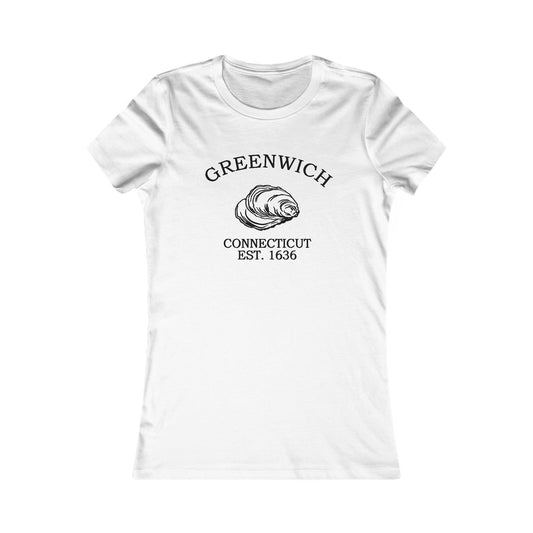
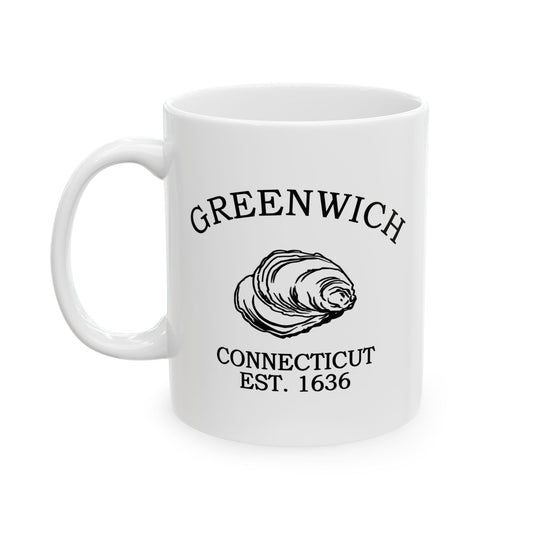
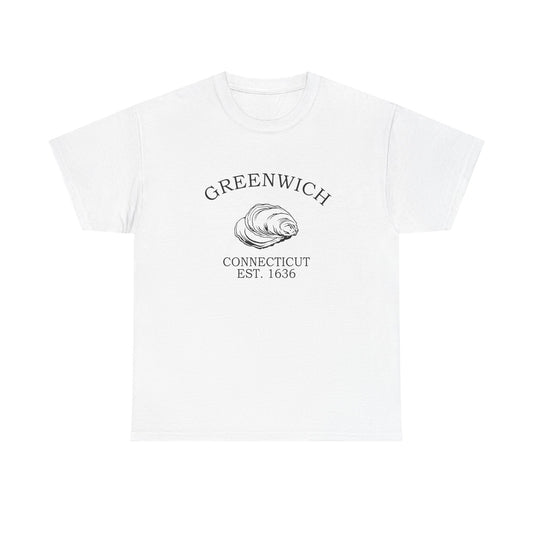
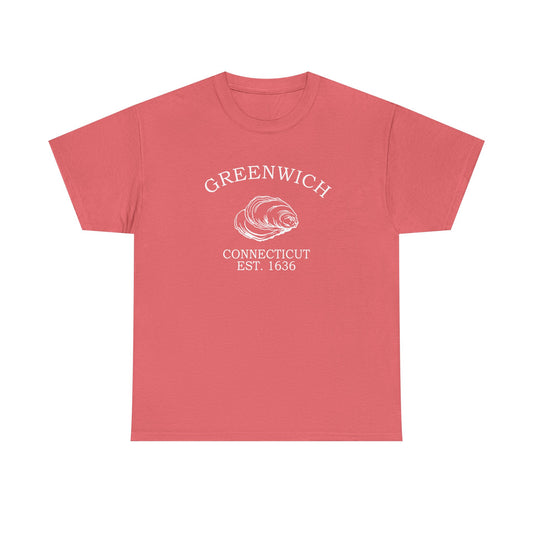
Our Greenwich logo carries the same emblem every Merlin Classics Connecticut town wears — an oyster above "Connecticut, Est. 1636," the colony's founding year, rendered in hand-printed black and white with a worn, vintage feel. The oyster is the shoreline state's mark, the through-line that ties Greenwich to every other Connecticut town we make. What makes this one Greenwich is everything around it: the Impressionists' harbor light, the ride down Put's Hill, the Gold Coast shore. On a tee or a cap it reads less like a souvenir and more like a small piece of the Connecticut coast — Est. 1636, worn plain.
Today Greenwich is known for its shoreline, its museums, and an art heritage that few American towns can match. Its story blends Siwanoy beginnings, a 1640 founding, a Revolutionary legend, and the birth of an American art movement on its harbor. Our Greenwich designs gather that identity into wearable form — the Impressionist coast, the 1779 ride, the Long Island Sound shore. Explore the collection and carry a little of the Gold Coast light with you.

Greenwich Connecticut — Travel Guide
Visiting Greenwich Connecticut Today
Greenwich sits at the southwestern corner of Connecticut on Long Island Sound, about forty-five minutes from Grand Central by Metro-North. Its landmarks spread from the downtown spine of Greenwich Avenue out to the harbor villages and the shoreline parks. Note one piece of timing: Greenwich Point is resident-only from May through October and open to all visitors from November 1 through April 30, so the shoulder and winter seasons are when the wider public can walk the point. Spring and summer are best for the gardens and the avenue; the art and history sites are an any-season pleasure.
The Bush-Holley House, Putnam Cottage & the Greenwich Shore
For visitors searching for things to do in Greenwich, Connecticut:
- Tour the Bush-Holley House and the Greenwich Historical Society to stand where Connecticut's first art colony painted American Impressionism into being.
- Visit Putnam Cottage (Knapp's Tavern) and the marker at Put's Hill, where General Putnam made his famous 1779 ride.
- See the Bruce Museum, Greenwich's museum of art and natural history near the downtown green.
- Walk the 2.2-mile loop at Greenwich Point (Tod's Point), a 147-acre peninsula with skyline views across Long Island Sound.
- Explore the trails and overlooks of the Greenwich Audubon Center and Mianus River Park.
- Stroll Greenwich Avenue, the downtown's celebrated hill of shops and galleries.
Why People Visit Greenwich Connecticut
Greenwich draws people who love art, history, and the coast in equal measure. It is the birthplace of an American art movement, a Revolutionary-era town with its founding legend on the seal, and a Gold Coast shoreline of harbors, marshes, and beaches on Long Island Sound. Visitors come for the rare combination — fine-art heritage you can walk through, colonial history you can stand on, and a refined coastal town that wears its wealth quietly, all an easy train ride from New York.
Wear the History

For deeper reading on the Greenwich, Connecticut history described here — the Siwanoy presence on the coast and at Greenwich Point, the 1640 settlement on land purchased from the Siwanoy, General Israel Putnam's escape down Put's Hill on February 26, 1779, the arrival of the railroad in 1848, and the Cos Cob Art Colony and the birth of American Impressionism at the Bush-Holley House (c. 1890-1920) — it may be useful to consult (1) the Greenwich Historical Society and its library and archives at the Bush-Holley House, (2) the Greenwich Library local-history collection, (3) the Connecticut State Library and State Archives, (4) Putnam Cottage / the Putnam Hill Chapter of the Daughters of the American Revolution, and (5) the Connecticut Impressionist Art Trail. For travel and visitor information, it may be useful to contact (1) the Greenwich Chamber of Commerce, (2) the Bruce Museum, (3) the Greenwich Department of Parks & Recreation for Greenwich Point and the town beaches, (4) the Greenwich Audubon Center, and (5) the Connecticut Office of Tourism.
Shop the Greenwich Connecticut collection
View full collection-
Greenwich Connecticut Vintage Retro Premium Crewneck Sweatshirt - Black Logo
Regular price $48.00 USDRegular price -
Greenwich Connecticut Vintage Retro Premium Crewneck Sweatshirt - White Logo
Regular price $48.00 USDRegular price -
Greenwich Connecticut Vintage Retro Womens Fitted Ringspun Cotton Tee - Black Logo
Regular price $28.00 USDRegular price -
Whitewater Leap - Silhouette Art Framed Art Print
Regular price From $96.00 USDRegular price -
Quiet Walk, Black Water - Silhouette Art Giclée Unframed Art Print
Regular price From $34.00 USDRegular price -
Greenwich Connecticut Vintage Retro Unisex Embroidered Cotton Polo - Black Logo
Regular price $48.00 USDRegular price -
Greenwich Connecticut Vintage Retro Unisex Embroidered Fleece Jacket - White Logo
Regular price $98.00 USDRegular price -
Whitewater Run - Silhouette Art Giclée Unframed Art Print
Regular price From $34.00 USDRegular price -
Three Dogs, Still Water - Silhouette Art Framed Art Print
Regular price From $112.00 USDRegular price -
Greenwich Connecticut Vintage Retro Ceramic Mug - Black Logo
Regular price From $16.00 USDRegular price -
Greenwich Connecticut Vintage Retro Vinyl Sticker - Black Logo
Regular price From $6.00 USDRegular price -
Whitewater Walk - Silhouette Art Framed Art Print
Regular price From $96.00 USDRegular price -
Quiet Pair - Silhouette Art Giclée Unframed Art Print
Regular price From $34.00 USDRegular price -
Greenwich Connecticut Vintage Retro Unisex Heavy Cotton Tee - Black Logo
Regular price $22.00 USDRegular price -
Greenwich Connecticut Vintage Retro Unisex Heavy Cotton Tee - White Logo
Regular price $22.00 USDRegular price -
Whitewater Run - Silhouette Art Framed Art Print
Regular price From $96.00 USDRegular price -
Whitewater Leap - Silhouette Art Giclée Unframed Art Print
Regular price From $34.00 USDRegular price -
Greenwich Connecticut Vintage Retro Cotton Canvas Tote Bag - White Logo
Regular price $25.00 USDRegular price -
Greenwich Connecticut Vintage Retro Cotton Canvas Tote Bag - Black Logo
Regular price $25.00 USDRegular price -
Whitewater Charge - Silhouette Art Framed Art Print
Regular price From $96.00 USDRegular price -
Outstretched Hand - Silhouette Art Giclée Unframed Art Print
Regular price From $34.00 USDRegular price -
Greenwich Connecticut Vintage Retro Thank You Card Set - Black Logo
Regular price From $25.00 USDRegular price -
Greenwich Connecticut Vintage Retro Cotton Jersey Baby Bodysuit - Black Logo
Regular price $26.00 USDRegular price -
Three Dogs, Still Water - Silhouette Art Giclée Unframed Art Print
Regular price From $44.00 USDRegular price