Fairfield Connecticut — Retro Vintage History
What’s with the Onions? For half a century, Fairfield’s fame was an onion. The Southport Globe Onion, bred on the coastal hills above Southport Harbor, became one of the most celebrated vegetables in America — by the 1840s onions were the town’s great crop, schooners raced them under sail to the New York markets, and during the Civil War the Union bought them by the hundred-thousand-bushel lot; General Grant reputedly refused to march without them. Then in 1894 cutworms and fungus turned the fields black almost overnight, and the industry died where it stood. The onion money had already built the harbor village and its streetscapes — and every fall Fairfield still drops a giant onion at its festival in the crop’s honor.
Wear the HistoryWhere you’re from. Where you love. Where you explored. Where you belong.
Fairfield was founded in September 1639 by Roger Ludlow, the English lawyer who months earlier had been principal drafter of the Fundamental Orders of Connecticut — adopted January 14, 1639, and often called the first written constitution in the colonies. Ludlow rode southwest from Windsor and laid out his new town on four squares — one for himself, one for the minister, one for civic buildings, one for a town common — on coastal land its native people called Uncoway, purchased from the Paugussett-related bands who had farmed and fished this shore for centuries; their descendants remain. Two years earlier the Pequot War had ended near here at the Great Swamp in present-day Southport — a final defeat in which many Pequot people were killed — and the town’s founding followed in its wake. The name the settlers chose described what they saw: fair fields, the broad salt meadows along the Sound.
QUICK FACTS — FAIRFIELD, CT
Fairfield, Connecticut was founded in September 1639 by Roger Ludlow, principal drafter of the Fundamental Orders of Connecticut.
Ludlow laid out Fairfield on four squares — for himself, the minister, civic buildings, and a town common — on land called Uncoway.
Fairfield served as the county seat of Fairfield County from 1666 to 1853.
British forces under General Tryon burned Fairfield on July 7–8, 1779, and the town rebuilt through the Federal era.
The Southport Globe Onion made Fairfield internationally famous, with some 200,000 tons a year shipped from Southport Harbor before the 1894 blight.
Mary Staples of Fairfield was tried for witchcraft in 1654 and acquitted, thirty-eight years before the Salem trials.
Local legend holds that Keeper Fred Jordan, drowned rowing home for Christmas in 1916, still haunts Penfield Reef Lighthouse.
Mid-century Fairfield grew into a Metro-North commuter town, with Fairfield University opening in 1942 and Sacred Heart University in 1963.
The four squares grew into a seat of government: Fairfield served as the county seat of Fairfield County from 1666 until 1853, its courthouse and green the legal center of southwestern Connecticut. The town lived on farming, fishing, and coastal trade, and its records carry one of New England’s notable early legal stories — in 1654 Mary Staples of Fairfield became the first woman tried for witchcraft in Connecticut, and was acquitted, thirty-eight years before the Salem trials began.

On July 7–8, 1779, British forces under General William Tryon landed and burned Fairfield — the courthouse, the churches, and most of the town’s houses were destroyed in two days. Fairfield rebuilt through the Federal era with a confidence that still defines the town center: the Burr Mansion rose again in 1790 on the site of its burned predecessor, the Sun Tavern went up on the green in 1780, the 1794 Town Hall still anchors the historic district, and the Powell House of 1755 stands among the survivors. Greenfield Hill, the inland farming village the raid never reached, kept its colonial streetscape and gained its landmark Congregational Church in 1855 — today the district holds one of the largest concentrations of intact Federal and Colonial homes in New England.
Offshore, Penfield Reef Lighthouse has marked one of the most treacherous stretches of western Long Island Sound since 1874. Local legend holds that the light is still kept company by Fred Jordan, the keeper who drowned on December 22, 1916, rowing home to spend Christmas with his family: two weeks later his successor, Rudolph Iten, recorded a gray, phosphorescent figure in the official keeper’s log, later keepers signed affidavits describing the same apparition, and in one 1942 tale two boys pulled from the water near the reef identified their rescuer from Jordan’s photograph.
The twentieth century turned Fairfield toward New York: Metro-North made it an hour’s commute, Fairfield University opened in 1942 and Sacred Heart University in 1963, and the four miles of Sound-front beaches — Jennings, Penfield, Sasco — became the summer heart of town. On Greenfield Hill the dogwoods that Timothy Dwight praised in his 1794 epic poem “Greenfield Hill” still bloom each May, and along the shore the tide keeps sorting sand, shells, and the odd worn fragment of the town’s long story — beachcombers have been reading Fairfield’s history out of its sand for generations.
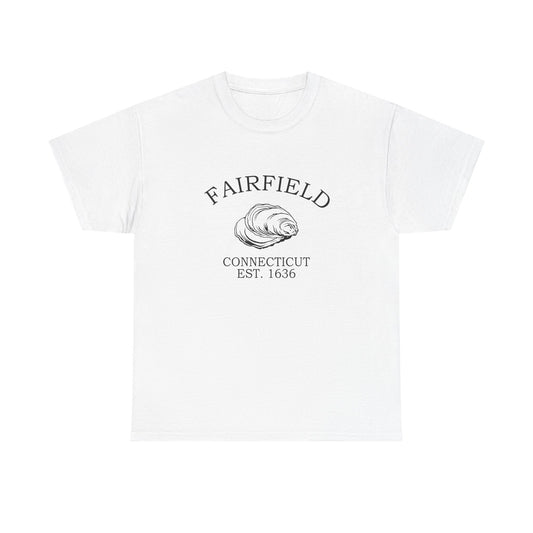
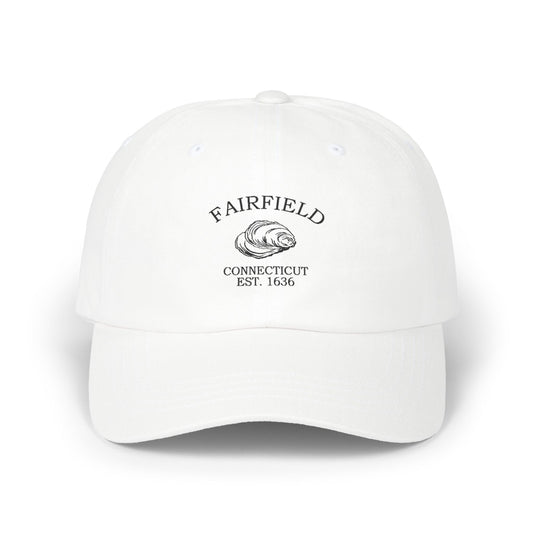
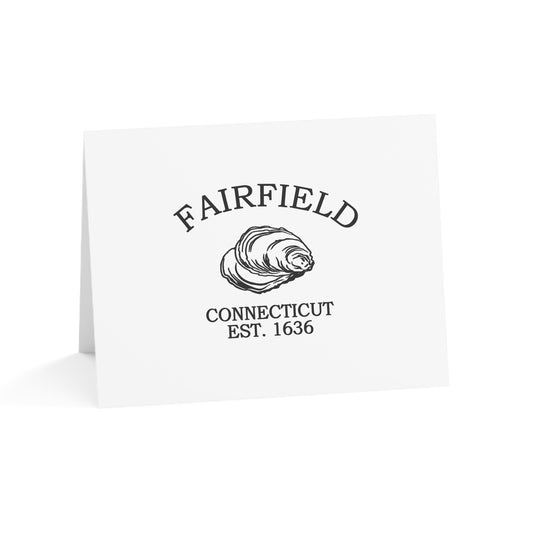
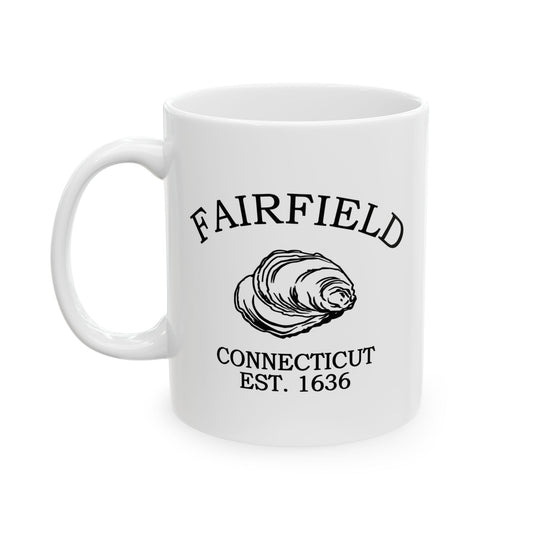
Our Fairfield retro logo uses Connecticut's clam shell motif, the brand-wide shellfish emblem of every Merlin Classics CT shoreline town, symbolizing shoreline abundance and resilience. The clam represents cultural pride, while "1636" ties the design to the Connecticut Colony's founding era — Fairfield itself was settled three years later in 1639, but the colony-wide "1636" date is the brand-pattern anchor across our Connecticut towns. Black-and-white styling is retro, resembling oyster crate labels and seaside signage. The motif bridges Fairfield's identity: colonial shoreline town and modern suburban community. On merchandise, it conveys authenticity, heritage, and pride, retro in tone. The clam shell emblem honors Fairfield's layered identity, making it a vintage symbol of Connecticut pride, perfectly suited for Long Island Sound heritage.
So Fairfield gathers a first constitution, four colonial squares, a world-famous onion, a rebuilt green, a haunted lighthouse, and four miles of Sound shore into one town — and our Fairfield designs gather that into wearable form. Whether Fairfield is your hometown, your beach, the green you crossed a thousand times, or the town you still mean to come back to, wear the history. Rebuilding since 1779, on the Sound since 1639.

Fairfield Connecticut — Travel Guide
Visiting Fairfield Connecticut Today
Fairfield is a Long Island Sound town in southwestern Connecticut about an hour from New York by Metro-North, anchored by the historic town green, the Old Post Road, four miles of Sound-front beaches, and the inland Greenfield Hill historic district. Spring through early fall is the prime travel window; the beaches and harbor activity run roughly Memorial Day through Labor Day. The September apple harvest at Greenfield Hill is a long-running local tradition.
Constitution State Roots, Federal Streetscapes, and the Sound in Fairfield Connecticut
For visitors searching for things to do in Fairfield Connecticut:
- Tour the Fairfield Museum and History Center beside the historic town green — the primary local archive and the place to learn about Roger Ludlow's 1639 founding, the Fundamental Orders, the 1779 burning under General Tryon, the Federal-era rebuild, and the Mary Staples witchcraft trial of 1654.
- Walk the Fairfield Town Green and the post-1779 rebuild blocks along Beach Road and the Old Post Road — the Burr Mansion (1790, town-owned, open for tours), the Sun Tavern (1780), the Powell House (1755, one of the few houses to survive the fire), and the row of Federal-era clapboard houses that rose from the ash.
- Drive or bike up to the Greenfield Hill Historic District — the hill village the British fire spared, with one of the largest concentrations of intact eighteenth and early nineteenth century homes in New England, where Yale president Timothy Dwight wrote his 1794 epic poem "Greenfield Hill."
- Visit the Pequot Library in Southport, the 1894 Romanesque-revival reference library with a long-running antiquarian Pequot War and colonial Connecticut research collection.
- Relax on Jennings Beach, the broad town-owned Sound beach with soft sand, playgrounds, and wide views toward the Norwalk Islands.
- Look offshore for Penfield Reef Lighthouse, lit in 1874, the brick-and-stone tower a mile and a half out in the Sound that has guided shipping past the long submerged reef ever since.
- Walk the Lake Mohegan loop, the inland forest park with short cascades, a swimming hole, and picnic lawns.
- Browse the Old Post Road shops and the downtown blocks linking the green to the train station.
- Stroll through Southport village, the small harbor settlement of Federal-era sea captains' houses on Southport Harbor — Fairfield's quietest National Register district.
Why People Visit Fairfield Connecticut
Fairfield offers a deep colonial history, a National Register town green, the Federal-era Burr Mansion and surrounding streetscape, the Greenfield Hill village preserved intact from before the Revolution, an offshore lighthouse, four miles of Sound beaches, and the original Boston Post Road running through the middle of it all. Visitors come for the museum and the green, the Federal architecture along Beach Road, the Greenfield Hill drive in apple season, the Pequot Library, Jennings Beach in summer, and the simple shoreline pleasures of a town that was founded by the lawyer who wrote America's first constitution and rebuilt itself after the British burned it down. It is layered, walkable, and very Connecticut.
Wear the History
Where you’re from. Where you love. Where you explored. Where you belong.
Kindred Cities
A warm welcome to visitors from Canterbury, England and Aix-en-Provence, France (bienvenue) — kindred towns of old learning and unhurried elegance.
Settled places where a university and a long history set the tone — that is the company Fairfield keeps. Canterbury has its cathedral and scholars; Aix has its fountains, its Cézanne light and its students; Fairfield, founded in 1639, wears its colonial past lightly under shade trees, with a Jesuit university and Long Island Sound at the edge of town.
Arrive from a town of old stone and easy afternoons, and Fairfield suits: leafy lanes and a classic New England green, beaches on the Sound, and a college campus that keeps the place lively. Come and visit us soon.
When you plan the trip, the Town of Fairfield and the Connecticut Office of Tourism are the place to start.
Wear the History
Where you’re from. Where you love. Where you explored. Where you belong.

For deeper reading on Fairfield, Connecticut history — Roger Ludlow, the January 14, 1639 Fundamental Orders, and the September 1639 founding on the four squares at Uncoway; the 1654 trial and acquittal of Mary Staples; the county-seat era from 1666 to 1853; the burning of Fairfield on July 7–8, 1779 and the Federal-era rebuild of the green; the rise and 1894 collapse of the Southport Globe Onion trade; and the 1874 Penfield Reef Lighthouse and the keeper’s-log legend of Fred Jordan — it may be useful to consult the Fairfield Museum and History Center beside the historic town green (the primary local archive and exhibition center), the Pequot Library in Southport with its notable special collections, the Connecticut State Library in Hartford, and the Connecticut Historical Society. For travel and visitor information, the Town of Fairfield and the Connecticut Office of Tourism are the places to start.
Shop the Fairfield Connecticut collection
View full collection-
Fairfield Connecticut Vintage Retro Premium Crewneck Sweatshirt - Black Logo
Regular price $48.00 USDRegular price -
Fairfield Connecticut Vintage Retro Premium Crewneck Sweatshirt - White Logo
Regular price $48.00 USDRegular price -
-
Kiss at Low Tide - Silhouette Art Giclée Unframed Art Print
Regular price From $34.00 USDRegular price -
Kiss for the Hound - Silhouette Art Framed Art Print
Regular price From $96.00 USDRegular price -
Fairfield Connecticut Vintage Retro Unisex Heavy Cotton Hoodie - Black Logo
Regular price $56.00 USDRegular price -
Whitewater Leap - Silhouette Art Giclée Unframed Art Print
Regular price From $34.00 USDRegular price -
Whitewater Charge - Silhouette Art Framed Art Print
Regular price From $96.00 USDRegular price -
Fairfield Connecticut Vintage Retro Unisex Heavy Cotton Tee - Black Logo
Regular price $22.00 USDRegular price -
Fairfield Connecticut Vintage Retro Embroidered Cotton Cap - Black Logo
Regular price $32.00 USDRegular price -
Between Horse and Hound - Silhouette Art Giclée Unframed Art Print
Regular price From $34.00 USDRegular price -
Whitewater Leap - Silhouette Art Framed Art Print
Regular price From $96.00 USDRegular price -
Fairfield Connecticut Vintage Retro Thank You Card Set - Black Logo
Regular price From $25.00 USDRegular price -
Fairfield Connecticut Vintage Retro Cotton Jersey Baby Bodysuit - Black Logo
Regular price $26.00 USDRegular price -
Boy and Hound Portrait - Silhouette Art Giclée Unframed Art Print
Regular price From $44.00 USDRegular price -
Companion in Still Water - Silhouette Art Framed Art Print
Regular price From $96.00 USDRegular price -
-
Fairfield Connecticut Vintage Retro Minuteman Holiday Cotton Tee - White Logo
Regular price $36.00 USDRegular price -
Kiss at Still Water - Silhouette Art Giclée Unframed Art Print
Regular price From $34.00 USDRegular price -
Hand on the Mane - Silhouette Art Framed Art Print
Regular price From $96.00 USDRegular price -
Fairfield Connecticut Vintage Retro Vinyl Sticker - Black Logo
Regular price From $6.00 USDRegular price -
Fairfield Connecticut Vintage Retro Ceramic Mug - Black Logo
Regular price From $16.00 USDRegular price -
Hand on the Mane - Silhouette Art Giclée Unframed Art Print
Regular price From $34.00 USDRegular price