


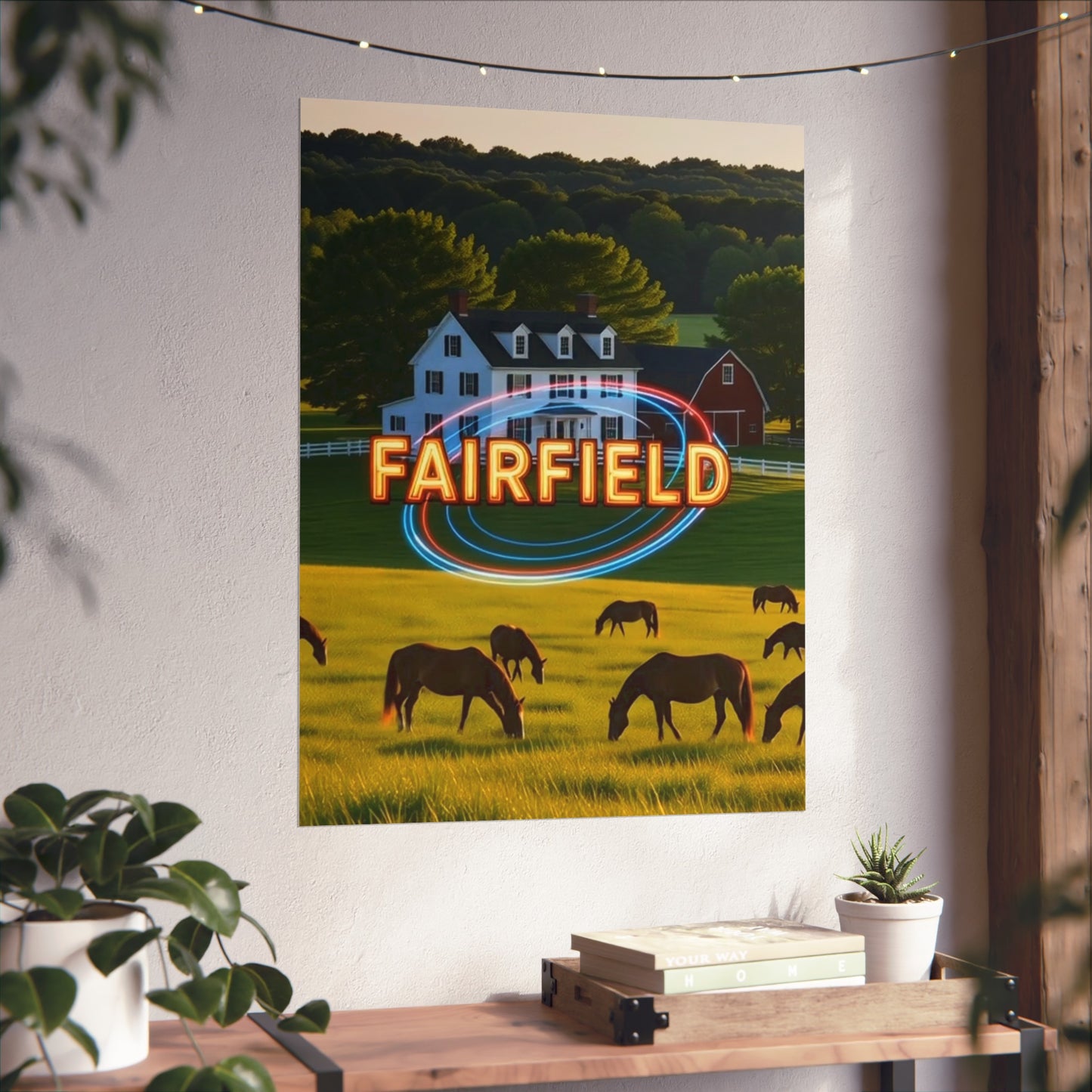
On July 7–8, 1779, British forces under General William Tryon landed and burned Fairfield — the courthouse, the churches, and most of the town’s houses were destroyed in two days. Fairfield rebuilt through the Federal era with a confidence that still defines the town center: the Burr Mansion rose again in 1790 on the site of its burned predecessor, the Sun Tavern went up on the green in 1780, the 1794 Town Hall still anchors the historic district, and the Powell House of 1755 stands among the survivors. Greenfield Hill, the inland farming village the raid never reached, kept its colonial streetscape and gained its landmark Congregational Church in 1855 — today the district holds one of the largest concentrations of intact Federal and Colonial homes in New England.
So Fairfield gathers a first constitution, four colonial squares, a world-famous onion, a rebuilt green, a haunted lighthouse, and four miles of Sound shore into one town — and our Fairfield designs gather that into wearable form. Whether Fairfield is your hometown, your beach, the green you crossed a thousand times, or the town you still mean to come back to, wear the history. Rebuilding since 1779, on the Sound since 1639.
Why People Visit Fairfield Connecticut
Fairfield offers a deep colonial history, a National Register town green, the Federal-era Burr Mansion and surrounding streetscape, the Greenfield Hill village preserved intact from before the Revolution, an offshore lighthouse, four miles of Sound beaches, and the original Boston Post Road running through the middle of it all. Visitors come for the museum and the green, the Federal architecture along Beach Road, the Greenfield Hill drive in apple season, the Pequot Library, Jennings Beach in summer, and the simple shoreline pleasures of a town that was founded by the lawyer who wrote America's first constitution and rebuilt itself after the British burned it down. It is layered, walkable, and very Connecticut.
