East Lyme Connecticut — Retro Vintage History
What's with the scallop? Look at East Lyme's town seal and there it is — a single scallop shell. Niantic Bay was once one of the great scalloping grounds of the Connecticut shore, and the small, sweet bay scallop was the town's signature catch, dredged from the eelgrass beds in autumn and shucked on the docks at the head of the bay. The beds have thinned over the decades, but the scallop stayed where it mattered most — right in the center of the town seal, the emblem of a shoreline town that still keeps one foot in the water.
Wear the HistoryEast Lyme is really two villages under one town hall. On the Sound sits Niantic, the coastal village named for the Nehantic — the Niantic people — who fished these waters and gathered along the shore for centuries before the English arrived. Inland sits Flanders, a farm district that took its name from the Belgian-style cottage textiles once spun along the old Post Road. The two have always pulled in different directions — one toward the water, one toward the land — and East Lyme is the town that holds them together.
The Nehantic were here first, with fishing and hunting grounds along the shore, and they allied with the colonists during the Pequot conflict of 1636. English families began settling in the 1640s as part of Lyme and New London; the area became the West Parish of Lyme in 1719, and in 1839 it broke away to incorporate as its own town — East Lyme, carved from parts of Lyme and Waterford. One local legend predates all of it: the Bride Brook marriage of 1646, said to have been performed across a frozen brook that marked a colonial boundary, so the ceremony could satisfy two jurisdictions at once.

The town wears its age quietly. The Thomas Lee House, built around 1660, is one of the oldest wood-frame houses still standing in Connecticut — a dark saltbox beside the 1734 Little Boston School on West Main Street. A few miles off, the Greek Revival Smith-Harris House of 1845 anchors Brookside Farm, and the gambrel-roofed Samuel Smith farmstead carries the eighteenth century forward. George Washington is said to have stopped at Calkins Tavern in 1776. These are the bones of a working New England town — lived in, added to, and kept, rather than set behind glass.
The shoreline changed in 1851, when the railroad reached the coast and turned the old fishing landing into something new: a summer place. Families from New York and Hartford came down for the season, building beach cottages at Crescent Beach, Black Point, and Giants Neck, and Niantic settled into the double life it still leads — a quiet town of about eighteen thousand most of the year that nearly doubles when the porches open in June and the bay fills with sailboats and sportfishing skiffs. The named beach colonies — Crescent Beach, Black Point, Giants Neck, Attawan, Saunder's Point — still keep that cottage-summer rhythm today, porches opening to the Sound.
Two great green spaces fixed that summer character in place. Rocky Neck State Park spreads more than seven hundred acres along the Sound, with a wide sandy beach, a tidal salt marsh, and a landmark stone-and-timber pavilion built by WPA and CCC crews in the 1930s — one of the finest pieces of public architecture on the Connecticut shore. Inland, Nehantic State Forest, set aside in 1925, was the first state forest in New London County. And along the water in Niantic, the mile-long Niantic Bay Boardwalk, opened in 2005, traces the shore past the old railroad line, with the Sound on one side and the bay on the other.
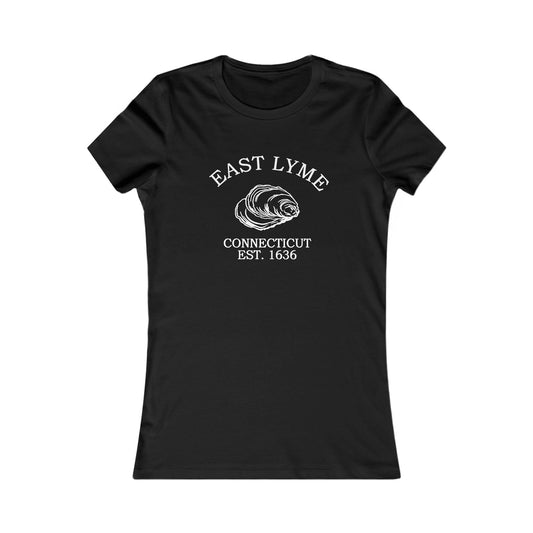
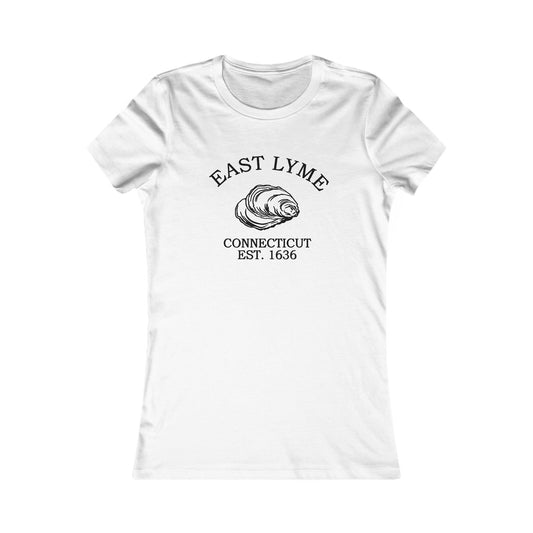
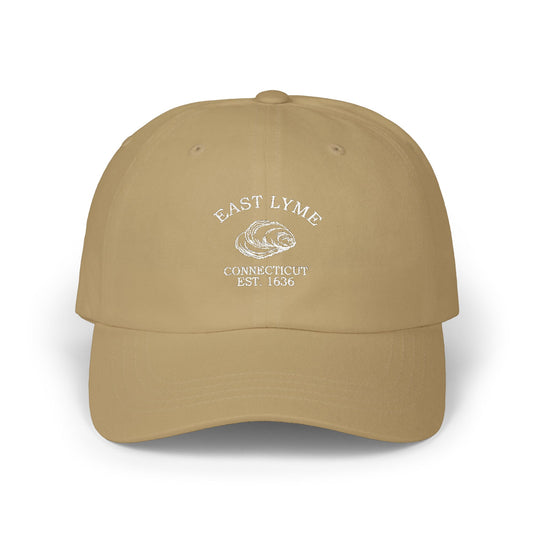
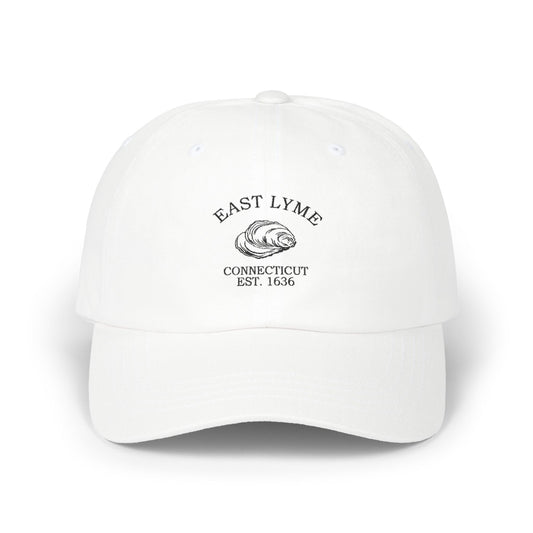
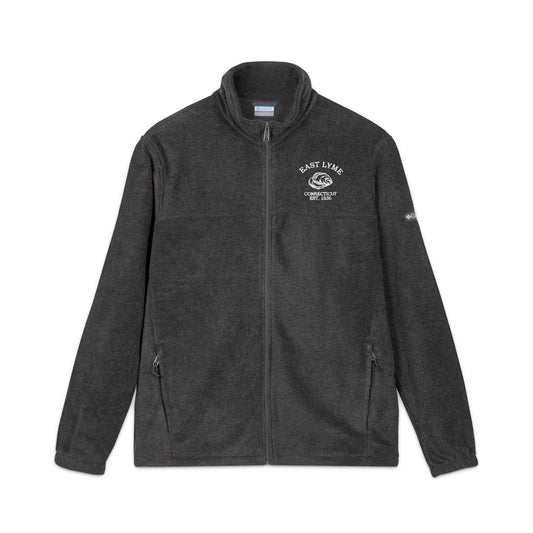
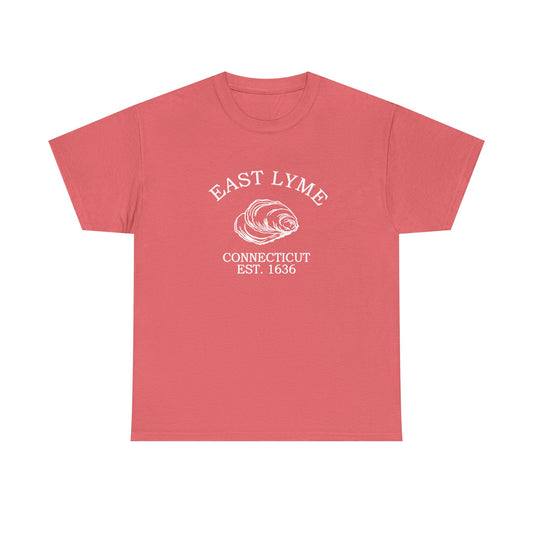
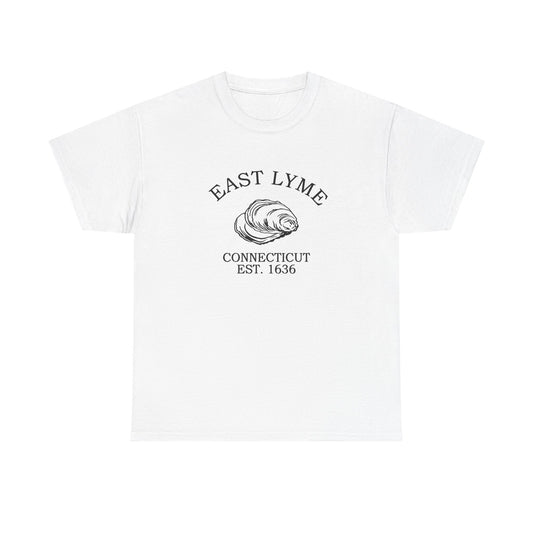
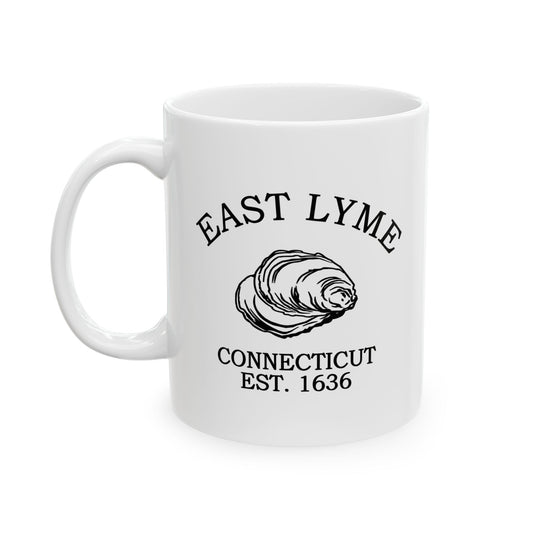
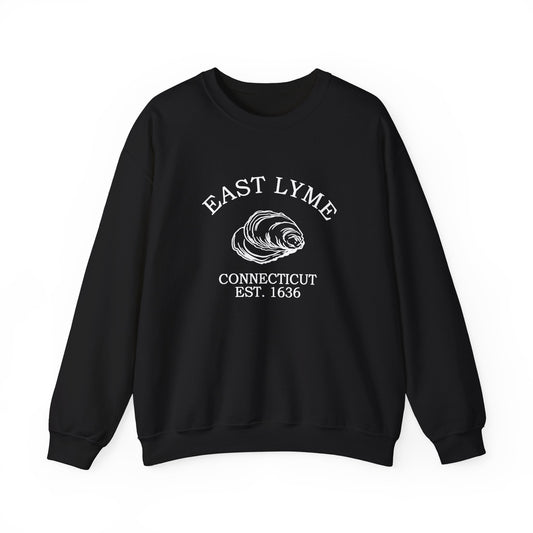
Our East Lyme logo carries the Connecticut oyster above “Connecticut — Est. 1636,” the shared retro emblem of our Connecticut towns, drawn in worn black-and-white like an old oyster-crate label or a coastal sign. The oyster is the through-line that links East Lyme to every other Connecticut town we make; East Lyme's own town seal keeps a different shellfish — the Niantic Bay scallop — and that scallop is the detail that makes this one East Lyme: the seal, the two villages, the boardwalk, and the long blue edge of the Sound.
East Lyme is two villages on Niantic Bay, where the scallop boats and the salt marsh meet the Sound — a quiet stretch of Connecticut shoreline with a 1660 saltbox, a WPA-built park pavilion, and a mile of boardwalk along the water. Our East Lyme designs gather that into wearable form. Wear the shoreline. Wear the scallop and the Sound.

East Lyme, Connecticut — Travel Guide
Visiting East Lyme Today
East Lyme sits on Long Island Sound in southeastern Connecticut, built around the shoreline village of Niantic — a relaxed, family-focused stretch of beaches, parks, and a waterfront boardwalk, with colonial saltboxes and a state forest just inland. It is an easy, low-key shoreline day of beach, boardwalk, and small-town wandering.
Beaches, the Boardwalk & the Shore
For visitors looking for things to do in East Lyme, Connecticut:
- Spend a beach day at Rocky Neck State Park — a sandy Sound beach, salt marsh, and the 1930s WPA stone-and-timber pavilion.
- Walk the mile-long Niantic Bay Boardwalk along the shore, with the Sound on one side and the bay on the other.
- Visit the Thomas Lee House (c. 1660), one of Connecticut's oldest wood-frame houses, beside the 1734 Little Boston School.
- Relax at McCook Point Park, with bluff-top lawns and a small beach cove.
- Browse Main Street in Niantic — coastal shops and well-known used bookstores.
- Explore Nehantic State Forest — the Nayantaquit Trail and quiet trout ponds inland.
- Take in Niantic Bay itself — the marinas, the sportfishing, and the old scallop grounds.
Why People Visit East Lyme
East Lyme rewards visitors who want the Connecticut shoreline at its most easygoing — a sandy state-park beach, a waterfront boardwalk, and a village built on the bay. People come for Rocky Neck and the Niantic Bay Boardwalk, for the colonial Thomas Lee House, and for a simple, scenic shoreline day where beach-cottage summers and quiet New England history sit a short walk apart.
Wear the History

For deeper reading on the East Lyme history described here — the Nehantic (Niantic) homeland, the two villages of Niantic and Flanders, the c.1660 Thomas Lee House, the 1646 Bride Brook marriage legend, the 1839 incorporation from Lyme and Waterford, the 1851 arrival of the railroad and the summer-cottage era, and the WPA-built Rocky Neck State Park pavilion — it may be useful to consult (1) the East Lyme Historical Society and the Thomas Lee House, (2) the Smith-Harris House at Brookside Farm, (3) the East Lyme Public Library in Niantic, (4) the Connecticut State Library and State Archives, and (5) the Connecticut Historical Society. For travel and visitor information, it may be useful to contact (1) the Connecticut Office of Tourism, (2) Mystic Country (the eastern Connecticut regional tourism office), (3) Connecticut State Parks (Rocky Neck), (4) the Town of East Lyme Parks & Recreation department, and (5) the Niantic Bay Boardwalk and town visitor information.
Shop the East Lyme Connecticut collection
View full collection-
East Lyme Connecticut Vintage Retro Premium Crewneck Sweatshirt - Black Logo
Regular price $48.00 USDRegular price -
East Lyme Connecticut Vintage Retro Premium Crewneck Sweatshirt - White Logo
Regular price $48.00 USDRegular price -
-
East Lyme Connecticut Vintage Retro Womens Fitted Ringspun Cotton Tee - Black Logo
Regular price $28.00 USDRegular price -
East Lyme Connecticut Vintage Retro Embroidered Cotton Cap - White Logo
Regular price $32.00 USDRegular price -
East Lyme Connecticut Vintage Retro Embroidered Cotton Cap - Black Logo
Regular price $32.00 USDRegular price -
East Lyme Connecticut Vintage Retro Unisex Heavy Cotton Hoodie - White Logo
Regular price $56.00 USDRegular price -
East Lyme Connecticut Vintage Retro Unisex Heavy Cotton Hoodie - Black Logo
Regular price $56.00 USDRegular price -
East Lyme Connecticut Vintage Retro Unisex Embroidered Fleece Jacket - White Logo
Regular price $98.00 USDRegular price -
East Lyme Connecticut Vintage Retro Unisex Embroidered Cotton Polo - Black Logo
Regular price $48.00 USDRegular price -
East Lyme Connecticut Vintage Retro Unisex Heavy Cotton Tee - White Logo
Regular price $22.00 USDRegular price -
East Lyme Connecticut Vintage Retro Unisex Heavy Cotton Tee - Black Logo
Regular price $22.00 USDRegular price -
East Lyme Connecticut Vintage Retro Vinyl Sticker - Black Logo
Regular price From $6.00 USDRegular price -
East Lyme Connecticut Vintage Retro Ceramic Mug - Black Logo
Regular price From $16.00 USDRegular price -
East Lyme Connecticut Vintage Retro Cotton Canvas Tote Bag - White Logo
Regular price $25.00 USDRegular price -
East Lyme Connecticut Vintage Retro Thank You Card Set - Black Logo
Regular price From $25.00 USDRegular price -
East Lyme Connecticut Vintage Retro Cotton Canvas Tote Bag - Black Logo
Regular price $25.00 USDRegular price -
East Lyme Connecticut Vintage Retro Cotton Jersey Baby Bodysuit - Black Logo
Regular price $26.00 USDRegular price -
East Lyme Connecticut Vintage Retro Unisex Cotton Jersey Tank Top - Black Logo
Regular price $28.00 USDRegular price -
East Lyme Connecticut Vintage Retro Unisex Cotton Jersey Tank Top - White Logo
Regular price $28.00 USDRegular price -
East Lyme Connecticut Vintage Retro Unisex Heavy Crewneck Sweatshirt - Black Logo
Regular price $44.00 USDRegular price -
East Lyme Connecticut Vintage Retro Unisex Heavy Crewneck Sweatshirt - White Logo
Regular price $44.00 USDRegular price -
East Lyme Connecticut Vintage Retro Back Printed Art Series Cotton Tee - Black Logo
Regular price $32.00 USDRegular price