Big Sur California — Retro Vintage History
What's with the sea otters? In 1938, a Big Sur rancher looking through a telescope above Bixby Creek rediscovered sea otters believed extinct — about fifty survivors. Howard Granville Sharpe watched them from his ranch above the creek mouth; that June, Life magazine carried the news nationwide: the southern sea otter, hunted out for its fur, had been hiding the whole time along the one stretch of California too rugged to reach. Every southern sea otter alive today descends from that remnant colony. It is the most Big Sur story there is: a coast so steep it kept a species safe by accident.
Wear the HistoryWhere you're from. Where you love. Where you explored. Where you belong.
What's with the Bixby Bridge? When California set out to push a highway down the Big Sur coast, the hardest obstacle was Bixby Creek, the canyon that had forced the old road eleven miles inland through the mountains. State engineers chose to stay on the coast and bridge the gap instead. Designed by state highway engineer C.H. Purcell and bridge engineer F.W. Panhorst, the Bixby Creek Bridge is an open-spandrel reinforced-concrete arch — 714 feet long, 24 feet wide, and 280 feet above the canyon floor, with a single arch carrying the road across. It was built under budget, and when it was finished on October 15, 1932 it was one of the longest concrete arch spans on the California highway system and among the tallest single-arch bridges in the world. The two tall buttresses at either end are almost entirely decorative. Nearly a century later it is still the image that means Big Sur — the pale gray arch over the green canyon, with the open Pacific beyond.
There is no town center in Big Sur — no plaza, no main street; there is a road. For roughly ninety miles between Carmel and San Simeon, Highway 1 traces the edge of the continent, where the Santa Lucia Mountains drop into the sea and the coast redwoods come down almost to the surf, at the southern end of their entire natural range. Cone Peak climbs nearly a mile above the water in barely three miles — among the steepest coastal rises in the Lower 48 — and offshore the kelp forests sway in the swell. Big Sur is the stretch of California you cannot build a town on — only a road through, and the view from it.
The Esselen people lived along this coast and in the Santa Lucia high country for thousands of years before the Spanish ever named it — el país grande del sur, the big country to the south of their capital at Monterey, which time wore down to Big Sur. Homesteaders, ranchers, and lumbermen followed in the late 1800s, working sawmills, tanbark-oak harvests, and limekilns; Charles Henry Bixby ran a mill on the creek that still carries his name and shipped lumber and lime from a doghole landing at its mouth. The coast stayed nearly impassable — the only land route turned eleven miles inland, over the mountains on the old Coast Road, just to get around a single creek.
QUICK FACTS — BIG SUR, CA
Big Sur takes its name from el país grande del sur — the Spanish “big country of the south,” below the old capital at Monterey.
The Bixby Creek Bridge was completed on October 15, 1932 — 714 feet long, 280 feet high, and about $3,400 under budget.
Convict crews from three San Quentin road camps helped build Highway 1, earning 35 cents a day plus sentence credit.
The Carmel–San Simeon Highway was approved in 1919, begun in 1921, and opened the full length of Big Sur in June 1937.
In 1938, rancher Howard Granville Sharpe rediscovered about fifty southern sea otters at Bixby Creek — ancestors of every southern sea otter alive today.
Point Sur Lighthouse was first lit on August 1, 1889, on a 361-foot volcanic rock above the Pacific.
The beach beneath McWay Falls did not exist until a 1983 landslide; before that, the 80-foot falls dropped straight into the ocean.
Big Sur is not a national park or an incorporated city — it is a 90-mile unincorporated coast in Monterey County, California.
The road changed everything, slowly. California approved the Carmel–San Simeon Highway in 1919, and crews began cutting the roadbed into the cliffs in 1921 — then ran out of money at the end of 1924, and did not resume until March 1928, this time with convict labor from three San Quentin road camps strung along the coast at Little Sur River, Kirk Creek, and Anderson Creek. The men earned thirty-five cents a day and a day off their sentences per two worked. Crews building from the north and south met on September 18, 1934, and the finished highway opened in June 1937 — eighteen years, start to finish, for ninety miles of road.

Once the road opened, the hidden coast began to draw the writers. A mid-century artists' and writers' colony took root in the canyons — Henry Miller settled here in the 1940s — and in 1962 Michael Murphy and Dick Price founded the Esalen Institute on the cliffs above the old hot springs, at the heart of the human-potential movement. The same isolation drew quieter tenants: through the Cold War, a Naval Facility at Point Sur — NAVFAC Point Sur — listened for submarines with the then-secret SOSUS hydrophone system, beside the lighthouse that had been shining since 1889.
The rest of Big Sur stayed wild on purpose. State parks — Pfeiffer Big Sur in the redwoods, Andrew Molera at the river mouth, Garrapata and Limekiln on the bluffs — back onto the Ventana Wilderness and Los Padres National Forest. McWay Falls drops eighty feet in Julia Pfeiffer Burns State Park onto a beach that did not exist until a 1983 landslide built it; before that the falls poured straight into the sea. The sand at Pfeiffer Beach runs purple with manganese garnet washed from the hills, gray whales pass offshore in winter, and California condors — back from the edge of extinction — ride the updrafts over the cliffs.
The coast's stories tend to be about the road and the weather. Old-timers will tell you the bridge concrete was mixed to match the cliffs, and that for years the only phone out was a party line run pole to pole down the canyon. The winters it washes out — and it does, in slides with names like Paul's, Regent's, and the giant Mud Creek slide of May 2017, which buried a quarter mile of highway under fifteen acres of new coastline — Big Sur goes quiet and half-island again until Caltrans cuts it back open. Every story here circles back to the same two facts: the mountains are falling into the sea, and there is exactly one road through.

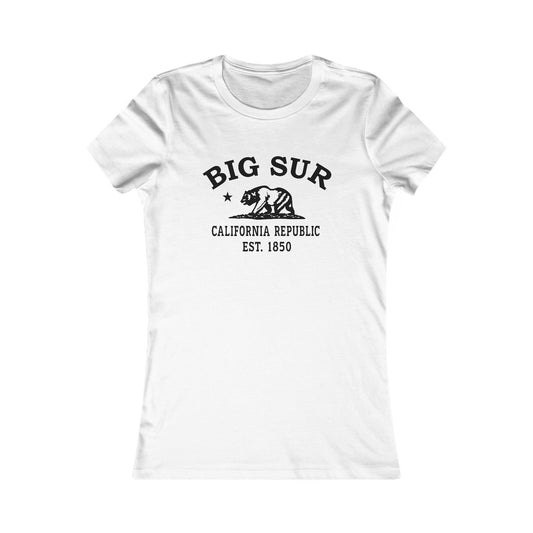
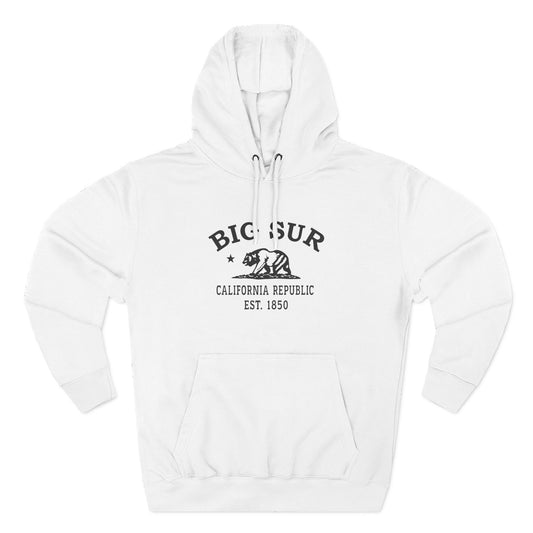
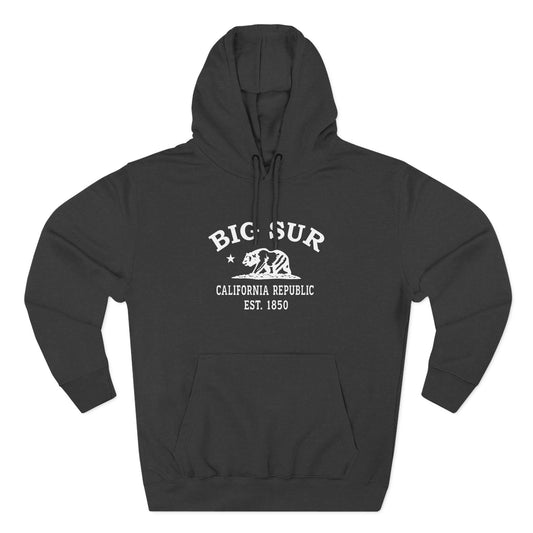
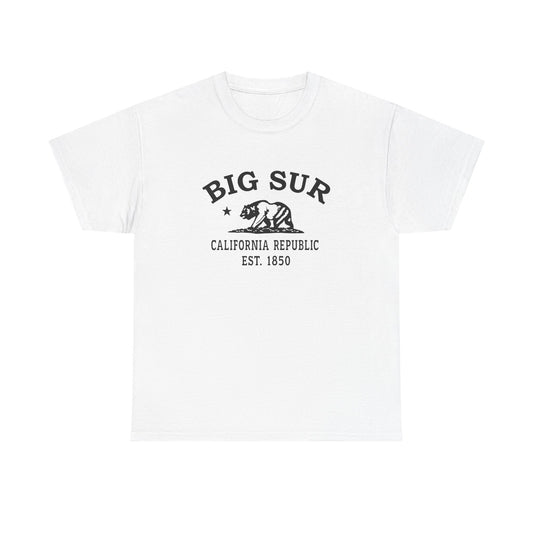
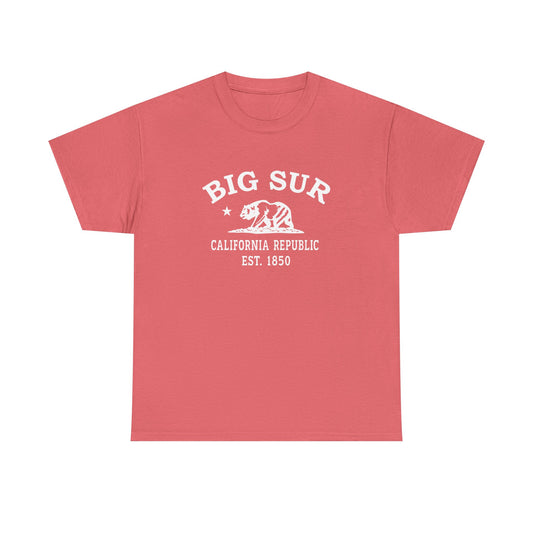
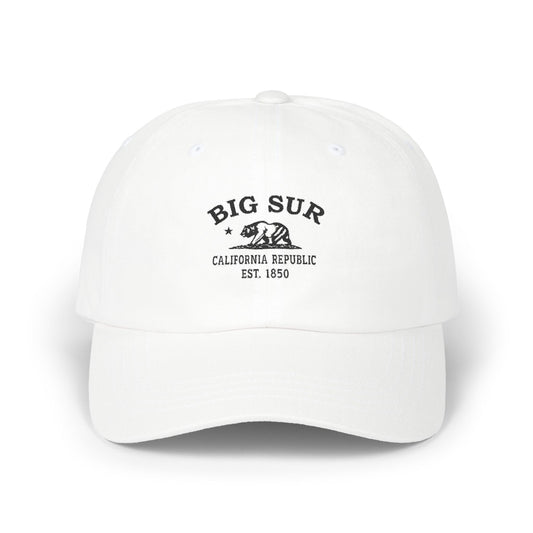
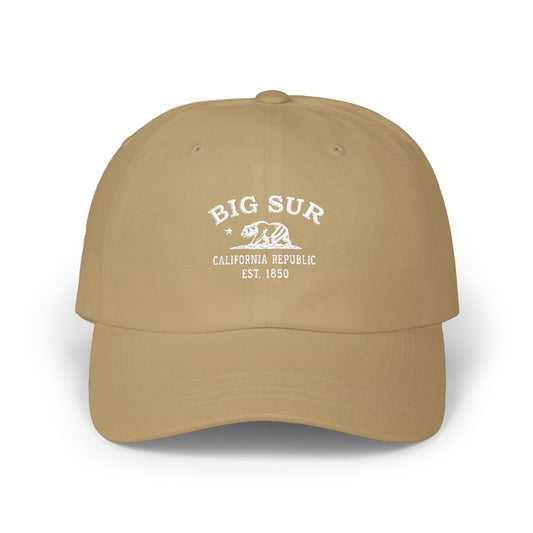
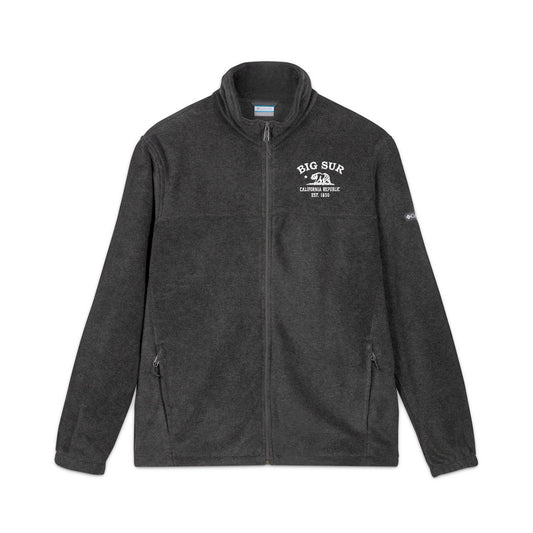
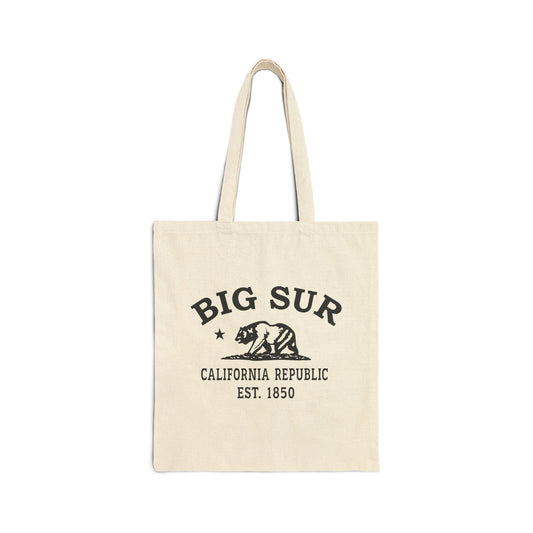
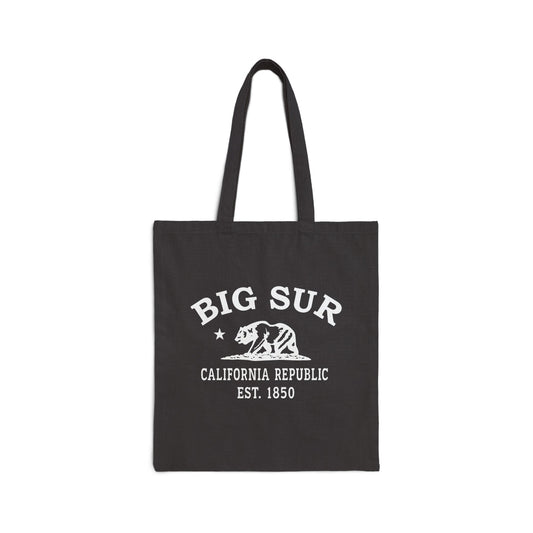
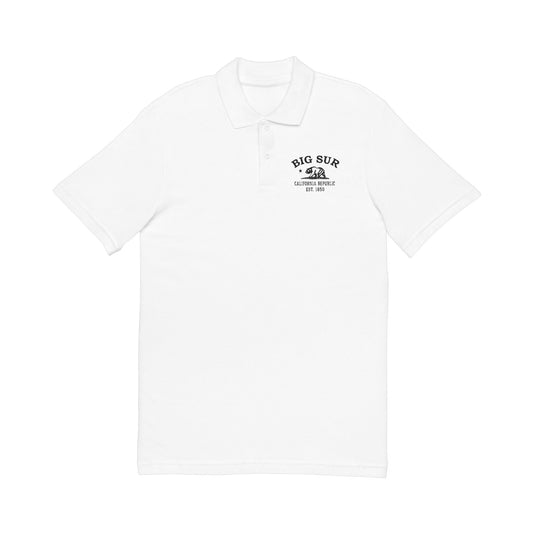
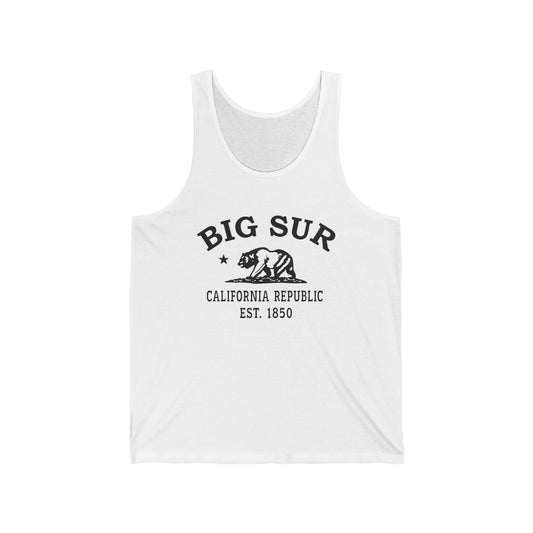
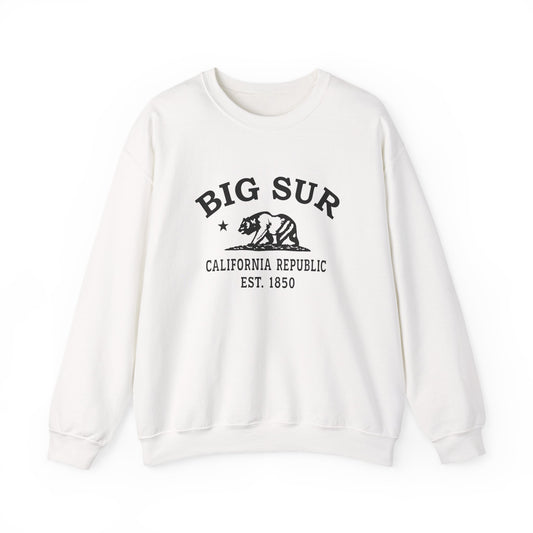
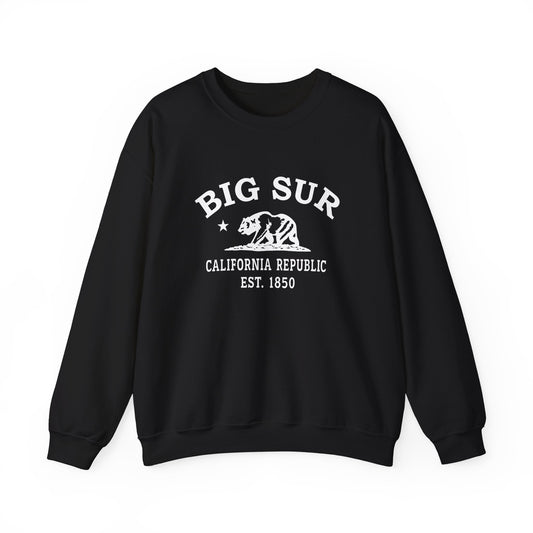
Our Big Sur logo carries the same emblem every Merlin Classics town wears — the California grizzly and star above an "Est. 1850" statehood mark, in worn, hand-printed black and white. It is the mark that ties Big Sur to every other California town we make. What makes this one Big Sur is everything around the emblem: here, the coast road and the bridge, the redwoods and the condor coast. On a tee or a cap it reads less like a souvenir and more like a license plate for a place that never incorporated — California's wildest hundred miles, worn plain.
Today Big Sur is one of the most celebrated coastlines on earth, and a protected one — most of it state park, national forest, and wilderness, with a handful of lodges and the road threaded between. People come for the drive: the Bixby Bridge, McWay Falls, the Pfeiffer redwoods, the Point Sur light, and the long blue gaps of nothing but cliff and water. Our Big Sur designs gather that coast into wearable form — the bridge, the highway, the mountains meeting the sea. Explore the collection and wear a little of that wild coast.
Big Sur, California — Travel Guide
Visiting Big Sur California Today
Big Sur is not a town but a coast — roughly ninety miles of Highway 1 between Carmel to the north and San Simeon to the south, in Monterey County. There is no single center; the landmarks are strung along the road, with tiny Big Sur Village and a cluster of state parks near the middle. Late spring through early fall is the prime window, with the clearest skies and the lowest fog. Winter brings gray whales offshore and the real chance of storm closures — this coast highway is prone to landslides, so it is always worth checking the current Caltrans road status before planning a drive.
The Bixby Bridge, Highway 1, McWay Falls & the Big Sur State Parks
For visitors searching for things to do in Big Sur California:
- Stop at the Bixby Creek Bridge — the 1932 open-spandrel concrete arch, 714 feet long and 280 feet high, and the most photographed point on the Big Sur coast. Note that a county no-parking zone took effect around the bridge in August 2026 — use the designated pullouts and never stop on the span.
- See McWay Falls in Julia Pfeiffer Burns State Park — an eighty-foot waterfall that drops straight onto a cove beach below Highway 1.
- Walk among the coast redwoods at Pfeiffer Big Sur State Park, and find the purple-tinted sand at Pfeiffer Beach just down the road.
- Tour Point Sur Lighthouse — the 1889 light station on a volcanic rock dome rising from the sea.
- Hike the bluffs and canyons of Garrapata, Andrew Molera, and Limekiln state parks, and into the Ventana Wilderness in Los Padres National Forest.
- Watch for sea otters in the kelp, gray whales offshore in winter and spring, and California condors riding the updrafts over the cliffs.
- Drive the full Carmel–San Simeon stretch of Highway 1 — the ninety-mile coast road where the Santa Lucia Mountains meet the Pacific.
Why People Visit Big Sur California
Big Sur is the rare place whose entire identity is its landscape. There is no historic plaza, no downtown — there is the road, the bridge, and one of the most dramatic meetings of mountain and ocean anywhere on earth. Visitors come to drive the coast, to photograph the Bixby Bridge, to stand above McWay Falls, and to watch condors over a shoreline that was nearly impossible to reach a century ago. They come because Big Sur is California with almost nothing built on it — only revealed, mile by mile, from a two-lane road.
Wear the History
Where you're from. Where you love. Where you explored. Where you belong.
Kindred Cities
Greetings to visitors from Cornwall, England and Amalfi, Italy (benvenuti) — fellow coasts where the cliffs fall straight into the sea.
Three of the world's great cliff coasts share one temperament: the vertigo where mountains fall straight into the ocean, the single ribbon of road clinging to the edge, the pull on painters and writers who come for the light and stay for the silence. Cornwall has it, the Amalfi Coast has it, and Big Sur holds its own among them.
Big Sur rewards the corniche driver and the cliff-top dreamer: redwoods down to the waterline, fog burning off by noon, and a coast road best taken slowly. Come and visit us soon.
Planning a visit starts with the Big Sur Chamber of Commerce and Visit California.
Wear the History
Where you're from. Where you love. Where you explored. Where you belong.

For deeper reading on the Big Sur, California history described here — the long Esselen presence on the coast and in the Santa Lucia Mountains, the Spanish-era name el país grande del sur, the late-1800s homesteading, lumber-mill, and limekiln era, the 1919–1937 construction of the Carmel–San Simeon Highway, the completion of the Bixby Creek Bridge on October 15, 1932, the 1889 Point Sur Lighthouse, the 1938 rediscovery of the southern sea otter at Bixby Creek, the mid-twentieth-century artists' and writers' colony, and the 1962 founding of the Esalen Institute — it may be useful to consult (1) the Big Sur Historical Society, (2) the Monterey County Free Libraries local-history collections, (3) California State Parks, Monterey District, for Pfeiffer Big Sur, Julia Pfeiffer Burns, Andrew Molera, and Point Sur state park records, (4) the Henry Miller Memorial Library for the Big Sur literary and arts heritage, and (5) the Bancroft Library at the University of California, Berkeley for Spanish- and Mexican-era Monterey-coast records. For current road and access information — important on a coast prone to landslide closures — it may be useful to check (1) Caltrans District 5 for live Highway 1 conditions and (2) the Big Sur Chamber of Commerce road-status updates. For travel and visitor information, it may be useful to contact (1) the Big Sur Chamber of Commerce, (2) the Monterey County Convention & Visitors Bureau, (3) California State Parks for the Big Sur coast parks, (4) the Los Padres National Forest (U.S. Forest Service) for the Ventana Wilderness, and (5) Point Sur State Historic Park for lighthouse tour information.
Shop the Big Sur California collection
View full collection-
Big Sur California Vintage Retro Premium Crewneck Sweatshirt - Black Logo
Regular price $48.00 USDRegular price -
Big Sur California Vintage Retro Premium Crewneck Sweatshirt - White Logo
Regular price $48.00 USDRegular price -
Big Sur California Vintage Retro Womens Fitted Ringspun Cotton Tee - Black Logo
Regular price $28.00 USDRegular price -
-
Big Sur California Vintage Retro Unisex Heavy Cotton Hoodie - Black Logo
Regular price $56.00 USDRegular price -
Big Sur California Vintage Retro Unisex Heavy Cotton Hoodie - White Logo
Regular price $56.00 USDRegular price -
Big Sur California Vintage Retro Unisex Heavy Cotton Tee - Black Logo
Regular price $22.00 USDRegular price -
Big Sur California Vintage Retro Unisex Heavy Cotton Tee - White Logo
Regular price $22.00 USDRegular price -
Big Sur California Vintage Retro Embroidered Cotton Cap - Black Logo
Regular price $32.00 USDRegular price -
Big Sur California Vintage Retro Embroidered Cotton Cap - White Logo
Regular price $32.00 USDRegular price -
Big Sur California Vintage Retro Unisex Embroidered Fleece Jacket - White Logo
Regular price $98.00 USDRegular price -
Big Sur California Vintage Retro Cotton Canvas Tote Bag - Black Logo
Regular price $25.00 USDRegular price -
Big Sur California Vintage Retro Cotton Canvas Tote Bag - White Logo
Regular price $25.00 USDRegular price -
Big Sur California Vintage Retro Back Printed Art Series Cotton Tee - Black Logo
Regular price $32.00 USDRegular price -
Big Sur California Vintage Retro Giclée Print Art Series Poster
Regular price From $38.00 USDRegular price -
Big Sur California Vintage Retro Unisex Embroidered Cotton Polo - Black Logo
Regular price $48.00 USDRegular price -
Big Sur California Vintage Retro Cotton Jersey Baby Bodysuit - Black Logo
Regular price $26.00 USDRegular price -
Big Sur California Vintage Retro Vinyl Sticker - Black Logo
Regular price From $6.00 USDRegular price -
Big Sur California Vintage Retro Ceramic Mug - Black Logo
Regular price From $16.00 USDRegular price -
Big Sur California Vintage Retro Thank You Card Set - Black Logo
Regular price From $25.00 USDRegular price -
Big Sur California Vintage Retro Unisex Cotton Jersey Tank Top - Black Logo
Regular price $28.00 USDRegular price -
Big Sur California Vintage Retro Unisex Heavy Crewneck Sweatshirt - Black Logo
Regular price $44.00 USDRegular price -
Big Sur California Vintage Retro Unisex Heavy Crewneck Sweatshirt - White Logo
Regular price $44.00 USDRegular price