Santa Barbara California — Retro Vintage History
What’s with the Dolphins? At the foot of Stearns Wharf, where State Street meets the sea, a bronze family of dolphins leaps from a fountain that has welcomed a million visitors a year since 1985. Sculptor Bud Bottoms dedicated it to the Chumash people, whose word for dolphin — alolk’oy — means to go around, to protect, and to go in peace; a bronze plaque of a Chumash cave painting is set into its base. And the fountain has a twin: in Toba, Japan, Santa Barbara’s sister city since 1966, an identical Dolphin Friendship Fountain faces the Pacific from the other side — two pods of bronze dolphins, one ocean between them.
Wear the HistoryWhere you’re from. Where you love. Where you explored. Where you belong.
The Chumash people have lived on this coast for more than nine thousand years, crossing the Santa Barbara Channel to the islands in redwood-plank tomol canoes and building some of the most populous native towns on the Pacific coast, including Syuxtun at the foot of today’s downtown. On December 4, 1602 — the feast day of Saint Barbara — Sebastián Vizcaíno’s storm-battered fleet sailed into the channel and gave it her name. Spain built El Presidio Real here on April 21, 1782, its last military outpost in Alta California, and in 1786 Father Fermín Lasuén founded Mission Santa Barbara, the “Queen of the Missions.” The mission era was devastating for the Chumash — disease and forced change swept through communities that had thrived for millennia — an honest part of this story; their descendants remain on this coast today.
QUICK FACTS — SANTA BARBARA, CA
The Chumash people have lived on the Santa Barbara coast for more than 9,000 years, crossing the channel in plank-built tomol canoes.
Vizcaíno named the channel for Saint Barbara on December 4, 1602 — her feast day — after his fleet survived a storm.
El Presidio Real, founded April 21, 1782, was Spain’s last military outpost built in Alta California.
Mission Santa Barbara, the “Queen of the Missions,” was founded in 1786 by Father Fermín Lasuén.
After the June 29, 1925 earthquake, Santa Barbara rebuilt under a citywide Spanish Colonial Revival mandate — crowned by the 1929 County Courthouse.
Stearns Wharf, built in 1872, is the oldest working wooden wharf in California.
The 1985 Dolphin Fountain honors the Chumash and has an identical twin in Toba, Japan, Santa Barbara’s sister city since 1966.
In the 1910s the Flying A silent-film studio made Santa Barbara an early motion-picture capital, before the industry settled in Hollywood.
Mexican rule arrived in 1822 and turned the coast to cattle ranchos; American statehood followed, and Santa Barbara incorporated on April 9, 1850 as the seat of its county. Stearns Wharf reached into the channel in 1872 — today the oldest working wooden wharf in California — the great Moreton Bay fig tree was planted in 1876, and in the 1910s the Flying A silent-film studio briefly made Santa Barbara one of the movie capitals of the world, before Hollywood took the industry south. El Paseo, the Spanish courtyard marketplace, opened in 1922.

Then came the morning of June 29, 1925, when a 6.8-magnitude earthquake leveled much of downtown. Santa Barbara answered with one of the most remarkable decisions in American city planning: it rebuilt itself from a single architectural rulebook. Led by preservationist Pearl Chase and an architectural board of review, the town mandated Spanish Colonial Revival — whitewashed stucco, red tile roofs, ironwork, arcades — and the result is the unusually coherent downtown you see today. The masterpiece came in 1929: the Santa Barbara County Courthouse, its hand-painted mural room and tiled tower regularly called the most beautiful public building in America.
The nickname “The American Riviera” fits the geography: the city faces due south along the longest south-facing stretch of coast on the West Coast outside Alaska, backed by the Santa Ynez Mountains like hills above a Mediterranean shore. Santa Barbara has guarded that coast, too — after the 1969 oil spill off this shoreline, the community’s response helped ignite the modern American environmental movement and inspire the first Earth Day in 1970, a legacy the city carries proudly.
The twentieth century filled in the picture: the Santa Barbara Bowl opened in its sandstone canyon in 1936, the university arrived in 1944, and Old Spanish Days has filled the streets with dancers and riders every August since 1924. East Beach and West Beach meet at the wharf, the harbor shelters the fishing fleet behind its breakwater, and the dolphins — real ones — still work the channel the way the Chumash stories always said they did: going around, protecting, going in peace.
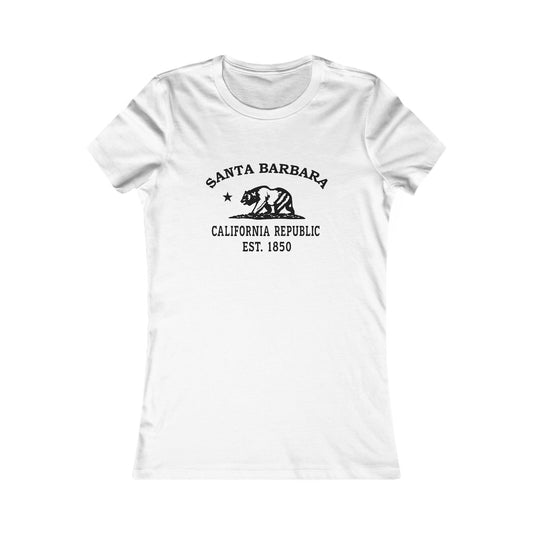
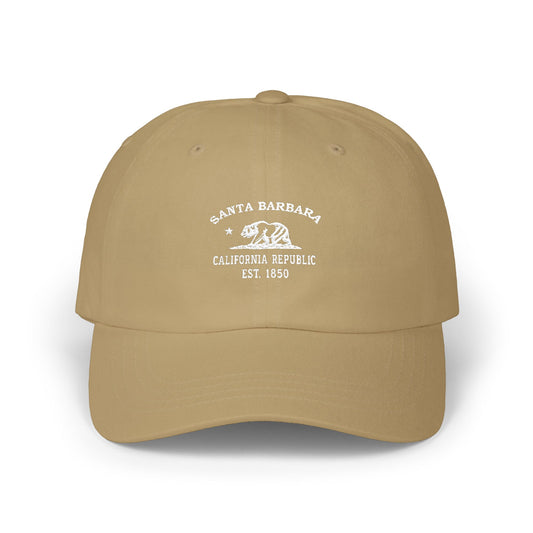
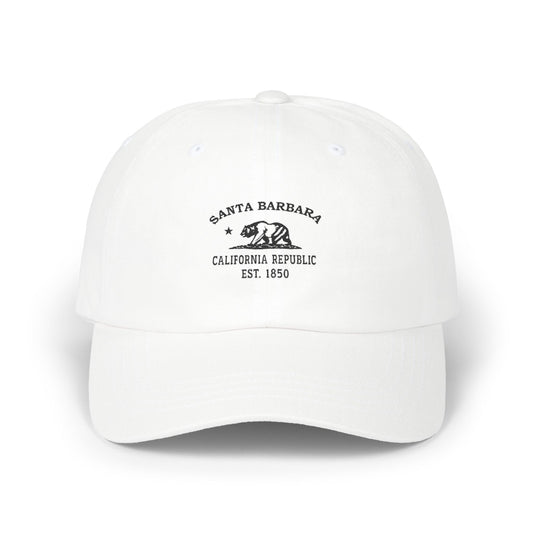
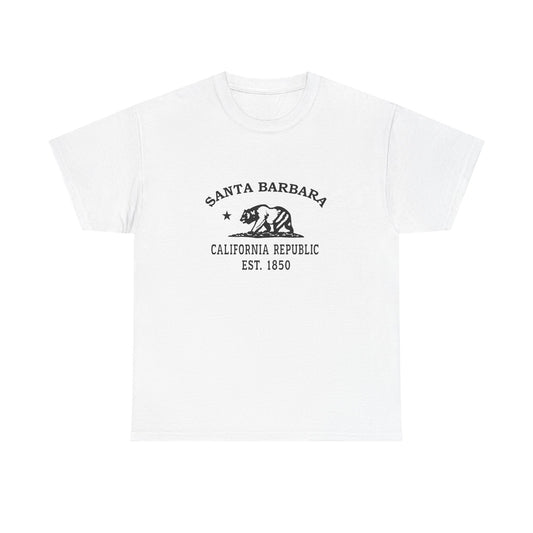
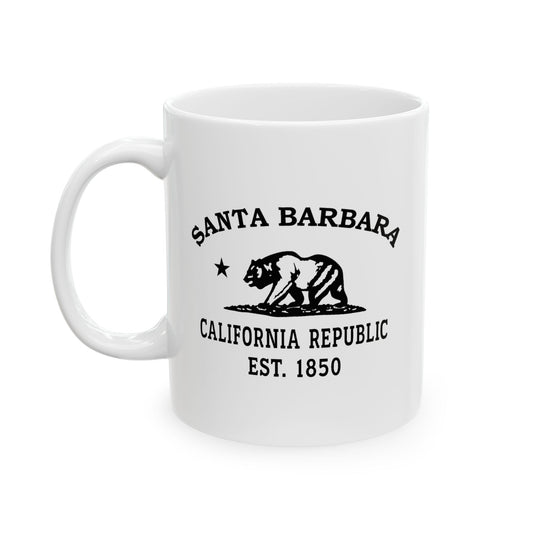
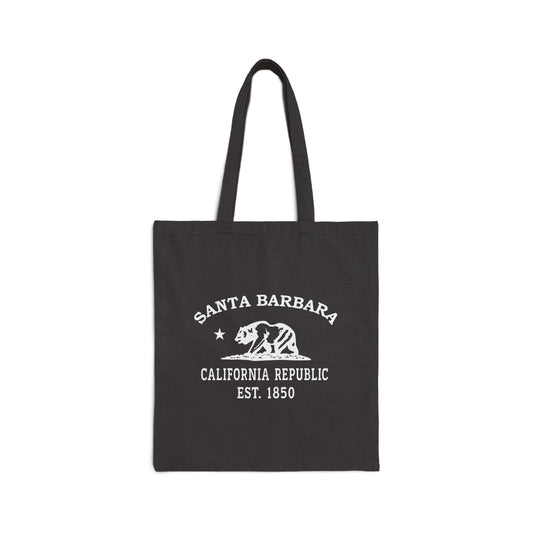
Our Santa Barbara retro logo uses California's bear and star motif, the brand-wide California emblem of every Merlin Classics CA town, symbolic of state pride and resilience. The bear embodies strength, independence, and wilderness heritage, while the star recalls the Bear Flag and California Republic spirit. The "1850" inscription ties the design to California statehood — the brand-pattern anchor across our California towns, regardless of each town's specific founding date. Black-and-white styling resembles WPA travel posters, citrus crate labels, or frontier signage, retro and practical. The motif bridges Santa Barbara's layered story: Chumash and Spanish roots, Mexican rancho era, American resilience, and the legislated post-1925 architectural identity. On merchandise, it communicates authenticity and endurance, retro vintage in tone, perfectly suited for honoring this American Riviera city.
So Santa Barbara gathers a nine-thousand-year coast, a saint’s-day naming, a royal presidio, a mission called a queen, a rulebook rebuild, a courthouse called America’s most beautiful, and a bronze pod of dolphins with a twin across the Pacific — and our Santa Barbara designs gather that into wearable form. Whether Santa Barbara is your hometown, your beach, your college years, or the coast you keep coming back to, wear the history. Whitewashed since 1925, on the Channel since 1782.

Santa Barbara California — Travel Guide
Visiting Santa Barbara Today
Santa Barbara sits on California's south-facing Central Coast between the Santa Ynez Mountains and the Santa Barbara Channel, roughly an hour and a half north of Los Angeles. Spanish Colonial Revival downtown architecture, four miles of south-facing beaches, the Channel Islands offshore, mission and presidio heritage, and one of the most beautiful courthouses in America anchor the experience. The mild Mediterranean climate runs year-round; summer is peak, the early-February Film Festival and the early-August Old Spanish Days Fiesta are the two biggest annual events.
The Riviera, the Queen of the Missions, and the 1925 Rebuild in Santa Barbara
For visitors searching for things to do in Santa Barbara California:
- Tour Mission Santa Barbara, the 1786 Queen of the Missions, the tenth of the California missions and the only one in continuous Franciscan use — the 1820 twin-towered stone façade, the Sacred Garden, the cemetery, the mission museum.
- Climb the Santa Barbara County Courthouse El Mirador clock tower for the free panoramic view across the red-tile roofs to the Channel and the islands; tour the 1929 sandstone Spanish Colonial Revival interior with the painted Mural Room ceiling.
- Walk through El Presidio Real de Santa Bárbara State Historic Park, the 1782 Spanish fort site downtown — one of the four original Spanish presidios in California, now a partial reconstruction with the original Cañedo Adobe and El Cuartel still standing.
- Walk Stearns Wharf, the 1872 wooden wharf running out into the harbor — the oldest working wooden wharf in California — for shops, the Sea Center aquarium, and views back to the city against the Santa Ynez Mountains.
- Stroll State Street, the historic downtown spine of the post-1925 rebuild, lined block after block with whitewashed stucco, red tile, arches, courtyards, and ironwork.
- Visit El Paseo, the 1922 Spanish courtyard complex built around the 1819 Casa de la Guerra adobe — the architectural prototype that helped shape the post-1925 rebuild rulebook.
- Walk East Beach and West Beach, the long Channel-front sands either side of Stearns Wharf, and out to Butterfly Beach in Montecito for the south-facing afternoon light.
- Drive up to the Santa Barbara Botanic Garden in Mission Canyon, with native California plant collections and trails through the chaparral above the mission.
- Stroll the Santa Barbara Museum of Art on State Street for rotating exhibits in a 1914 Spanish-revival building.
- Catch a show at the Santa Barbara Bowl, the 1936 hillside amphitheater above downtown — one of the oldest outdoor concert venues in California.
- Take the Channel Islands ferry from the harbor out to Santa Cruz or Anacapa Island in the Channel Islands National Park, the rugged offshore archipelago the Chumash called Limuw, Anyapakh, and Tuqan.
- Time a visit for Old Spanish Days Fiesta in early August — the city's signature five-day annual festival of Spanish Colonial and Mexican-rancho heritage centered on the courthouse Sunken Garden.
Why People Visit Santa Barbara
Santa Barbara offers a south-facing Pacific coast, a 1786 mission, a 1782 presidio, a 1929 courthouse, a 1922 Spanish courtyard, a 1872 wharf, and an entire downtown legislated into matching whitewashed stucco and red tile a hundred years ago. Visitors come for the Queen of the Missions, the courthouse tower view, the wharf at sunset, the four miles of beach, the August Fiesta, and the simple Mediterranean pleasure of a city where the rulebook for what a block should look like was written down and is still followed. It is the American Riviera, and the architecture earns the name.
Wear the History
Where you’re from. Where you love. Where you explored. Where you belong.
Kindred Cities
Greetings, friends from Toba (ようこそ) — our partner on the pearl-diving coast of Japan.
Santa Barbara and Toba are two beautiful seaside towns that found each other across the Pacific. Toba, on Japan's Ise-Shima coast, is the home of the cultured pearl, where the art of growing pearls was invented and the ama divers still work the bays; Santa Barbara, the American Riviera, sets its red-tiled, mission-era town between the mountains and the sea. Two coasts that live by the water and dress beautifully for it.
Santa Barbara and Toba have been sisters since 1966, and each keeps a Dolphin Friendship Fountain in the other's honour — a small twin landmark binding the pearl coast of Japan to the California shore.
Come from Toba and Santa Barbara will charm you: Spanish-tiled streets below the Riviera hills, a historic mission and pier, palm-lined beaches and the wine country just behind — the easy elegance that earned the town its nickname. Come and visit us soon.
When you plan the trip, Visit Santa Barbara is the place to start.
Wear the History
Where you’re from. Where you love. Where you explored. Where you belong.

For deeper reading on Santa Barbara, California history — the Chumash people and their thousands of years on this channel coast; the December 4, 1602 naming by Sebastián Vizcaíno; the April 21, 1782 founding of El Presidio Real and the 1786 founding of Mission Santa Barbara by Father Fermín Lasuén; the Mexican rancho era and the April 9, 1850 incorporation; Stearns Wharf (1872) and El Paseo (1922); the June 29, 1925 earthquake and the Spanish Colonial Revival rebuilding that followed, crowned by the 1929 County Courthouse; and the Dolphin Fountain and its twin in Toba, Japan — it may be useful to consult the Santa Barbara Historical Museum on De la Guerra Street, the Presidio Research Center, the Santa Barbara Public Library’s local history collections, the mission archive-library, and the California Historical Society. For travel and visitor information, Visit Santa Barbara is the place to start.
Shop the Santa Barbara California collection
View full collection-
Santa Barbara California Vintage Retro Premium Crewneck Sweatshirt - Black Logo
Regular price $48.00 USDRegular price -
Santa Barbara California Vintage Retro Premium Crewneck Sweatshirt - White Logo
Regular price $48.00 USDRegular price -
Santa Barbara California Vintage Retro Womens Fitted Ringspun Cotton Tee - Black Logo
Regular price $28.00 USDRegular price -
Between Horse and Hound - Silhouette Art Giclée Unframed Art Print
Regular price From $34.00 USDRegular price -
Companion in Still Water - Silhouette Art Framed Art Print
Regular price From $96.00 USDRegular price -
Santa Barbara California Vintage Retro Embroidered Cotton Cap - White Logo
Regular price $32.00 USDRegular price -
Santa Barbara California Vintage Retro Embroidered Cotton Cap - Black Logo
Regular price $32.00 USDRegular price -
Whitewater Run - Silhouette Art Giclée Unframed Art Print
Regular price From $34.00 USDRegular price -
Whitewater Charge - Silhouette Art Framed Art Print
Regular price From $96.00 USDRegular price -
Santa Barbara California Vintage Retro Unisex Heavy Cotton Tee - Black Logo
Regular price $22.00 USDRegular price -
Santa Barbara California Vintage Retro Cotton Jersey Baby Bodysuit - Black Logo
Regular price $26.00 USDRegular price -
Between Two Hounds Portrait - Silhouette Art Framed Art Print
Regular price From $112.00 USDRegular price -
Santa Barbara California Vintage Retro Vinyl Sticker - Black Logo
Regular price From $6.00 USDRegular price -
Santa Barbara California Vintage Retro Unisex Heavy Cotton Tee - White Logo
Regular price $22.00 USDRegular price -
Santa Barbara California Vintage Retro Cotton Canvas Tote Bag - Black Logo
Regular price $25.00 USDRegular price -
Whitewater Leap - Silhouette Art Giclée Unframed Art Print
Regular price From $34.00 USDRegular price -
Boy and Hound - Silhouette Art Framed Art Print
Regular price From $96.00 USDRegular price -
Santa Barbara California Vintage Retro Ceramic Mug - Black Logo
Regular price From $16.00 USDRegular price -
Santa Barbara California Vintage Retro Cotton Canvas Tote Bag - White Logo
Regular price $25.00 USDRegular price -
Boy and Hound - Silhouette Art Giclée Unframed Art Print
Regular price From $34.00 USDRegular price -
Whitewater Walk - Silhouette Art Framed Art Print
Regular price From $96.00 USDRegular price -
Santa Barbara California Vintage Retro Back Printed Art Series Cotton Tee - Black Logo
Regular price $32.00 USDRegular price -
Santa Barbara California Vintage Retro Giclée Print Art Series Poster
Regular price From $38.00 USDRegular price -
Three Dogs, Still Water - Silhouette Art Giclée Unframed Art Print
Regular price From $44.00 USDRegular price