Ketchikan Alaska — Retro Vintage History
What's with Ketchikan? Ketchikan is Alaska's First City — its earliest extant incorporated city, the Salmon Capital of the World, and the first Inside Passage port of call. It clings to the shore of Revillagigedo Island where the Tongass rainforest meets Tongass Narrows — a town built on pilings and boardwalks, stitched together by salmon, cedar, and rain. The Tlingit fished this creek for centuries; the canneries turned it into a boomtown; the totem poles made it a world capital of Northwest Coast art. Every version of Alaska starts here.
Wear the HistoryWhere you're from. Where you love. Where you explored. Where you belong.
Long before the first cannery, the mouth of Ketchikan Creek was a summer fish camp of the Tongass and Cape Fox Tlingit — the Taant'a Kwáan, the "Sea Lion Tribe." The name they left on the water, Kitschk-hin, is conventionally translated "thundering wings of an eagle," and the modern Tlingit spelling is Kichx̱áan. Captain George Vancouver had sailed through in 1793, naming Revillagigedo Island and Behm Canal and marking the sea-stack of New Eddystone Rock, but for another ninety years the creek stayed what it had always been: a salmon place.

The salmon brought the outsiders. A saltery went up in the area in 1883, and in 1885 Mike Martin — scouting for an Oregon canning company — bought 160 acres at the creek mouth from the Tlingit leader Chief Kyan. Martin and the Nova Scotian George Clark set up a saltery and a general store, the creek's first salmon cannery followed within two years, and the Klondike stampede of 1896-99 washed thousands of prospectors past the new dock. On August 25, 1900, Ketchikan incorporated — and because the towns that beat it to a charter later dissolved or consolidated, it stands today as the earliest extant incorporated city in Alaska.
QUICK FACTS — KETCHIKAN, ALASKA
Ketchikan incorporated on August 25, 1900, and is the earliest extant incorporated city in Alaska — the source of its First City name.
Mike Martin bought 160 acres at Ketchikan Creek from the Tlingit leader Chief Kyan in 1885; the creek's first salmon cannery followed within two years.
By 1936, seven canneries were packing about 1.5 million cases of salmon a year — the Salmon Capital of the World at full boil.
Ketchikan holds the world's largest collection of standing totem poles, across Saxman, Totem Bight, Potlatch Park, and the Totem Heritage Center.
The Tongass National Forest — the largest national forest in the United States — surrounds the town and is headquartered here.
Ketchikan measures its 150-plus inches of yearly rain on a downtown Liquid Sunshine Gauge, and locals rarely carry umbrellas.
Creek Street's houses stand on pilings over Ketchikan Creek; the boardwalk was the town's red-light district from 1903 to 1954.
The name comes from the Tlingit Kitschk-hin — conventionally translated "thundering wings of an eagle" — for the creek the town grew around.
The nickname, though, came from the map, not the paperwork: northbound ships entering Alaska from Puget Sound make Ketchikan their first port of call, and "Alaska's First City" stuck. What the ships found was a salmon empire. By 1936 seven canneries were packing roughly 1.5 million cases a year, and Ketchikan wore the title Salmon Capital of the World. All five Pacific salmon — king, sockeye, coho, pink, and chum — still run the local waters, and every August you can watch them climb the fish ladder on Ketchikan Creek in the middle of downtown.
What's with the Boardwalk Fog of Ketchikan? The town clings to the water on pilings and planks, so weather arrives right at ankle level, sliding in from the channel and softening everything it touches. Boardwalk Fog is that familiar veil that turns harbor lamps into halos and makes spruce-covered hills vanish one layer at a time. A quick rule is to watch the dock lights: if the glow spreads wide and milky, the mist will thicken; if it stays tight, it will lift with the next breeze. Cold water and warm air do the work, and the wooden walkways keep you close enough to feel it. When the fog drifts through, Ketchikan looks like a quiet shoreline sketch.
The creek had a wilder era, too. From 1903 to 1954, Creek Street — the boardwalk on pilings over the water — was the town's red-light district, home to as many as thirty establishments; sportsmen joked it was the only place where both the fish and the fishermen went upstream to spawn. Dolly Arthur, its most famous madam, worked the green house at Number 24 from 1919 on, and her home survives as Dolly's House Museum. The discreet back path over the hill earned its own enduring name: Married Man's Trail.
Timber built the second economy. Sitka spruce from the surrounding Tongass — the largest national forest in the country, its regional headquarters right in town — fed sawmills and, in 1954, the big pulp mill at Ward Cove that anchored the town for four decades until its 1997 closing. Logging's showman legacy survives downtown, where the Great Alaskan Lumberjack Show still runs axe throws and log-rolls for the summer crowds.
And through every boom, the poles kept watch. Ketchikan holds the world's largest collection of standing totem poles, spread across four destinations — Saxman Totem Park south of town, Totem Bight State Park to the north, Potlatch Park beside it, and the Totem Heritage Center downtown, which since 1976 has preserved unrestored nineteenth-century poles retrieved from Tlingit and Haida village sites. The carving tradition never stopped: master carvers still raise new poles, and the Tlingit, Haida, and Tsimshian communities remain the living center of the town's art.

Rain is the price of all of it — more than 150 inches a year, measured with a wink on the downtown Liquid Sunshine Gauge. The reward is the setting: Misty Fjords National Monument begins about forty miles east, 2.3 million acres of glacier-cut granite walls, hanging valleys, and waterfalls that visitors reach by floatplane or boat up Behm Canal. Deer Mountain rises straight from the streets, its trail switchbacking to alpine views over Tongass Narrows; eagles crowd the spruce tops; and black bears fish Herring Cove in late summer.
The modern town runs on the water it always ran on. The Alaska Marine Highway ferries thread the Inside Passage, floatplanes buzz the Narrows, and the cruise fleet has made Ketchikan one of Alaska's busiest summer ports — the First City for more than a million visitors a year, five minutes from rainforest quiet in any direction. Commercial fishing and charter boats still work the same waters Chief Kyan's people fished, and the artist Ray Troll's fish-obsessed studio downtown keeps the salmon in the town's bloodstream.
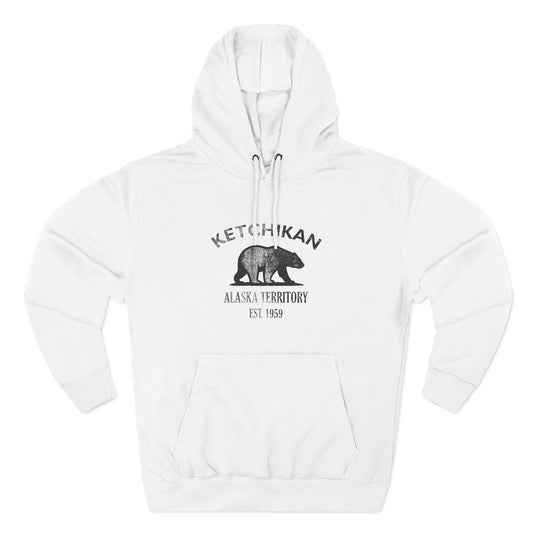
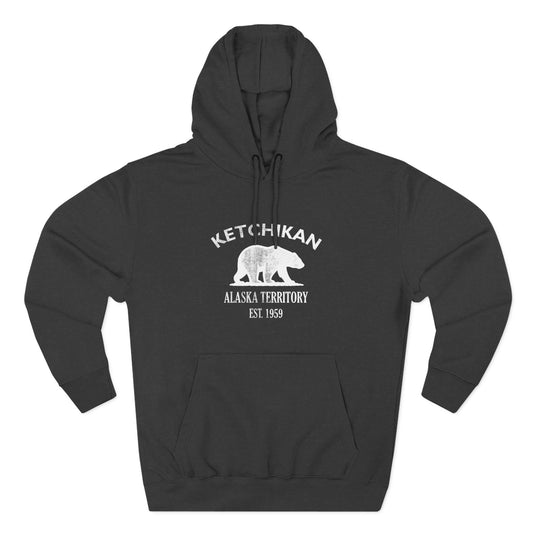
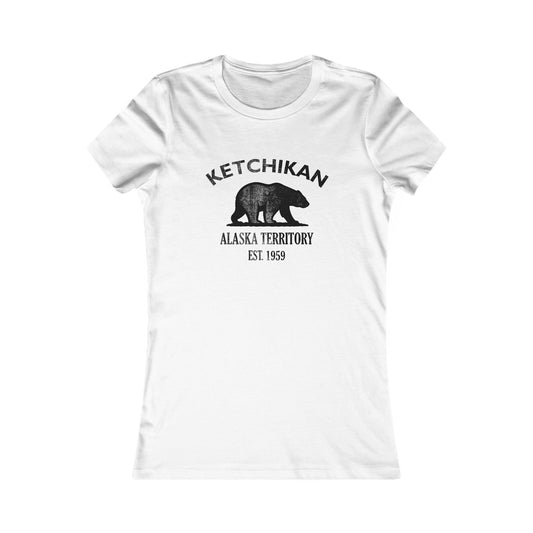
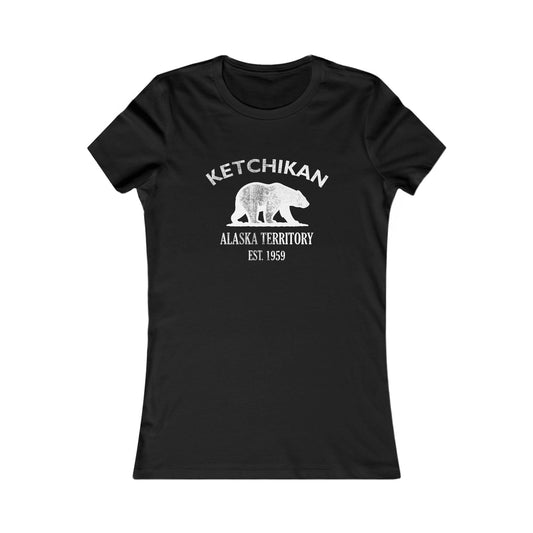
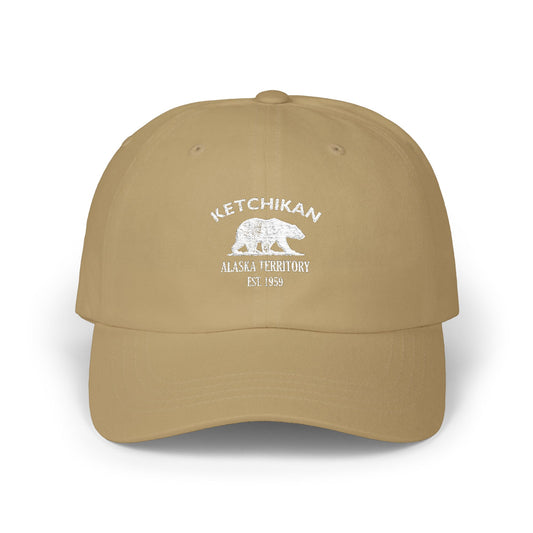
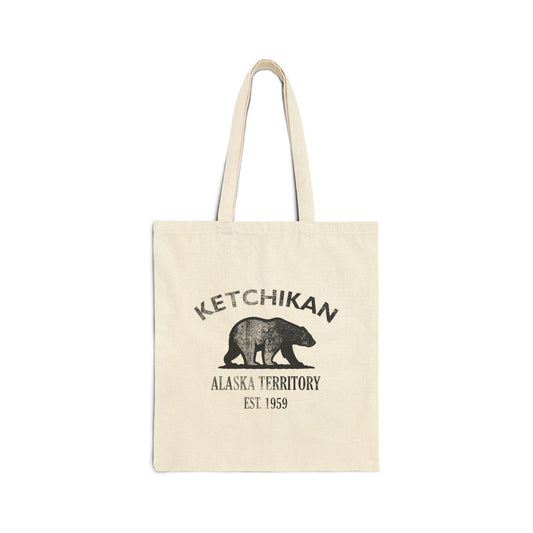
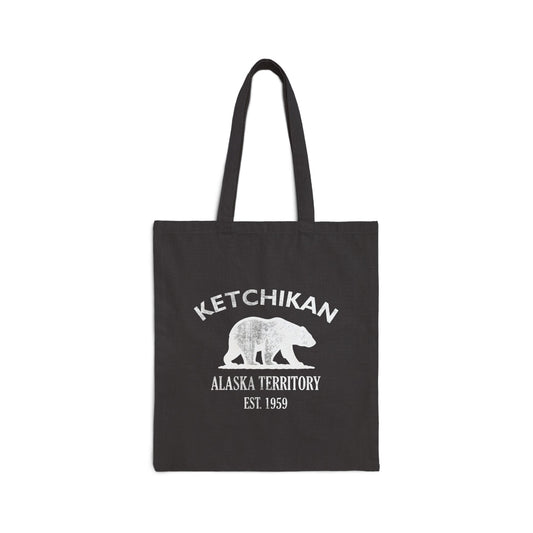
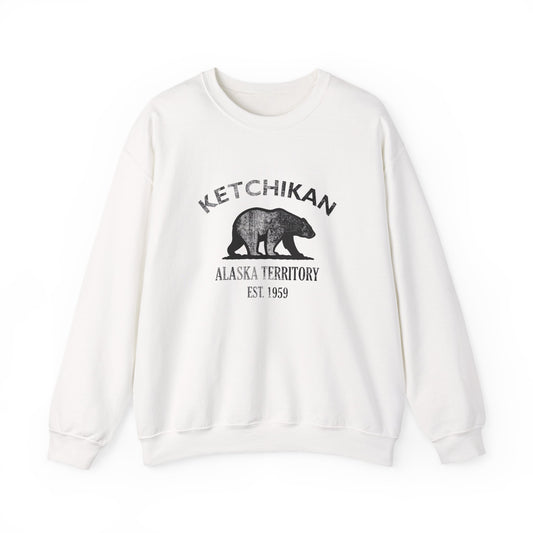
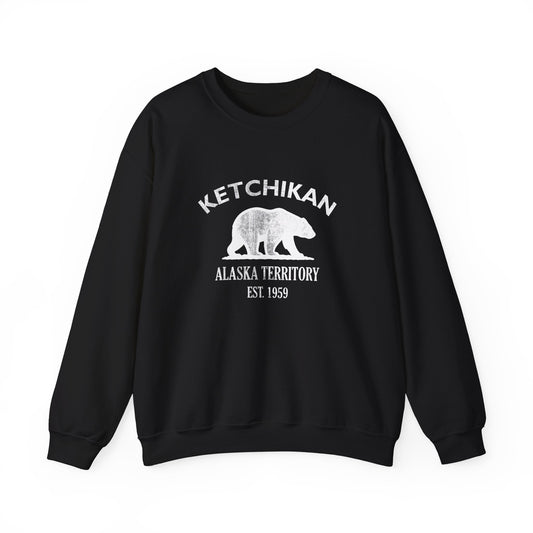
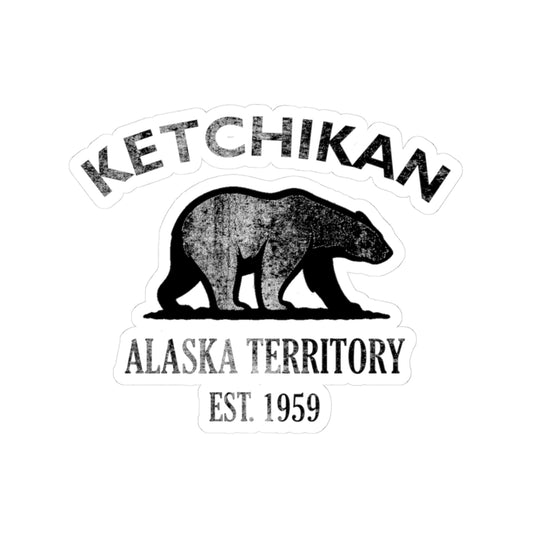
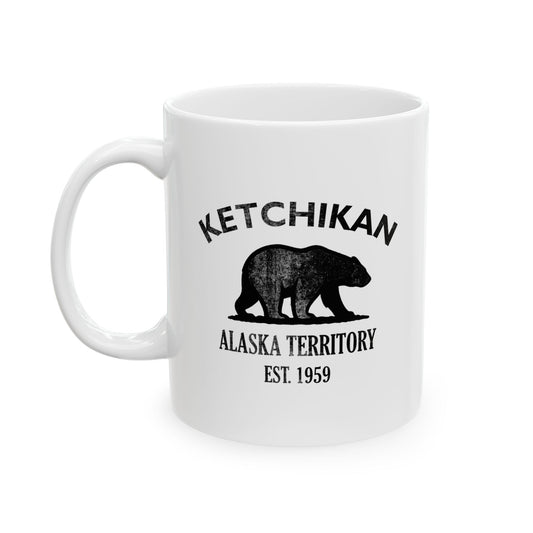
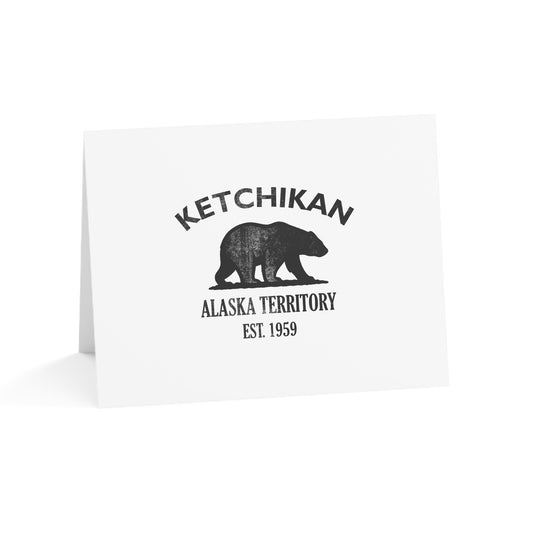
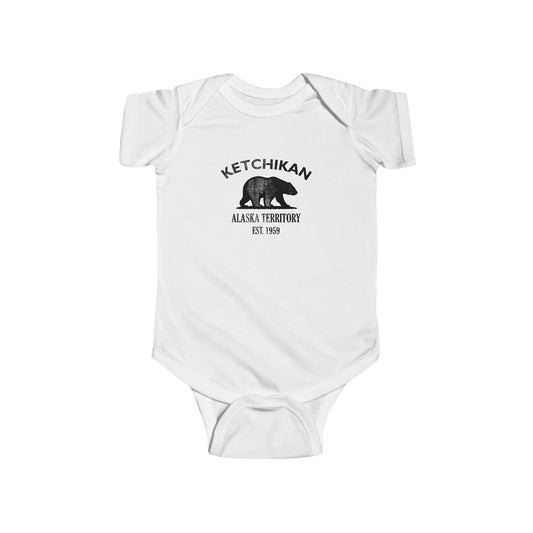
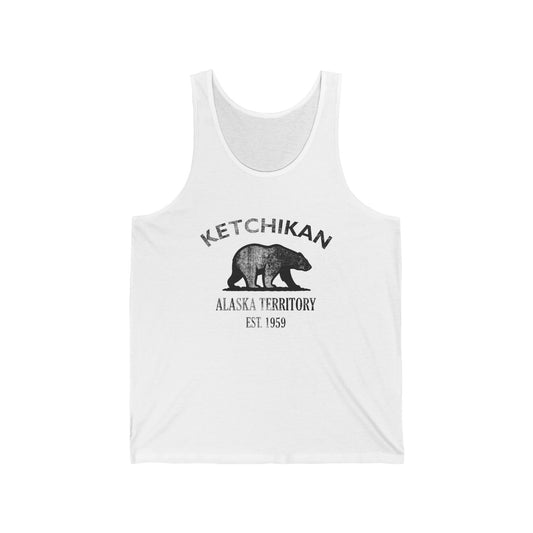
Our Ketchikan designs carry Alaska's distressed bear over the town name and Est. 1959, the statehood year — crate-label and outfitter-stamp styling for the town that canned the world's salmon and carved its tallest stories in cedar. Wear the First City — the boardwalks, the totems, the rain, and all five salmon of the thundering-wings creek.
Ketchikan, Alaska — Travel Guide
Visiting Ketchikan Alaska Today
Ketchikan sits on the western shore of Revillagigedo Island in Southeast Alaska's Inside Passage, about 679 miles north of Seattle and 235 miles south of Juneau — reachable only by boat or by air, via Ketchikan International Airport across Tongass Narrows or the Alaska Marine Highway ferries. The cruise season runs May through September; November through March is the quiet season. Expect rain — more than 150 inches a year — and pack layers, waterproof shoes, and no umbrella: locals just wear the weather.
Creek Street, Totems, Tongass Rainforest, and Misty Fjords
For visitors searching for things to do in Ketchikan Alaska:
- Creek Street — the boardwalk on pilings, Dolly's House Museum, the salmon ladder, and Married Man's Trail over the hill.
- The totem circuit — Saxman Totem Park, Totem Bight State Park, Potlatch Totem Park, and the Totem Heritage Center's unrestored 19th-century poles.
- Misty Fjords National Monument — granite fjords, waterfalls, and New Eddystone Rock by floatplane or boat up Behm Canal.
- The Tongass — rainforest trails from Rainbird to the Deer Mountain climb; bears at Herring Cove in late summer; eagles everywhere.
- Town life — the Great Alaskan Lumberjack Show, waterfront seafood, Cape Fox Lodge above downtown, and the summer salmon derby.
Why People Visit Ketchikan Alaska
Because it is the concentrated version of Southeast Alaska: a walkable historic waterfront where the totem poles are real, the salmon run through downtown, the rainforest starts at the last streetlight, and the fjords are a floatplane ride away. First port of call, and for many travelers the one they remember longest.
Wear the HistoryWhere you're from. Where you love. Where you explored. Where you belong.
Kindred Cities
Greetings, friends from Kanayama (ようこそ) — Ketchikan keeps a friendship across the whole Pacific.
Ketchikan's kindred town is Kanayama, Japan — a mountain community in Gifu Prefecture, now part of the city of Gero — and the bond is one of Alaska's longest-running: every year since 1986, the two towns have traded students, Ketchikan teenagers living with Kanayama host families and Kanayama students walking the boardwalks over Ketchikan Creek. Two rainy, forested, river-threaded towns, half a world apart, each sending its young people to learn the other's water.
Come from Kanayama and Ketchikan will feel like a wilder cousin of home — mist on spruce hills, salmon in the river, and a town that measures its rain with a wink. Come and visit us soon.
When you plan the trip, the Ketchikan Visitors Bureau — the area's official visitor office — is the place to start.
Wear the History
Where you're from. Where you love. Where you explored. Where you belong.

For deeper reading on Ketchikan, Alaska history described here — the centuries of Tongass and Cape Fox Tlingit (Taant'a Kwáan) summer-fish-camp life at Ketchikan Creek before contact, the Kitschk-hin name etymology conventionally translated "thundering wings of an eagle," the 1793 Captain George Vancouver naming of Revillagigedo Island and Behm Canal and New Eddystone Rock, the 1883 first fish saltery in the Ketchikan area, the 1885 Mike Martin founding of the first Ketchikan Creek salmon cannery, the late-1880s Clark & Martin saltery and general store partnership, the 1896-1899 Yukon Gold Rush prospecting boom in the Ketchikan region, the August 25 1900 incorporation as the earliest extant incorporated city in Alaska, the 1903 city ordinance establishing Creek Street as the licensed red-light district on the east bank of Ketchikan Creek, the 1903-1954 era of the Creek Street brothels, the 1917 Black Mary Thomas acquisition of The Star at 5 Creek Street, the 1919 Dolly Arthur opening of 24 Creek Street, the early-1930s peak of the Salmon Capital era with thirteen canneries packing more than a million cases of salmon a year, the 1954 closure of the Creek Street brothels and the same-year opening of the Ketchikan Pulp Company mill at Ward Cove, the 1959 Alaska statehood, the 1976 establishment of the Totem Heritage Center, the December 1 1978 Carter proclamation of Misty Fjords National Monument under the Antiquities Act, the December 2 1980 statutory establishment of Misty Fjords under ANILCA, the 1993 National Register listing of The Star, the 1997 closure of the Ketchikan Pulp Company mill at Ward Cove ending the pulp era, the 2014 National Register listing of the Creek Street Historic District, and the modern cruise-tourism era with more than a million summer visitors a year stepping off the first port of call north from the Lower 48 — it may be useful to consult (1) the Tongass Historical Museum on Dock Street for the city's salmon, timber, and town-growth interpretive collection and the Sanborn fire insurance map runs for the Ketchikan waterfront, (2) the Ketchikan Museums Department city archives for the 1900-forward municipal records and the Creek Street Historic District documentation, (3) the Alaska State Library Historical Collections in Juneau for the territorial-era Ketchikan records, the Alaska Historical Society Journal article runs on the panhandle communities, and the Daily News and Ketchikan Chronicle microfilm runs, (4) the Alaska State Archives in Juneau for the territorial municipal records, the 1900 incorporation papers, and the cannery-era industry records, (5) the University of Alaska Southeast Egan Library in Juneau for the Southeast Alaska academic literature, the Tlingit-language Lingít Aaní scholarship, and the panhandle-economy studies, (6) the Sealaska Heritage Institute in Juneau for the Tongass and Cape Fox Tlingit, Haida, and Tsimshian cultural records of Southeast Alaska, (7) the Totem Heritage Center on Deermount Street for the 19th-century totem-pole conservation archive and the Tongass-area village-site documentation, (8) the U.S. Forest Service Tongass National Forest headquarters in Ketchikan and the Southeast Alaska Discovery Center for the 16.7-million-acre forest records and the Misty Fjords National Monument 1978-forward documentation, (9) the Advisory Council on Historic Preservation files for the Ketchikan National Historic Landmark District designation, and (10) the National Park Service Alaska Regional Office for the ANILCA-era federal-land records. For deeper local Ketchikan research, it may be useful to reach out to (1) the Tongass Historical Museum, (2) the Ketchikan Museums Department, (3) the Ketchikan Public Library local history room, (4) the Sealaska Heritage Institute, (5) the Alaska State Library Historical Collections, (6) the Alaska State Archives, (7) the Totem Heritage Center, and (8) the U.S. Forest Service Tongass National Forest headquarters. For travel and visitor information in Ketchikan, it may be useful to contact (1) the Ketchikan Visitors Bureau, (2) the Ketchikan Chamber of Commerce, (3) the U.S. Forest Service Tongass National Forest headquarters and the Southeast Alaska Discovery Center for Misty Fjords National Monument and Tongass-area public-lands information, (4) the Alaska Department of Natural Resources Division of Parks and Outdoor Recreation for Totem Bight State Historical Park visitor information, (5) the City of Ketchikan Parks and Recreation Department for Deer Mountain trail and Waterfront Promenade information, (6) the Alaska Marine Highway System for ferry-route information across the Inside Passage, and (7) the Ketchikan International Airport on Gravina Island for jet-service information. Readers interested in the broader cultural reception of Ketchikan and its First City identity — the centuries of Tlingit summer-fish-camp life at Kitschk-hin, the 1793 Vancouver naming of Revillagigedo Island, the 1885 Mike Martin cannery founding, the August 25 1900 incorporation as the earliest extant incorporated city in Alaska, the 1903-1954 Creek Street red-light era, the Salmon Capital of the World cannery decades, the Rain Capital identity, the Wickedest City in Alaska nickname, the 1954-1997 Ketchikan Pulp Company mill at Ward Cove, the 1978 Misty Fjords proclamation, the 2014 Creek Street Historic District listing, and the modern cruise era — will find that the named places (Ketchikan Creek, Revillagigedo Island, Tongass Narrows, Deer Mountain, Creek Street, Dolly's House, The Star, Stedman Bridge, Married Man's Trail, Ward Cove, Gravina Island, the Tongass National Forest, Misty Fjords National Monument, Behm Canal, Rudyerd Bay, Punchbowl Cove, New Eddystone Rock, the Alexander Archipelago, the Inside Passage, the Totem Heritage Center, Totem Bight State Historical Park, Saxman Totem Park, Potlatch Park, the Tongass Historical Museum, and the Southeast Alaska Discovery Center), the named historical figures (Mike Martin, George Clark, Captain George Vancouver, Chief Kyan, Dolly Arthur, Black Mary Thomas), and the named historical moments (the Tlingit Kitschk-hin summer fish camp, the 1793 Vancouver survey, the 1883 first saltery, the 1885 first cannery, the 1900 incorporation, the 1903 Creek Street ordinance, the 1903-1954 red-light era, the early-1930s thirteen-cannery peak, the 1954 brothel closures and pulp-mill opening, the 1959 Alaska statehood, the 1976 Totem Heritage Center establishment, the 1978 Misty Fjords proclamation, the 1993 The Star listing, the 1997 pulp-mill closure, the 2014 Creek Street Historic District listing, and the modern cruise-tourism era) recur across all of these traditions as a shared cultural grammar of foundational Ketchikan history grounded specifically on Revillagigedo Island at the southern end of the Inside Passage beneath the largest national forest in the United States.
Shop the Ketchikan Alaska collection
View full collection-
Ketchikan Alaska Vintage Retro Premium Crewneck Sweatshirt - Black Logo
Regular price $48.00 USDRegular price -
Ketchikan Alaska Vintage Retro Premium Crewneck Sweatshirt - White Logo
Regular price $48.00 USDRegular price -
Ketchikan Alaska Vintage Retro Unisex Heavy Cotton Hoodie - Black Logo
Regular price $56.00 USDRegular price -
Ketchikan Alaska Vintage Retro Unisex Heavy Cotton Hoodie - White Logo
Regular price $56.00 USDRegular price -
Ketchikan Alaska Vintage Retro Womens Fitted Ringspun Cotton Tee - Black Logo
Regular price $28.00 USDRegular price -
-
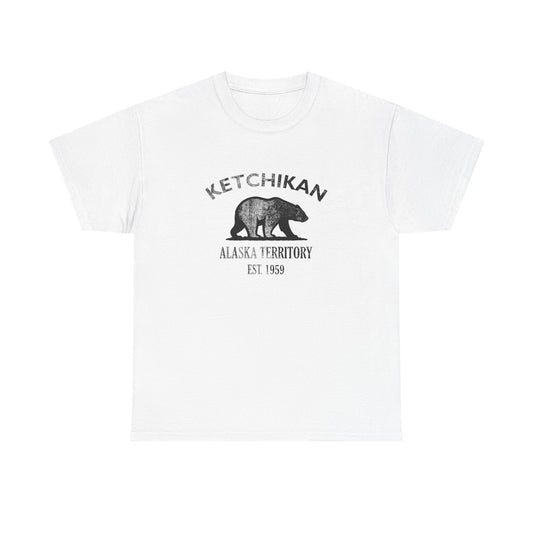
Ketchikan Alaska Vintage Retro Unisex Heavy Cotton Tee - Black Logo
Regular price $22.00 USDRegular price -
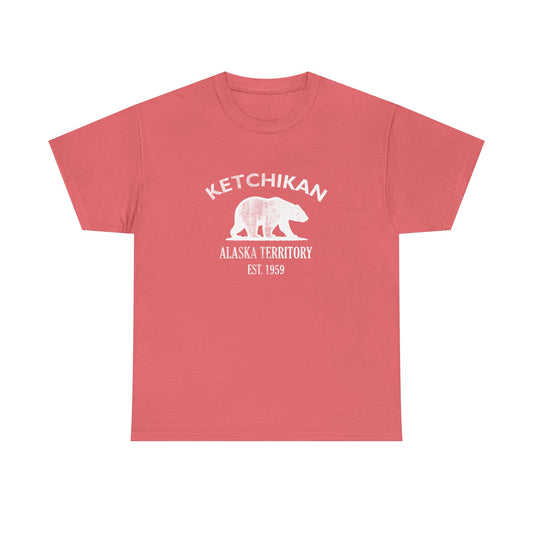
Ketchikan Alaska Vintage Retro Unisex Heavy Cotton Tee - White Logo
Regular price $22.00 USDRegular price -
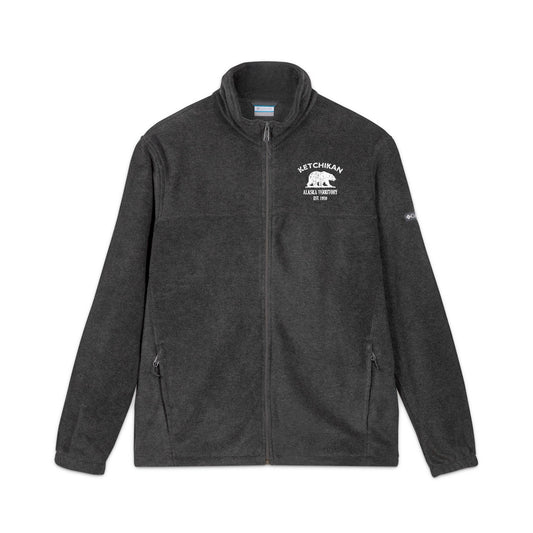
Ketchikan Alaska Vintage Retro Unisex Embroidered Fleece Jacket - White Logo
Regular price $98.00 USDRegular price -
Ketchikan Alaska Vintage Retro Embroidered Cotton Cap - Black Logo
Regular price $32.00 USDRegular price -
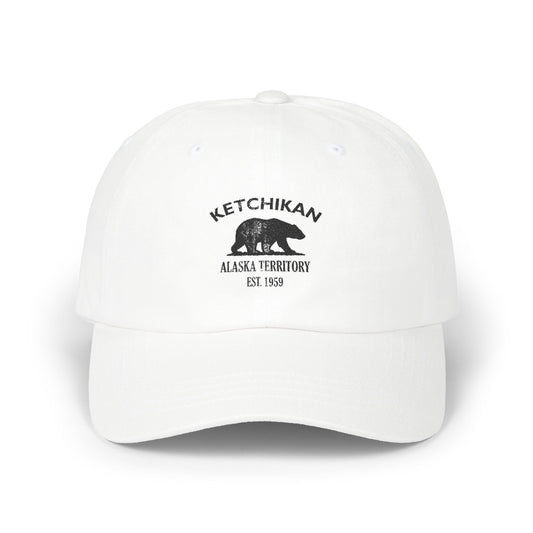
Ketchikan Alaska Vintage Retro Embroidered Cotton Cap - White Logo
Regular price $32.00 USDRegular price -
Ketchikan Alaska Vintage Retro Back Printed Art Series Cotton Tee - Black Logo
Regular price $32.00 USDRegular price -
Ketchikan Alaska Vintage Retro Giclée Print Art Series Poster
Regular price From $38.00 USDRegular price -
Ketchikan Alaska Vintage Retro Cotton Canvas Tote Bag - Black Logo
Regular price $25.00 USDRegular price -
Ketchikan Alaska Vintage Retro Cotton Canvas Tote Bag - White Logo
Regular price $25.00 USDRegular price -
Ketchikan Alaska Vintage Retro Unisex Heavy Crewneck Sweatshirt - Black Logo
Regular price $44.00 USDRegular price -
Ketchikan Alaska Vintage Retro Unisex Heavy Crewneck Sweatshirt - White Logo
Regular price $44.00 USDRegular price -
Ketchikan Alaska Vintage Retro Unisex Embroidered Cotton Polo - Black Logo
Regular price $48.00 USDRegular price -
Ketchikan Alaska Vintage Retro Vinyl Sticker - Black Logo
Regular price From $6.00 USDRegular price -
Ketchikan Alaska Vintage Retro Ceramic Mug - Black Logo
Regular price From $16.00 USDRegular price -
Ketchikan Alaska Vintage Retro Thank You Card Set - Black Logo
Regular price From $25.00 USDRegular price -
Ketchikan Alaska Vintage Retro Cotton Jersey Baby Bodysuit - Black Logo
Regular price $26.00 USDRegular price -
Ketchikan Alaska Vintage Retro Unisex Cotton Jersey Tank Top - Black Logo
Regular price $28.00 USDRegular price