Waikīkī Hawaii — Retro Vintage History
What's with the Pink Palace? The flamingo-pink, Spanish-Moorish landmark that has anchored Waikīkī Beach since 1927 is the image the world keeps of Hawaiʻi — the Royal Hawaiian Hotel, the “Pink Palace of the Pacific.” But it stands on far older ground. Its gardens are Helumoa, a royal coconut grove where, legend says, a great rooster once scratched the earth, and where the chief Kakuhihewa and, later, Kamehameha himself kept their homes. Waikīkī — the name means “spouting fresh water” — was a place of kings and surf long before it was a place of hotels, and its story runs deeper than any postcard.
Wear the HistoryThat name tells you what this place once was. Waikīkī, “spouting water,” was named for the springs and streams that gushed from the Koʻolau valleys — Makiki, Mānoa, and Pālolo — and spread across a broad coastal plain. The old ahupuaʻa, or land division, of Waikīkī was vast, reaching from Kou, the future Honolulu, toward Maunalua at the island's east end. Where high-rises now stand was once some two thousand acres of marsh and wetland, fed by mountain water and framed, then as now, by the crater of Lēʻahi — Diamond Head — at the end of the beach.

From the mid-1400s, Hawaiians turned that wetland into one of the most productive landscapes in the islands. They built loʻi kalo — irrigated taro terraces — and loko iʻa, walled fishponds, laced together by ʻauwai (irrigation channels), raising taro, fish, and seaweed in steady abundance. Waikīkī was a breadbasket and a center of power: high chiefs kept residences and heiau here, drawn by the food, the fresh water, and the surf. At Kālia, on the western shore, a family of fishers and watermen worked the ponds — and among their descendants would be a boy named Duke Kahanamoku.
For centuries Waikīkī was the playground of the aliʻi, who rode its long, gentle waves on koa-wood longboards — heʻe nalu, the sport of kings, born on these very shoulders of surf. It was a seat of power, too. In 1794 Kamehameha landed his war canoes on this beach in the campaign that would unite the islands, and after his victory Waikīkī served as the young Kingdom's first capital, in 1795 and 1796. He built a home at Helumoa and, in 1809, moved his court here — to the same grove where the Pink Palace stands today.

The resort era grew out of that royal ground. In the 1880s King Kalākaua cut the first real road to Waikīkī, opening it to recreation; by 1893 the little Sans Souci had become one of Hawaiʻi's first beach resorts, and Robert Louis Stevenson lingered there. The Moana Hotel — the “First Lady of Waikīkī” — opened in 1901, and in 1927 the Matson Line raised the Royal Hawaiian, the Pink Palace itself, on the Helumoa grove. Elegant ships carried mainland visitors to its doors, and Waikīkī began its second life as the most famous beach in the Pacific.
That second life had a price. To drain the wetlands — officially against mosquitoes, in practice to turn marsh into buildable land — the territory dug the Ala Wai Canal between 1921 and 1928, diverting the very streams that had given Waikīkī its name. The taro patches and fishponds were filled, the Hawaiian families who farmed them displaced, and the spouting waters stilled. What rose in their place was the modern resort district the world now knows — built, quite literally, over the drained breadbasket of old Waikīkī.
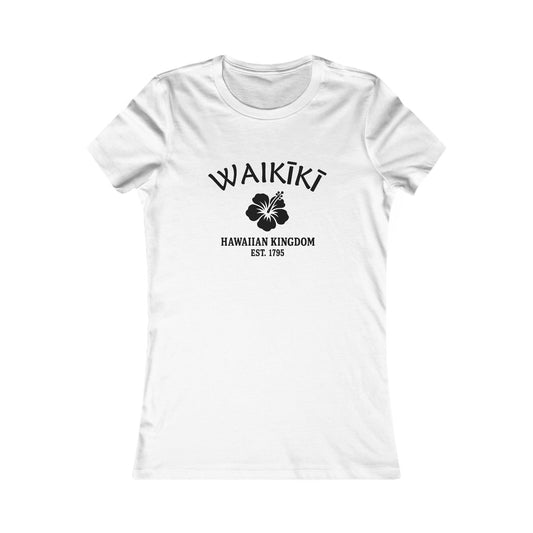
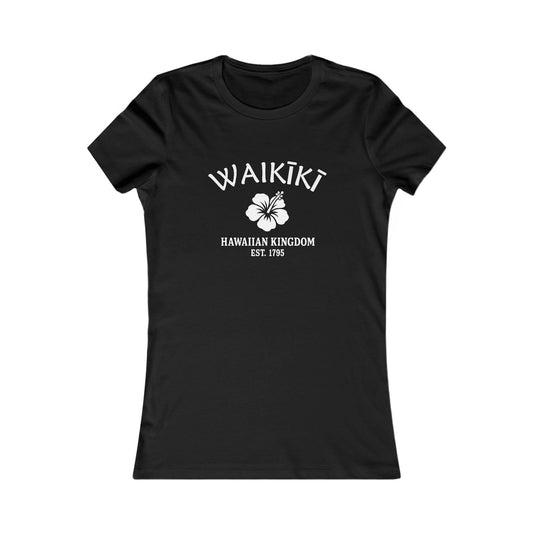
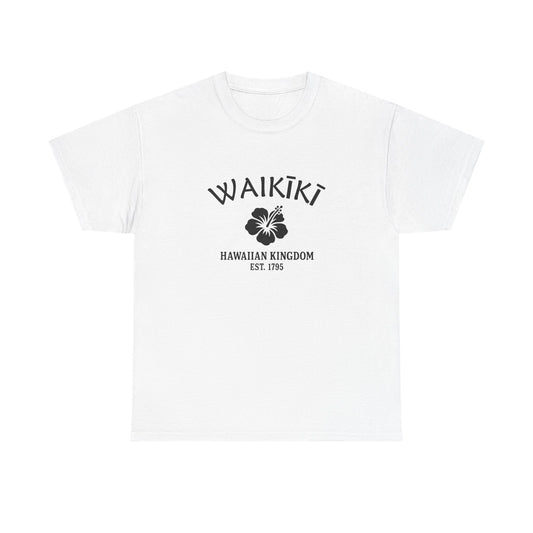
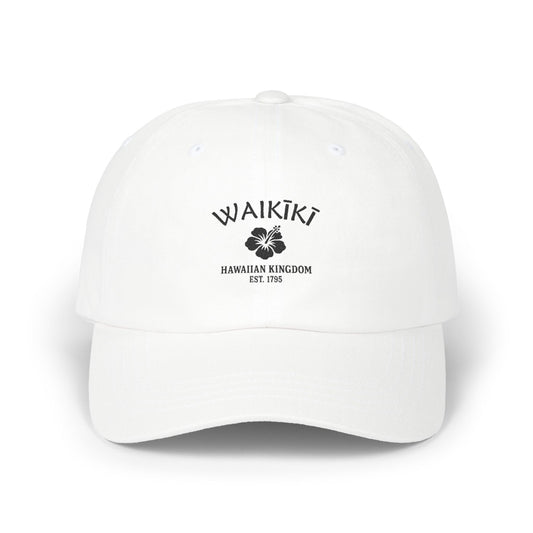
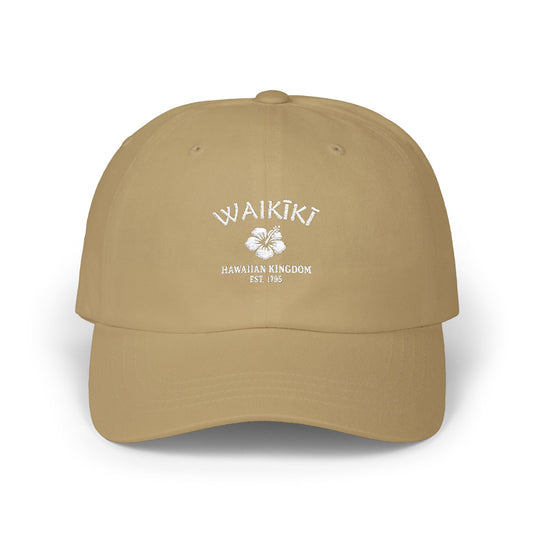
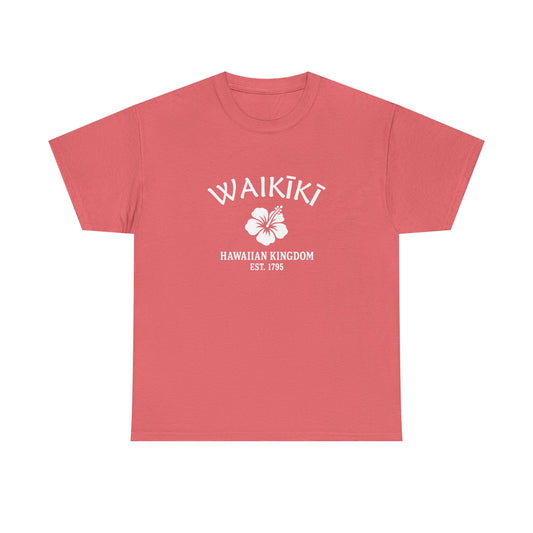
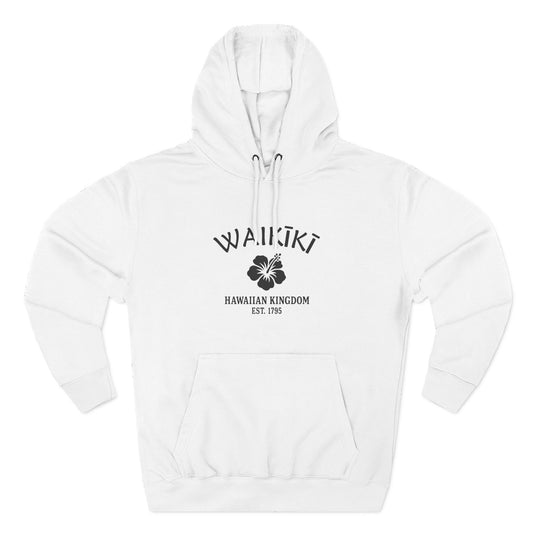
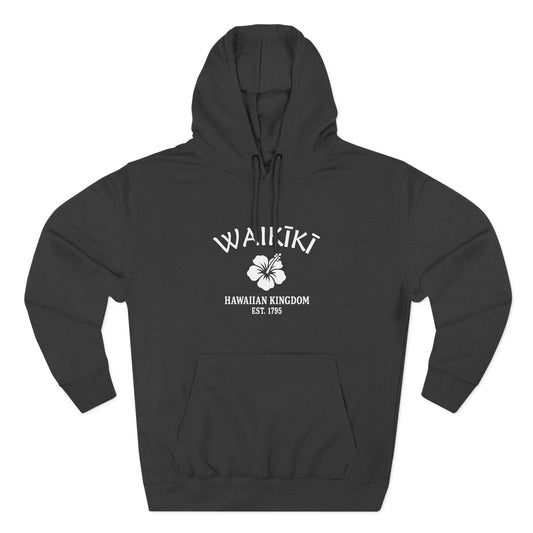
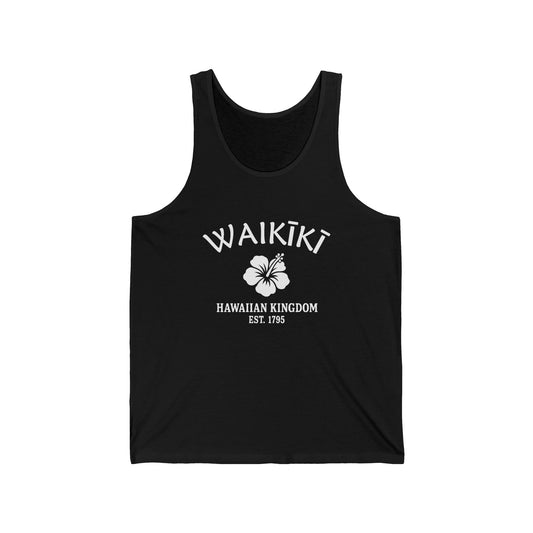
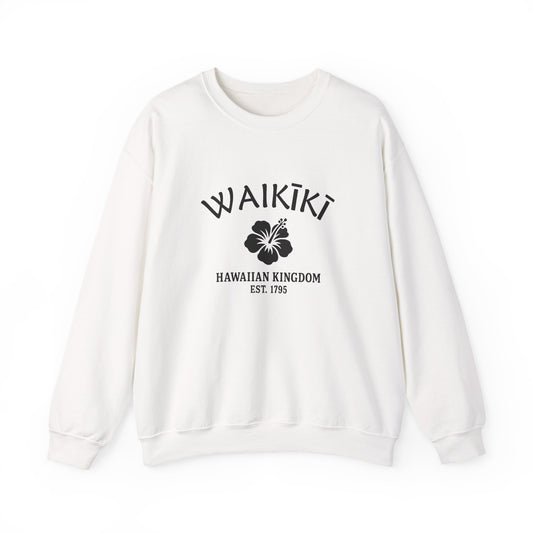
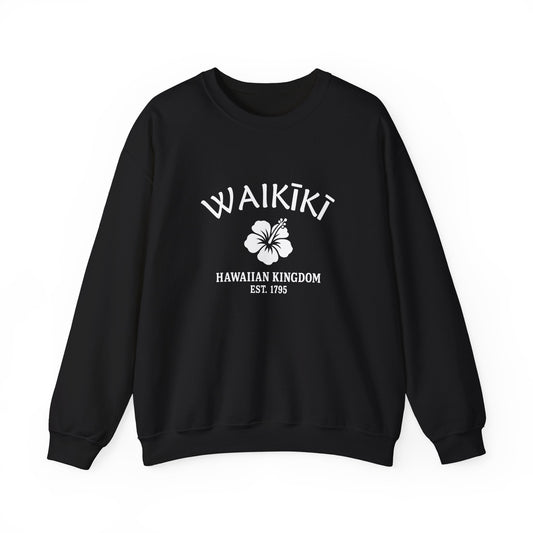
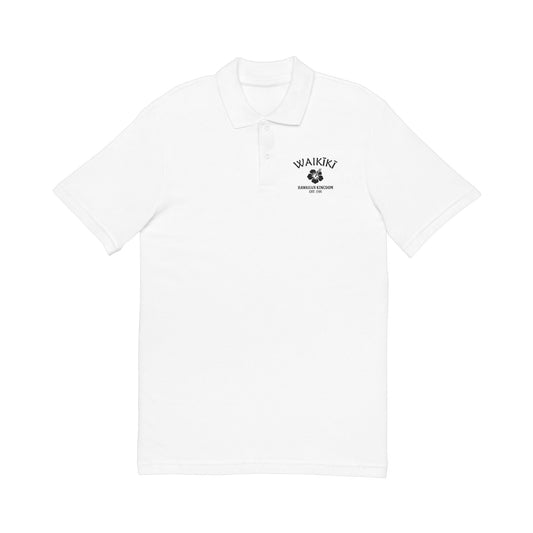
Our Waikīkī design wears the hibiscus, Hawaiʻi's flower, beneath the words “Hawaiian Kingdom · Est. 1795” — a date that belongs to Waikīkī more than to most, for this was the Kingdom's first capital in that founding year. Rendered in clean black and white, like an old travel decal or luggage label, it is a heritage mark — a nod to the islands' own story and to the deep Hawaiian identity of Waikīkī, the spouting waters. It is worn for the place and its people, not for any single chapter of its past.
Today Waikīkī is where the world learns to surf. The royal sport the aliʻi rode here became a global one through Duke Kahanamoku, the Kālia boy turned Olympic champion, whose bronze statue now stands on the sand with arms spread wide in welcome. Outrigger canoes still launch through the breakers, hula and music drift from the beachfront, and beneath the towers the old name endures — Waikīkī, the spouting waters, a royal shore that taught the world to ride the waves. Our designs carry that older, deeper name with pride.
Waikīkī, Hawaiʻi — Travel Guide
Visiting Waikīkī Today
Waikīkī sits on the south shore of Oʻahu, a famous urban beach where surf history, royal grounds, and city life share two miles of golden sand. A little planning turns a postcard into a place:
Surf, Sand & Royal Grounds in Waikīkī
For visitors looking for things to do in Waikīkī, Oʻahu:
- Take a first surf lesson on Waikīkī's long, gentle rollers — the same waves the aliʻi rode, and where Duke Kahanamoku made the sport famous.
- Hike Diamond Head (Lēʻahi) for the switchback climb to the crater rim and a sweeping view back over the beach and the city.
- Find the bronze Duke Kahanamoku statue on Kūhiō Beach, arms open in welcome, his surfboard at his back.
- Walk the gardens of the Royal Hawaiian — the 1927 “Pink Palace” — and the Moana Surfrider, the 1901 “First Lady of Waikīkī,” on the old Helumoa royal grove.
- Ride an outrigger canoe out through the breakers, then catch a wave back to the sand the Hawaiian way.
- Stroll Kalākaua Avenue, named for the king who opened Waikīkī, past shops, music, and the evening glow off the water.
- Spread out in Kapiʻolani Park and visit the Honolulu Zoo and the Waikīkī Aquarium at the Diamond Head end of the beach.
- Walk the Ala Wai Canal at dusk to see the waterway that drained old Waikīkī and made the modern beach.
Why People Visit Waikīkī
Waikīkī offers a whole world in two miles of sand: the birthplace of modern surfing, royal history beneath the hotels, Diamond Head at the end of the beach, and the easy warmth of Hawaiian hospitality. It is the most famous beach in the Pacific — and for the surfers, paddlers, and families who live and gather here, simply home.
Wear the History
Kindred Cities
A warm welcome to visitors from Nice, France (bienvenue) and Vancouver, Canada — like-minded beaches backed by a glittering city.
Waikīkī is the most famous urban beach in the Pacific, and Nice and Vancouver play in the same league. Nice lines its Promenade des Anglais along the Riviera's blue; Vancouver sets its beaches against glass towers and coastal mountains; Waikīkī curves its golden sand beneath Diamond Head and a wall of hotels, the birthplace of modern surfing where Duke Kahanamoku once rode the waves. Three city beaches where the surf meets the skyline.
Waikīkī welcomes everyone to the heart of Hawaiian leisure: gentle surf for first-timers, Diamond Head rising at the end of the beach, outrigger canoes and sunset mai tais, and a boardwalk of shops and music steps from the sand. Come and visit us soon.
When you plan the trip, the Oʻahu Visitors Bureau is the place to start.
Wear the History

For deeper reading on the Waikīkī history described here — the “spouting waters” and the Koʻolau streams, the loʻi kalo and loko iʻa of the old wetland, Helumoa and the royal residences, the aliʻi surf and Kamehameha's 1794 landing, the Moana and Royal Hawaiian hotels, and the building of the Ala Wai Canal — it may be useful to consult (1) the Bernice Pauahi Bishop Museum, (2) the Hawaiʻi State Archives in Honolulu, (3) the University of Hawaiʻi at Mānoa Hawaiian Collection, (4) the Native Hawaiian Hospitality Association and the Waikīkī Historic Trail, and (5) the Hawaiian Historical Society. For travel and visitor information, it may be useful to contact (1) the Oʻahu Visitors Bureau and the wider Hawaiʻi Visitors and Convention Bureau, (2) the Hawaiʻi Tourism Authority, (3) the City and County of Honolulu Department of Parks and Recreation (for Kapiʻolani Park and Kūhiō Beach), (4) TheBus Oʻahu transit information, and (5) the Daniel K. Inouye International Airport information desk.
Shop the Waikīkī Hawaiʻi collection
View full collection-
Waikiki Hawaii Vintage Retro Premium Crewneck Sweatshirt - Black Logo
Regular price $48.00 USDRegular price -
Waikiki Hawaii Vintage Retro Premium Crewneck Sweatshirt - White Logo
Regular price $48.00 USDRegular price -
Waikiki Hawaii Vintage Retro Womens Fitted Ringspun Cotton Tee - Black Logo
Regular price $28.00 USDRegular price -
-
Waikiki Hawaii Vintage Retro Unisex Heavy Cotton Tee - Black Logo
Regular price $22.00 USDRegular price -
Waikiki Hawaii Vintage Retro Embroidered Cotton Cap - Black Logo
Regular price $32.00 USDRegular price -
Waikiki Hawaii Vintage Retro Embroidered Cotton Cap - White Logo
Regular price $32.00 USDRegular price -
Waikiki Hawaii Vintage Retro Unisex Heavy Cotton Tee - White Logo
Regular price $22.00 USDRegular price -
Waikiki Hawaii Vintage Retro Unisex Heavy Cotton Hoodie - Black Logo
Regular price $56.00 USDRegular price -
Waikiki Hawaii Vintage Retro Unisex Heavy Cotton Hoodie - White Logo
Regular price $56.00 USDRegular price -
Waikiki Hawaii Vintage Retro Unisex Embroidered Fleece Jacket - White Logo
Regular price $98.00 USDRegular price -
Waikiki Hawaii Vintage Retro Giclée Print Art Series Poster
Regular price From $38.00 USDRegular price -
Waikiki Hawaii Vintage Retro Back Printed Art Series Cotton Tee - Black Logo
Regular price $32.00 USDRegular price -
Waikiki Hawaii Vintage Retro Vinyl Sticker - Black Logo
Regular price From $6.00 USDRegular price -
Waikiki Hawaii Vintage Retro Ceramic Mug - Black Logo
Regular price From $16.00 USDRegular price -
Waikiki Hawaii Vintage Retro Cotton Canvas Tote Bag - White Logo
Regular price $25.00 USDRegular price -
Waikiki Hawaii Vintage Retro Cotton Canvas Tote Bag - Black Logo
Regular price $25.00 USDRegular price -
Waikiki Hawaii Vintage Retro Thank You Card Set - Black Logo
Regular price From $25.00 USDRegular price -
Waikiki Hawaii Vintage Retro Cotton Jersey Baby Bodysuit - Black Logo
Regular price $26.00 USDRegular price -
Waikiki Hawaii Vintage Retro Unisex Cotton Jersey Tank Top - Black Logo
Regular price $28.00 USDRegular price -
Waikiki Hawaii Vintage Retro Unisex Cotton Jersey Tank Top - White Logo
Regular price $28.00 USDRegular price -
Waikiki Hawaii Vintage Retro Unisex Heavy Crewneck Sweatshirt - Black Logo
Regular price $44.00 USDRegular price -
Waikiki Hawaii Vintage Retro Unisex Heavy Crewneck Sweatshirt - White Logo
Regular price $44.00 USDRegular price -
Waikiki Hawaii Vintage Retro Unisex Embroidered Cotton Polo - Black Logo
Regular price $48.00 USDRegular price