San Francisco California — Retro Vintage History
What’s with the Orange Bridge? The Golden Gate Bridge was very nearly a striped one. When chief engineer Joseph B. Strauss’s great span went up across the strait in the 1930s, the Navy lobbied to paint it black with yellow stripes so ships could see it in the fog; the Army Air Corps preferred red and white. But the consulting architect, Irving Morrow, had watched the steel arrive from the East coated in a red-lead primer that glowed against the headlands, and he fought to keep something close to it — a color called International Orange. He won. When two hundred thousand people walked across the new bridge on opening day, May 27, 1937, it was already the color the world knows: the warm orange that burns through the gray when the fog pours in, chosen precisely because the fog was coming. And the name is older than the gold: John C. Frémont named the strait Chrysopylae — Greek for Golden Gate — in 1846, two years before anyone found a nugget. The gold, like everything else here, arrived after the name was ready for it.
Wear the HistoryWhere you’re from. Where you love. Where you explored. Where you belong.
What’s with the Streetcar Conductor? In 1944, a sixteen-year-old from the Fillmore decided she wanted the job everyone told her she could not have. Maya Angelou — then Marguerite Johnson, come of age in wartime San Francisco — kept returning to the streetcar company office until they relented, and became the first Black woman streetcar conductor in San Francisco, working the cars in her tailored uniform while still in high school. The city stayed in her story as she became one of America’s defining memoirists and poets, a voice of the century honored with the Presidential Medal of Freedom. In 2022 the nation put that story in every pocket: the United States Mint issued the Maya Angelou quarter — the very first coin of the American Women Quarters Program — its reverse showing her with arms uplifted, a bird in flight and a rising sun behind her.

The peninsula was home long before the bridge or the gold. The Yelamu, a Ramaytush Ohlone people, lived on these seven miles by seven miles for thousands of years. The Spanish arrived in 1776: Fathers Francisco Palóu and Pedro Cambón celebrated the first mass at Mission San Francisco de Asís that June — five days before the Declaration of Independence was signed across the continent — and the Presidio followed in September. The mission era devastated the Yelamu, a loss the city’s story owes its first honesty to. The 1791 adobe chapel, Mission Dolores, still stands as the oldest intact building in San Francisco, and a Mexican-era village called Yerba Buena grew along the cove until 1847, when it took the name San Francisco.
QUICK FACTS — SAN FRANCISCO, CA
The Navy wanted the Golden Gate Bridge painted black with yellow stripes; architect Irving Morrow fought for International Orange, and won.
John C. Frémont named the strait Chrysopylae — the Golden Gate — in 1846, two years before gold was discovered in California.
At 4 a.m. on August 2, 1873, Andrew Hallidie ran the first cable car down Clay Street; the system is the only moving National Historic Landmark in the United States.
The earthquake of April 18, 1906 and the four-day fire that followed destroyed eighty percent of the city and killed more than three thousand people; the rebuilt city hosted a world’s fair by 1915.
Mark Twain never actually said the famous line about the coldest winter being a San Francisco summer — the city keeps the quote anyway.
At sixteen, Maya Angelou became San Francisco’s first Black woman streetcar conductor; her 2022 quarter was the first coin of the American Women Quarters Program.
Wilma Mankiller came to San Francisco in the 1956 relocation era and called the Alcatraz occupation her awakening; in 1985 she became the first woman Principal Chief of the Cherokee Nation.
San Francisco and Cork, Ireland have been formal sister cities since 1984 — one of a family of sister-city ties that spans the globe, from Seoul and Paris to Barcelona and Assisi.
Gold made the instant city. On January 24, 1848, James Marshall found gold on the American River, and that May the merchant Sam Brannan — who had quietly bought every pick, shovel, and pan in town — walked the streets shouting the news with a vial of flakes in his fist. By the end of 1849 a village of fewer than a thousand held twenty-five thousand people; ships arrived faster than crews would stay, and the cove filled with an armada of abandoned hulls. San Francisco incorporated on April 15, 1850, the same year California became the thirty-first state, and the Argonauts of 1849 gave the city its founding character: improvised, polyglot, and certain the impossible was a scheduling problem — a city confident enough, a decade on, to humor Joshua Norton, the ruined merchant who proclaimed himself Emperor Norton I of the United States and was mourned by thousands when he died.

The hills got their machines and their houses in the same generation. At four in the morning on August 2, 1873, the London-born inventor Andrew Smith Hallidie took the controls of the Clay Street Hill Railroad and ran the world’s first successful cable car down the Nob Hill grade — a system that still climbs the hills today as the only moving National Historic Landmark in the United States. The Painted Ladies of Alamo Square rose in the 1890s, the Queen Anne row on Steiner Street that has posed for every generation of photographers since, and the 1898 Ferry Building anchored the foot of Market Street.
At 5:12 in the morning on April 18, 1906, a magnitude-7.9 earthquake on the San Andreas Fault ran for forty-five seconds and toppled the city; the fire that followed burned for four days, destroyed eighty percent of San Francisco, and killed more than three thousand people. It remains the city’s defining catastrophe — and its defining recovery. San Francisco rebuilt fast enough to host a world’s fair nine years later, the Panama-Pacific International Exposition of 1915, whose Palace of Fine Arts by Bernard Maybeck still stands on the Marina. Coit Tower added its fluted column to Telegraph Hill in 1933, and Alcatraz Island served as the federal penitentiary from 1934 to 1963.
What’s with the Principal Chief? Six years after the prison closed, Alcatraz got different visitors — and one of them was a young woman the city had raised. Wilma Mankiller came to San Francisco in 1956 as a child, when her Cherokee family was moved from Oklahoma under the federal relocation program; she grew up in the city’s working neighborhoods and studied at San Francisco State. When Indians of All Tribes occupied Alcatraz beginning in November 1969, she crossed the bay to support it and later called the nineteen-month occupation her political awakening. That road led home: in 1985 she became the first woman Principal Chief of the Cherokee Nation, led it for a decade, and received the Presidential Medal of Freedom. In 2022 the United States Mint honored her with the Wilma Mankiller quarter in the American Women Quarters Program — her gaze resolute, wrapped in a traditional shawl beside the seven-pointed star of the Cherokee Nation.

The neighborhoods carry the rest of the story. Chinatown, the oldest in North America, runs lantern-lit behind the Dragon Gate — its story reaching back through Angel Island, the immigration station in the bay, and the old dream of Gold Mountain; North Beach keeps the espresso and the memory of the Beat Generation, whose poets gathered at the City Lights bookstore from 1953; the Mission holds the old adobe church, the murals, and the burrito that bears its name; the Castro became a symbol of gay life in America — Harvey Milk, the first openly gay elected official in California, served the city from here before his assassination in 1978; and Haight-Ashbury hosted the Summer of Love in 1967. The fog pours through the Gate on schedule every evening in summer, the 415 answers the phone, and the tech era writes the newest chapter on the same seven-by-seven grid the Yelamu knew first.
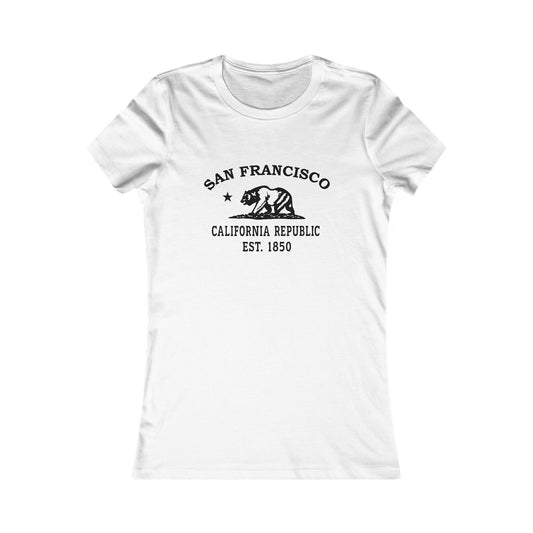
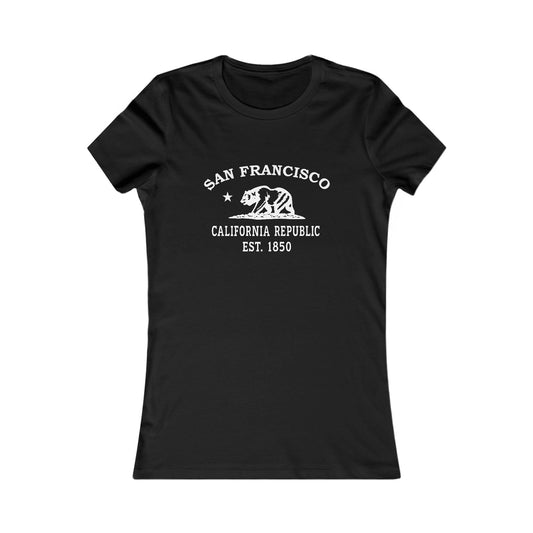
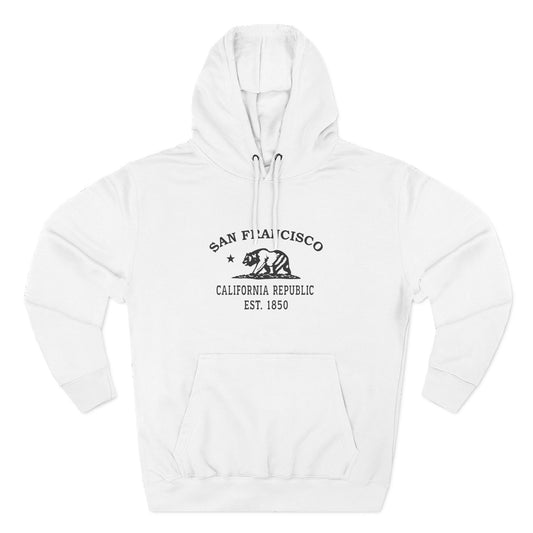
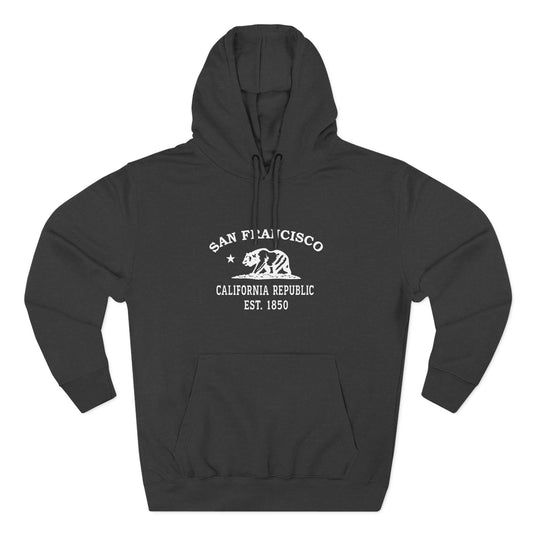
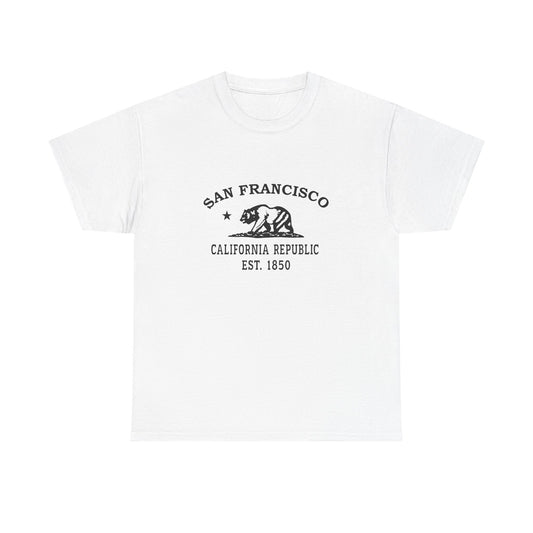
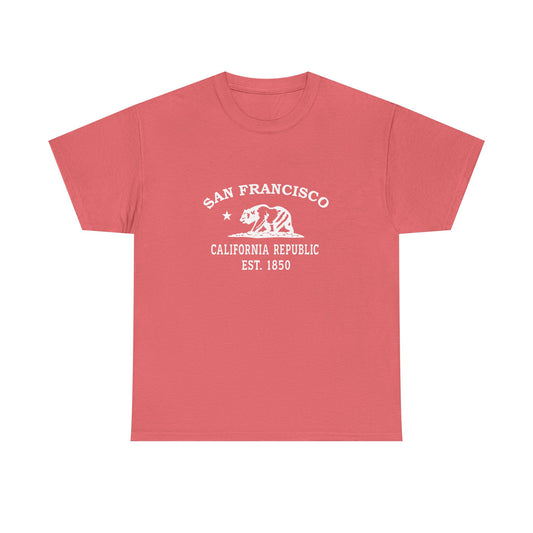
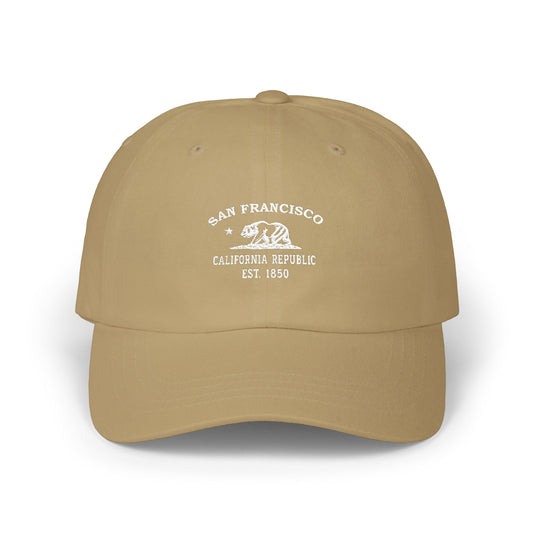
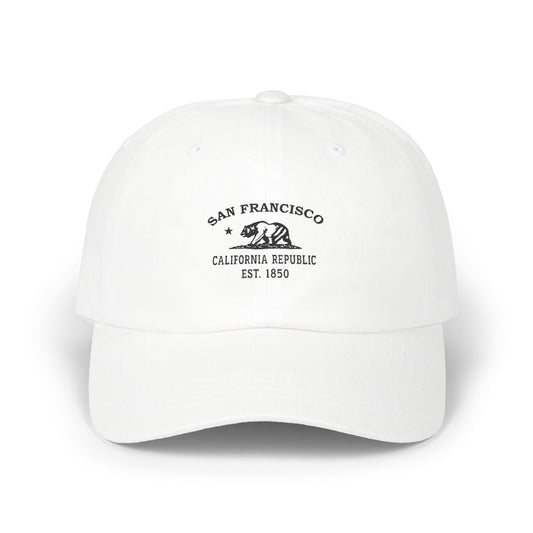
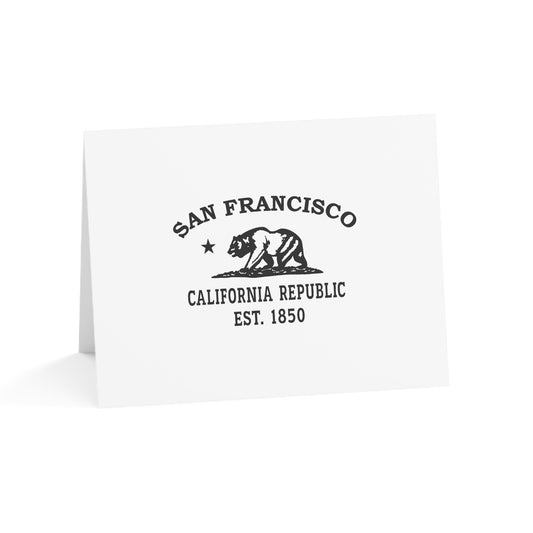
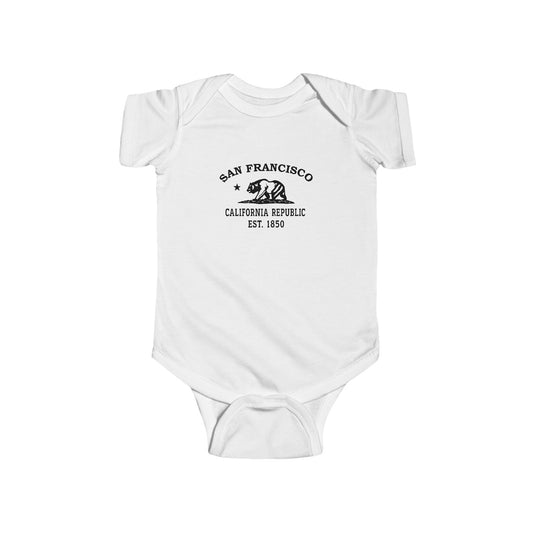
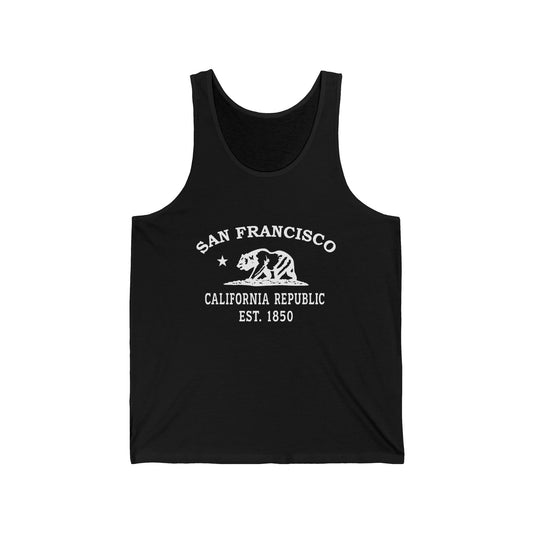
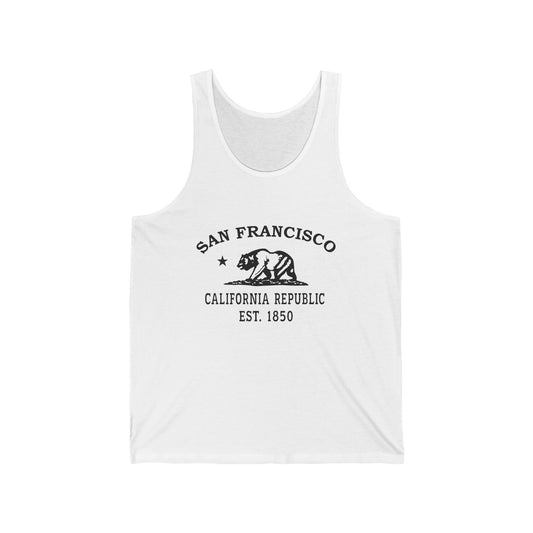
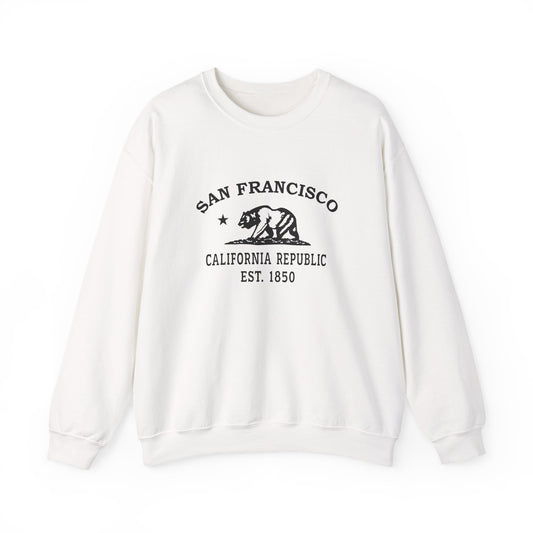
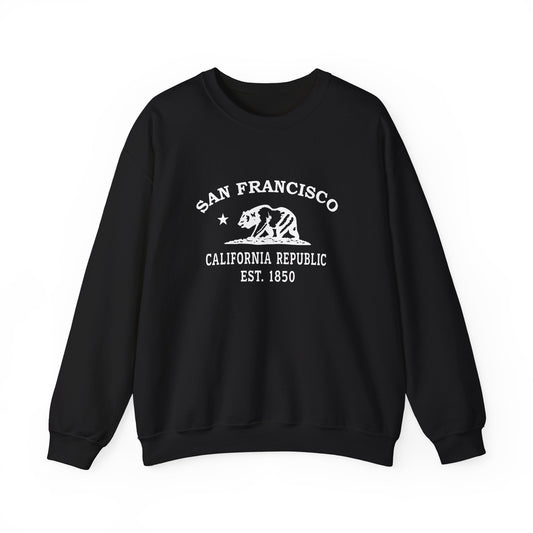
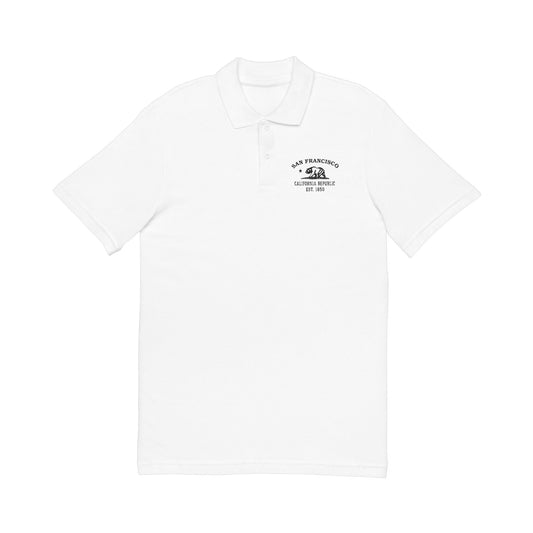
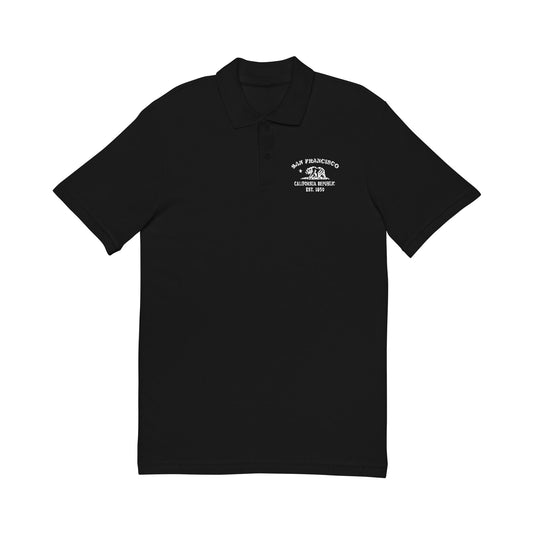
Our San Francisco retro logo carries the California Bear and star of the Bear Flag tradition, with "1850" stamped beneath — the year of California statehood and San Francisco’s incorporation. The black-and-white styling is retro, in the visual vocabulary of WPA posters, crate labels, and the wayfinding of the rebuilt city. The bear and star, paired with the date, place the design in the founding generation of the state — and the city that came back from 1906, built the Bridge, and ran the cable cars every day in between.
So San Francisco gathers a mission and a gold rush, an earthquake and a rebirth, an orange bridge and a moving landmark, a streetcar conductor and a Principal Chief onto one fog-swept peninsula — and our San Francisco designs gather that into wearable form. Whether San Francisco is your hometown, your hill, your fog, or the city you still mean to reach, wear the history. On the Bay since 1776.

San Francisco California — Travel Guide
Visiting San Francisco California Today
San Francisco fills a seven-by-seven-mile peninsula between the Pacific and its bay — hills, fog, and neighborhoods that change character block by block. There is no real summer: the fog runs May through September and the clearest weeks come in September and October, so pack layers whatever the calendar says. The cable cars, the bridge, and most of the great viewpoints are walkable or a short ride apart.
The Golden Gate, the Cable Cars, and the Neighborhoods
For visitors searching for things to do in San Francisco California:
- Walk or bike the Golden Gate Bridge, then see it from Fort Point below, Baker Beach, or the Marin headlands — International Orange against the fog.
- Ride a cable car over Nob Hill and Russian Hill — the 1873 system is the only moving National Historic Landmark in the country.
- Take the ferry to Alcatraz Island for the penitentiary years and the view back at the city.
- See the Painted Ladies from Alamo Square at golden hour, the Queen Anne row of the 1890s against the downtown skyline.
- Enter Chinatown through the Dragon Gate for dim sum and lantern-strung alleys — the oldest Chinatown in North America.
- Wander North Beach for espresso, the City Lights bookstore of the Beats, and the climb to Coit Tower on Telegraph Hill — listening for the wild parrots overhead.
- Visit the Mission District for Mission Dolores — the 1791 adobe that is the city’s oldest building — the murals, and a Mission-style burrito.
- Graze the Ferry Building marketplace, then watch the sea lions haul out along the Fisherman’s Wharf piers.
- Walk Lands End past the Sutro Baths ruins to Ocean Beach, or catch the whole grid from Twin Peaks.
- Drive — or better, walk — the crooked block of Lombard Street down Russian Hill.
Why People Visit San Francisco California
San Francisco offers the orange bridge in the fog, a moving landmark for a transit system, an island prison with a harbor view, Victorian rows and mission adobe, and hills that hand you a postcard at every crest. Visitors come for the Golden Gate, the cable cars, Alcatraz, the neighborhoods, the food, and the fog that is part of the architecture. On the Bay since 1776.
Wear the History
Where you’re from. Where you love. Where you explored. Where you belong.
Kindred Cities
Welcome, friends from Seoul (환영합니다), Cork (fáilte), Paris (bienvenue) and San Francisco's sister cities around the world.
Few American cities look outward like San Francisco, and its family of sisters spans the globe. Seoul links it to the dynamism of Korea; Cork honours the Irish who poured into the city and shaped it; Paris is a fellow capital of style perched on the water; and the list runs on to Barcelona, Assisi and beyond. A city of immigrants and ideas, sister to half the world.
San Francisco and Cork have been sisters since 1984, a nod to the Irish heritage written deep into the city — from the workers who built it to the parade that fills Market Street each March.
Come from Seoul, Cork or Paris and San Francisco will take your breath: the bridge and the bay, cable cars over the hills, fog spilling through the Golden Gate, and a city packed with the food and faces of everywhere at once. Come and visit us soon.
When you plan the trip, the San Francisco Travel Association is the place to start.
Wear the History
Where you’re from. Where you love. Where you explored. Where you belong.
Shop the San Francisco California collection
View full collection-
San Francisco California Vintage Retro Premium Crewneck Sweatshirt - Black Logo
Regular price $48.00 USDRegular price -
San Francisco California Vintage Retro Premium Crewneck Sweatshirt - White Logo
Regular price $48.00 USDRegular price -
San Francisco California Vintage Retro Womens Fitted Ringspun Cotton Tee - Black Logo
Regular price $28.00 USDRegular price -
-
San Francisco California Vintage Retro Unisex Heavy Cotton Hoodie - Black Logo
Regular price $56.00 USDRegular price -
San Francisco California Vintage Retro Unisex Heavy Cotton Hoodie - White Logo
Regular price $56.00 USDRegular price -
San Francisco California Vintage Retro Back Printed Art Series Cotton Tee - Black Logo
Regular price $32.00 USDRegular price -
San Francisco California Vintage Retro Giclée Print Art Series Poster
Regular price From $38.00 USDRegular price -
San Francisco California Vintage Retro Unisex Heavy Cotton Tee - Black Logo
Regular price $22.00 USDRegular price -
San Francisco California Vintage Retro Unisex Heavy Cotton Tee - White Logo
Regular price $22.00 USDRegular price -
San Francisco California Vintage Retro Embroidered Cotton Cap - White Logo
Regular price $32.00 USDRegular price -
San Francisco California Vintage Retro Embroidered Cotton Cap - Black Logo
Regular price $32.00 USDRegular price -
San Francisco California Vintage Retro Vinyl Sticker - Black Logo
Regular price From $6.00 USDRegular price -
San Francisco California Vintage Retro Ceramic Mug - Black Logo
Regular price From $16.00 USDRegular price -
San Francisco California Vintage Retro Cotton Canvas Tote Bag - White Logo
Regular price $25.00 USDRegular price -
San Francisco California Vintage Retro Cotton Canvas Tote Bag - Black Logo
Regular price $25.00 USDRegular price -
San Francisco California Vintage Retro Thank You Card Set - Black Logo
Regular price From $25.00 USDRegular price -
San Francisco California Vintage Retro Cotton Jersey Baby Bodysuit - Black Logo
Regular price $26.00 USDRegular price -
San Francisco California Vintage Retro Unisex Cotton Jersey Tank Top - White Logo
Regular price $28.00 USDRegular price -
San Francisco California Vintage Retro Unisex Cotton Jersey Tank Top - Black Logo
Regular price $28.00 USDRegular price -
San Francisco California Vintage Retro Unisex Heavy Crewneck Sweatshirt - Black Logo
Regular price $44.00 USDRegular price -
San Francisco California Vintage Retro Unisex Heavy Crewneck Sweatshirt - White Logo
Regular price $44.00 USDRegular price -
San Francisco California Vintage Retro Unisex Embroidered Cotton Polo - Black Logo
Regular price $48.00 USDRegular price