San Diego California — Retro Vintage History
What's with the harbor that never sleeps? San Diego sits on one of the great natural deep-water harbors of the Pacific coast — a wide, sheltered bay tucked behind the Coronado peninsula and the long sandbar of the Silver Strand. That bay is the reason the city exists. Juan Rodríguez Cabrillo sailed into it in 1542, the first European known to reach the coast of present-day California; a mission and presidio rose on the bluffs above it in 1769; and for more than a century the United States Navy has made it a homeport, until the harbor became a place that works around the clock. Stand on the Embarcadero at any hour and something is moving on the water. America's harbor, since 1769.
Wear the HistoryWhere you're from. Where you love. Where you explored. Where you belong.
What's with the Astronaut? San Diego's harbor story has a space-age rhyme. On June 18, 1983, Dr. Sally Ride became the first American woman in space, a Stanford-trained physicist chosen for NASA's first astronaut class to include women. When her flying days were done she came to San Diego: professor of physics at UC San Diego, and in 2001 the founder of Sally Ride Science, started on the same campus to draw young people — girls especially — into science. Today the university's oceanographers operate a research vessel named R/V Sally Ride, homeported on the very bay this page began with. She has been inducted into the National Women's Hall of Fame and the Astronaut Hall of Fame, and in 2018 she appeared on a USPS Forever stamp. In 2022 the United States Mint honored her in the American Women Quarters Program: the quarter's reverse shows Ride at the space shuttle's window, looking down at Earth, beside the words E PLURIBUS UNUM.

Long before any of that, the bay and its mesas were home to the Kumeyaay (Tipai-Ipai) people, who lived across this corner of the coast for thousands of years — fishing the estuaries, gathering in the canyons, and trading along paths that ran inland to the desert and south into what is now Mexico. The Kumeyaay homeland was established and complete long before a European sail appeared on the horizon, and the community remains part of the region today. San Diego's story does not begin in 1769; it begins with them.
QUICK FACTS — SAN DIEGO, CA
San Diego began in July 1769, when Spain founded the Presidio of San Diego and Mission San Diego de Alcalá — the first of California's twenty-one missions.
The Kumeyaay (Tipai-Ipai) people lived on San Diego Bay and its mesas for thousands of years before European contact, and remain part of the region today.
In 1542 Juan Rodríguez Cabrillo sailed into San Diego Bay, the first European known to reach the coast of present-day California.
Sebastián Vizcaíno named the bay San Diego in 1602, for the feast day of San Diego de Alcalá.
Alonzo Horton bought the bayfront flats in 1867 and laid out the 'New Town' that became modern downtown San Diego.
By the mid-twentieth century San Diego's tuna fleet, crewed largely by Portuguese and Italian fishing families, made the city the tuna capital of the world.
Sally Ride, the first American woman in space, taught physics at UC San Diego and appears on a 2022 United States quarter.
The california burrito, filled with carne asada and french fries, was invented in San Diego's taco shops in the 1980s.
European San Diego dates to the summer of 1769, when Spanish expeditions established the Presidio of San Diego and Mission San Diego de Alcalá — the first of the twenty-one California missions and the first European settlement on the West Coast of the present-day United States. It is the event that earned the city its enduring nickname, the 'Birthplace of California.' The mission era is also a difficult history: in 1775 the Kumeyaay rose against the mission in an act of resistance against a system imposed on their land and their lives. San Diego holds both truths at once — the founding that opened California to the wider world, and the people whose home it already was.

Spanish rule gave way to Mexican rule in 1821, and the surrounding ranchos shaped a generation of life before California passed to the United States in 1848. San Diego incorporated as an American city in 1850, but the old settlement clustered around the presidio in what is now Old Town. The modern downtown is the work of one man's gamble: in 1867 Alonzo Horton bought the bayfront flats and laid out a 'New Town' close to the water, betting that a city should sit beside its harbor. He was right, and the center of San Diego has faced the bay ever since.
The early twentieth century gave the city its grandest set piece. For the Panama-California Exposition of 1915–16 — staged to mark San Diego as the first U.S. port of call for ships coming north through the new Panama Canal — architect Bertram Goodhue filled Balboa Park with a Spanish Colonial Revival fantasia of towers, arches, and tiled domes, on parkland the horticulturist Kate Sessions had been planting with trees since the 1890s. The California Tower, the Cabrillo Bridge, and the Botanical Building still stand, and the park grew into the largest urban cultural park in the country. Add the Victorian turrets of the 1888 Hotel del Coronado across the bay and the white adobe of the old mission, and San Diego's look comes into focus: mission, Victorian seaside, and Spanish-colonial arch, all under the same bright sky.
Through the World Wars the harbor turned San Diego into a Navy city. The deep bay and mild weather made it an ideal homeport, and the fleet, the air station on North Island, and the Marine recruit depot grew into the economic backbone of the region — the Pacific Fleet's principal home and one of the largest naval concentrations anywhere. The bay fed the city too: by mid-century the tuna fleet, crewed largely by Portuguese and Italian fishing families, had made San Diego the tuna capital of the world, and the old Naval Training Center on Point Loma lives on today as Liberty Station. The city built airplanes as well: Charles Lindbergh's Spirit of St. Louis was designed and assembled in San Diego in 1927. For generations of sailors and Marines, 'stationed in San Diego' has been a line in countless life stories, and the phrase still carries the salt air, the gray ships, and the harbor that taught them the Pacific.
Today San Diego trades on its climate as much as its history — 'America's Finest City,' roughly seventy degrees the year round, with the Pacific at the doorstep. Visitors and locals split their days between Balboa Park's museums and gardens, the coves and cliffs of La Jolla — where bright-orange garibaldi, California's state marine fish, cruise the tide pools and the underwater park — the lighthouse of Point Loma, and the long beaches of Coronado, Mission Beach, and Ocean Beach. The city eats from its own taco shops: fish tacos, carne asada fries, and the california burrito, invented right here. The bay glitters, the sun drops behind Point Loma, and the same harbor that started the whole story keeps right on working into the evening.
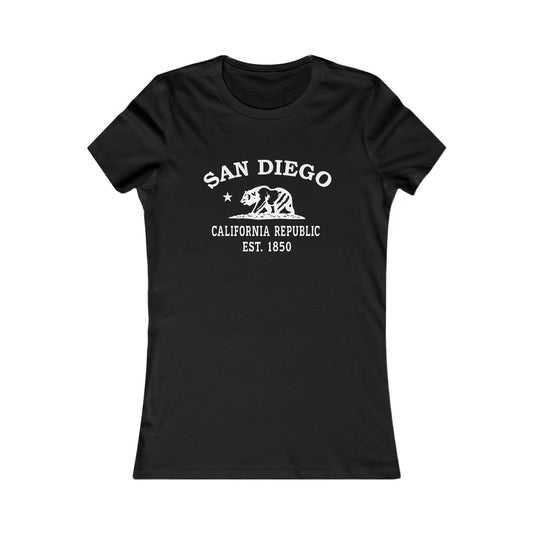
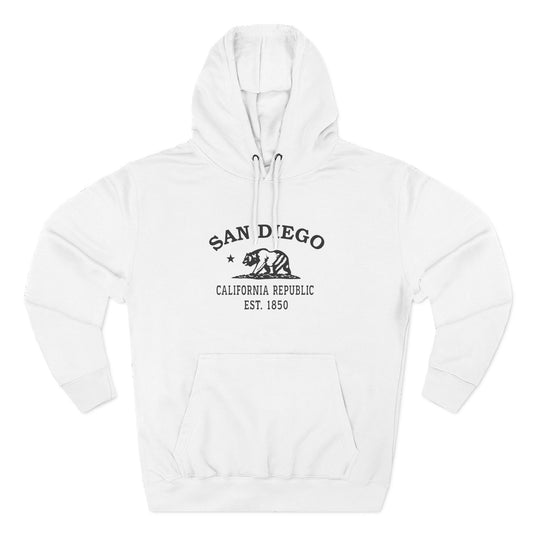
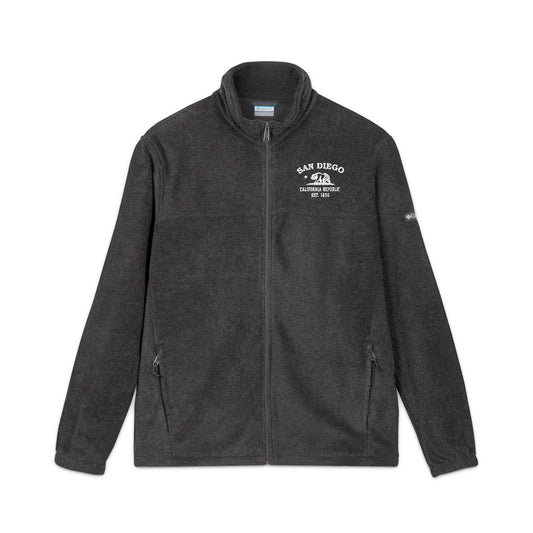
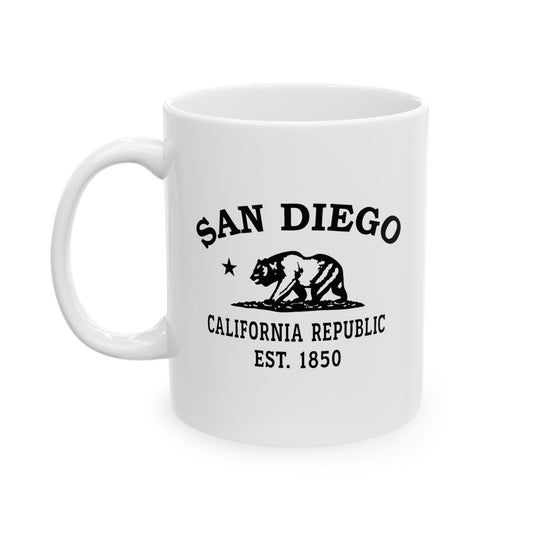
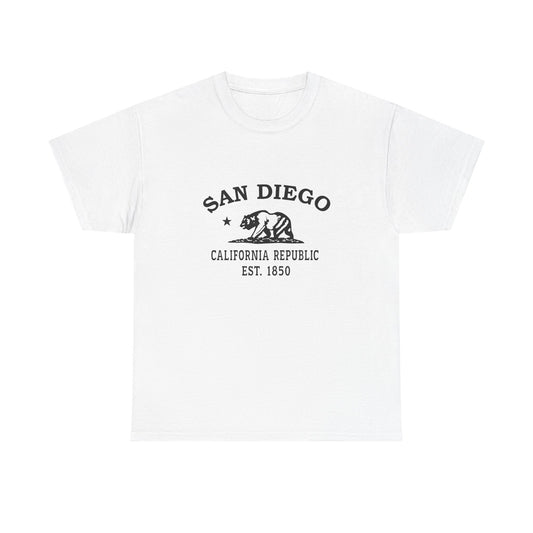
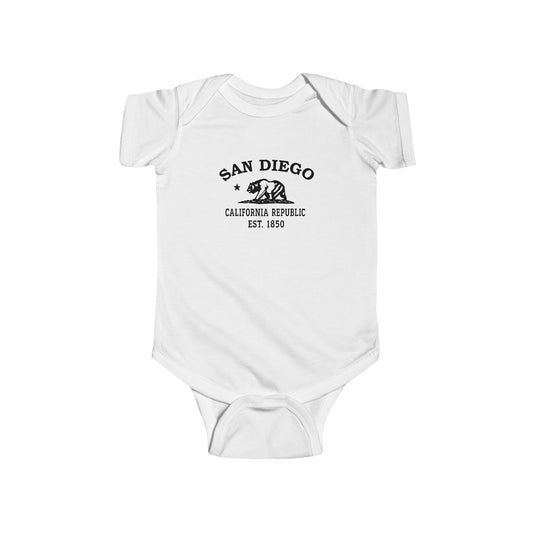
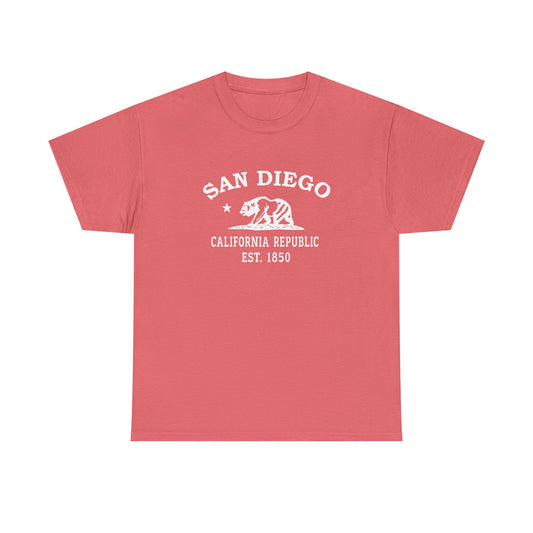
Our San Diego logo carries the California Republic bear and star above '1850,' the year of statehood — the shared retro emblem of every Merlin Classics California place. Rendered in a worn black-and-white that recalls a WPA poster or an old crate label, the bear-and-star is California in shorthand: tough, independent, and sun-bleached. The bear is the through-line that links San Diego to every other California place we make. What makes this one San Diego is everything around it — the bay and the fleet, Balboa Park's towers, the mission and the presidio, and the Coronado roofline across the water.
Today San Diego is where California began, on a bay that has been America's harbor since 1769. Its story runs from the Kumeyaay homeland and Cabrillo's landing, through the first mission and the New Town on the water, to the Exposition's towers and the Navy fleet that still calls the harbor home. Our San Diego designs gather that identity into wearable form — the bear and star, the bay, and the city that never quite turns the lights off. San Diego, California: where the West Coast story started, on a working harbor.

San Diego, California — Travel Guide
Visiting San Diego Today
San Diego spreads around its bay in mild, sunny stretches of waterfront, park, and beach. The Spanish-Colonial towers of Balboa Park sit just north of downtown, the harbor and Embarcadero line the bay, Point Loma and Coronado guard its mouth, and the coast runs north through La Jolla's coves — most of it reachable on an easy, seventy-degree afternoon.
Balboa Park, the Bay & the Coast
For visitors looking for things to do in San Diego, California:
- Spend a day in Balboa Park — Spanish Colonial Revival towers, gardens, and museums (the free lots fill by mid-morning).
- Catch a free Sunday concert at the Spreckels Organ Pavilion's outdoor pipe organ.
- Walk the Embarcadero along the bay, past the fishing boats of Tuna Harbor and the downtown waterfront.
- Drive out to Cabrillo National Monument on Point Loma for the 1855 lighthouse, tide pools, and harbor views.
- Cross to Coronado for the Victorian turrets of the 1888 Hotel del Coronado and the wide Silver Strand beach.
- Watch the sea lions at La Jolla Cove, then snorkel the underwater park off La Jolla Shores — bright-orange garibaldi, leopard sharks, and the Shell Beach tide pools.
- Wander Old Town's adobes — the Casa de Estudillo in the free state historic park — and the Victorian Gaslamp Quarter.
- Walk Liberty Station on Point Loma, the old Naval Training Center reborn as an arts-and-food district.
- See the murals of Chicano Park in Barrio Logan, a National Historic Landmark beneath the bridge approaches.
- Eat like a local: fish tacos and california burritos from a taco shop, and Little Italy's old fishermen's quarter.
- Hike Cowles Mountain in Mission Trails Regional Park for the city's highest summit, or the bluffs of Torrey Pines State Natural Reserve.
Why People Visit San Diego
San Diego rewards visitors with a rare mix: deep early-California history, a working Navy harbor, great parks, and miles of Pacific coast under a famously mild sky. People come for Balboa Park and the bay, the beaches and Point Loma sunsets, and the story of the city where California began — historic, easygoing, unmistakably Californian.
Wear the History
Where you're from. Where you love. Where you explored. Where you belong.
Kindred Cities
Welcome, friends from Yokohama, Japan (ようこそ), Jeonju, South Korea (환영합니다), Tijuana, Mexico (bienvenidos) and San Diego's sister cities beyond.
San Diego made Yokohama its very first sister city, and the friendship shows all over town: the Yokohama Friendship Bell on Shelter Island, the Japanese Friendship Garden in Balboa Park, even zoo animals traded between them. Jeonju brings the crafts and cuisine of Korea; Tijuana, minutes south, is less a sister than a twin across the line. A border city at home with the whole Pacific.
Yokohama has been San Diego's sister since 1957, among the first such ties on the West Coast — sealed by the Friendship Bell in 1958 and a garden in Balboa Park, with koalas and other creatures exchanged between their zoos over the years.
Come from any of them and San Diego will hand you the good life: the bay and the beaches, Balboa Park and its world-famous zoo, fish tacos and a border culture that makes the city feel like two countries at once. Come and visit us soon.
When you plan the trip, the San Diego Tourism Authority is the place to start.
Wear the History
Where you're from. Where you love. Where you explored. Where you belong.

For deeper reading on the San Diego history described here — the Kumeyaay (Tipai-Ipai) homeland, Cabrillo's 1542 landing and Vizcaíno's 1602 naming of the bay, the 1769 founding of the Presidio and Mission San Diego de Alcalá and the 1775 Kumeyaay uprising, the Mexican rancho era, the 1850 incorporation and Alonzo Horton's 1867 New Town, the 1915–16 Panama-California Exposition and Balboa Park, and the twentieth-century Navy, tuna-fleet, and aviation buildout — it may be useful to consult (1) the San Diego History Center in Balboa Park, (2) the San Diego Public Library's California Room, (3) the California State Archives and the California Historical Society, (4) the Kumeyaay community and tribal cultural resources, and (5) the National Park Service for Cabrillo National Monument; for Sally Ride's story, the United States Mint's American Women Quarters Program materials. For travel and visitor information, it may be useful to contact (1) the San Diego Tourism Authority, (2) the Balboa Park visitor center, (3) the City of San Diego Parks and Recreation Department, (4) California State Parks, and (5) the regional transit and airport information desks.
Shop the San Diego California collection
View full collection-
San Diego California Vintage Retro Premium Crewneck Sweatshirt - Black Logo
Regular price $48.00 USDRegular price -
San Diego California Vintage Retro Premium Crewneck Sweatshirt - White Logo
Regular price $48.00 USDRegular price -
-
Whitewater Run - Silhouette Art Giclée Unframed Art Print
Regular price From $34.00 USDRegular price -
Whitewater Run - Silhouette Art Framed Art Print
Regular price From $96.00 USDRegular price -
San Diego California Vintage Retro Unisex Heavy Cotton Hoodie - Black Logo
Regular price $56.00 USDRegular price -
San Diego California Vintage Retro Unisex Embroidered Fleece Jacket - White Logo
Regular price $98.00 USDRegular price -
Whitewater Walk - Silhouette Art Framed Art Print
Regular price From $96.00 USDRegular price -
Whitewater Charge - Silhouette Art Giclée Unframed Art Print
Regular price From $34.00 USDRegular price -
San Diego California Vintage Retro Vinyl Sticker - Black Logo
Regular price From $6.00 USDRegular price -
San Diego California Vintage Retro Ceramic Mug - Black Logo
Regular price From $16.00 USDRegular price -
Whitewater Charge - Silhouette Art Framed Art Print
Regular price From $96.00 USDRegular price -
Three Dogs, Still Water - Silhouette Art Giclée Unframed Art Print
Regular price From $44.00 USDRegular price -
San Diego California Vintage Retro Unisex Heavy Cotton Tee - Black Logo
Regular price $22.00 USDRegular price -
San Diego California Vintage Retro Cotton Jersey Baby Bodysuit - Black Logo
Regular price $26.00 USDRegular price -
Whitewater Leap - Silhouette Art Framed Art Print
Regular price From $96.00 USDRegular price -
Shoreline Gathering - Silhouette Art Giclée Unframed Art Print
Regular price From $44.00 USDRegular price -
San Diego California Vintage Retro Back Printed Art Series Cotton Tee - Black Logo
Regular price $32.00 USDRegular price -
San Diego California Vintage Retro Giclée Print Art Series Poster
Regular price From $38.00 USDRegular price -
Three Dogs, Still Water - Silhouette Art Framed Art Print
Regular price From $112.00 USDRegular price -
Quiet Walk, Black Water - Silhouette Art Giclée Unframed Art Print
Regular price From $34.00 USDRegular price -
San Diego California Classic Embroidered Vintage Retro Cotton Cap - White Logo
Regular price $32.00 USDRegular price -
San Diego California Vintage Retro Unisex Heavy Cotton Tee - White Logo
Regular price $22.00 USDRegular price -
Small Steps - Silhouette Art Framed Art Print
Regular price From $112.00 USDRegular price