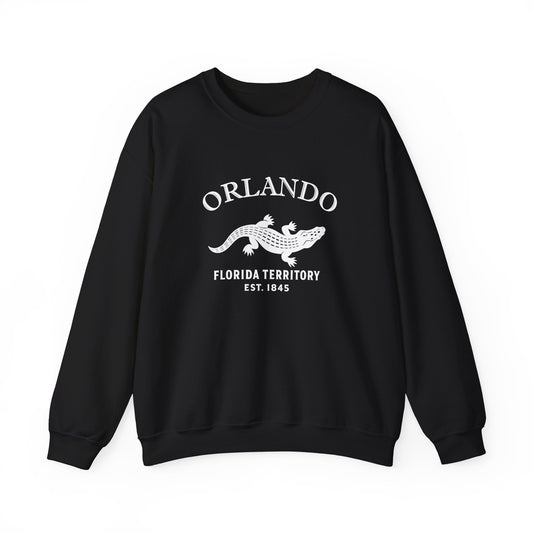
Orlando Florida — Retro Vintage History
What's with everyone expecting Disney? Say "Orlando" and most people picture the theme parks — and that is genuinely part of the fun. But the parks are the newest chapter of a much richer place. Greater Orlando was drawing presidents, world-class art, and Florida's first four-year college long before the castles ever lit up, and the best surprise of all sits just two miles north of downtown, in a separate little city called Winter Park. Start the story there and it only gets better — a lost palace, rescued treasure, and a whole quieter Orlando most visitors never plan for.
Wear the HistoryWhat's with the peacocks in Winter Park? Just north of downtown Orlando, the city of Winter Park keeps peacocks — they roam its brick-street neighborhoods and appear on the city seal, and hardly anyone remembers why. The answer runs a thousand miles north, to a burned palace on Long Island, and it is the reason the Orlando area holds the finest collection of American stained glass anywhere.
The story belongs to Louis Comfort Tiffany, the jeweler's son who chose colored light over the family name. Between 1902 and 1905, on the North Shore of Long Island at Laurel Hollow near Oyster Bay, Tiffany built Laurelton Hall — an eighty-four-room house he designed down to the last fountain and pane of glass, ringed by gardens above Cold Spring Harbor and crowned by a minaret. He kept peacocks there and threw famous feasts. After his death the estate faltered; its contents were auctioned in 1946, and in 1957 fire gutted the long-abandoned house.
What survived came south. Hugh and Jeannette McKean — she the granddaughter of Charles Hosmer Morse, the industrialist who had shaped modern Winter Park after becoming its largest landowner in 1904 — drove to the ruins and saved what they could. Jeannette had founded the Morse Gallery of Art in Winter Park in 1942; the rescued Tiffany glass became the heart of what is today the Charles Hosmer Morse Museum of American Art on Park Avenue, whose treasures include the Daffodil Terrace and the chapel Tiffany designed for the 1893 World's Fair. The peacocks that strut Winter Park's streets are descendants of the birds the McKeans brought home — a living thread back to Laurelton Hall.
Winter Park itself is the older, quieter Orlando: Park Avenue's brick shops and sidewalk cafés, Rollins College on Lake Virginia, Central Park under its oaks, and a scenic boat tour that threads a chain of lakes past lakeshore gardens. It was built as a winter resort in the 1880s by New Englanders who named the streets for the states they left, and it has kept that graceful, tree-shaded calm ever since — two miles and a world away from the theme parks.
What's with the swans on Lake Eola? Cross back into Orlando proper, and its own oldest identity is just as quiet as the parks are loud. In the middle of downtown sits Lake Eola — a deep little lake with a fountain at its heart and white swans gliding across the water, ringed by century-old oaks and brick streets. The swans are the city's oldest symbol, the very picture of "The City Beautiful," Orlando's official nickname. The Seminole people knew this lake country long before European settlement; cattle pioneer Aaron Jernigan became the first permanent settler in 1843, and the frontier outpost was named Orlando around 1857 — by local lore for a sentinel named Orlando Reeves, or, some say, for Shakespeare's "As You Like It." In 1875 the Town of Orlando was incorporated with about eighty-five residents, a courthouse town on the Central Florida cattle frontier.

Once the South Florida Railroad arrived in 1880 — the same line that fed the young resort of Winter Park up the track — Orlando became the heart of Florida's citrus country. Through the "Golden Era" of the 1880s and early 1890s, orange groves spread across the flatlands and the crate labels of the day turned Orlando oranges into a brand. Men like Jacob Summerlin, the "Cattle King of Florida," carried the cattle-and-citrus story into the new city. Then the Great Freeze of 1894-95 devastated the groves and ended the boom — but the citrus identity, and that bright orange-crate-label look, never left. Orlando's older downtown still holds it: "Old Orlando" along Orange Avenue, the 1889 Church Street depot, and the historic neighborhoods around Lake Eola like Lake Eola Heights and Thornton Park, all under the oaks that give the City Beautiful its name.
And then, in 1971, the theme parks arrived, and the world's picture of Orlando changed overnight. It brought the crowds, the wonder, and a global fame few cities ever know — a chapter worth celebrating in its own right. But the older greater Orlando never went anywhere. It simply carried on beneath the fame: the swans still glide, the peacocks still roam Winter Park, and Tiffany's rescued light still glows on Park Avenue.

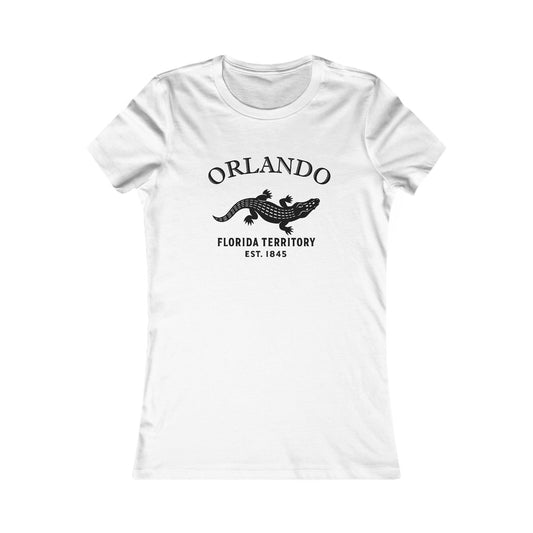
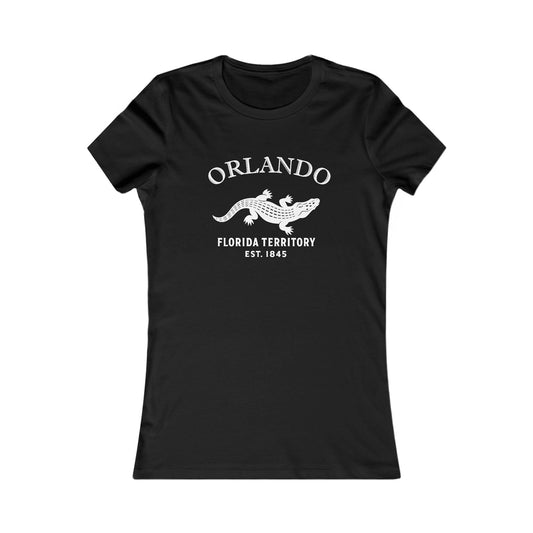
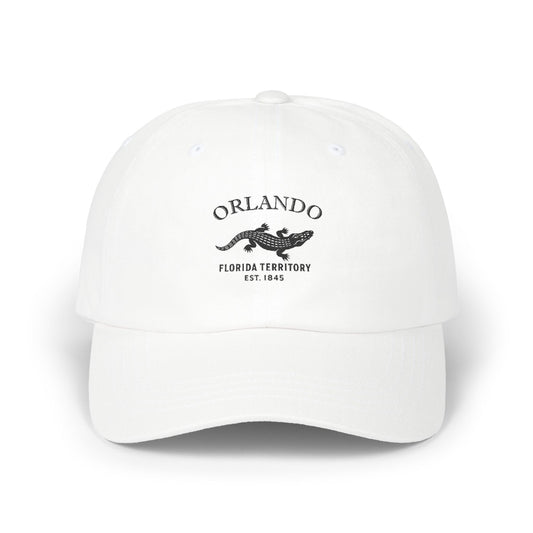
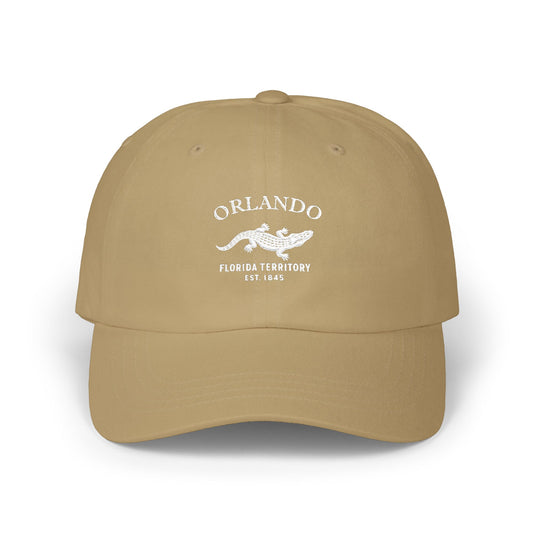
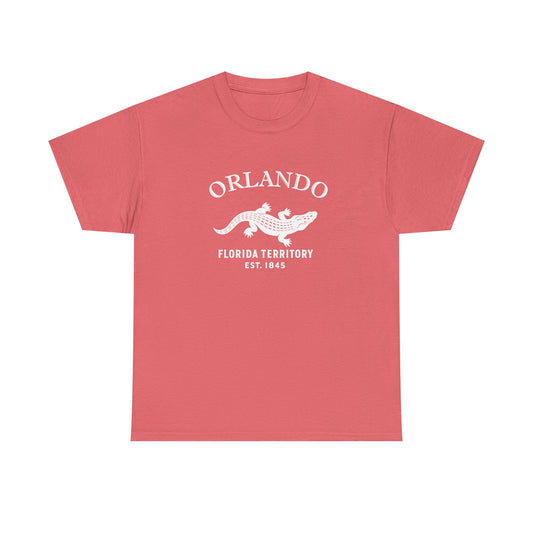
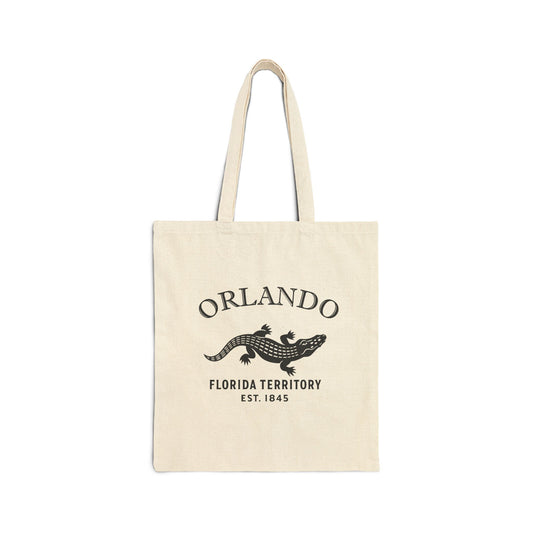
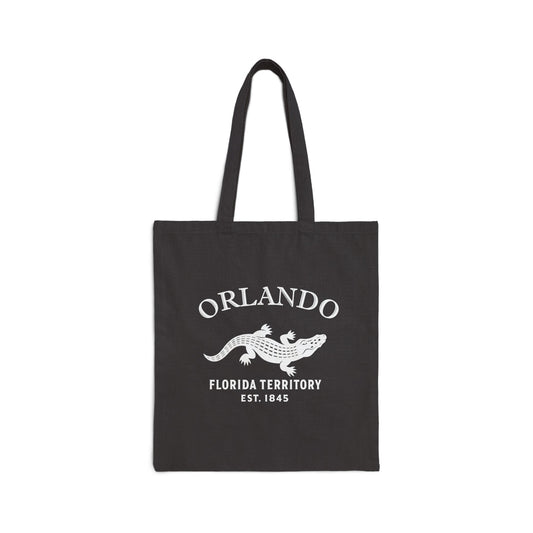
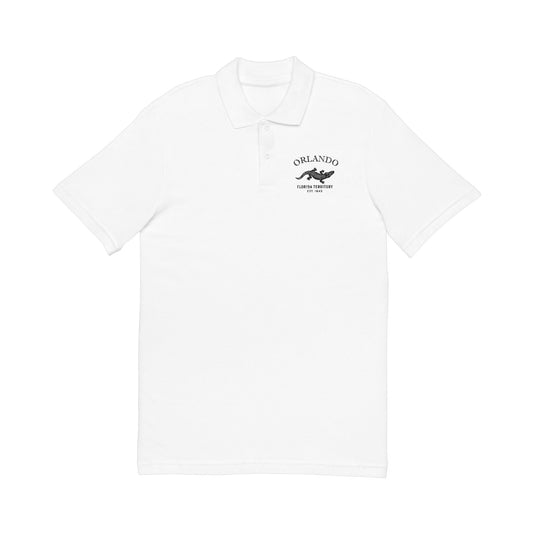
Our Orlando logo carries Florida's alligator over "Florida Territory · Est. 1845," the year Florida joined the Union — the shared emblem of every Merlin Classics Florida place. Printed black-and-white with the worn look of an old citrus-crate stamp, the gator reads as wild Florida in shorthand: tough, sun-baked, and unmistakably of the place. What makes this one Orlando is the country behind it — Lake Eola, the swans, the orange groves of the City Beautiful, and the whole rich metro that surrounds it, from Winter Park's Tiffany glass to the theme parks that made the name famous.
Today "Orlando" means the world to travelers, but its oldest identities are the quiet ones: a lake-dotted City Beautiful with swans on the water and orange country at its back, and a tree-shaded Winter Park two miles north where a jeweler's rescued light still burns. Our Orlando designs gather that heritage — the gator-and-1845 emblem, Lake Eola, and the citrus Golden Era — into wearable form, with a proud nod to the whole greater-Orlando story. Wear the history, and carry a little of it home.
Greater Orlando & Winter Park, Florida — Travel Guide
Visiting Greater Orlando Today
Beyond the famous attractions, greater Orlando rewards slower days — lakeside parks and historic downtowns in the city itself, and, two miles north, the brick avenues, gardens, and world-class Tiffany glass of Winter Park. Together they make an easy pairing: the City Beautiful by day's start, Park Avenue by afternoon.
In Orlando — Lake Eola, Old Orlando & the City Beautiful
For visitors looking for things to do in Orlando, Florida:
- Circle Lake Eola on the paved loop, with the fountain, the swans, and swan-shaped paddle boats.
- Wander historic "Old Orlando" downtown — Orange Avenue, brick streets, and century-old oaks.
- Visit the 1889 Church Street depot and the surrounding historic district.
- Explore the lakeside historic neighborhoods like Lake Eola Heights and Thornton Park.
- Stroll the city's gardens and lakefront parks, the green heart of the City Beautiful.
In Winter Park — Park Avenue, the Morse Museum & Tiffany's Laurelton Glass
For visitors looking for things to do in Winter Park, Florida:
- See the Charles Hosmer Morse Museum of American Art on Park Avenue — home to Louis Comfort Tiffany's rescued Laurelton Hall glass, the reassembled 1893 Tiffany Chapel, and the Daffodil Terrace.
- Stroll Park Avenue's brick sidewalks — shops, galleries, cafés, and the oaks of Central Park.
- Take the Winter Park Scenic Boat Tour through the chain of lakes, past lakeshore estates and gardens.
- Visit the campus of Rollins College on Lake Virginia, Florida's first four-year college (1885).
- Wander Kraft Azalea Garden and Mead Botanical Garden, and time a visit to the Winter Park Sidewalk Art Festival if it's the season.
- Keep an eye out for the peacocks — the living legacy of Laurelton Hall, roaming the neighborhoods.
Why People Visit Greater Orlando
The world comes to Orlando for its attractions, but its enduring charm is everything around them: lakes, oaks, swans, and a citrus-country past in the city itself, and a Winter Park two miles north that holds the finest Tiffany glass on earth. Visitors who slow down find gardens, historic downtown streets, lakefront paths, and a rescued palace's worth of colored light — a whole greater Orlando that feels a world away from the crowds.
Wear the History
Kindred Cities
Welcome, friends from Urayasu (ようこそ) and Seine-et-Marne (bienvenue) — fellow homes of the Magic Kingdom abroad — and a warm hello to our nearer kin in Winter Park, Florida, and Laurel Hollow, New York.
Orlando's two formal sister ties share an unmistakable common thread: each is home to a Disney resort. Urayasu, on Tokyo Bay, hosts Tokyo Disneyland — the first Disney park built outside America, on land that was a humble Edo fishing village within living memory. Seine-et-Marne, east of Paris, holds Disneyland Paris, and the royal château of Fontainebleau besides. Orlando linked with Urayasu in 1989 and with Seine-et-Marne in 1991 — three corners of a global theme-park family, and three places the world travels to for the same kind of wonder.
Closer to home, two kindred places round out our story. Winter Park, Florida, is greater Orlando's cultured neighbor — Park Avenue, Rollins College, and the Morse Museum's rescued Tiffany glass — the older, quieter half of the same metro. And Laurel Hollow, New York, on Long Island's Gold Coast near Oyster Bay, is where it all began: the site of Tiffany's Laurelton Hall above Cold Spring Harbor, the lost palace whose surviving glass, and whose peacocks, found a second home in Winter Park. From a Long Island harbor to a Florida park, the same light still travels.
Greater Orlando repays every kind of visitor — theme-park wonder and citrus-country calm, swans on Lake Eola and Tiffany glass on Park Avenue, all under the same warm Central Florida sun. Come and visit us soon.
When you plan the trip, Visit Orlando is the place to start.
Wear the History

For deeper reading on the greater-Orlando history described here — the Seminole-frontier and cattle-pioneer era, the naming legend, the citrus Golden Era and the Great Freeze, "Old Orlando" downtown, and Winter Park's story of Rollins College, Charles Hosmer Morse, and the Tiffany glass the McKeans rescued from Laurelton Hall — it may be useful to consult (1) the Orange County Regional History Center and the Winter Park History Museum, (2) the Orlando Public Library and Winter Park Public Library local-history collections, (3) the Charles Hosmer Morse Museum of American Art and the Rollins College archives, (4) the State Library and Archives of Florida and the Florida Historical Society, and (5) for the Laurelton Hall origin, the Oyster Bay Historical Society and the Long Island Gold Coast estate collections. For travel and visitor information, it may be useful to contact (1) Visit Orlando and the Winter Park Welcome Center, (2) the regional chambers of commerce, (3) the City of Orlando and City of Winter Park parks departments, (4) the Florida State Parks office, and (5) NWS Melbourne advisories during hurricane and summer-storm season.
Shop the Orlando Florida collection
View full collection-
Orlando Florida Vintage Retro Premium Crewneck Sweatshirt - Black Logo
Regular price $48.00 USDRegular price -
Orlando Florida Vintage Retro Premium Crewneck Sweatshirt - White Logo
Regular price $48.00 USDRegular price -
Orlando Florida Vintage Retro Womens Fitted Ringspun Cotton Tee - Black Logo
Regular price $28.00 USDRegular price -
-
Orlando Florida Vintage Retro Embroidered Cotton Cap - Black Logo
Regular price $32.00 USDRegular price -
Orlando Florida Vintage Retro Embroidered Cotton Cap - White Logo
Regular price $32.00 USDRegular price -
Orlando Florida Vintage Retro Vinyl Sticker - Black Logo
Regular price From $6.00 USDRegular price -
Orlando Florida Vintage Retro Unisex Heavy Cotton Hoodie - Black Logo
Regular price $56.00 USDRegular price -
Orlando Florida Vintage Retro Unisex Heavy Cotton Hoodie - White Logo
Regular price $56.00 USDRegular price -
Orlando Florida Vintage Retro Unisex Heavy Cotton Tee - Black Logo
Regular price $22.00 USDRegular price -
Orlando Florida Vintage Retro Unisex Heavy Cotton Tee - White Logo
Regular price $22.00 USDRegular price -
Orlando Florida Vintage Retro Cotton Canvas Tote Bag - Black Logo
Regular price $25.00 USDRegular price -
Orlando Florida Vintage Retro Cotton Canvas Tote Bag - White Logo
Regular price $25.00 USDRegular price -
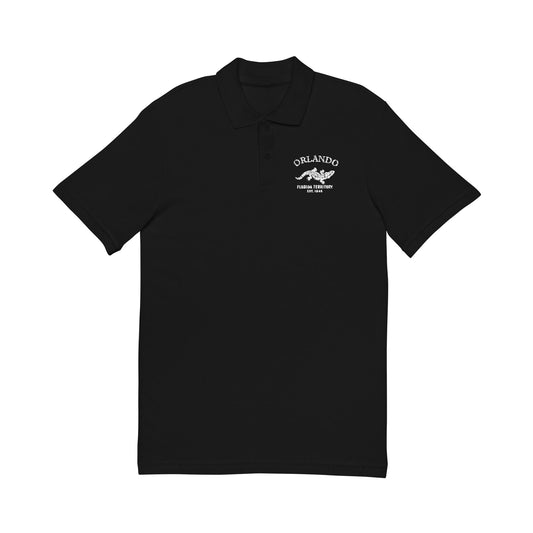
Orlando Florida Vintage Retro Unisex Embroidered Cotton Polo - Black Logo
Regular price $48.00 USDRegular price -
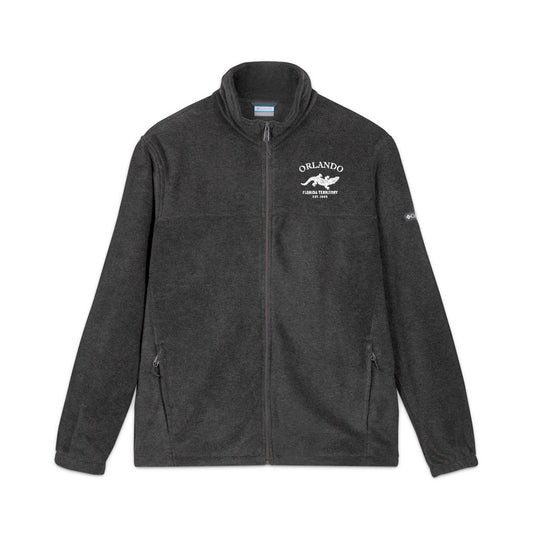
Orlando Florida Vintage Retro Unisex Embroidered Fleece Jacket - White Logo
Regular price $98.00 USDRegular price -
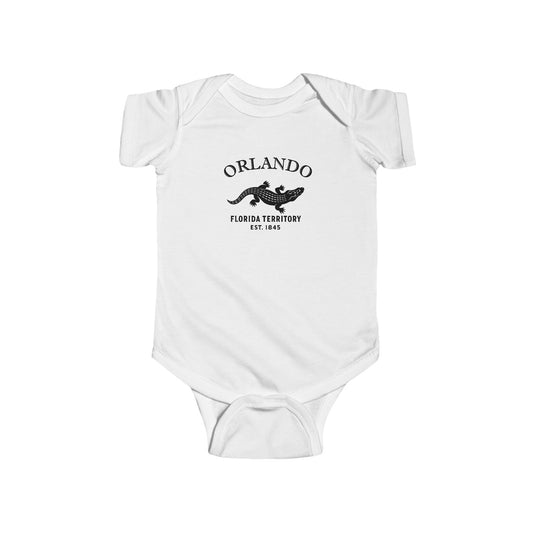
Orlando Florida Vintage Retro Cotton Jersey Baby Bodysuit - Black Logo
Regular price $26.00 USDRegular price -
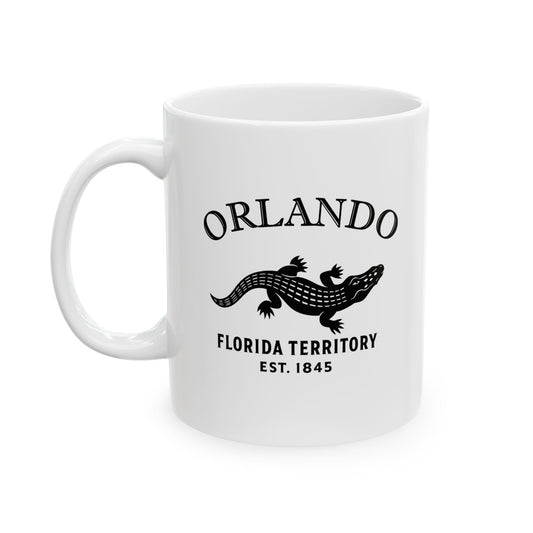
Orlando Florida Vintage Retro Ceramic Mug - Black Logo
Regular price From $16.00 USDRegular price -
Orlando Florida Vintage Retro Thank You Card Set - Black Logo
Regular price From $25.00 USDRegular price -
Orlando Florida Vintage Retro Unisex Cotton Jersey Tank Top - White Logo
Regular price $28.00 USDRegular price -
Orlando Florida Vintage Retro Unisex Cotton Jersey Tank Top - Black Logo
Regular price $28.00 USDRegular price -
Orlando Florida Vintage Retro Unisex Heavy Crewneck Sweatshirt - Black Logo
Regular price $44.00 USDRegular price -
Orlando Florida Vintage Retro Unisex Heavy Crewneck Sweatshirt - White Logo
Regular price $44.00 USDRegular price