Noank Connecticut — Retro Vintage History
What's with the village that built America's wooden ships? On a steep little peninsula at the mouth of the Mystic River — water on three sides, barely two square miles — the Palmer Brothers Shipyard grew, by the mid-to-late 1800s, into the largest builder of wooden ships in the United States. Three hundred men worked the ways, turning out everything from fishing smacks to Long Island Sound steamers — by some counts six hundred to a thousand vessels in all. It is an unlikely thing for a village this small, and it is the heart of Noank's story: a working harbor that once launched more wooden hulls than anywhere in America.
Wear the HistoryLong before the shipyards, the point belonged to the Pequot, who knew it as Nauyang — 'point of land' — and used it as a summer fishing and camping ground, documented here as early as 1614. The Pequot were forced from this coast in 1655, in the aftermath of the Pequot War; the removal was a dispossession, and it should be named as one. The village still carries the Pequot name it was given, and the Mashantucket and Eastern Pequot nations remain part of southeastern Connecticut today. Noank's story begins on Pequot ground.
The peninsula passed into colonial hands in 1712, acquired by James Morgan through a land lottery; the earliest surviving house, the Yeomans place on Palmer Cove, dates to about 1713. Growth was slow — there were still only a handful of houses by the 1820s — because the point was nearly an island, cut off to the northwest and open to the water everywhere else. It kept the isolated, end-of-the-road feeling that the village has never quite lost.

Everything changed around 1850, when the Palmer brothers, John and Robert, established their shipyard and Noank found its calling. The yard built the famous 'Noank smack' — a fast, able fishing sloop native to the village — and one of them, the Emma C. Berry of 1866, survives today as a National Historic Landmark, the oldest commercial sailing vessel of her kind still afloat. The C. H. Mallory and Spicer steamship interests added to the bustle from 1861. For a few decades a tiny Connecticut point was a genuine center of American shipbuilding.
Around the yards grew a fishing village. Noank ran a fleet of more than sixty vessels, many of them share-owned by the families who crewed them, and the harbor filled with the work of fishing, oystering, and lobstering. A velvet mill opened in 1905; the Connecticut State Lobster Hatchery took root around 1912; and the lobster shacks that still steam at the water's edge carry the same trade forward. Noank has always made its living from the Sound.
The village that the shipwrights and fishing families built is remarkably intact. The Noank Historic District — listed on the National Register in 1979 — preserves a dense run of mid-to-late nineteenth-century cottages in Greek Revival, Gothic, and Stick-Eastlake styles, lining the winding lanes of the point with picturesque woodwork and iron fences. The Noank Baptist Church of 1867 still crowns the high ground, though its twin towers were lost in the great hurricane of 1938. And every year since 1876 the village has held one of the longest continuously running Memorial Day parades in the country.
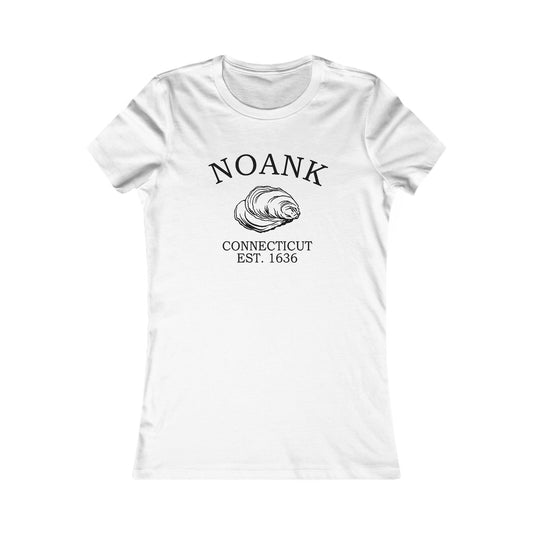
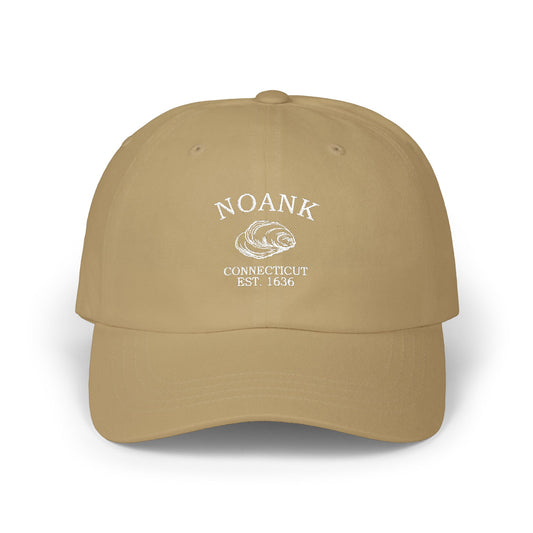
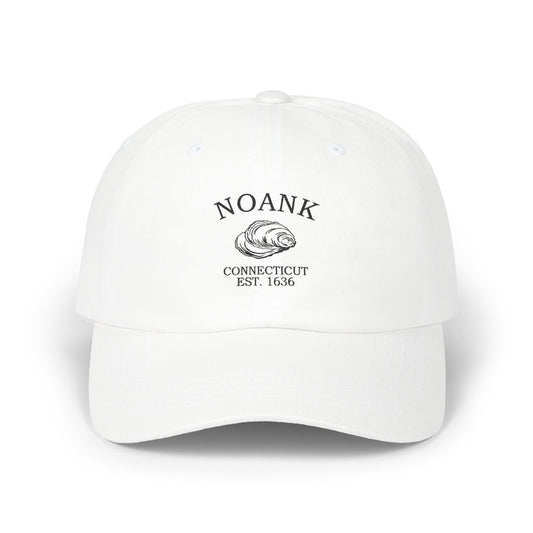
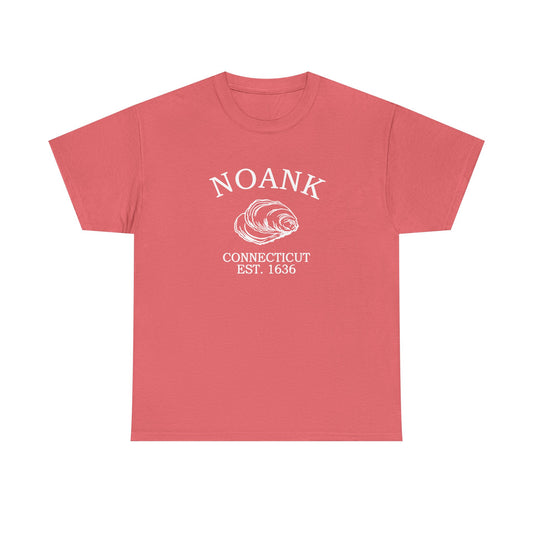
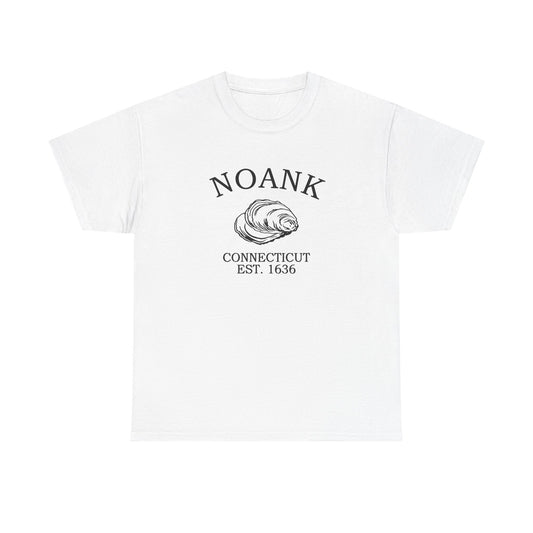
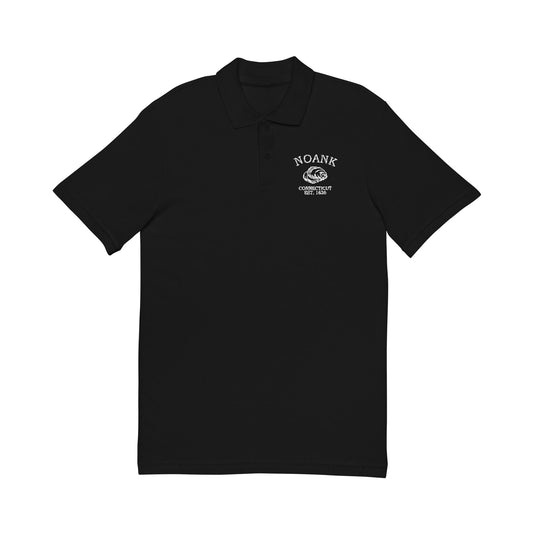
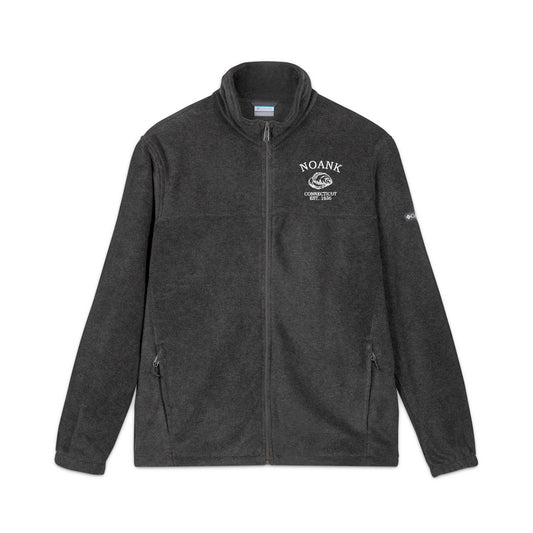
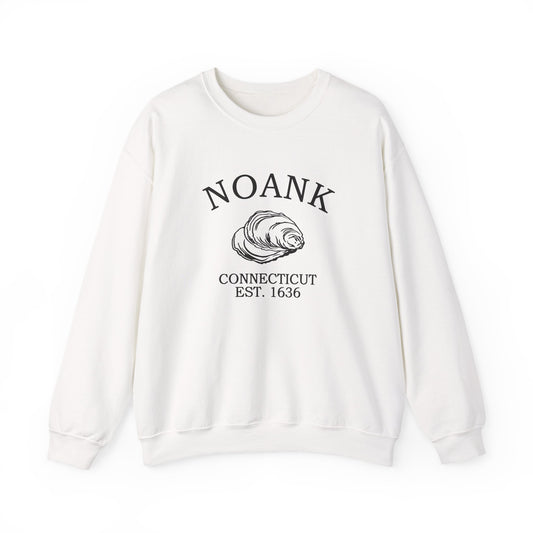
Our Noank logo carries the Connecticut shoreline's oyster above 'Est. 1636,' the year of Connecticut's colonial founding — the shared retro emblem of every Merlin Classics Connecticut place. Drawn in a worn black-and-white that recalls an old oyster-crate label, the oyster is the shoreline in shorthand: briny, working, and unpretentious. The oyster is the through-line that links Noank to every other Connecticut place we make. What makes this one Noank is everything around it — the Palmer yard and the smack, the harbor and the lobster shacks, the cottages and the steeple on the point.
Today Noank is a working harbor at the end of the point, where the Mystic River meets Fishers Island Sound. Its story runs from the Pequot ground it was taken from, through the Morgan lottery and the slow early years, to the Palmer yard that made it a shipbuilding town and the fishing village it has remained. Our Noank designs gather that identity into wearable form — the oyster, the harbor, and the quiet of a village at the end of the road. Noank, Connecticut: a working harbor where the river meets the Sound.

Noank, Connecticut — Travel Guide
Visiting Noank Today
Noank is a small, walkable harbor village on a peninsula at the mouth of the Mystic River, within the town of Groton. Boatyards and marinas line the water, historic cottages climb the lanes to the Baptist-church steeple, and a beach and a lighthouse view sit a short way off — a compact, salt-worn shoreline village best taken slowly, on foot.
The Harbor, the Historic District & the Point
For visitors looking for things to do in Noank, Connecticut:
- Relax at Esker Point Beach, with its gentle sand and a broad view over Fishers Island Sound.
- Walk the working waterfront at the Noank Shipyard and the village marinas, on the historic Palmer yard site.
- Look out to Morgan Point Lighthouse, the 1860s light at the mouth of the Mystic River (a private home — admire it from the village).
- Wander the Noank Historic District's lanes of 19th-century shipyard-worker cottages up to the 1867 Baptist church.
- Stop in at the Latham-Chester Store, home of the Noank Historical Society's local-history collection.
- Settle in at one of the village's seaside lobster shacks for a meal right at the water's edge.
Why People Visit Noank
Noank rewards visitors who like their shoreline quiet and real — a working harbor instead of a boardwalk, a dense historic village instead of a strip. People come for the boatyards and the lobster shacks at the water's edge, for the walk through the cottage-lined historic district, and for the view out to the Sound from the end of the point. It is peaceful, photogenic, and unmistakably a Connecticut fishing village.
Wear the History

For deeper reading on the Noank history described here — the Pequot 'Nauyang' and the 1655 displacement following the Pequot War, the 1712 Morgan land lottery and the early farms, the Palmer Brothers Shipyard and the 'Noank smack' (including the 1866 Emma C. Berry), the Mallory and Spicer steamship interests, the fishing-and-lobstering economy and the Connecticut State Lobster Hatchery, and the 1979 National Register historic district — it may be useful to consult (1) the Noank Historical Society and the Latham-Chester Store, (2) the Mystic & Noank Library, (3) the Connecticut State Library and State Archives, (4) the Mashantucket Pequot Museum and Research Center for Pequot history, and (5) Mystic Seaport Museum, where the Emma C. Berry is preserved. For travel and visitor information, it may be useful to contact (1) the Town of Groton, (2) the Mystic Coast & Country / regional tourism office, (3) Connecticut State Parks, (4) the Groton parks and recreation department, and (5) the regional transit and visitor-information desks.
Shop the Noank Connecticut collection
View full collection-
Noank Connecticut Vintage Retro Premium Crewneck Sweatshirt - Black Logo
Regular price $48.00 USDRegular price -
Noank Connecticut Vintage Retro Premium Crewneck Sweatshirt - White Logo
Regular price $48.00 USDRegular price -
-
Noank Connecticut Vintage Retro Womens Fitted Ringspun Cotton Tee - Black Logo
Regular price $28.00 USDRegular price -
Noank Connecticut Vintage Retro Embroidered Cotton Cap - White Logo
Regular price $32.00 USDRegular price -
Noank Connecticut Vintage Retro Embroidered Cotton Cap - Black Logo
Regular price $32.00 USDRegular price -
Noank Connecticut Vintage Retro Unisex Heavy Cotton Hoodie - White Logo
Regular price $56.00 USDRegular price -
Noank Connecticut Vintage Retro Unisex Heavy Cotton Hoodie - Black Logo
Regular price $56.00 USDRegular price -
Noank Connecticut Vintage Retro Unisex Heavy Cotton Tee - White Logo
Regular price $22.00 USDRegular price -
Noank Connecticut Vintage Retro Unisex Heavy Cotton Tee - Black Logo
Regular price $22.00 USDRegular price -
Noank Connecticut Vintage Retro Unisex Embroidered Cotton Polo - Black Logo
Regular price $48.00 USDRegular price -
Noank Connecticut Vintage Retro Unisex Embroidered Fleece Jacket - White Logo
Regular price $98.00 USDRegular price -
Noank Connecticut Vintage Retro Back Printed Art Series Cotton Tee - Black Logo
Regular price $32.00 USDRegular price -
Noank Connecticut Vintage Retro Giclée Print Art Series Poster
Regular price From $38.00 USDRegular price -
Noank Connecticut Vintage Retro Vinyl Sticker - Black Logo
Regular price From $6.00 USDRegular price -
Noank Connecticut Vintage Retro Ceramic Mug - Black Logo
Regular price From $16.00 USDRegular price -
Noank Connecticut Vintage Retro Cotton Canvas Tote Bag - White Logo
Regular price $25.00 USDRegular price -
Noank Connecticut Vintage Retro Cotton Canvas Tote Bag - Black Logo
Regular price $25.00 USDRegular price -
Noank Connecticut Vintage Retro Thank You Card Set - Black Logo
Regular price From $25.00 USDRegular price -
Noank Connecticut Vintage Retro Cotton Jersey Baby Bodysuit - Black Logo
Regular price $26.00 USDRegular price -
Noank Connecticut Vintage Retro Unisex Cotton Jersey Tank Top - Black Logo
Regular price $28.00 USDRegular price -
Noank Connecticut Vintage Retro Unisex Cotton Jersey Tank Top - White Logo
Regular price $28.00 USDRegular price -
Noank Connecticut Vintage Retro Unisex Heavy Crewneck Sweatshirt - Black Logo
Regular price $44.00 USDRegular price