Key Largo Florida — Retro Vintage History
What's with Key Largo? Key Largo is the gateway of the Florida Keys — first island down the Overseas Highway, self-styled Diving Capital of the World, and home of America's first undersea park. It runs thirty-three green-water miles toward Key West, took its name from Spanish charts and its fame from a 1948 Bogart film — and has been trading happily on both ever since.
Wear the HistoryWhere you're from. Where you love. Where you explored. Where you belong.
The name came long before the fame. Spanish sailors called the island Cayo Largo — "long key" — and the name appears on charts as far back as a 1639 Dutch map. Calusa and Tequesta peoples knew these islands for centuries before that, fishing the flats and moving between the mangrove shores; later came wreckers, salvaging cargo off the reef that would one day make the island famous for gentler reasons.

The farming century is the island's least-remembered chapter. Through the late 1800s and early 1900s, Key Largo grew pineapples and key limes for northern markets, and mule wagons hauled the crop to packing houses by the landings. The little settlement at the island's heart went by Rock Harbor — a name that would last until Hollywood intervened. Hurricanes, competition, and blight wound the plantations down, but the key lime never left the Keys; it just moved from the groves into the pie.
QUICK FACTS — KEY LARGO, FL
Key Largo is the first and largest of the Florida Keys — thirty-three miles long, the gateway where the Overseas Highway begins.
The name is Spanish — Cayo Largo, "long key" — and appears on charts as far back as a 1639 Dutch map.
The island's farming era grew pineapples and key limes; the settlement at its heart was called Rock Harbor.
Flagler's Overseas Railroad crossed Key Largo on its way to Key West in 1912; the 1935 Labor Day hurricane ended the line.
The Overseas Highway opened on the railroad's path in 1938 — U.S. 1, running the length of the Keys.
On June 1, 1952, Rock Harbor renamed itself Key Largo, trading on the fame of the 1948 film of that name.
John Pennekamp Coral Reef State Park, created in 1960, was the first undersea park in the United States.
The bronze Christ of the Abyss has stood in twenty-five feet of water off Key Largo Dry Rocks since 1965.
What's with the Blue Holes of Key Largo? Out on the flats, the water is so clear and thin that shapes on the bottom look closer than they are, and every patch of dark sand reads like a hidden pocket. Blue Holes is the nickname for those sudden dips and hollows in the seafloor, little bowls where sea grass parts and the color deepens, making snorkelers pause. A quick cue is the blue-spot rule: if a circle turns navy inside turquoise, you found a deeper pocket or channel edge and you move carefully. That is depth and light, not anything spooky. In calm sun, the shallows hold these dark ovals like punctuation in a bright sentence.
Henry Flagler's Overseas Railroad — the "railroad that went to sea" — crossed Key Largo on its way down the chain, and the first train ran through to Key West in 1912. For two decades the island sat on one of the boldest rail lines ever built in America, until the Labor Day hurricane of 1935 — the strongest ever to strike the United States — tore out the line below. The railroad never ran again; the Overseas Highway opened along its path in 1938, and U.S. 1 has carried the Keys' traffic ever since.
Then came the strangest turn in the island's story: it renamed itself after a movie. A 1948 film noir borrowed the island's name for a storm-lashed hotel drama, and the picture became a classic. On June 1, 1952, the Rock Harbor post office made it official — the town would be Key Largo, trading on a fame the island had technically lent the film in the first place. The loop closed again in 1982, when the actual African Queen — the 1912 steam launch from the 1951 river epic, now on the National Register — took up residence in a Key Largo canal, where she still runs visitors today.

The island's greatest treasure was underwater all along. Off Key Largo runs the Florida Reef — the only living coral barrier reef in the continental United States and among the largest reef systems on Earth. In 1960, after years of alarm at coral looting, the state created John Pennekamp Coral Reef State Park — the first undersea park in the United States, named for the Miami editor who fought for it. Since 1965 the park's emblem has been the bronze Christ of the Abyss, standing in twenty-five feet of water off Key Largo Dry Rocks with arms raised toward the surface light.
The park made the island the Diving Capital of the World. Dive shops line the highway; glass-bottom boats, snorkeling tours, and charters work Molasses Reef and the wrecks; and at Jules' Undersea Lodge, guests scuba down to the world's first underwater hotel and sleep beneath the surface. Coral nurseries now work to restore what heat and time have stressed — the island that once mined its reef now replants it.
Away from the reef, Key Largo is a last refuge. The Dagny Johnson Key Largo Hammock Botanical State Park protects one of the largest tracts of West Indian tropical hardwood hammock in the continental United States — home of the Key Largo woodrat, found nowhere else on Earth — and the Florida Keys Wild Bird Center nurses pelicans and herons back to the sky. On the bay side, the island opens onto Florida Bay and the Everglades: Key Largo is the rare town with a national park to its west and America's first undersea park to its east.
Hurricanes remain the island's oldest story — Donna in 1960 ran the Keys end to end, and storms before and since have each taken their toll — but Key Largo's pattern has always been the same: rebuild, replant, reopen. The neon motels and drive-ins of the mid-century boom gave way to dive resorts and marinas, and the island settled into what it is now: the Keys' front door, tourist-bright on the highway and wild a hundred yards off it.
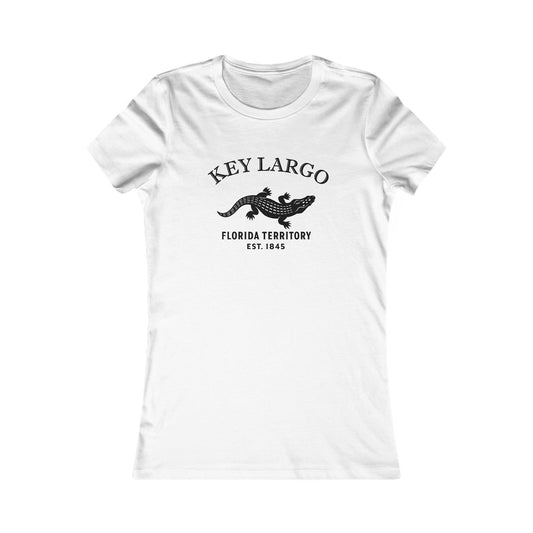
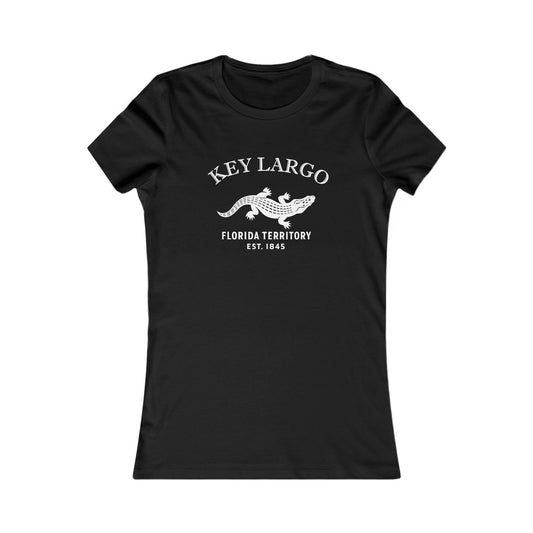
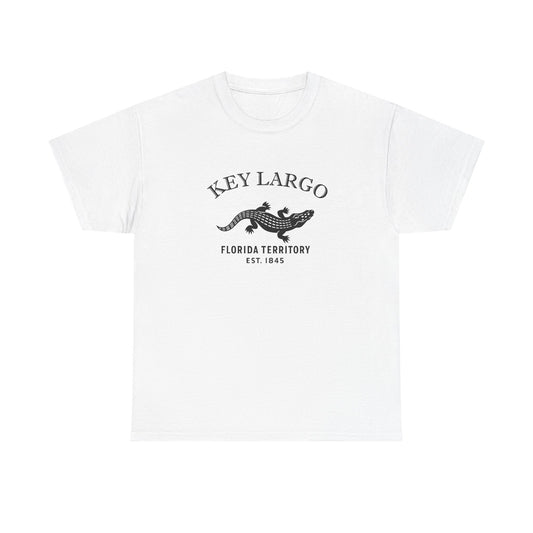
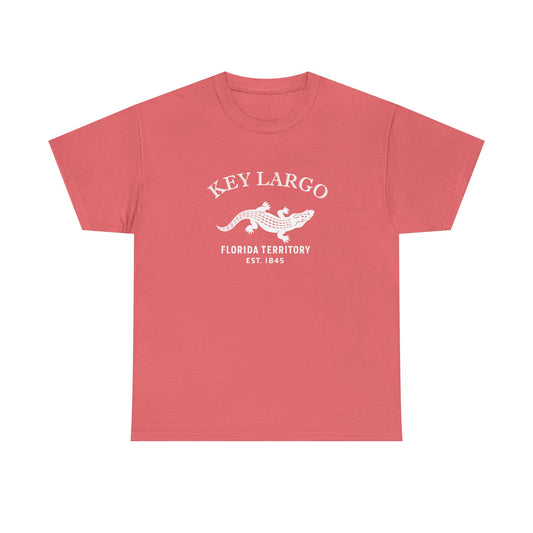
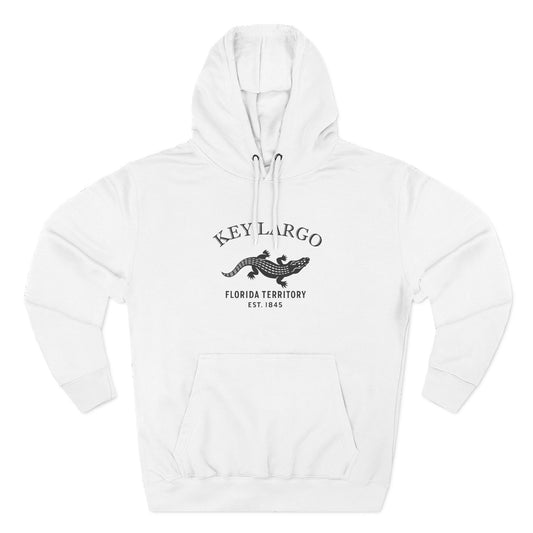
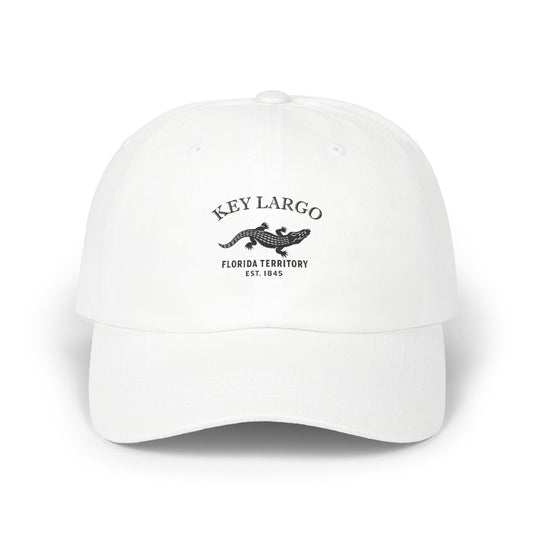
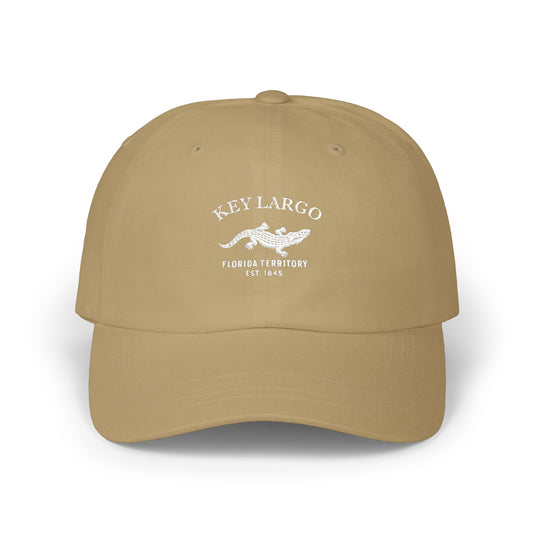
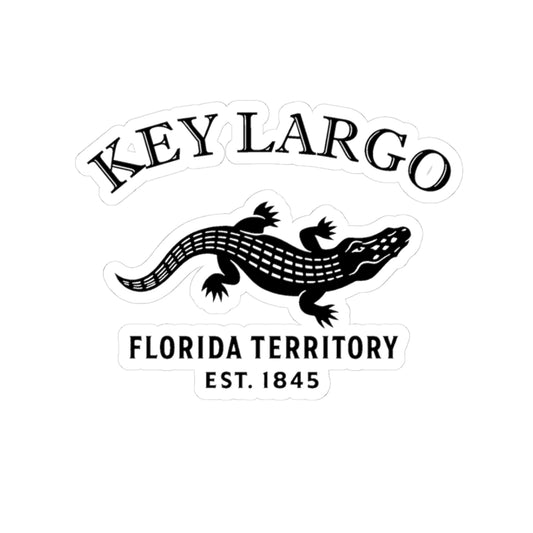
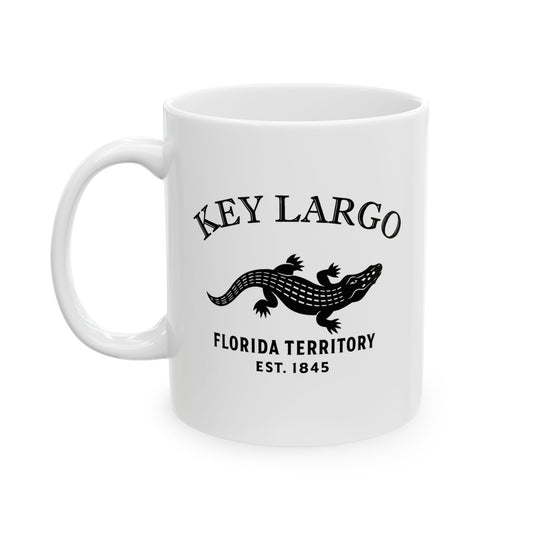
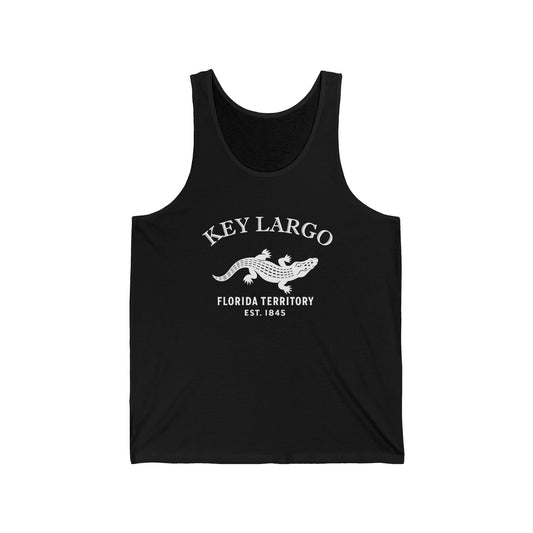
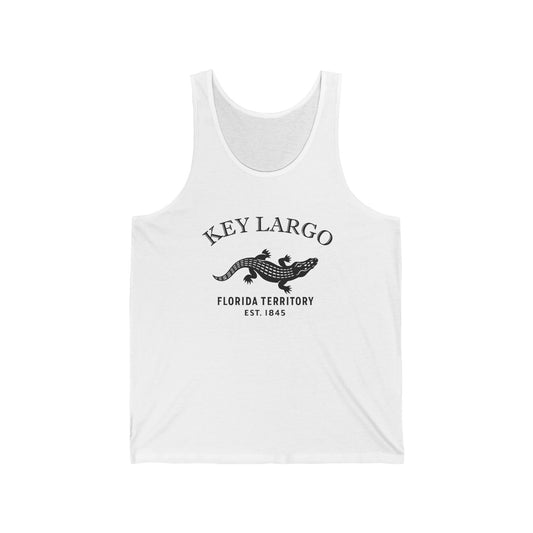
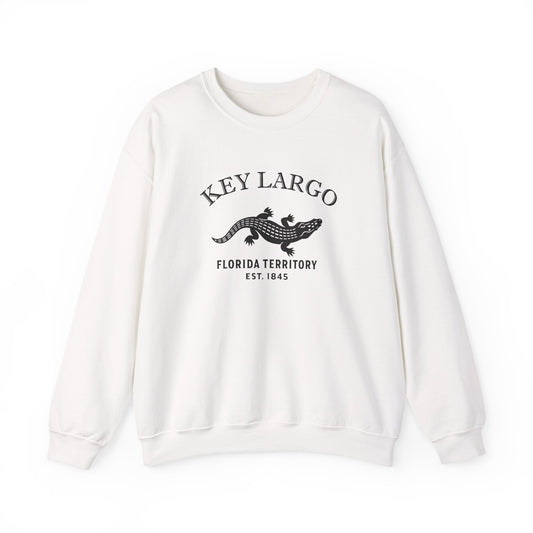
Our Key Largo logo carries the Florida alligator above "Est. 1845," the year of Florida statehood — the shared retro emblem of our Florida places, drawn in worn black-and-white like an old citrus-crate label. The alligator is storm-tested toughness, the through-line that links Key Largo to every Florida town we make; what makes this one Key Largo is everything around it — the long green island, the reef, the renaming, and the road south.
Today Key Largo is the first of the Keys in every sense — first island down the highway, first undersea park in America, first name travelers learn on the way to Key West. Its story runs from Cayo Largo on a Dutch chart through pineapple wagons, a drowned railroad, and a Hollywood rename to the Diving Capital of the World. Wear a little of the island that gave its name to a film and took it back.
Key Largo, Florida — Travel Guide
Visiting Key Largo Florida Today
Key Largo runs along the Overseas Highway from roughly mile marker 90 to 107, about an hour south of Miami — the first island of the Florida Keys and the gateway to the rest. The reef side faces the Atlantic; the bay side opens onto Florida Bay and the Everglades. Winter and spring bring the calmest, clearest water; summer is warm, quiet, and stormy-afternoon tropical.
The Reef, the Park & the Diving Capital of the World
For visitors searching for things to do in Key Largo, Florida — or simply snorkeling near me from anywhere in the Upper Keys:
- Snorkel or dive John Pennekamp Coral Reef State Park — America's first undersea park — by glass-bottom boat, snorkel tour, or scuba charter.
- Descend to the Christ of the Abyss off Key Largo Dry Rocks, or dive Molasses Reef and the wrecks beyond.
- Ride the actual African Queen — the 1912 steam launch from the 1951 film — on a canal cruise.
- Sleep underwater at Jules' Undersea Lodge, the world's first underwater hotel.
- Walk the hardwood hammock at Dagny Johnson Key Largo Hammock Botanical State Park, and visit the Florida Keys Wild Bird Center.
- Kayak the mangroves into Florida Bay, or day-trip west to Everglades National Park.
- End every day the Keys way: a sunset cruise and a slice of key lime pie.
Why People Visit Key Largo Florida
Key Largo is the Diving Capital of the World and the first of the Keys: the gateway island where the Overseas Highway begins, home of the first undersea park in the United States, the Christ of the Abyss beneath the reef, and the only living coral barrier reef in the continental U.S. — with the Everglades across the bay and Key West waiting down the road.
Wear the History
Where you're from. Where you love. Where you explored. Where you belong.
Kindred Cities
Greetings, neighbors from Islamorada — the Village of Islands, next stop down the Overseas Highway.
Key Largo's kindred town is its down-the-road sibling. Islamorada picks up where Key Largo leaves off — the purple isles of the Upper Keys, sportfishing capital to Key Largo's diving capital, the two of them sharing one highway, one reef, and one long green chain of islands between the Atlantic and the bay. Travelers rarely see one without the other; the mile markers just keep counting down.
Come up from Islamorada and Key Largo is the front porch of the Keys — the first island, the biggest reef park, and the town that named itself after a movie. Come and visit us soon.
When you plan the trip, the Florida Keys & Key West visitor bureau — the islands' official tourism office — is the place to start.
Wear the History
Where you're from. Where you love. Where you explored. Where you belong.

For deeper reading on Key Largo, Florida history described here — the Spanish Cayo Largo charted on a 1639 Dutch map, the Calusa and Tequesta presence in the Keys, the Rock Harbor pineapple-and-lime village, the 1938 arrival of the Overseas Highway, the June 1 1952 renaming of Rock Harbor to Key Largo, the 1960 Eisenhower Key Largo Coral Reef Preserve, the 1963 opening of John Pennekamp Coral Reef State Park as the first undersea park in the United States, the August 25 1965 submersion of the Christ of the Abyss off Key Largo Dry Rocks, the April 14 1972 National Register listing of the park, the 2002 sinking of the USS Spiegel Grove as an artificial reef, and the modern Diving-Capital era on the only living coral barrier reef in the continental United States — it may be useful to consult (1) the Florida Keys History Center at the Monroe County Public Library in Key West for the Upper Keys regional records, (2) the State Library and Archives of Florida in Tallahassee for the territorial and statehood-era records, (3) HistoryMiami Museum for the South Florida and Keys regional history, (4) the Monroe County Clerk and the unincorporated-community records for Key Largo, (5) the Florida Department of Environmental Protection and Florida State Parks for the John Pennekamp Coral Reef State Park and Dagny Johnson Key Largo Hammock records, (6) the National Oceanic and Atmospheric Administration (NOAA) for the Florida Keys National Marine Sanctuary records, (7) the Library of Congress and the National Archives for the Overseas Highway and federal-survey records, (8) the University of Miami and Florida International University libraries for the regional scholarly and coral-reef research literature, (9) the Florida Keys Wild Bird Center and the local historical societies for community history, and (10) Britannica and the official park histories for the Pennekamp, Christ of the Abyss, and Florida-statehood records. For deeper local Key Largo research, it may be useful to reach out to (1) the Florida Keys History Center, (2) the Key Largo Public Library, (3) the Historical Preservation Society of the Upper Keys, (4) the State Library and Archives of Florida, and (5) HistoryMiami Museum. For travel and visitor information in Key Largo, it may be useful to contact (1) the Key Largo Chamber of Commerce, (2) the Florida Keys & Key West tourism council, (3) John Pennekamp Coral Reef State Park, (4) the Florida Keys National Marine Sanctuary, (5) Dagny Johnson Key Largo Hammock Botanical State Park, and (6) the Florida Keys Wild Bird Center. Readers interested in the broader cultural reception of Key Largo and its First-of-the-Keys and Diving-Capital identity — the 1639 Cayo Largo charts, the Calusa and Tequesta presence, the Rock Harbor village, the 1938 Overseas Highway, the 1952 rename, the 1960 Eisenhower preserve, the 1963 first US undersea park, the 1965 Christ of the Abyss, and the modern reef-and-dive era — will find that the named places (Key Largo, the Florida Keys, John Pennekamp Coral Reef State Park, the Florida Keys National Marine Sanctuary, Christ of the Abyss / Key Largo Dry Rocks, the Florida Reef, Dagny Johnson Key Largo Hammock Botanical State Park, the Overseas Highway, Card Sound Road, Jewfish Creek, Rock Harbor, Hawk Channel, Florida Bay, the USS Spiegel Grove, Key West, and Miami), the named historical figures (John D. Pennekamp, Guido Galletti, Carl G. Fisher, Hernando de Escalante Fontaneda, and Bernard Romans), and the named historical moments (the 1639 first map reference, the 1938 Overseas Highway, the 1952 rename, the 1960 preserve, the 1963 first undersea park, the 1965 Christ of the Abyss, the 1972 National Register listing, and the 2002 Spiegel Grove sinking) recur across all of these traditions as a shared cultural grammar of foundational Key Largo history grounded specifically on the first and largest of the Florida Keys, the Diving Capital of the World on the only living coral barrier reef in the continental United States.
Shop the Key Largo Florida collection
View full collection-
Key Largo Florida Vintage Retro Premium Crewneck Sweatshirt - Black Logo
Regular price $48.00 USDRegular price -
Key Largo Florida Vintage Retro Premium Crewneck Sweatshirt - White Logo
Regular price $48.00 USDRegular price -
Key Largo Florida Vintage Retro Womens Fitted Ringspun Cotton Tee - Black Logo
Regular price $28.00 USDRegular price -
-
Key Largo Florida Vintage Retro Unisex Heavy Cotton Tee - Black Logo
Regular price $22.00 USDRegular price -
Key Largo Florida Vintage Retro Unisex Heavy Cotton Tee - White Logo
Regular price $22.00 USDRegular price -
Key Largo Florida Vintage Retro Unisex Heavy Cotton Hoodie - Black Logo
Regular price $56.00 USDRegular price -
Key Largo Florida Vintage Retro Unisex Heavy Cotton Hoodie - White Logo
Regular price $56.00 USDRegular price -
Key Largo Florida Vintage Retro Back Printed Art Series Cotton Tee - Black Logo
Regular price $32.00 USDRegular price -
Key Largo Florida Vintage Retro Giclée Print Art Series Poster
Regular price From $38.00 USDRegular price -
Key Largo Florida Vintage Retro Unisex Embroidered Cotton Polo - Black Logo
Regular price $48.00 USDRegular price -
Key Largo Florida Vintage Retro Unisex Embroidered Fleece Jacket - White Logo
Regular price $98.00 USDRegular price -
Key Largo Florida Vintage Retro Embroidered Cotton Cap - Black Logo
Regular price $32.00 USDRegular price -
Key Largo Florida Vintage Retro Embroidered Cotton Cap - White Logo
Regular price $32.00 USDRegular price -
Key Largo Florida Vintage Retro Vinyl Sticker - Black Logo
Regular price From $6.00 USDRegular price -
Key Largo Florida Vintage Retro Ceramic Mug - Black Logo
Regular price From $16.00 USDRegular price -
Key Largo Florida Vintage Retro Cotton Canvas Tote Bag - White Logo
Regular price $25.00 USDRegular price -
Key Largo Florida Vintage Retro Cotton Canvas Tote Bag - Black Logo
Regular price $25.00 USDRegular price -
Key Largo Florida Vintage Retro Thank You Card Set - Black Logo
Regular price From $25.00 USDRegular price -
Key Largo Florida Vintage Retro Cotton Jersey Baby Bodysuit - Black Logo
Regular price $26.00 USDRegular price -
Key Largo Florida Vintage Retro Unisex Cotton Jersey Tank Top - White Logo
Regular price $28.00 USDRegular price -
Key Largo Florida Vintage Retro Unisex Cotton Jersey Tank Top - Black Logo
Regular price $28.00 USDRegular price -
Key Largo Florida Vintage Retro Unisex Heavy Crewneck Sweatshirt - Black Logo
Regular price $44.00 USDRegular price