Juneau Alaska — Retro Vintage History
What's with Juneau? Juneau is Alaska's capital and the only U.S. state capital with no road access — you arrive by air or sea, between mountains and channel. Floatplane, ferry, or cruise ship: those are the ways in, and the ways out. Pinned between the Gastineau Channel and mountains that rise straight from the docks, Alaska's capital runs on government, tourism, and the long memory of gold.
Wear the HistoryWhere you're from. Where you love. Where you explored. Where you belong.
The land was never empty. The A'akw Kwáan — the "Small Lake People" of the Tlingit — and the T'aaḵu Kwáan of the Taku have lived along this channel for millennia, fishing Auke Bay and the salmon streams, naming every water: the flats at Gold Creek were Dzántik'i Héeni, "river where the flounders gather." Captain George Vancouver charted Gastineau Channel in 1794 and sailed on; for most of another century the channel stayed Tlingit water under a thin Russian claim, sold unseen to the United States in 1867.

The founding took a guide. In 1880, Chief Kowee of the A'akw Kwáan led prospectors Joe Juneau and Richard Harris up Gold Creek to the color they had failed to find on their own, and the camp that sprang up that October is often called the first new town founded in Alaska after the purchase. It nearly carried a different name — Harrisburg, then Rockwell — before the miners voted in 1881 to call it Juneau. Kowee's reward was smaller than his part deserved, and the town has spent a century restoring his name to the story.
QUICK FACTS — JUNEAU, AK
Juneau is the only U.S. state capital with no road access to the rest of the continent — you arrive by air or by sea.
The A'akw Kwáan Tlingit have lived here for millennia; their name for Gold Creek's flats, Dzántik'i Héeni, means "river where the flounders gather."
In 1880, Chief Kowee of the A'akw Kwáan led prospectors Joe Juneau and Richard Harris to gold — and a town was born.
Juneau is often called the first new town founded in Alaska after the 1867 purchase from Russia.
The Treadwell complex on Douglas Island ranked among the largest gold mines on Earth before the sea flooded it in 1917.
Juneau became Alaska's capital in 1906, taking the seat from Sitka; the first territorial legislature met here in 1913.
Mendenhall Glacier flows thirteen miles from the Juneau Icefield; its 1962 visitor center was the U.S. Forest Service's first.
The City and Borough of Juneau spans over 3,200 square miles — among U.S. cities, second in size only to Sitka.
The gold itself was mostly low-grade and locked in rock, which made Juneau a hard-rock town of stamp mills and tunnels rather than gold pans. Across the channel on Douglas Island, the Treadwell complex grew into one of the largest gold-mining operations on Earth — hundreds of stamps thundering day and night, company swimming pool and all — until April 1917, when the workings under the channel collapsed and the sea poured in. The Alaska-Juneau mine on the mainland carried on until 1944, and its ruins still climb the mountainside above town.
Government arrived while the stamps were still falling. In 1906 the capital of the District of Alaska moved from Sitka — the old Russian capital — to booming Juneau; the Governor's Mansion rose in 1912, the first territorial legislature met here in 1913, and the marble-columned Capitol opened in 1931. When statehood came on January 3, 1959, Juneau became a state capital — still without a road to anywhere, a distinction it keeps on purpose and by geography alike.
What's with the Gold Shadows of Juneau? In a city pinned between mountains and water, light arrives in angles: low sun, steep slopes, and long shade lines that slide across streets and docks. Gold Shadows is the nickname for that warm tint you see when sun hits wet rock and cloud breaks, turning gray weather briefly luminous. A quick cue is the ridge-glow rule: if the upper treeline lights up while downtown stays dim, the next ten minutes will be bright and sharp. That is gaps in cloud and coastal optics, not magic. With water below and ice carved valleys above, Juneau makes shadow feel like part of the color palette, not the absence of it.
North of town, the ice does the advertising. Mendenhall Glacier flows thirteen miles down from the 1,500-square-mile Juneau Icefield to a lake dotted with bergs, with Nugget Falls thundering beside it — close enough to walk to from a visitor center that was, in 1962, the first the U.S. Forest Service ever built. The glacier is retreating, and the blue ice caves that form and collapse along its edge have become their own pilgrimage. South of town, Tracy Arm's fjord walls and tidewater glaciers make the day-boat run; overhead, flightseeing planes trace the icefield itself.
The water works just as hard. Humpback whales feed the length of Stephens Passage and Auke Bay — summer whale watching here is close to a guarantee — the Macaulay Salmon Hatchery walks visitors through the run, and bald eagles crowd the channel like gulls. Downtown, the Mount Roberts Tramway climbs from the cruise docks to the alpine, Perseverance Trail follows the old mining road up Gold Creek, the Red Dog Saloon pours under sawdust and swinging doors, and Eaglecrest — the city's own ski area on Douglas Island — turns the capital into a ski town every winter.

Juneau today is a capital of about thirty-two thousand that hosts well over a million cruise visitors a summer, a government town and a Tlingit cultural center at once — every two years, Celebration fills the streets with Tlingit, Haida, and Tsimshian dance in one of the largest Native gatherings in Alaska. The borough sprawls over three thousand square miles of ice, forest, and channel; the town itself is a few steep blocks you can walk in an afternoon.
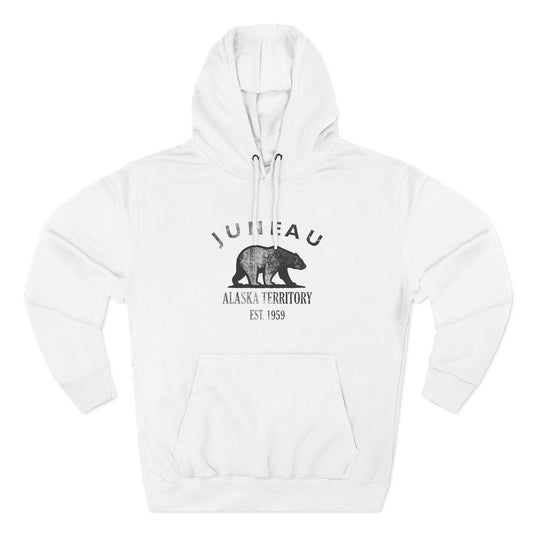
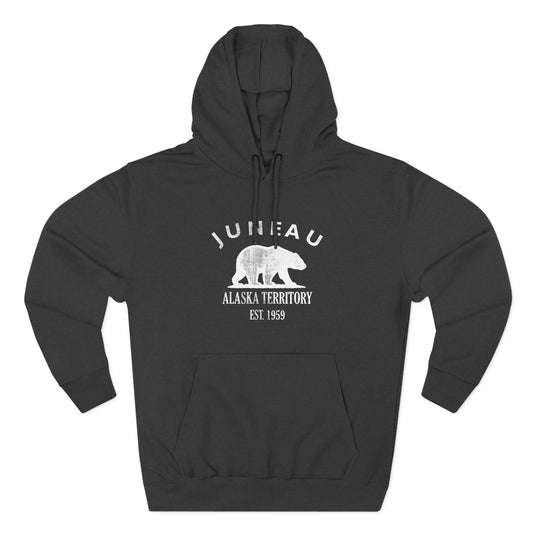
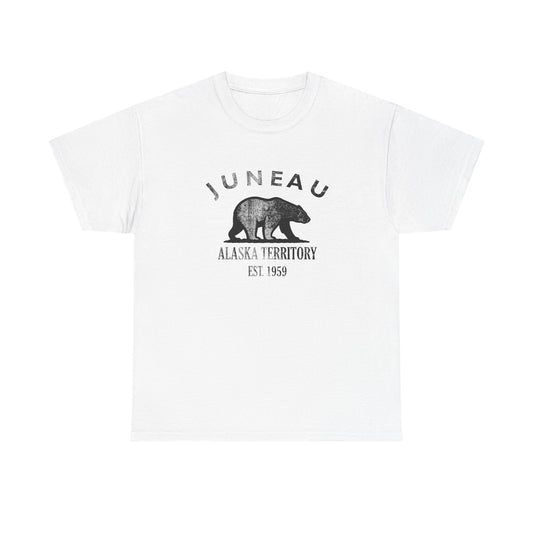
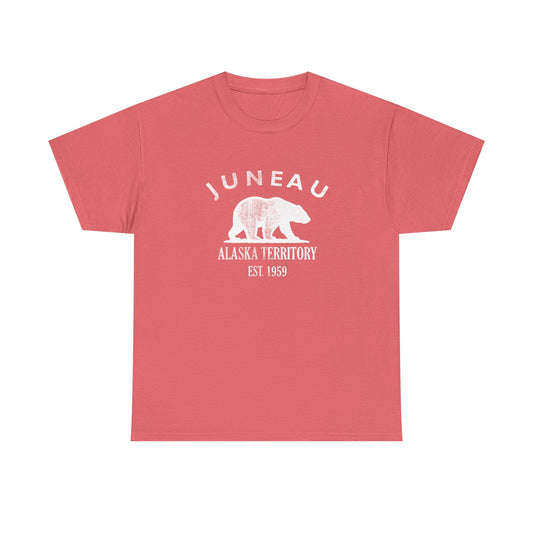
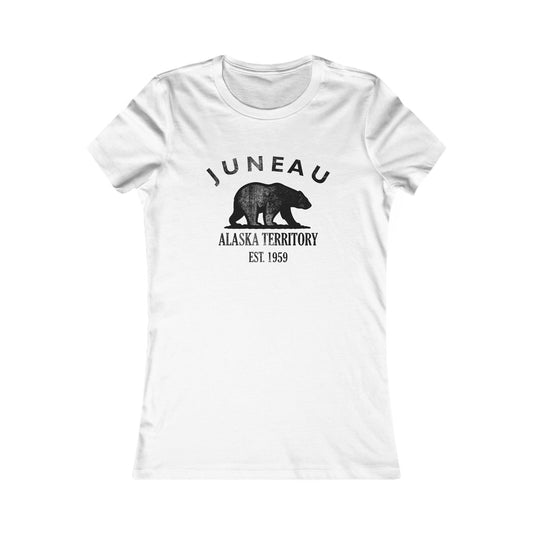
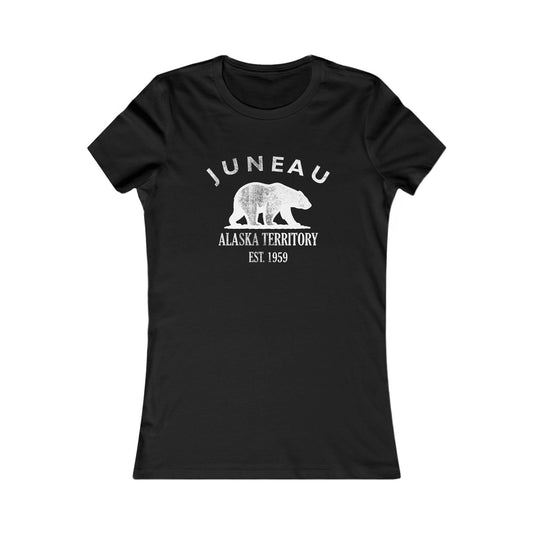
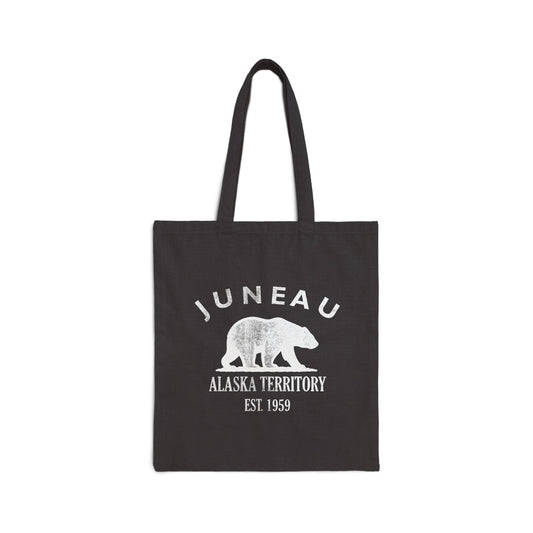
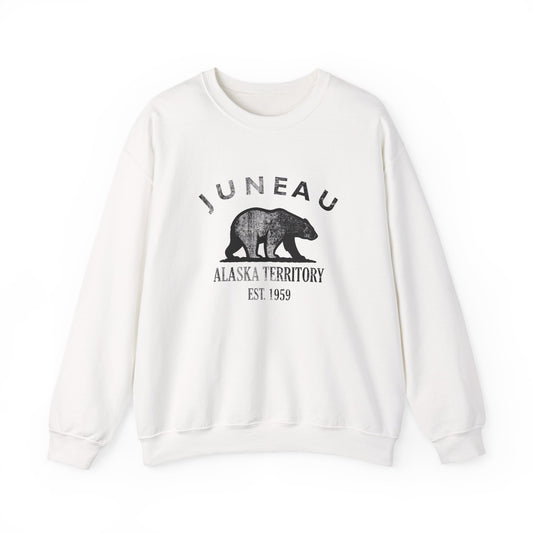
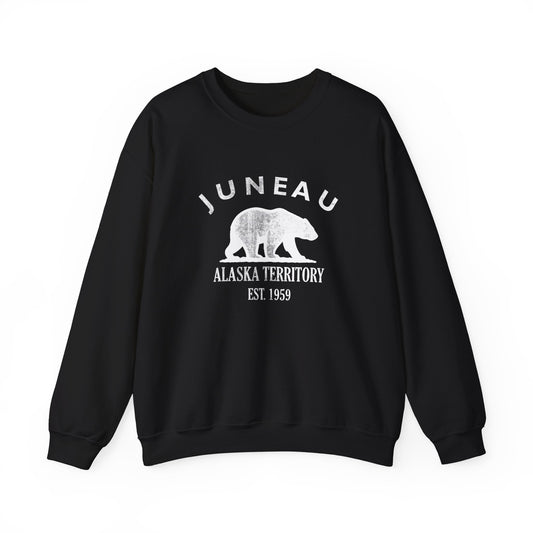
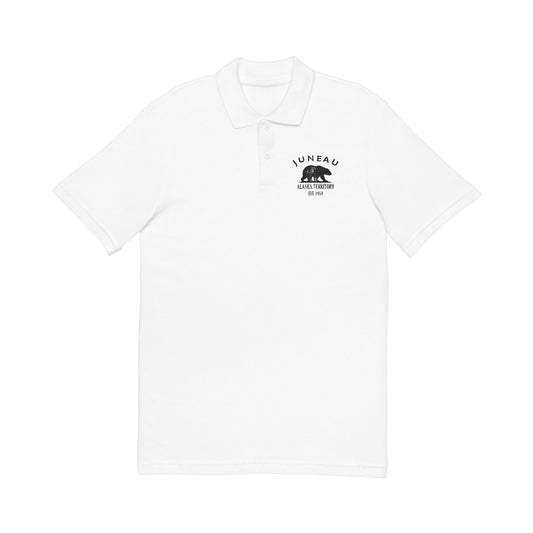
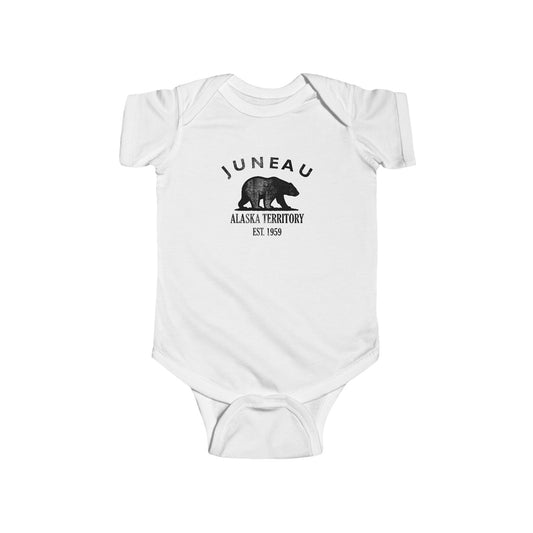
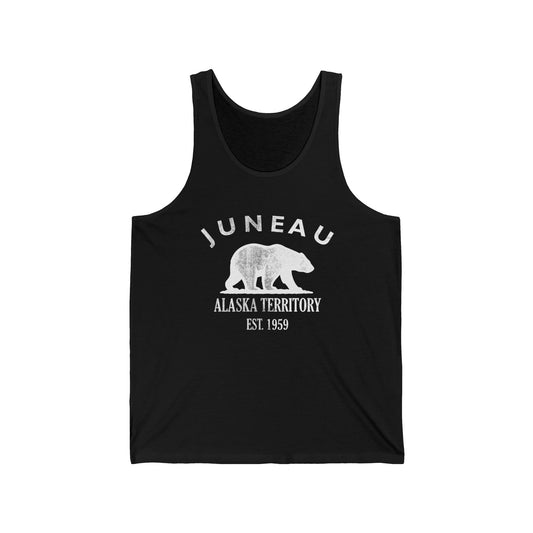
Our Juneau logo carries Alaska's distressed bear above "Est. 1959," the year of statehood — the shared retro emblem of our Alaska places, drawn in worn black-and-white like an old cannery crate stamp. The bear is the through-line that links Juneau to every other Alaska town we make; what makes this one Juneau is everything around it — the roadless capital, Kowee's creek, the drowned mine, and the ice.
Today Juneau is the capital you have to earn — no highway delivers you; you fly the panhandle or sail the channel, and arrive in a town where the legislature and the glacier share a zip code. Its story runs from Dzántik'i Héeni through Kowee's tip, the Treadwell thunder, and the 1906 move to the roadless capital of the forty-ninth state. Wear a little of the capital that keeps its own company.
Juneau, Alaska — Travel Guide
Visiting Juneau Alaska Today
Juneau sits in Southeast Alaska's panhandle on Gastineau Channel — reached only by air or sea, with daily jets from Seattle and Anchorage, the state ferry, and a summer parade of cruise ships. May through September brings whales, long light, and every trail open; winter brings northern lights, quiet streets, and Eaglecrest's slopes across the channel.
Capital Buildings, Mendenhall & the Ice
For visitors searching for things to do in Juneau, Alaska:
- Walk to the ice at Mendenhall Glacier — visitor center, Nugget Falls trail, and berg-dotted Mendenhall Lake, with guided treks and the ever-shifting ice caves for the ambitious.
- Ride the Mount Roberts Tramway from the cruise docks to the alpine, then hike higher.
- Cruise Tracy Arm Fjord's tidewater glaciers, or go whale watching on Stephens Passage and Auke Bay — summer humpbacks are close to a guarantee.
- Tour the Alaska State Capitol, pass the 1912 Governor's Mansion, and visit the Alaska State Museum and the 1894 St. Nicholas Russian Orthodox Church.
- Hike Perseverance Trail up Gold Creek past the mining ruins, or cross to Douglas Island for the Treadwell remains and Eaglecrest.
- See the salmon run at Macaulay Salmon Hatchery, find quiet at the Shrine of St. Thérèse, and end at the Red Dog Saloon.
- Fly the Juneau Icefield — flightseeing over 1,500 square miles of ice.
Why People Visit Juneau Alaska
Juneau is the capital of Alaska as a civic destination and a wilderness port in one — the only U.S. state capital with no road access, the 1931 Capitol, a walk-to glacier, whales in the channel, and gold-rush ruins on the mountainside. People come by ship and plane for the ice and the whales, and find a small stubborn capital that likes being hard to reach.
Wear the History
Where you're from. Where you love. Where you explored. Where you belong.
Kindred Cities
Greetings, friends from Sitka — the old capital salutes the new.
Juneau's kindred city is the one it took the crown from. Sitka was the capital of Russian America and then of the District of Alaska until 1906, when the government followed the gold to Gastineau Channel — and the two have been bound ever since by the ferry run, the fishing fleet, and the shared water of the panhandle. Sitka keeps the Russian bishop's house and the older story; Juneau keeps the legislature and the newer one. Between them they hold the whole history of the Southeast.
Come over from Sitka and Juneau will feel like the busy cousin — cruise docks and committee rooms where Sitka has totem parks and quiet — but the mountains and the rain treat both towns exactly alike. Come and visit us soon.
When you plan the trip, Travel Juneau — the city's official visitor bureau — is the place to start.
Wear the History
Where you're from. Where you love. Where you explored. Where you belong.

For deeper reading on Juneau, Alaska history described here — the thousands of years of Auk Tlingit (A'akw Kwáan) and Taku Tlingit stewardship of Dzánti K'ihéeni and Gastineau Channel, the 1794 Captain George Vancouver charting of Stephens Passage and Gastineau Channel, the 1879 John Muir visit to the region, the 1880 Chief Kowee delivery of ore samples to the Sitka mining engineer George Pilz, the July 17 1880 service agreement between Pilz, Juneau, and Harris, the October 18 1880 mother-lode gold strike by Joseph Juneau and Richard T. Harris guided by Chief Kowee at the head of Gold Creek at Snow Slide Gulch in Silver Bow Basin, the same-day staking of the 160-acre town site as the first Alaska town founded after the 1867 U.S. Purchase and the first founded directly from a gold strike, the 1881 miner-vote renaming from Harrisburg to Juneau, the 1882 opening of the Treadwell Mine on Douglas Island by John Treadwell, the 1894 construction of St. Nicholas Russian Orthodox Church as the oldest original Russian Orthodox church in Southeast Alaska, the 1898 Wickersham House on Chicken Ridge, the June 6 1900 Alaska Civil Code signed by President William McKinley designating Juneau the capital of the District of Alaska, the September 8 1906 physical transfer of the seat of government from Sitka to Juneau under Governor Wilford B. Hoggatt, the 1912 Alaska Governor's Mansion on Calhoun Avenue, the 1917 catastrophic Treadwell Mine cave-in and flooding ending one of the world's premier gold operations, the 1931 completion of the Federal and Territorial Building (today's State Capitol) with its six exterior columns of Tokeen Alaska marble, the 1944 closure of the A-J Mine ending the Juneau gold era, the January 3 1959 Alaska statehood as the 49th state of the Union, the July 1 1970 consolidation of the City of Juneau, the City of Douglas, and the Greater Juneau Borough into the City and Borough of Juneau at 3,255 square miles as the second-largest U.S. city by area, the 1996 opening of the Mt. Roberts Tramway (Goldbelt Tram) from the cruise dock to a station near the summit of Mount Roberts, and the modern cruise-tourism era as a principal Inside Passage port of call — it may be useful to consult (1) the Alaska State Library Historical Collections in Juneau and the Alaska Historical Society Journal for the territorial-era Juneau records and the long-running Hawaiian Journal of History equivalent for Alaska scholarship, (2) the Alaska State Archives in Juneau for the territorial municipal records and the 1900 Alaska Civil Code and 1906 capital-transfer documents, (3) the Alaska State Museum at the Father Andrew P. Kashevaroff State Library, Archives and Museum (the SLAM building) for the city-archaeological and territorial-era collections, (4) the Juneau-Douglas City Museum for the city's salmon, gold-mining, and town-growth interpretive collection, (5) the City and Borough of Juneau Historic Preservation Office for the National Register listings and the Capitol-area architectural records, (6) the Gastineau Channel Historical Society for the long-running Juneau timeline and the 1906 mailboat Georgia and Hoggatt-arrival documentation, (7) the University of Alaska Southeast Egan Library in Auke Bay for the Southeast Alaska academic literature, the Tlingit-language Lingít Aaní scholarship, and the panhandle-economy studies, (8) the Sealaska Heritage Institute in Juneau for the Tlingit, Haida, and Tsimshian cultural records of Southeast Alaska, (9) the U.S. Forest Service Tongass National Forest headquarters in Ketchikan and the Mendenhall Glacier Visitor Center (the oldest U.S. Forest Service visitor center in the country) for the Tongass-area public-lands records, (10) the Wickersham House State Historical Site for the territorial-judge-era papers, and (11) the Last Chance Mining Museum at the end of Basin Road for the A-J Mine compressor-building and 1880-1944 Juneau gold-mining records. For deeper local Juneau research, it may be useful to reach out to (1) the Alaska State Library Historical Collections, (2) the Alaska State Archives, (3) the Juneau-Douglas City Museum, (4) the Gastineau Channel Historical Society, (5) the City and Borough of Juneau Historic Preservation Office, (6) the Sealaska Heritage Institute, (7) the University of Alaska Southeast Egan Library, and (8) the Last Chance Mining Museum. For travel and visitor information in Juneau, it may be useful to contact (1) the Juneau Convention and Visitors Bureau (Travel Juneau), (2) the Juneau Chamber of Commerce, (3) the U.S. Forest Service Mendenhall Glacier Visitor Center for Mendenhall Glacier and Tongass National Forest information, (4) the City and Borough of Juneau Parks and Recreation Department for trail and city-park information including the Perseverance Trail and the Treadwell Historic Trail, (5) the Alaska State Capitol guided-tour office during legislative session and summer months, (6) the Alaska Marine Highway System for Inside Passage ferry-route information from the Auke Bay terminal, and (7) Juneau International Airport for jet-service information. Readers interested in the broader cultural reception of Juneau and its capital-with-no-road identity — the thousands of years of Auk Tlingit and Taku Tlingit life along Gastineau Channel, the 1794 Vancouver charting, the 1879 Muir visit, the 1880 Kowee-Juneau-Harris gold strike at Silver Bow Basin, the October 18 1880 town-site staking as the first Alaska town founded after the 1867 U.S. Purchase, the 1881 Harrisburg-to-Juneau renaming, the 1882-1917 Treadwell Mine era on Douglas Island, the 1894 St. Nicholas Russian Orthodox Church construction, the June 6 1900 Alaska Civil Code, the September 8 1906 capital transfer from Sitka, the 1931 Federal and Territorial Building completion, the 1944 A-J Mine closure, the 1959 Alaska statehood, the 1970 City and Borough consolidation, the 1996 Mt. Roberts Tramway opening, and the modern cruise-port era — will find that the named places (Gastineau Channel, Gold Creek, Silver Bow Basin, Snow Slide Gulch, Mount Juneau, Mount Roberts, Douglas Island, Mendenhall Glacier, Mendenhall Lake, Mendenhall River, the Juneau Icefield, Auke Bay, Berners Bay, the Alaska State Capitol, the Governor's Mansion, the St. Nicholas Russian Orthodox Church, the Wickersham House, the Juneau-Douglas City Museum, the Treadwell Mine ruins, the A-J Mine and Last Chance Mining Museum, the Mt. Roberts Tramway, Juneau International Airport, the Alaska Marine Highway, the Inside Passage, the Alexander Archipelago, the Tongass National Forest, Sitka, Ketchikan, Skagway, and Anchorage), the named historical figures (Joseph Juneau, Richard T. Harris, Chief Kowee, George Pilz, John Treadwell, John Muir, Captain George Vancouver, and Governor Wilford B. Hoggatt), and the named historical moments (the centuries of Auk Tlingit and Taku Tlingit life along Gastineau Channel, the 1794 Vancouver charting, the 1879 Muir visit, the 1880 Kowee-Juneau-Harris gold strike, the October 18 1880 town-site staking, the 1881 renaming, the 1882-1917 Treadwell Mine era, the 1894 St. Nicholas construction, the 1900 Alaska Civil Code, the 1906 capital transfer, the 1931 Capitol completion, the 1944 A-J Mine closure, the 1959 statehood, the 1970 consolidation, the 1996 Tramway opening, and the modern cruise-port era) recur across all of these traditions as a shared cultural grammar of foundational Juneau history grounded specifically on the eleven-mile Gastineau Channel waterfront beneath Mount Juneau in the only U.S. state capital with no road access to the rest of the continent.
Shop the Juneau Alaska collection
View full collection-
Juneau Alaska Vintage Retro Premium Crewneck Sweatshirt - Black Logo
Regular price $48.00 USDRegular price -
Juneau Alaska Vintage Retro Premium Crewneck Sweatshirt - White Logo
Regular price $48.00 USDRegular price -
Juneau Alaska Vintage Retro Unisex Heavy Cotton Hoodie - Black Logo
Regular price $56.00 USDRegular price -
Juneau Alaska Vintage Retro Unisex Heavy Cotton Hoodie - White Logo
Regular price $56.00 USDRegular price -
Juneau Alaska Vintage Retro Unisex Heavy Cotton Tee - Black Logo
Regular price $22.00 USDRegular price -
Juneau Alaska Vintage Retro Unisex Heavy Cotton Tee - White Logo
Regular price $22.00 USDRegular price -
Juneau Alaska Vintage Retro Womens Fitted Ringspun Cotton Tee - Black Logo
Regular price $28.00 USDRegular price -
-
Juneau Alaska Classic Embroidered Vintage Retro Cotton Cap - White Logo
Regular price $32.00 USDRegular price -
Juneau Alaska Classic Embroidered Vintage Retro Cotton Cap - Black Logo
Regular price $32.00 USDRegular price -
Juneau Alaska Vintage Retro Back Printed Art Series Cotton Tee - Black Logo
Regular price $32.00 USDRegular price -
Juneau Alaska Vintage Retro Giclée Print Art Series Poster
Regular price From $38.00 USDRegular price -
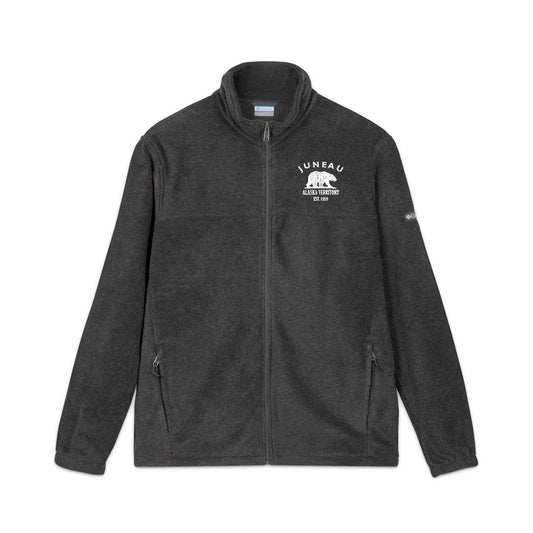
Juneau Alaska Vintage Retro Unisex Embroidered Fleece Jacket - White Logo
Regular price $98.00 USDRegular price -
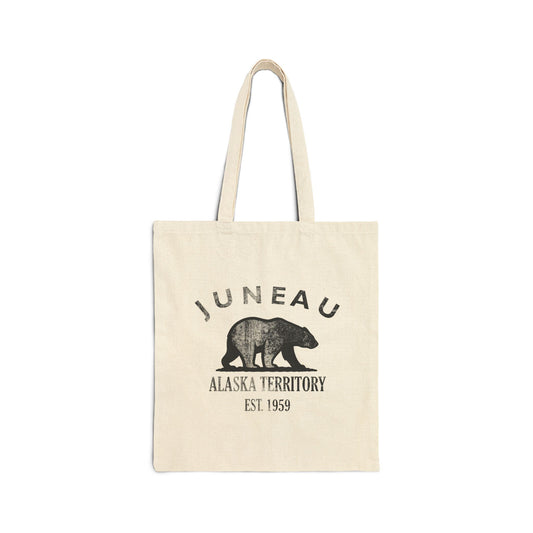
Juneau Alaska Vintage Retro Cotton Canvas Tote Bag - Black Logo
Regular price $25.00 USDRegular price -
Juneau Alaska Vintage Retro Cotton Canvas Tote Bag - White Logo
Regular price $25.00 USDRegular price -
Juneau Alaska Vintage Retro Unisex Heavy Crewneck Sweatshirt - Black Logo
Regular price $44.00 USDRegular price -
Juneau Alaska Vintage Retro Unisex Heavy Crewneck Sweatshirt - White Logo
Regular price $44.00 USDRegular price -
Juneau Alaska Vintage Retro Unisex Embroidered Cotton Polo - Black Logo
Regular price $48.00 USDRegular price -
Juneau Alaska Vintage Retro Vinyl Sticker - Black Logo
Regular price From $6.00 USDRegular price -
Juneau Alaska Vintage Retro Ceramic Mug - Black Logo
Regular price From $16.00 USDRegular price -
Juneau Alaska Vintage Retro Thank You Card Set - Black Logo
Regular price From $25.00 USDRegular price -
Juneau Alaska Vintage Retro Cotton Jersey Baby Bodysuit - Black Logo
Regular price $26.00 USDRegular price -
Juneau Alaska Vintage Retro Unisex Cotton Jersey Tank Top - White Logo
Regular price $28.00 USDRegular price