-
Waterford Connecticut Vintage Retro Premium Crewneck Sweatshirt - Black Logo
Regular price $48.00 USDRegular price -
Waterford Connecticut Vintage Retro Premium Crewneck Sweatshirt - White Logo
Regular price $48.00 USDRegular price -
Waterford Connecticut Vintage Retro Unisex Heavy Cotton Hoodie - White Logo
Regular price $56.00 USDRegular price -
Shoreline Trio - Silhouette Art Giclée Unframed Art Print
Regular price From $34.00 USDRegular price -
Shoreline Trio - Silhouette Art Framed Art Print
Regular price From $96.00 USDRegular price -
Waterford Connecticut Vintage Retro Womens Fitted Ringspun Cotton Tee - Black Logo
Regular price $28.00 USDRegular price -
Waterford Connecticut Vintage Retro Embroidered Cotton Cap - Black Logo
Regular price $32.00 USDRegular price -
Between Horse and Hound - Silhouette Art Giclée Unframed Art Print
Regular price From $34.00 USDRegular price -
Boy and Hound - Silhouette Art Framed Art Print
Regular price From $96.00 USDRegular price -
Waterford Connecticut Vintage Retro Unisex Heavy Cotton Tee - Black Logo
Regular price $22.00 USDRegular price -
Waterford Connecticut Vintage Retro Unisex Embroidered Fleece Jacket - White Logo
Regular price $98.00 USDRegular price -
Shoreline Trio II - Silhouette Art Giclée Unframed Art Print
Regular price From $34.00 USDRegular price -
Whitewater Run - Silhouette Art Framed Art Print
Regular price From $96.00 USDRegular price -
Waterford Connecticut Vintage Retro Cotton Jersey Baby Bodysuit - Black Logo
Regular price $26.00 USDRegular price -
Whitewater Run - Silhouette Art Giclée Unframed Art Print
Regular price From $34.00 USDRegular price -
Boy and Hound Portrait - Silhouette Art Giclée Unframed Art Print
Regular price From $44.00 USDRegular price -
Waterford Connecticut Vintage Retro Vinyl Sticker - Black Logo
Regular price From $6.00 USDRegular price -
Waterford Connecticut Vintage Retro Ceramic Mug - Black Logo
Regular price From $16.00 USDRegular price -
Hand on the Mane - Silhouette Art Giclée Unframed Art Print
Regular price From $34.00 USDRegular price -
Shoreline Trio II - Silhouette Art Framed Art Print
Regular price From $96.00 USDRegular price -
Waterford Connecticut Vintage Retro Unisex Heavy Cotton Tee - White Logo
Regular price $22.00 USDRegular price -
Waterford Connecticut Vintage Retro Embroidered Cotton Cap - White Logo
Regular price $32.00 USDRegular price -
Whitewater Leap - Silhouette Art Giclée Unframed Art Print
Regular price From $34.00 USDRegular price -
Between Horse and Hound - Silhouette Art Framed Art Print
Regular price From $96.00 USDRegular price -
-
Waterford Connecticut Vintage Retro Unisex Heavy Crewneck Sweatshirt - Black Logo
Regular price $44.00 USDRegular price -
Kiss at Still Water - Silhouette Art Giclée Unframed Art Print
Regular price From $34.00 USDRegular price -
Horse at Low Tide - Silhouette Art Framed Art Print
Regular price From $96.00 USDRegular price -
Waterford Connecticut Vintage Retro Cotton Canvas Tote Bag - White Logo
Regular price $25.00 USDRegular price -
Waterford Connecticut Vintage Retro Cotton Canvas Tote Bag - Black Logo
Regular price $25.00 USDRegular price -
Companion in Still Water - Silhouette Art Framed Art Print
Regular price From $96.00 USDRegular price -
Between Two Hounds Portrait - Silhouette Art Framed Art Print
Regular price From $112.00 USDRegular price -
Waterford Connecticut Vintage Retro Thank You Card Set - Black Logo
Regular price From $25.00 USDRegular price -
Waterford Connecticut Vintage Retro Unisex Cotton Jersey Tank Top - Black Logo
Regular price $28.00 USDRegular price -
Between Two Hounds Portrait - Silhouette Art Giclée Unframed Art Print
Regular price From $44.00 USDRegular price





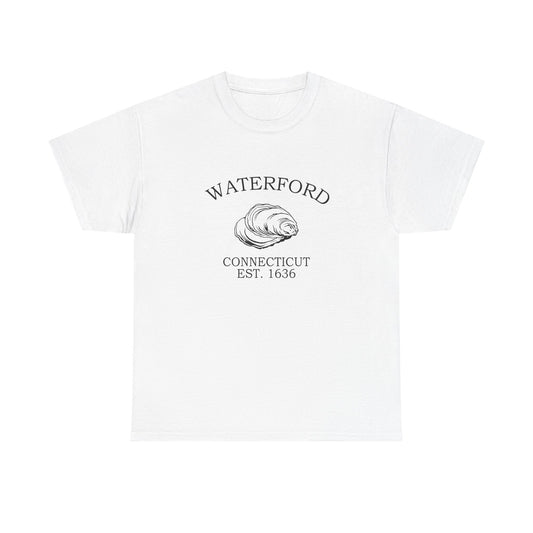






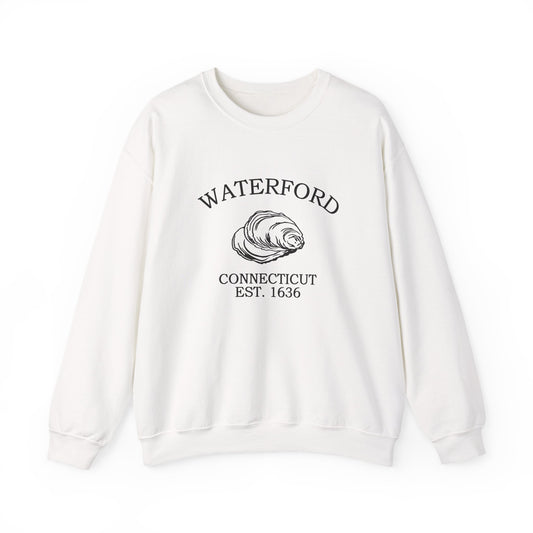





Waterford Connecticut — Retro Vintage History
What's with the granite? Walk Waterford's woods and you'll find it everywhere — stone walls in the trees, old steps, boulders squared off by hand. The reason sits at Millstone Point, where granite has been quarried since 1737. Waterford stone went into monuments and buildings across the region, and a whole corner of town, Graniteville, took its name from the trade. The quarrying ran from the 1700s into the 1930s, and the walls and foundations it left behind still lace the shoreline. Before the beaches and the gardens, Waterford was a place that sent its bedrock out into the world — granite built to last.
Wear the HistoryThe town itself came later than its stone. For a century and a half this was the "West Farms" of New London — English colonists first raised crops on Fog Plain in 1645, and a sawmill turned at Quaker Hill by 1653. The farmers along the Sound eventually wanted a town of their own, and on October 8, 1801, Waterford was incorporated as Connecticut's 109th town. It took its name from the old city of Waterford in Ireland, a fitting borrow for a coast town. From the start it was a place of farms, fishing, and granite, strung along twenty-three miles of Long Island Sound shoreline.

Through the nineteenth century Waterford was a working shoreline. Farmers raised sheep on the rolling uplands of Quaker Hill and Jordan; fishermen and traders worked the coves; and the granite men cut and hauled stone from Millstone Point. The town had no single mill-town center — instead a scatter of villages and landings, each with its own character, tied together by the Sound and the two rivers that bound the town east and west, the Thames and the Niantic. It was quiet, rural, and durable, the kind of place that changed slowly and kept what it had. Stone walls still run through the second-growth woods where pastures used to be, quiet markers of all that work.
Then, at the turn of the twentieth century, Waterford gained a palace by the sea. Edward and Mary Harkness — heirs to a Standard Oil fortune — built Eolia, a forty-two-room Renaissance Revival mansion, on a green point above the Sound around 1907. They laid out formal gardens, later refined by the great landscape architect Beatrix Farrand, and spent their summers there among the boxwood and the salt air. Mary Harkness left the estate to Connecticut, and in the 1950s it became Harkness Memorial State Park — its lawns, gardens, and water tower now open to anyone who wants to walk down to the water.
Waterford's quiet coast drew artists as well as gardeners. In 1964 the Eugene O'Neill Theater Center opened here, named for the Nobel-laureate playwright who had grown up just down the shore in New London. Its summer playwriting workshops — the National Playwrights Conference — have launched a remarkable share of the American stage, and the O'Neill is now woven into the town's identity as deeply as its beaches. Nearby, the landmark buildings of Seaside State Park stand on their own green point, a striking piece of early-twentieth-century shoreline architecture preserved as open space.
Today Waterford keeps the balance it has always kept — a shoreline town that is half history, half easy coastal living. Its beaches and coves draw summer crowds: Waterford Beach Park, Jordan Cove, Alewife Cove, the marinas at Mago Point on the Niantic. Harkness and Seaside hold long stretches of the coast as open parkland, and the O'Neill keeps the lights on for new plays each summer. It is a town of villages and greens and granite walls, looking out across Long Island Sound, comfortable in its own quiet. Waterford has never needed to be loud to be itself.
Our Waterford logo carries Connecticut's clam shell above "Connecticut — Est. 1636," the shared retro emblem of our Connecticut towns; the shell speaks to the shoreline, and 1636 marks the founding of the Connecticut Colony itself — not the town, which came much later, in 1801. Rendered in worn black-and-white, like an old oyster-crate label or seaside signage, it ties Waterford to every other Connecticut town we make. What makes this one Waterford is the story behind it — the granite, the gardens of Harkness, and the long light off the Sound.
So Waterford gathers granite quarries, a seaside estate, and a famous stage onto a granite coast on Long Island Sound. Our Waterford designs gather that into wearable form. Wear the history. Waterford, Connecticut — Eolia's gardens, a granite coast, and the long light of Long Island Sound.

Waterford, Connecticut — Travel Guide
Visiting Waterford Today
Waterford is a Connecticut shoreline town on Long Island Sound, between the Niantic and Thames Rivers — a place of seaside gardens, granite-walled woods, and quiet beaches, easy to explore in an afternoon.
Harkness, the Beaches & the O'Neill
For visitors looking for things to do in Waterford, Connecticut:
- Wander Harkness Memorial State Park — the Eolia mansion, gardens, and broad lawns above the Sound.
- Swim at Waterford Beach Park, a sandy cove with gentle water and summer concerts.
- Visit the Eugene O'Neill Theater Center, home of the National Playwrights Conference.
- Walk the green point and shoreline at Seaside State Park.
- Launch a kayak or watch the boats at Mago Point on the Niantic River.
- Stroll the Connecticut College Arboretum's trails and native-plant gardens near Quaker Hill.
Why People Visit Waterford
Visitors come to Waterford for an unspoiled stretch of the Connecticut coast: the gardens and mansion at Harkness, a famous playwriting center, granite-walled woods, and rocky beaches on Long Island Sound. It sits minutes from New London and the Mystic shoreline, with two state parks holding long reaches of open coast. Equal parts heritage and easy beach time, Waterford rewards anyone who likes the shore quiet and the history close at hand.
Wear the History
Kindred Cities
Greetings to visitors from Waterford in Ireland (fáilte) and Cork — fellow coasts of the old country.
Connecticut's Waterford took its name from the Irish city, and the bond suits a shore town. Ireland's Waterford is the country's oldest city, a Viking foundation famous the world over for its crystal; Cork is the easy-going harbour capital of the south; Connecticut's Waterford keeps its own quiet coast on Long Island Sound, with the gardens of Harkness and the famous playwriting workshops of the Eugene O'Neill center. Old-country names on a New England shore.
Waterford suits the visitor who likes the shore unspoiled: the seaside mansion and gardens at Harkness Memorial Park, the playwrights' workshops at the O'Neill, rocky beaches on the Sound, and an easy New England quiet. Come and visit us soon.
When you plan the trip, the Town of Waterford and the Connecticut Office of Tourism are the place to start.
Wear the History

For deeper reading on the Waterford history described here — the granite quarrying at Millstone Point from 1737, the "West Farms" of New London and the 1801 incorporation, the Harkness estate at Eolia with its Beatrix Farrand gardens, and the founding of the Eugene O'Neill Theater Center in 1964 — it may be useful to consult (1) the Waterford Historical Society, (2) the Waterford Public Library local history room, (3) the Connecticut State Library and Archives, (4) the Waterford town clerk's records office, and (5) the Connecticut Historic Preservation Office. For travel and visitor information, it may be useful to contact (1) the Town of Waterford, (2) the Connecticut Office of Tourism, (3) the Waterford Parks and Recreation Department, (4) the Connecticut State Parks office (Harkness and Seaside), and (5) the New London regional visitor information desk.
- Choosing a selection results in a full page refresh.
- Opens in a new window.