


Clinton New Jersey Holiday Ornament — The Mill That Was Black, Then White, Then Red
Clinton New Jersey Holiday Ornament — The Mill That Was Black, Then White, Then Red
Couldn't load pickup availability
The Red Mill. Before it was red it was black. In 1905 the man who owned the mill on the South Branch of the Raritan stopped grinding grain and started grinding graphite, and a greasy black dust settled on every porch in Clinton until the town made him stop; he switched to talc, and for a few years it was the White Mill. It became the Red Mill only when it became a museum. And the waterwheel that makes it the most photographed building in New Jersey is not the wheel that ran it - a turbine replaced that in 1903; the wheel everyone shoots went in during the 1960 restoration. Two things Clinton walks past every day.
Ralph Hunt built the mill around 1810 to process wool, across the river from the stone mill his father had built in 1763 - two mills, one dam, one river. Cheap English cloth killed the wool business; by 1820 Hunt was telling the census the place had done very little for two or three years, and he soon lost more than four hundred acres and both mills to the mortgage. The Taylor family took over and renamed the village: Hunt's Mills became Clinton, after DeWitt Clinton, the governor who dug the Erie Canal. The town was incorporated in 1865. Behind the mill, Irish quarrymen from Halstead Street worked the Mulligan limestone cliff, and when the great fire of 1891 took the center of town, Clinton rebuilt in Mulligan stone.
For a hundred and eighteen years the mill kept reinventing itself. Wool, then feed and flour and plaster, then peach baskets on the ground floor. From 1892 the second floor housed the Clinton Illuminating and Water Company, and the mill lit the town's street lamps. Then graphite, then talc, running day and night with three run of stone and six kerosene torches after midnight, until it closed in 1928. Nearly every owner who ran it went broke or sold at a loss. It survived anyway.
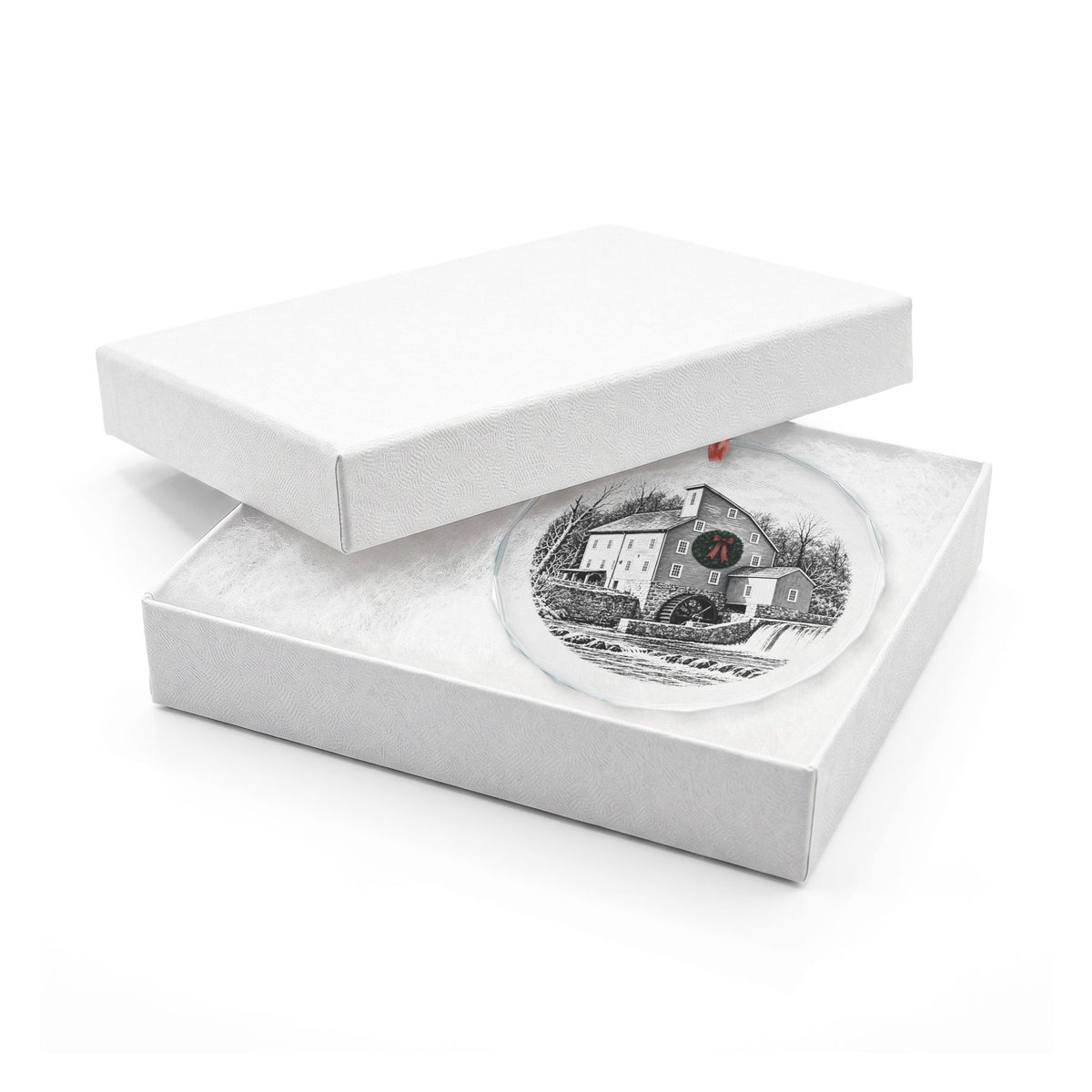
In 1960 five townsmen - an insurance man, a lumberyard owner, the restaurateur at the Clinton House, a schoolteacher, and the artist James Marsh - bought the derelict mill for fifteen thousand dollars and met every Friday at noon at the Clinton House for twelve years until it was a museum. Marsh bought the quarry and gave it to them. That is the mill in our drawing: the wheel they put back, the stone dam and the falls, bare winter trees, and an evergreen wreath with a red bow on the mill wall, because December in Clinton starts when the lights go on at the mill.
The art is our own pen-and-ink drawing, printed on a three-inch faceted crystal glass round and white-backed so the lines read sharp against a lit tree; the wreath and bow are the only color. The faceted edge catches light from every angle. Arrives boxed - your choice of white or gold gift box at checkout. For Clinton and Hunterdon County, for anyone who has stood on the Main Street bridge with a camera, for mill and river people. Merlin Classics profits support hunger relief. See the rest of our crystal glass town ornaments.
3-inch (76 mm) round crystal glass ornament · faceted gem-cut edge · white-backed print for crisp contrast · red ribbon hanger · your choice of white or gold gift box, included · free U.S. shipping.
Share


Wear Local. Feed Local. Stay Classic.
Product FAQs
How does your sizing work?
Because items are made to order, we can’t accept returns for sizing or color choices. We do accept returns for defects, misprints, or shipping damage. Please review the detailed photos and descriptions before purchasing. Women’s fitted tees run small; if you prefer a looser fit, consider sizing up.
How do I send gifts?
All items ship without prices and include a simple packing slip for easy gifting. Enter the recipient’s shipping address and your billing address at checkout. Use your contact info to receive tracking updates. Orders typically arrive within 6–11 business days—please allow extra time for time-sensitive gifts.
How do I care for my item?
For apparel: wash cold, inside-out, with like colors; avoid bleach and high heat; tumble dry low or hang dry. For embroidery, iron inside-out to protect the stitching. See specific care instructions in product descriptions and also follow general best practices in caring for your items for long term enjoyment.
How are items made and when will they arrive?
We make each item on demand using premium blanks, embroidery, and soft-hand prints. Production usually takes 2–5 business days (excluding weekends and holidays). You’ll receive tracking once shipped. We currently ship to U.S. addresses via USPS, UPS, or FedEx. Most orders arrive within 6-12 business days.
What’s the return/exchange policy?
We accept returns for defects, misprints, or damage on arrival. Report issues within 30 days with photos and your order number, and we’ll replace or refund. Size or color changes aren’t supported after purchase, so please consult size charts before ordering if you are at all unsure.
Who are we?
Merlin Classics is a volunteer-run, AI-assisted apparel project celebrating timeless local style. Every item is made to order, and profits (revenue minus external product/marketing cost) support hunger-relief programs in the communities our collections spotlight. Classic looks, real local impact—every purchase helps.