Free U.S. Shipping
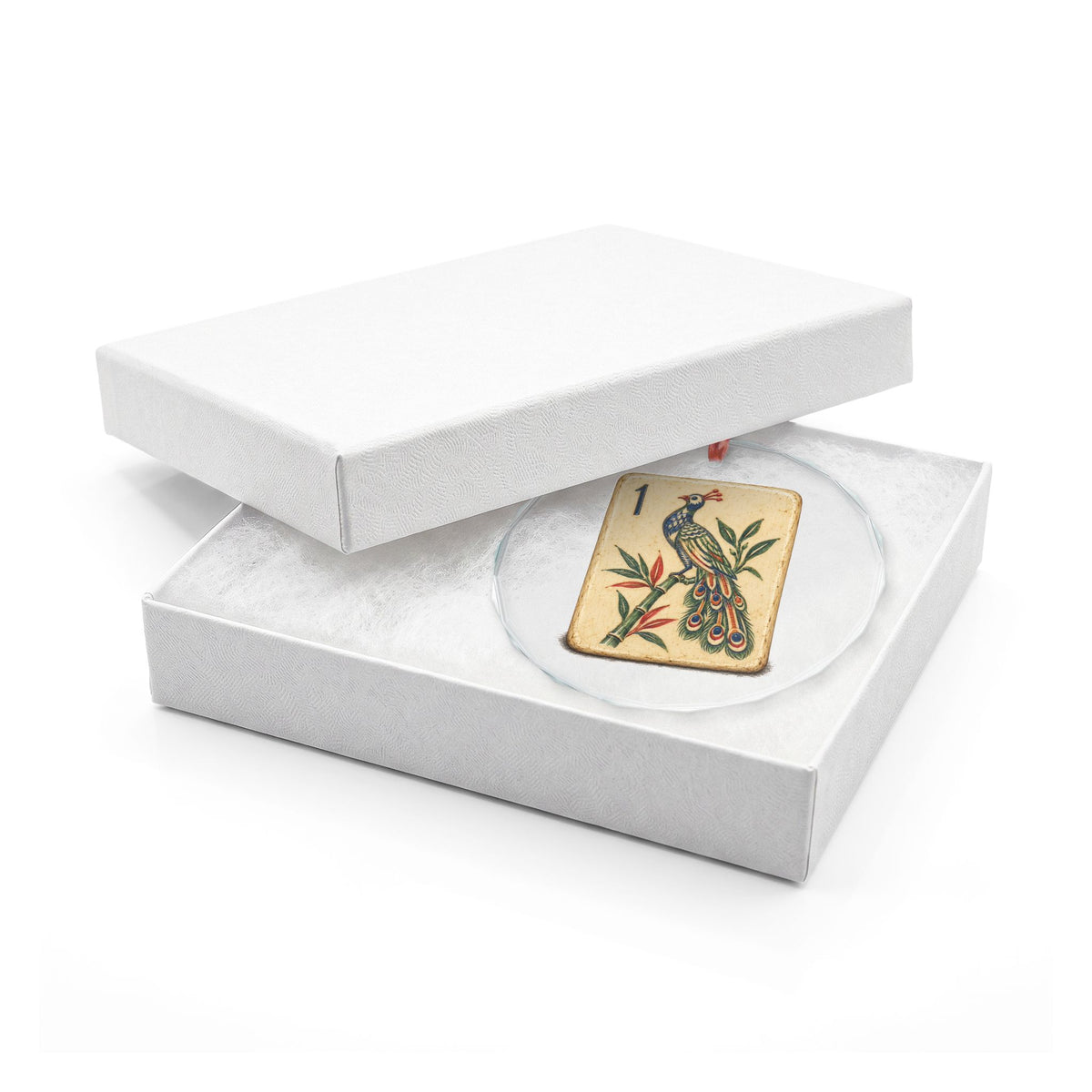
The game is named for this bird. In Cantonese mahjong is maa zoek, sparrow — the usual explanation being that a table of tiles being washed sounds like a tree full of them. The One Bamboo is the only picture tile in the three suits, and on the old bone-and-bamboo sets the carver gave it everything he had: a crested bird on a bamboo stalk, tail fanned, the numeral cut in the corner. Engraved in that hand-cut line and printed on clear crystal, with faded jade, indigo and vermilion in the feathers.
Nobody can say exactly where mahjong began, which has not stopped anyone from claiming it. The best evidence puts it in the Yangtze delta in the 1860s and 1870s, among the card games of Ningbo and Shanghai, and Ningbo has built a museum to the claim; a local story credits an official named Chen Yumen with assembling the tiles, and it is a good story even if nobody can prove it. From there the game went down the coast and across the water to Hong Kong, where it became the city's game the way baseball became Brooklyn's. Hong Kong plays it fast and for money: thirteen tiles in the hand, a hundred and forty-four on the table with the flowers and seasons in, scoring counted in fan with a three-fan minimum at most tables, and a self-drawn win worth more than one claimed off a discard. The limit hands have names like Thirteen Orphans and Nine Gates and are talked about for years afterward. The tiles themselves were a Hong Kong trade — hand-carved and hand-colored in shophouses on the Kowloon side, a craft that outlasted the factories by decades. The sound of it on a Sunday afternoon, through an open window in a walk-up, with a grandmother at the table who has not lost since the Handover, is Hong Kong.
A three-inch clear crystal ornament with a faceted edge, the engraving printed to the glass so the cut bird reads like a bone tile held to a window. The bird is the crested peacock-sparrow of the old sets, perched on a single stalk of bamboo with the numeral 1 in the upper corner, the ivory face crackled with age. It hangs on the tree, on the handle of the tile case, or on a hook by the door of anyone who has ever shouted sik wu.
For the Hong Konger abroad, the grandmother who taught everyone at the table and still beats them, the Cantonese kitchen where the tiles come out after dinner at the New Year, and anyone who learned pung, kong, chow before they could read.
A plain set prints characters on the dragons. This one has the bird, because the bird is the name.
3-inch (76 mm) round crystal glass ornament, faceted gem-cut edge, white-backed print for crisp contrast, red ribbon hanger, white or gold gift box chosen at checkout, free U.S. shipping.
QUICK FACTS — MAH JONGG HOLIDAY ORNAMENT — THE SPARROW TILE
Series: Heritage Mah Jongg, from The Mah Jongg Collection
Design: The Sparrow Tile — the One Bamboo sparrow tile, drawn in the engraved style of an old set, printed artwork
Blank: 3-inch (76 mm) round clear crystal glass ornament, faceted gem-cut edge
Print: white-backed print for contrast, red ribbon hanger
Packaging: white or gold gift box, chosen at checkout
Made to order in the USA