Sonoma California — Retro Vintage History
What's with the Bear? Before sunrise on June 14, 1846, about thirty American settlers rode south into the Mexican pueblo of Sonoma, took General Mariano Vallejo into custody at his home on the edge of the town's eight-acre plaza, and raised a flag one of them had hand-painted on a strip of unbleached cotton: a grizzly bear, a five-pointed star, a red bar, and the words "California Republic." The painter, William Todd, meant his bear to look fierce; locals reportedly thought it looked more like a stray pig. Fierce or not, it held. The settlers declared an independent republic — the only one California has ever had — and it lasted just twenty-five days, until the United States flag went up over the same plaza on July 9, 1846. But the bear endured. That hand-painted grizzly and star became the basis of the California state flag, formally adopted in 1911, and the Bear Flag still flies over Sonoma Plaza every June 14. The bear on the flag — and on our Sonoma logo — was born right here.
Wear the HistoryCoast Miwok, Southern Pomo, and Wappo people had lived in the Sonoma Valley — Jack London's "Valley of the Moon" — for thousands of years before any of this. Father José Altimira raised Mission San Francisco Solano on the north edge of what would become the plaza on July 4, 1823 — the twenty-first, last, and northernmost of the California missions, and the only one founded under Mexican rather than Spanish rule. The mission was secularized in 1834. General Mariano Guadalupe Vallejo arrived from Monterey the following year and in 1835 laid out the Mexican pueblo of Sonoma around its eight-acre plaza, building barracks on the north side and his own home, Lachryma Montis, just west of town. Twelve years later, the Bear Flag Party rode in. After the United States took California in 1848 and statehood followed on September 9, 1850, Sonoma settled into its second chapter — agriculture, wine, and the railroad. Agoston Haraszthy founded Buena Vista Winery just east of town in 1857, planting European Vitis vinifera and earning the title father of California viticulture. The city formally incorporated in 1883.

Walk Sonoma Plaza today and the town is still organized around it. Eight acres of lawns, paths, fountains, a pond, and a 1908 Mission Revival City Hall at the center, ringed on all four sides by an unbroken arc of adobe and brick — the same buildings that framed the pueblo when Vallejo laid it out in 1835 and the Bear Flaggers raised their standard in 1846. Mission San Francisco Solano stands on the northeast corner, the Sonoma Barracks beside it; the Bear Flag Monument, a bronze of a Bear Flagger raising the flag dedicated in 1932, marks the spot on the northeast lawn where Todd's flag went up. The Toscano, Swiss, and Sonoma Hotels face the square from the north and west. It is the largest town plaza in California, a National Historic Landmark district — and the only town square in the state where a sovereign republic was ever declared.
The town's lore comes from the Plaza and from the Valley. Residents will point you to the back room of the Sonoma Barracks where Todd is said to have painted the flag the night before the raising, and tell you how Vallejo, in full dress uniform, offered the Bear Flaggers his own brandy while waiting to be taken to Sutter's Fort. They'll point east to Buena Vista's 1857 vines and the European rootstock Haraszthy brought back that started an industry, and north to Glen Ellen, where Jack London wrote The Valley of the Moon at Beauty Ranch and died in 1916 with a Sonoma novel on his desk. And they will tell you, too, that Coast Miwok, Pomo, and Wappo families lived in this valley for thousands of years — and that the 1838 smallpox epidemic which swept the Sonoma Valley remains the heaviest layer of that long history.
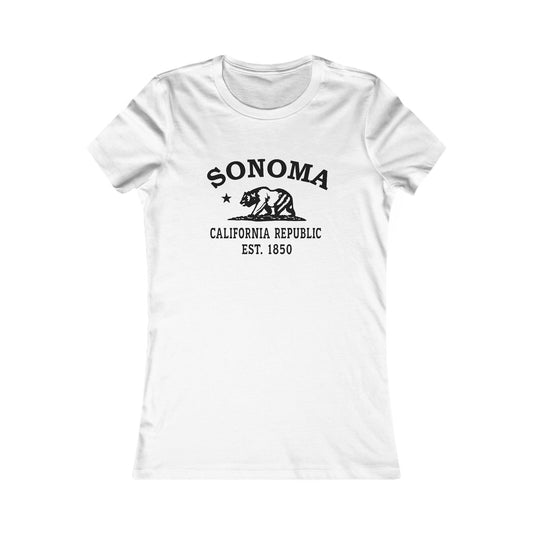
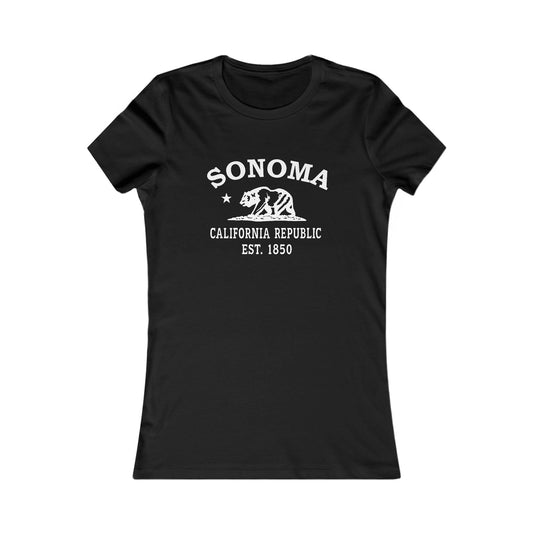
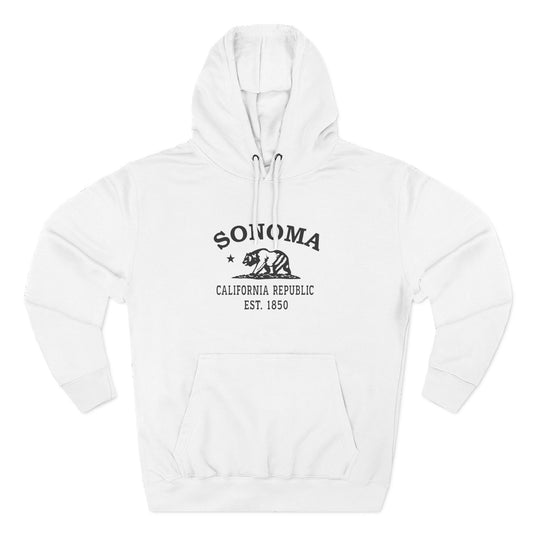
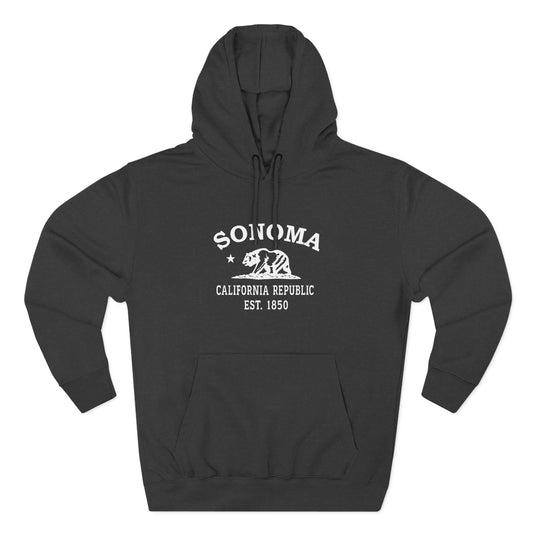
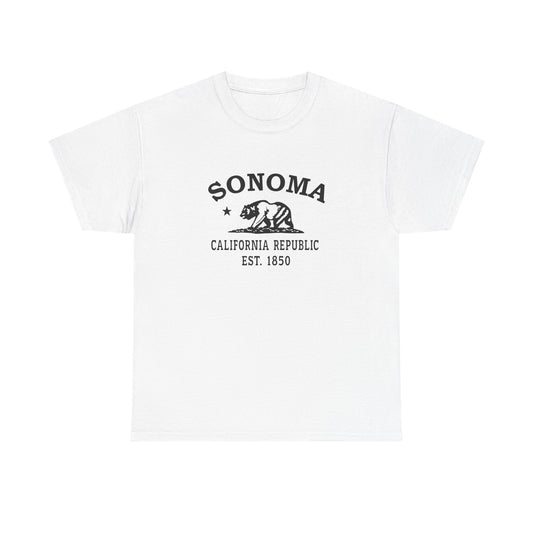
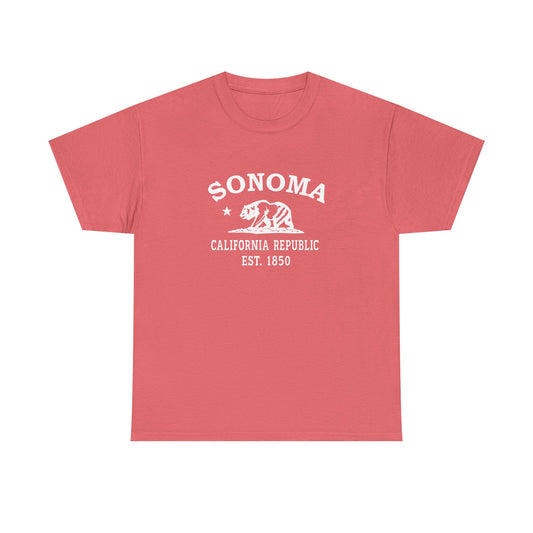
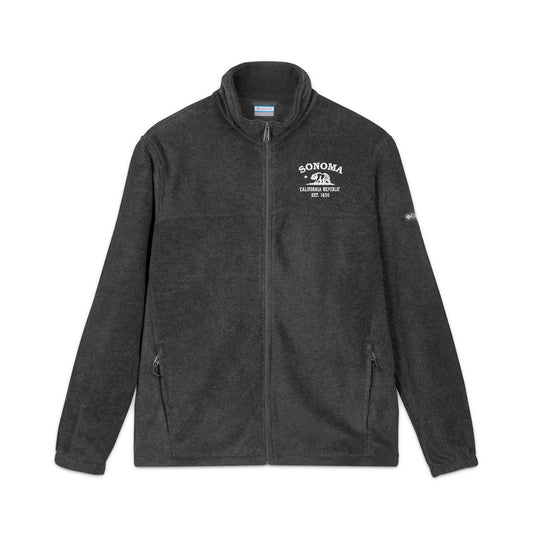
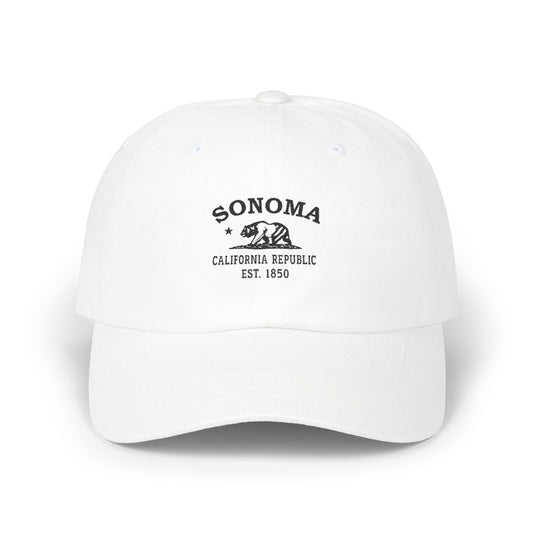
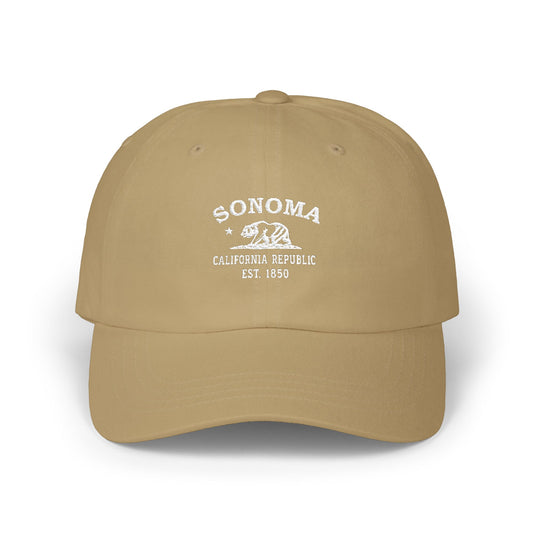
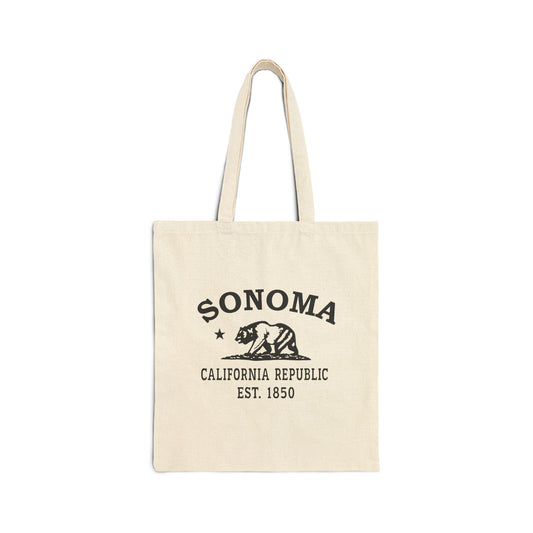
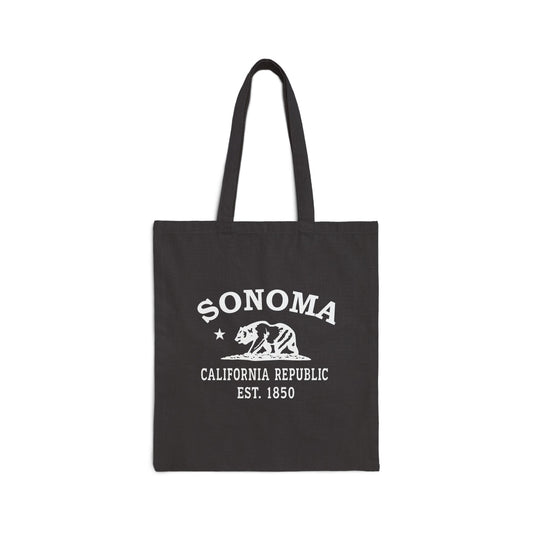
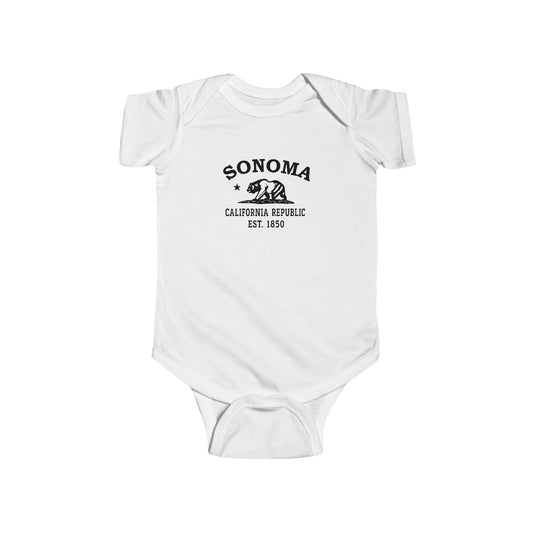
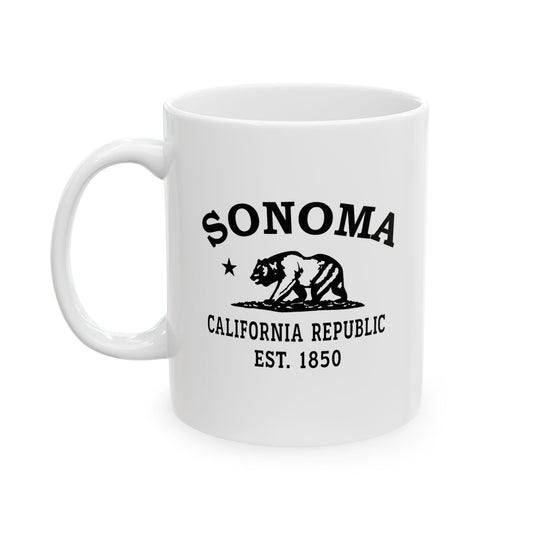
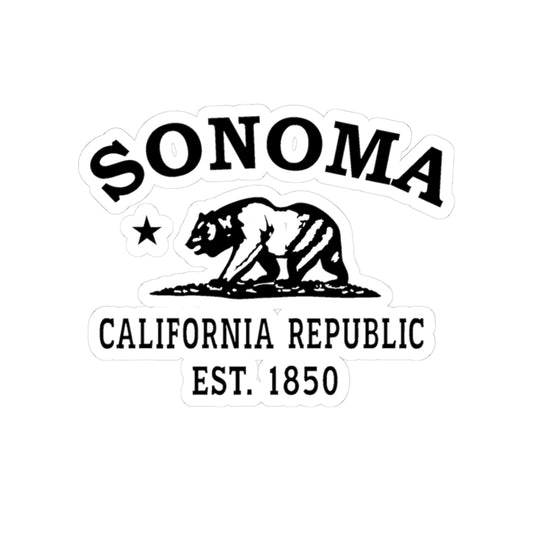
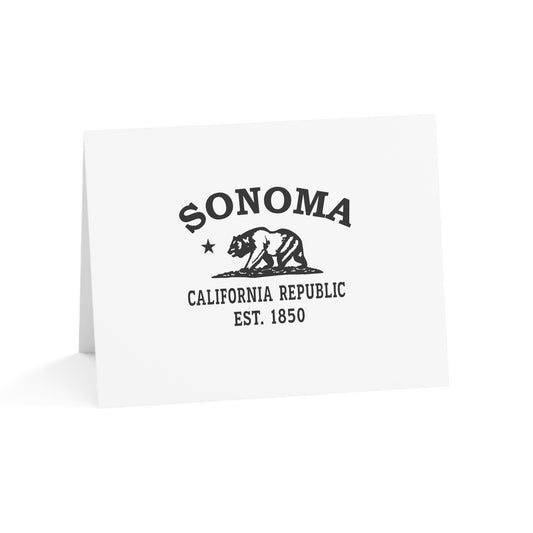
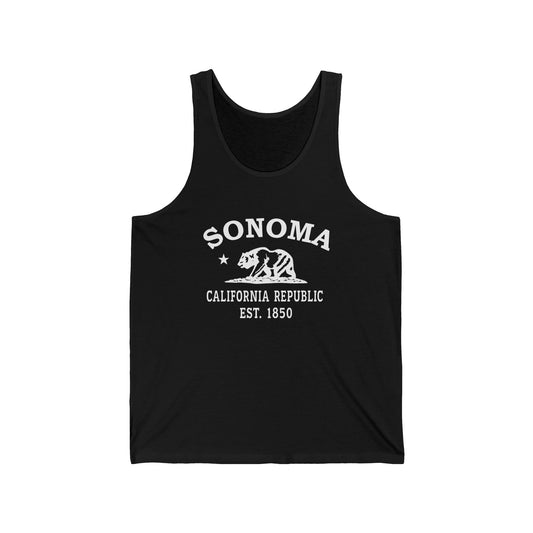
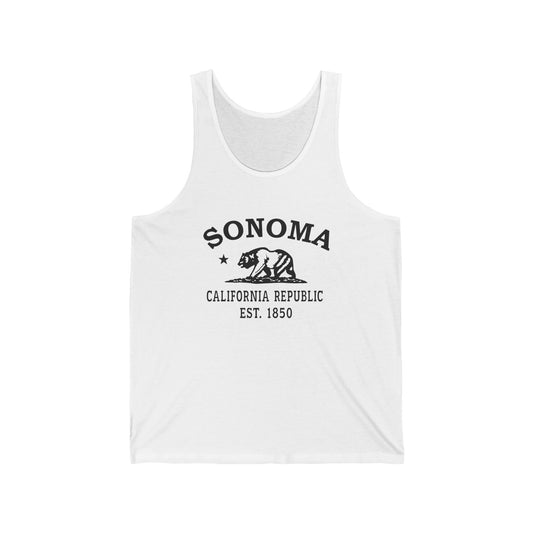
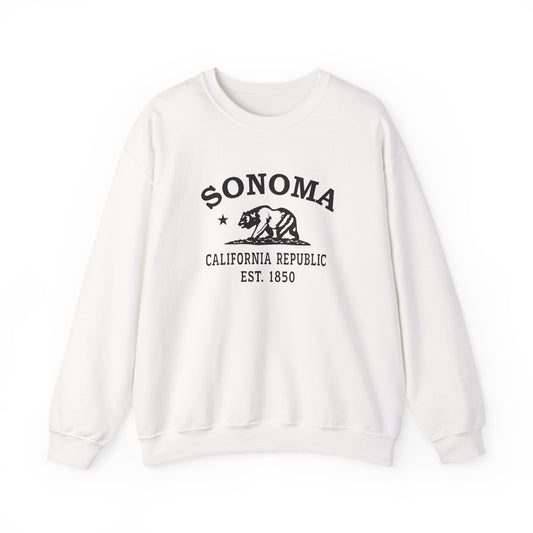
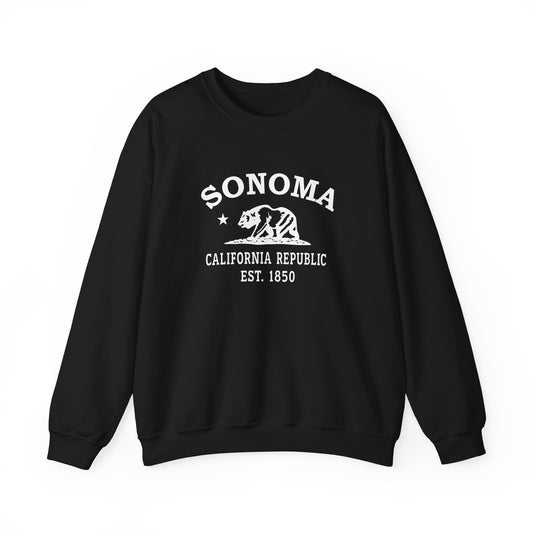
Our Sonoma retro logo carries the California Republic bear and star — the same bear and star Todd hand-painted on the Plaza in 1846, the same pair that became the state flag in 1911. The "Est. 1850" beneath them marks California statehood, the year the Republic settled finally into the United States. Rendered in black-and-white with a hand-printed, distressed feel, the design reads less like a souvenir and more like a piece of California's actual paperwork — the original flag, the original star, the original year. On a tee or a cap it carries the simplest possible statement: California started here.
Today Sonoma is the historic anchor of California's wine country, a year-round destination organized around the same eight-acre plaza General Vallejo paced out in 1835. Visitors come for the Plaza, the Mission, the Barracks, the Bear Flag Monument and the adobes; for the Sonoma Valley AVA wineries north and east of town pouring Cabernet, Chardonnay, Pinot Noir, and Zinfandel; for the Valley of the Moon drive up to Glen Ellen; and for the Sonoma Coast a short drive west. Our Sonoma designs gather that identity into wearable form. Explore the collection and carry California's flag with you.

Sonoma California — Travel Guide
Visiting Sonoma California Today
Sonoma sits in the southern Sonoma Valley about an hour north of San Francisco, organized around the largest town plaza in California — eight acres of lawn ringed by mission-era adobes and Mexican-era civic buildings. The town is compact and walkable; the Plaza, Mission San Francisco Solano, the Sonoma Barracks, the Bear Flag Monument, Lachryma Montis (Vallejo's home), and the Toscano and Swiss Hotels are all within fifteen minutes on foot of one another. Late spring through fall is the prime travel window. June 14 is Bear Flag Day, with the Plaza re-enactment. The August–October crush season is the marquee wine-tourism stretch.
Sonoma Plaza, Mission Solano, Bear Flag Monument & Sonoma Valley Wine Country
For visitors searching for things to do in Sonoma California:
- Walk Sonoma Plaza — eight acres, the largest town plaza in California, ringed by adobes, with the Mission Revival City Hall in the center and the Bear Flag Monument on the northeast lawn.
- Tour Mission San Francisco Solano on the Plaza's northeast corner — the 21st, last, and northernmost of the California missions and the only one founded under Mexican rule, established by Father José Altimira on July 4, 1823.
- Visit the Sonoma Barracks beside the Mission — the 1830s Mexican army barracks where General Vallejo's troops were stationed and where the Bear Flag was painted in 1846, now part of Sonoma State Historic Park.
- See the Bear Flag Monument on the Plaza's northeast lawn — a bronze of a Bear Flagger raising the flag, dedicated in 1932 on the spot where the original flag was raised on June 14, 1846.
- Tour Lachryma Montis, General Vallejo's Carpenter-Gothic home a short walk west of the Plaza, preserved as part of Sonoma State Historic Park.
- Visit Buena Vista Winery just east of town — founded in 1857 by Agoston Haraszthy, the father of California viticulture, and the birthplace of California's premium wine industry.
- Drive the Sonoma Valley AVA — the Valley of the Moon — north toward Glen Ellen and Kenwood, with vineyards producing Cabernet, Chardonnay, Pinot Noir, and Zinfandel, oak hills, and the Mayacamas Mountains forming the eastern wall.
- Detour to Jack London State Historic Park in Glen Ellen — the Beauty Ranch where London wrote The Valley of the Moon, a regional Sonoma Valley site about twenty minutes north.
- Drive west to the Sonoma Coast — about forty miles to Bodega Bay and the long Pacific shoreline of Sonoma Coast State Park.
- Return June 14 for Bear Flag Day, when the Plaza fills for the annual re-enactment of the 1846 raising.
Why People Visit Sonoma California
Sonoma is the rare California town where the state's earliest chapters are still standing on the same square. Visitors come for the Plaza — the largest town plaza in California — and the adobes that ring it. They come for the Bear Flag Monument and the story of the 25-day California Republic. They come for Mission San Francisco Solano, the last of the California missions. They come for Buena Vista and the Sonoma Valley AVA, where California's premium wine country began. And they come because Sonoma is, in the most literal way, where California started.
Wear the History
Kindred Cities
Greetings, friends from Chambolle-Musigny, France (bienvenue) — our partner in the heart of Burgundy.
Sonoma and Chambolle-Musigny are two wine villages that understood each other at first sip. Chambolle-Musigny is a tiny Burgundian commune of barely three hundred souls, its name on some of the most coveted Pinot Noir on earth; Sonoma is the cradle of California wine, where the first mission vines were planted and the Bear Flag was raised on its leafy plaza. Both measure life by the vine and the vintage.
Sonoma made Chambolle-Musigny its sister in 1959 — its oldest such bond — the work of Sonoma vintner Frank Bartholomew, who had friends in the Burgundy village. The partnership still goes by 'Chamson,' half Chambolle, half Sonoma.
Come from Chambolle-Musigny and Sonoma will pour you a warm welcome: tasting rooms ringing a historic plaza, the mission and the Bear Flag monument, golden hills of vineyard, and a table that takes its wine and its food equally seriously. Come and visit us soon.
When you plan the trip, the Sonoma Valley Visitors Bureau is the place to start.
Wear the History

For deeper reading on the Sonoma, California history described here — the 1823 founding of Mission San Francisco Solano by Father José Altimira as the last and northernmost of the California missions and the only one established under Mexican rule, the 1834 secularization of the mission, the 1835 founding of the Mexican pueblo of Sonoma by General Mariano Guadalupe Vallejo around the eight-acre plaza that is still the largest town plaza in California, the June 14, 1846 raising of the hand-painted Bear Flag in Sonoma Plaza by the Bear Flag Party and the 25-day California Republic under William B. Ide that followed, the July 9, 1846 raising of the United States flag over the same plaza ending the Republic, the September 9, 1850 admission of California to the Union as the 31st state, the 1857 founding of Buena Vista Winery just east of town by Agoston Haraszthy as the birthplace of California viticulture, the 1883 incorporation of the City of Sonoma, the 1911 adoption of the Bear Flag as the official state flag of California, and the long Coast Miwok, Southern Pomo, and Wappo heritage of the Sonoma Valley before any of it — it may be useful to consult (1) the Sonoma State Historic Park interpretive collections covering the Mission, the Barracks, the Toscano Hotel, and Lachryma Montis, (2) the Sonoma Valley Historical Society and the Depot Park Museum in Sonoma for local town and Plaza history, (3) the California State Library and California State Archives in Sacramento for the Bear Flag Revolt documents, Vallejo papers, and California Republic records, (4) the Bancroft Library at the University of California, Berkeley for Mexican-era Alta California land grants, mission records, and the Hubert Howe Bancroft California historical collection, and (5) the California Historical Society in San Francisco for Bear Flag, Vallejo, Haraszthy, and California-statehood collections. For deeper local and family-history research in Sonoma, the Sonoma Valley, and Sonoma County, it may be useful to reach out to (1) the Sonoma Valley Historical Society and the Sonoma Public Library local history room, (2) the Sonoma County History & Genealogy Library in Santa Rosa, (3) the Sonoma County Library system genealogy collections, (4) the California Mission Studies Association for mission-era research, and (5) the State Historic Preservation Office of California for Sonoma Plaza National Historic Landmark district records, Sonoma Barracks records, and Mission San Francisco Solano records. For travel and visitor information, it may be useful to contact (1) the Sonoma Valley Visitors Bureau, (2) the Sonoma Plaza Visitor Center, (3) California State Parks for Sonoma State Historic Park and Jack London State Historic Park, (4) Sonoma County Tourism for broader regional travel, and (5) the National Park Service for the Juan Bautista de Anza National Historic Trail context.
Shop the Sonoma California collection
View full collection-
Sonoma California Vintage Retro Premium Crewneck Sweatshirt - Black Logo
Regular price $48.00 USDRegular price -
Sonoma California Vintage Retro Premium Crewneck Sweatshirt - White Logo
Regular price $48.00 USDRegular price -
Sonoma California Vintage Retro Womens Fitted Ringspun Cotton Tee - Black Logo
Regular price $28.00 USDRegular price -
-
Sonoma California Vintage Retro Unisex Heavy Cotton Hoodie - Black Logo
Regular price $56.00 USDRegular price -
Sonoma California Vintage Retro Unisex Heavy Cotton Hoodie - White Logo
Regular price $56.00 USDRegular price -
Sonoma California Vintage Retro Unisex Heavy Cotton Tee - Black Logo
Regular price $22.00 USDRegular price -
Sonoma California Vintage Retro Unisex Heavy Cotton Tee - White Logo
Regular price $22.00 USDRegular price -
Sonoma California Vintage Retro Unisex Embroidered Fleece Jacket - White Logo
Regular price $98.00 USDRegular price -
Sonoma California Vintage Retro Embroidered Cotton Cap - Black Logo
Regular price $32.00 USDRegular price -
Sonoma California Vintage Retro Embroidered Cotton Cap - White Logo
Regular price $32.00 USDRegular price -
Sonoma California Vintage Retro Back Printed Art Series Cotton Tee - Black Logo
Regular price $32.00 USDRegular price -
Sonoma California Vintage Retro Giclée Print Art Series Poster
Regular price From $38.00 USDRegular price -
Sonoma California Vintage Retro Cotton Canvas Tote Bag - Black Logo
Regular price $25.00 USDRegular price -
Sonoma California Vintage Retro Cotton Canvas Tote Bag - White Logo
Regular price $25.00 USDRegular price -
Sonoma California Vintage Retro Cotton Jersey Baby Bodysuit - Black Logo
Regular price $26.00 USDRegular price -
Sonoma California Vintage Retro Ceramic Mug - Black Logo
Regular price From $16.00 USDRegular price -
Sonoma California Vintage Retro Vinyl Sticker - Black Logo
Regular price From $6.00 USDRegular price -
Sonoma California Vintage Retro Thank You Card Set - Black Logo
Regular price From $25.00 USDRegular price -
Sonoma California Vintage Retro Unisex Cotton Jersey Tank Top - White Logo
Regular price $28.00 USDRegular price -
Sonoma California Vintage Retro Unisex Cotton Jersey Tank Top - Black Logo
Regular price $28.00 USDRegular price -
Sonoma California Vintage Retro Unisex Heavy Crewneck Sweatshirt - Black Logo
Regular price $44.00 USDRegular price -
Sonoma California Vintage Retro Unisex Heavy Crewneck Sweatshirt - White Logo
Regular price $44.00 USDRegular price