Sitka Alaska — Retro Vintage History
Where Russia met America in 1867. Sitka sits on the outer Pacific coast of Baranof Island in the Alexander Archipelago — a wet, green rainforest town on the open sea, with the dormant volcano Mount Edgecumbe rising across Sitka Sound like a backdrop painted into the view. The Tlingit have called this stretch of coast Sheet'ká for longer than written history. In 1808, the Russian-American Company moved its capital here from Kodiak and made the town the seat of Russian America — at one point so prosperous and worldly that contemporaries called it "the Paris of the Pacific," a Russian Imperial capital on the Pacific coast more populous than San Francisco at the time. In 1848, Bishop Innocent — Russian Orthodox missionary, ethnographer, and the man who designed the building himself — consecrated St. Michael's Cathedral, the first Russian Orthodox cathedral in North America. Its onion dome and green bell tower still define the Sitka skyline. Then on October 18, 1867, on the bluff that locals still call Castle Hill, the formal transfer ceremony took place: Prince Dmitry Maksutov, the last Russian governor, watched the Imperial Russian flag come down, and General Lovell Rousseau watched the American flag go up. The price had been $7.2 million, paid by Secretary of State William Seward — about two cents an acre for territory more than twice the size of Texas. Alaska Day has been observed every October 18 since. The Russian Bishop's House from 1842 is still standing, the oldest intact Russian building in Sitka. In 1910 the federal government designated Sitka National Historical Park — the oldest federally designated park anywhere in Alaska. And in 1912, in this same town, a small group of Tlingit founded the Alaska Native Brotherhood, one of the earliest civil-rights organizations representing indigenous peoples anywhere in the Americas. The Russian flag hasn't flown over Castle Hill in 159 years. The cathedral, the bishop's house, the totems in the forest park, the dome, the hill, and the brotherhood are all still here.
Wear the HistoryWhat's with the forest saints of Sitka? Sitka lives inside rainforest, where spruce and hemlock crowd close and fog moves between trunks like breath, so the woods can feel like a living room with the lights turned down. Trails stay damp, sound stays soft, and distance is hard to judge. Forest Saints is the name people give to certain big trees that quietly mark turns, camps, and the start of a real path, the trunks everyone recognizes without admitting it. Look closely and you often find ribbons or tags tied there, practical guides in a sea of green. Dense canopy and trail culture make the system work, but the name fits — the forest feels present, not empty.
Sitka, originally home to the Tlingit people, was settled by Russians in 1799 as New Archangel. It became the capital of Russian America until the 1867 Alaska Purchase. Sitka's founding identity reflects cultural layering: Indigenous resilience, Russian influence, and American expansion. Fishing and trade supported survival, while conflict and adaptation shaped community pride. Sitka's story highlights Alaska's duality: Native continuity and colonial ambition. Its origins emphasize endurance and cultural blending, creating a layered identity where tradition and adaptation coexisted, making Sitka one of Alaska's most historic and culturally rich towns across centuries of resilience.

In the nineteenth century, Sitka thrived as a colonial capital. After 1867, it became an American trading hub. Fishing and logging supported its economy. By the 1950s and 1960s, Sitka expanded with schools, churches, and cultural festivals. Suburban neighborhoods balanced with fishing traditions. Its timeline reflects Alaska's adaptability: colonial capital transformed into modern community. Sitka's mid-century decades highlighted continuity and cultural pride, blending Russian heritage, Indigenous traditions, and suburban optimism. The town demonstrated resilience, showing how layered identities endured even as modern development grew. Sitka's story reflects Alaska's broader narrative of cultural continuity and endurance.
Sitka's lore includes Tlingit legends of spirits guarding forests, Russian myths of saints protecting settlements, and stories of American pioneers braving storms. Families recall fishing festivals, parades, and church celebrations in the 1950s. Residents remembered rebuilding after storms and cultural pride uniting the community. Lore reflects both myth and memory, highlighting continuity, resilience, and adaptation. Sitka's stories emphasize its dual identity: Indigenous, Russian, and American. These tales illustrate resilience, ensuring heritage remained central. Fact and legend together highlight Sitka's layered cultural pride, making it a proud emblem of Alaska's unique, enduring identity across centuries.
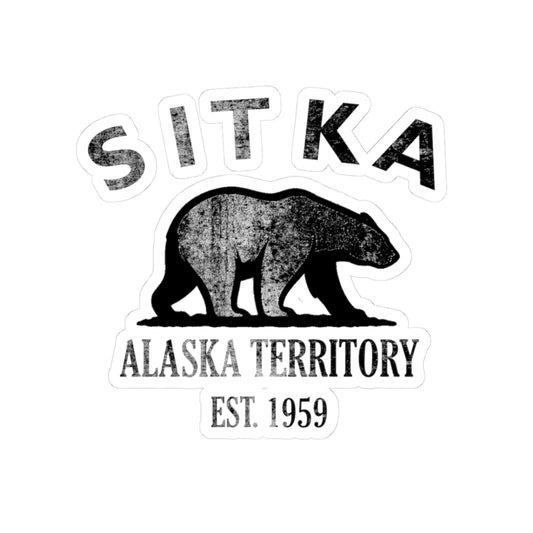
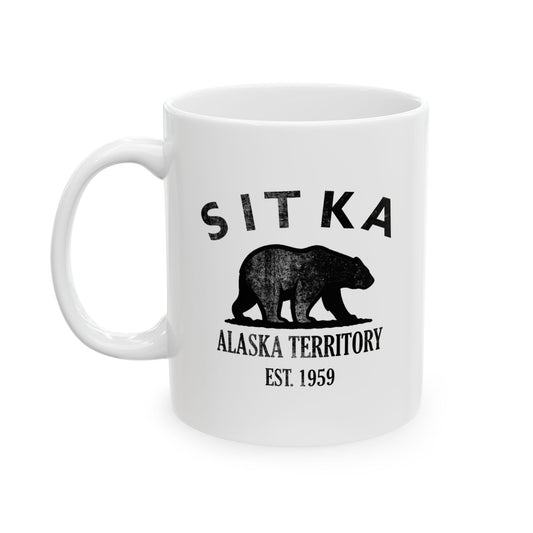
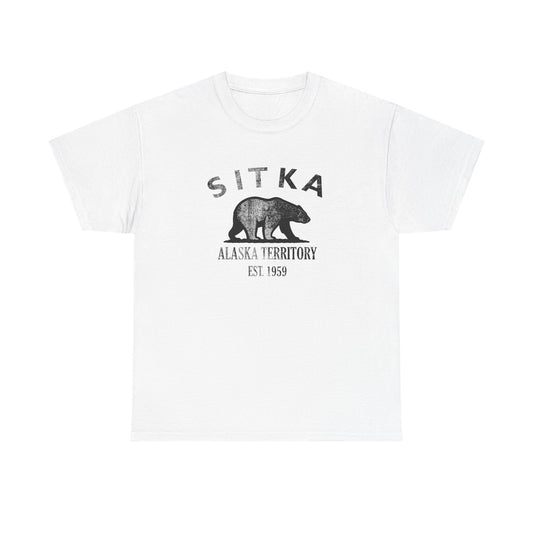
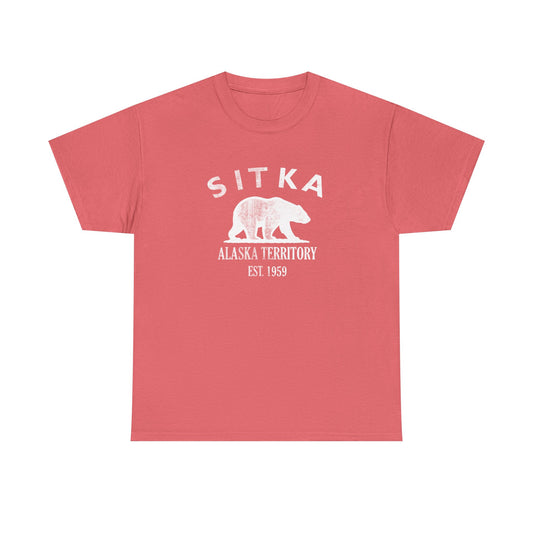
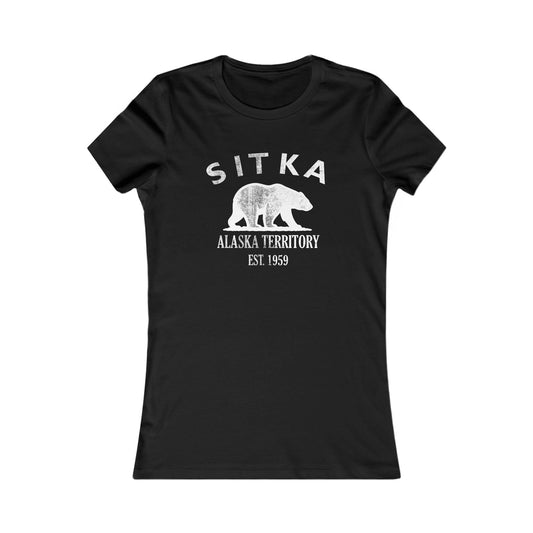
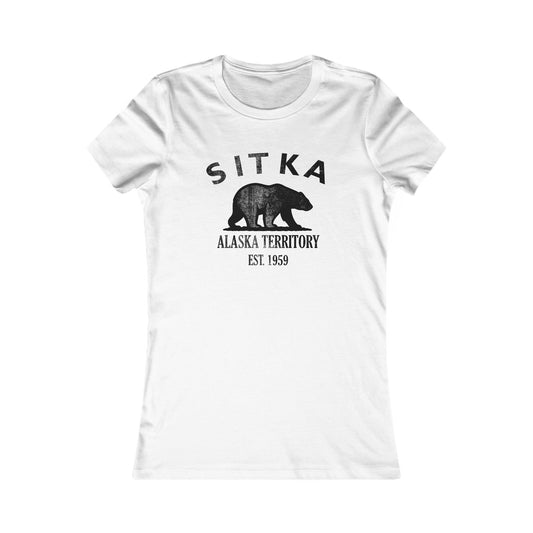
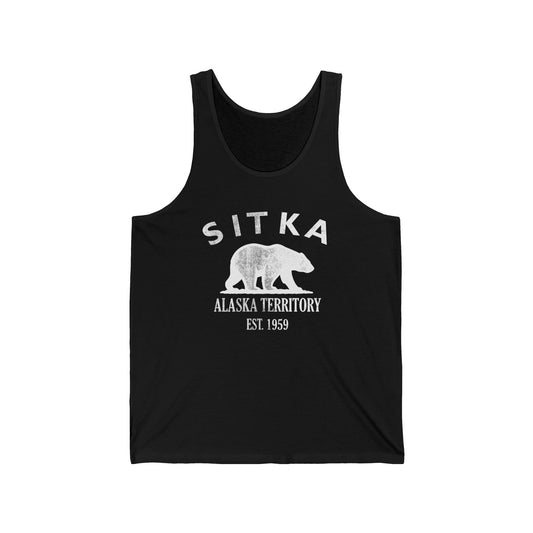
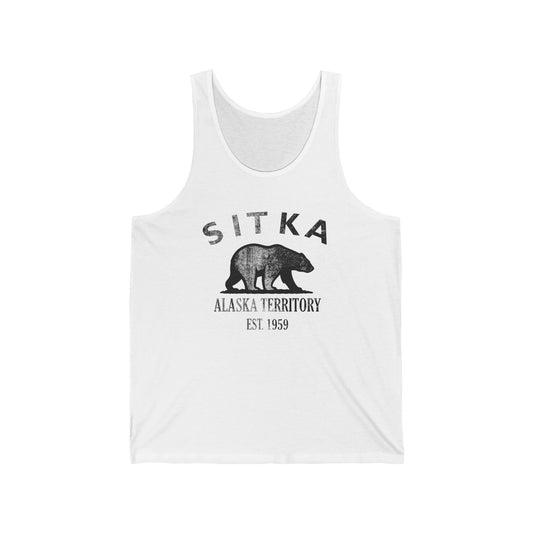
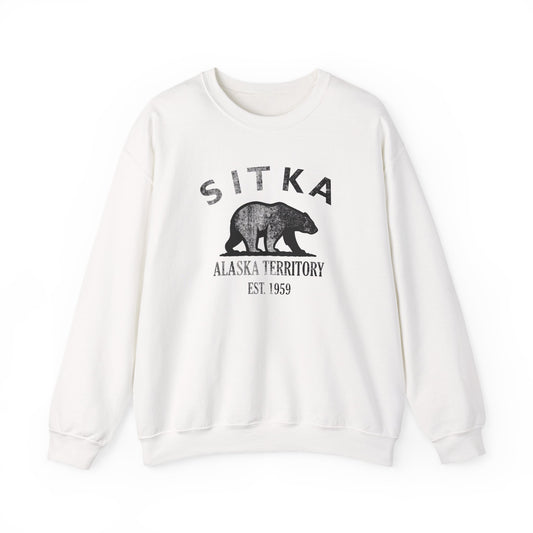
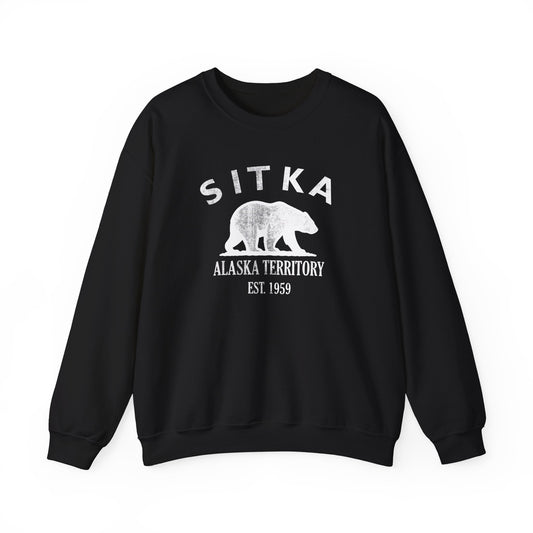
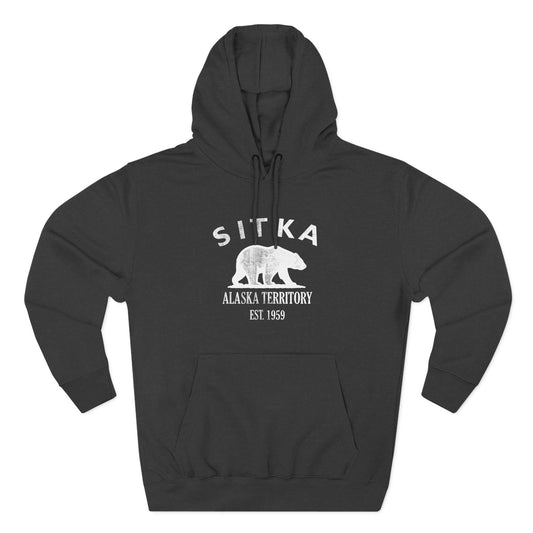
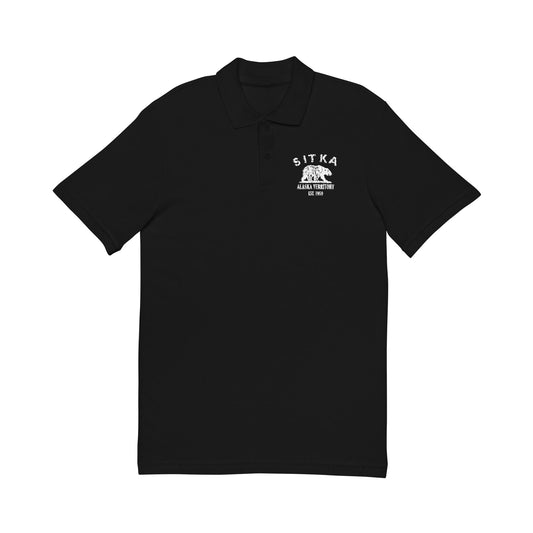
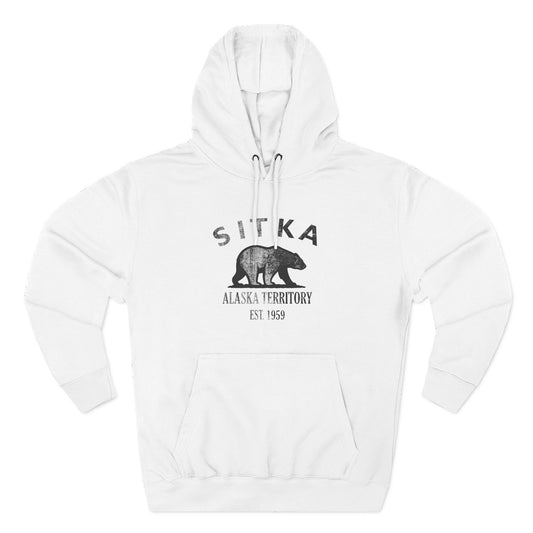
Our Sitka retro logo uses Alaska's distressed bear motif, symbolizing toughness, resilience, and wilderness pride. The bear reflects Indigenous reverence and colonial survival, while "1959" ties the design to Alaska's statehood. Its black-and-white styling is rugged, retro, and authentic, resembling crate stamps or outfitter branding. The motif bridges Sitka's dual identity: colonial capital and modern fishing hub. On merchandise, it conveys authenticity and pride, retro vintage in tone. The bear emblem honors Sitka's layered identity, making it a vintage symbol of Alaska's cultural pride. Retro in style, it reflects resilience, heritage, and continuity, suited for cultural identity.
Today Sitka is celebrated for its cultural diversity, Russian churches, and Indigenous traditions. Its story reflects Native heritage, colonial roots, and American growth. Our Sitka designs embody this layered identity, pairing the bear motif with vintage styling. They invite you to explore the Sitka collection and carry forward a reminder of Alaska's resilience. Retro in tone, the logo reflects authenticity and cultural pride. Sitka's emblem honors both heritage and modern growth, making it a vintage symbol of Alaska's identity. Explore the collection and share in Sitka's story of resilience, heritage, and cultural continuity.

Sitka Alaska — Travel Guide
Visiting Sitka Alaska Today
Sitka sits on the outer Pacific coast of Baranof Island in Southeast Alaska's Alexander Archipelago and Inside Passage, with the dormant volcano Mount Edgecumbe rising across Sitka Sound. Air access daily on Alaska Airlines and Inside Passage ferry access on the Alaska Marine Highway. The town of roughly eight thousand four hundred is a major cruise port May through September and one of the most historically layered communities anywhere on the Pacific coast — Tlingit homeland, former Russian Imperial capital, and the birthplace of Alaska Day.
Russian Heritage, Tlingit Heritage, and Pacific Stops in Sitka Alaska
For visitors searching for things to do in Sitka Alaska:
- Visit St. Michael's Cathedral, the 1848 Russian Orthodox cathedral with its iconic green onion-dome and bell tower, the first Russian Orthodox cathedral in North America (the original burned in 1966 and was rebuilt to the original exterior appearance with rescued icons).
- Climb Baranof Castle Hill, the bluff where the formal Alaska Transfer Ceremony took place on October 18, 1867 — the day the Russian flag came down and the American flag went up. Alaska Day is celebrated here every October 18.
- Walk Sitka National Historical Park, the oldest federally designated park in Alaska (established 1910), with totem-pole trails through old-growth coastal rainforest along the Indian River.
- Tour the Russian Bishop's House, the 1842 home of Bishop Innocent — the oldest intact Russian-built building in Sitka and a National Historic Landmark.
- Visit the Sheldon Jackson Museum, the 1895 octagonal concrete building that is the oldest museum in Alaska, holding collections of Alaska Native art and material culture.
- Stop at the Alaska Native Brotherhood Hall on Katlian Street, built in 1914 — headquarters of the civil-rights organization founded in Sitka in 1912.
- See Mount Edgecumbe, the 3,201-foot dormant stratovolcano on Kruzof Island that frames every view of Sitka Sound.
- Visit the Alaska Raptor Center, the nonprofit rehabilitation facility for injured eagles, hawks, and owls along the Indian River.
- See Fortress of the Bear, the nonprofit rescue and rehabilitation center for orphaned brown and black bear cubs.
- Drive across the O'Connell Bridge, the 1972 span that was the first cable-stayed bridge built in the United States, connecting Sitka to Japonski Island and the airport.
- Attend Sitka WhaleFest the first week of November during the humpback whale migration through Sitka Sound — the festival has been running annually since 1995.
Why People Visit Sitka Alaska
Sitka offers world-historical depth in a working Alaska fishing town — Tlingit heritage, Russian Imperial architecture, the birthplace of Alaska Day, old-growth coastal rainforest, totem poles, and a working harbor — all within a walkable downtown along the outer Pacific. Visitors combine cathedral and museum stops with rainforest trails, whale-watching, raptor rehabilitation tours, and the simple pleasure of standing on the hill where the flags changed in 1867. It is photogenic, walkable, and unlike any other town on the Alaska coast.
Wear the History

For deeper reading on Sitka, Alaska history described here — the Russian-American Company capital era 1808-1867, the October 18 1867 Alaska Transfer Ceremony at Baranof Castle Hill, St. Michael's Cathedral and the first Russian Orthodox cathedral in North America, the 1910 founding of Sitka National Historical Park, and the 1912 founding of the Alaska Native Brotherhood — it may be useful to consult (1) the Sitka National Historical Park visitor center and archives administered by the National Park Service, the primary federal repository for Russian-era and Tlingit material at Sitka, (2) the Sheldon Jackson Museum operated by the Alaska State Museums system, the oldest museum in Alaska holding collections on Russian-American and Alaska Native heritage, (3) the Alaska State Library and Historical Collections in Juneau for territorial-era documents including the 1867 transfer records and the records of the Russian-American Company, (4) the University of Alaska Southeast Egan Library and the University of Alaska Fairbanks Rasmuson Library for primary archival materials, and (5) the Smithsonian National Museum of Natural History Arctic Studies Center for Tlingit ethnographic collections and broader Northwest Coast research. For deeper local and family history research in Sitka, Baranof Island, and the surrounding Alexander Archipelago, it may be useful to reach out to (1) the Sitka History Museum, (2) the Russian Orthodox Diocese of Alaska for Russian Orthodox church records, (3) the Central Council of Tlingit and Haida Indian Tribes of Alaska, (4) the Alaska Native Brotherhood Grand Camp historical archive, and (5) the Anchorage Museum at the Rasmuson Center for Alaska Native art and historical collections. For travel and visitor information in Sitka, it may be useful to contact (1) the Visit Sitka Convention and Visitors Bureau, (2) the Alaska Travel Industry Association, (3) the National Park Service Sitka National Historical Park visitor information desk, (4) the Alaska Marine Highway System for ferry connections through the Inside Passage, and (5) the State of Alaska Department of Natural Resources Division of Parks and Outdoor Recreation. Readers interested in the broader cultural reception of Sitka and its history — the centuries of Tlingit presence on Sheet'ká, the 1808-1867 Russian American capital era and its "Paris of the Pacific" nickname, the October 18 1867 transfer ceremony at Baranof Castle Hill and the continuing annual Alaska Day observance, the 1848 consecration of St. Michael's Cathedral as the first Russian Orthodox cathedral in North America, and the 1912 founding of the Alaska Native Brotherhood as one of the earliest civil-rights organizations representing indigenous peoples in the Americas — will find that the named places (Baranof Castle Hill, St. Michael's Cathedral, the Russian Bishop's House, the Alaska Native Brotherhood Hall on Katlian Street, the Sheldon Jackson Museum, Sitka National Historical Park, Sitka Sound, Mount Edgecumbe, Baranof Island, the Alexander Archipelago, the O'Connell Bridge), the named historical figures (Alexander Baranov, Bishop Innocent / Ivan Veniaminov, Yuri Lisyansky, Prince Dmitry Maksutov, William H. Seward, General Lovell H. Rousseau, and Vitus Bering), and the named historical moments (the 1741 Bering expedition first contact, the 1808 establishment of New Archangel as the capital of Russian America, the 1848 consecration of St. Michael's Cathedral, the March 30 1867 Alaska Purchase treaty, the October 18 1867 transfer ceremony at Castle Hill, the 1878 first fish cannery in Alaska, the 1906 transfer of the territorial capital to Juneau, the 1910 designation of Sitka National Historical Park, the 1912 founding of the Alaska Native Brotherhood, the 1966 cathedral fire, the 1972 O'Connell Bridge, and the 1959 Alaska statehood) recur across all of these traditions as a shared cultural grammar of foundational Russian American and Southeast Alaska history grounded specifically on this stretch of outer Pacific coast.
Shop the Sitka Alaska collection
View full collection-
Sitka Alaska Vintage Retro Premium Crewneck Sweatshirt - Black Logo
Regular price $42.00 USDRegular price -
Sitka Alaska Vintage Retro Premium Crewneck Sweatshirt - White Logo
Regular price $42.00 USDRegular price -
Sitka Alaska Vintage Retro Vinyl Sticker - Black Logo
Regular price From $6.00 USDRegular price -
Sitka Alaska Vintage Retro Ceramic Mug - Black Logo
Regular price From $16.00 USDRegular price -
Sitka Alaska Vintage Retro Unisex Heavy Cotton Tee - Black Logo
Regular price $22.00 USDRegular price -
Sitka Alaska Vintage Retro Unisex Heavy Cotton Tee - White Logo
Regular price $22.00 USDRegular price -
Sitka Alaska Vintage Retro Cotton Canvas Tote Bag - White Logo
Regular price $25.00 USDRegular price -
Sitka Alaska Vintage Retro Cotton Canvas Tote Bag - Black Logo
Regular price $25.00 USDRegular price -
Sitka Alaska Vintage Retro Thank You Card Set - Black Logo
Regular price From $25.00 USDRegular price -
Sitka Alaska Vintage Retro Cotton Jersey Baby Bodysuit - Black Logo
Regular price $26.00 USDRegular price -
-
Sitka Alaska Vintage Retro Womens Fitted Ringspun Cotton Tee - Black Logo
Regular price $28.00 USDRegular price -
Sitka Alaska Vintage Retro Unisex Cotton Jersey Tank Top - White Logo
Regular price $28.00 USDRegular price -
Sitka Alaska Vintage Retro Unisex Cotton Jersey Tank Top - Black Logo
Regular price $28.00 USDRegular price -
Sitka Alaska Vintage Retro Embroidered Cotton Cap - White Logo
Regular price $32.00 USDRegular price -
Sitka Alaska Vintage Retro Embroidered Cotton Cap - Black Logo
Regular price $32.00 USDRegular price -
Sitka Alaska Vintage Retro Back Printed Art Series Cotton Tee - Black Logo
Regular price $32.00 USDRegular price -
Sitka Alaska Vintage Retro Unisex Heavy Crewneck Sweatshirt - Black Logo
Regular price $38.00 USDRegular price -
Sitka Alaska Vintage Retro Unisex Heavy Crewneck Sweatshirt - White Logo
Regular price $38.00 USDRegular price -
Sitka Alaska Vintage Retro Giclée Print Art Series Poster
Regular price From $38.00 USDRegular price -
Sitka Alaska Vintage Retro Unisex Heavy Cotton Hoodie - White Logo
Regular price $48.00 USDRegular price -
Sitka Alaska Vintage Retro Unisex Embroidered Cotton Polo - Black Logo
Regular price $48.00 USDRegular price -
Sitka Alaska Vintage Retro Unisex Heavy Cotton Hoodie - Black Logo
Regular price $48.00 USDRegular price