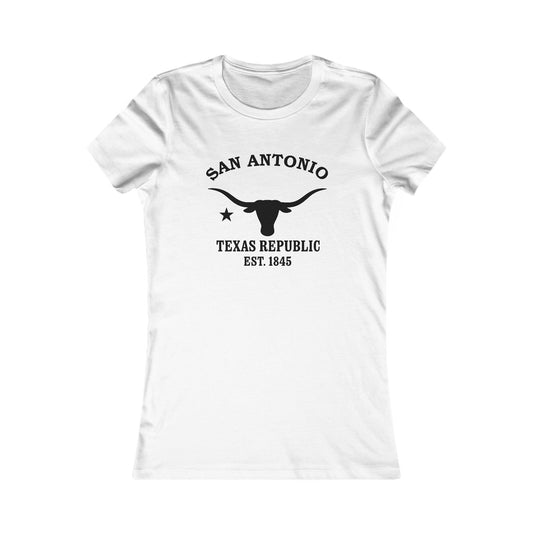
San Antonio Texas — Retro Vintage History
It started with a mission and a river. In 1718 Spanish friars founded a mission and a presidio on a spring-fed river in South Texas and named both for St. Anthony. Within a few years there were five missions strung along the water, and a town grew up among them — built by Spanish friars, Canary Island farmers, German brewers, and Texas cattlemen. Three centuries later the missions are a World Heritage Site and the river is the most famous walk in Texas. This is the deep, layered San Antonio underneath it all — and this page tells that story.
Wear the HistoryWhere you’re from. Where you love. Where you explored. Where you belong.
The river was Payaya homeland — one of many Coahuiltecan peoples of South Texas — and they knew it as Yanaguana long before it carried a Spanish name; a 1691 expedition reached it on St. Anthony's feast day and gave the river his name. In May 1718 Fray Antonio de Olivares and the governor Martín de Alarcón founded Mission San Antonio de Valero and the Presidio San Antonio de Béxar on its banks. Over the next thirteen years four more missions followed up and down the river — the largest concentration of Spanish colonial missions in North America.

The missions came first, but the town proper came in 1731, when fifty-six colonists from the Canary Islands — sent across the Atlantic by the Spanish crown — laid out San Fernando de Béxar around a central plaza and began the church that became San Fernando Cathedral. It was the first organized civil town in Texas, and their plaza is still the heart of downtown. For the next century San Antonio was the most important town between the Rio Grande and the Louisiana line — the capital of Spanish, and then Mexican, Texas.
QUICK FACTS — SAN ANTONIO, TX
San Antonio was founded in May 1718, when Spanish colonists established Mission San Antonio de Valero and a presidio on the river.
The city and its river are named for Saint Anthony of Padua, whose feast day fell when a Spanish expedition reached the site in 1691.
The Payaya, a Coahuiltecan people, knew the San Antonio River as Yanaguana long before it carried a Spanish name.
In 1731 fifty-six colonists from the Canary Islands founded San Fernando de Béxar, the first organized civil town in Texas.
San Antonio's five Spanish colonial missions were named a UNESCO World Heritage Site in 2015, the only such site in Texas.
Local legend holds that the ghosts of children push stalled cars uphill off railroad tracks on San Antonio's south side.
The chili queens sold supper in San Antonio's plazas for roughly fifty years, helping seed what became Tex-Mex cooking.
HemisFair '68, the 1968 world's fair, brought the Tower of the Americas downtown and remade the River Walk as a destination.
What's with the Canary Islanders? Here's the part almost nobody knows: San Antonio's first civil town wasn't founded by Texans, or even by mainland Spaniards. In 1731 the Spanish crown shipped fifty-six colonists all the way from the Canary Islands — the volcanic Atlantic islands off the northwest coast of Africa — to anchor a real town beside the missions. They platted San Fernando de Béxar around a central plaza, started a parish church, and formed the first elected civil government in Texas. Their descendants, the isleños, still hold reunions, and the cathedral they began still stands on Main Plaza. A Texas city founded by islanders from off the coast of Africa — that's the kind of origin story San Antonio specializes in.

The five missions are the city's crown. San José, the “Queen of the Missions,” still shows its carved Rose Window and great stone granary; Concepción keeps traces of its painted walls; San Juan and Espada anchor the southern end of the river trail. They were built on the labor and conversion of the region's Indigenous peoples, a hard history the stones carry, and the crown secularized them in 1793. Mission San Antonio de Valero, the first of them, is the one the world now knows as the Alamo. A battle was fought there in 1836 during the Texas Revolution, with heavy losses on both sides; it is a solemn place, remembered very differently by different people. In 2015 the five missions were named a UNESCO World Heritage Site — the only one in Texas.
A different kind of landmark runs below the streets. In 1929 the architect Robert Hugman drew a plan to turn the downtown river into a level of the city all its own — a cypress-shaded paseo of stone stairs and footbridges, a street of water beneath the street of cars. Above it the city kept layering: the chili queens who sold supper in the plazas for some fifty years and helped seed what the country now calls Tex-Mex — barbacoa and puffy tacos, a bowl of fideo, aguas frescas sweating in the heat — then German brewers, the cattle drives and the rail boom, conjunto accordions, and a long run as “Military City.” And local legend holds that the ghosts of children push stalled cars uphill off a set of railroad tracks on the south side, a story San Antonians have told each other for generations.
What's with Jovita Idar? San Antonio's story keeps adding voices, and one of them is hers. Born in Laredo in 1885, she trained as a schoolteacher, then turned to journalism, writing for her family's Spanish-language newspaper La Crónica on the education and rights of Mexican Americans in Texas. In 1911 she helped found the Liga Femenil Mexicanista, one of the earliest Mexican American women's organizations in the state; in 1914, when Texas Rangers came to shut down the newspaper El Progreso, she stood in the doorway and turned them back. Idar moved to San Antonio in 1917 and gave the city the rest of her working life: a free kindergarten, interpreting for Spanish-speaking hospital patients, editing El Heraldo Cristiano. In 2023 the United States Mint honored her on a quarter in the American Women Quarters Program, her figure framed by the mastheads of the papers she wrote for.

Our San Antonio logo gathers the Texas end of that story into a Texas longhorn — the cattle breed that built the open range — and a Lone Star over “1845,” the year of statehood and the shared emblem of every Merlin Classics Texas place. Printed black-and-white with the worn look of a branding iron or a rodeo poster, the longhorn and star read as Texas in shorthand — cattle country, the Lone Star, the open range — set over the deep Spanish-colonial city the missions built.
Today San Antonio is the second-largest city in Texas and one of the most-visited in the country, but its heart is still the oldest civic story in the state: a 1718 mission on a river, five Spanish missions strung along the water, a town founded by Canary Island colonists, and three centuries of Tejano, Spanish, German, and Texas-cattle heritage layered one over another. Our San Antonio designs gather that identity into wearable form — the river, the missions, the longhorn-and-star, the 1718 founding. From the mission bells to the River Walk — wear a little of San Antonio's three centuries of Texas soul.
San Antonio, Texas — Travel Guide
Visiting San Antonio Today
San Antonio sits on the San Antonio River at the southern edge of the Texas Hill Country — the second-largest city in Texas and the cultural heart of South Texas. Its deepest history is also its most visitable: five Spanish colonial missions along one river, a cathedral begun by Canary Island colonists, and the paseo that turned the water into a downtown of its own.
The Missions, the River & the Old Town
For visitors looking for things to do in San Antonio, Texas:
- Walk the River Walk / Paseo del Río, the cypress-shaded promenade a level below the downtown streets.
- Follow the Mission Trail south to San José, Concepción, San Juan, and Espada — the UNESCO World Heritage missions.
- See the Rose Window and the great stone granary at Mission San José, the Queen of the Missions.
- Visit the Alamo — Mission San Antonio de Valero — and its Long Barrack on Alamo Plaza.
- Stand on Main Plaza before San Fernando Cathedral, begun by the Canary Island colonists in the 1730s.
- Browse La Villita and Market Square / El Mercado for Tejano crafts, conjunto music, and puffy tacos.
- Ride to the top of the Tower of the Americas, the 1968 HemisFair landmark in Hemisfair park.
- Wander Brackenridge Park and the free Japanese Tea Garden, built into an old limestone quarry.
- Walk the King William District, the 19th-century German-Texan neighborhood south of downtown.
- (If you have time…) the Spanish Governor's Palace off Military Plaza — a 1749 adobe house with a quiet walled garden, two minutes from Main Plaza.
Why People Visit San Antonio
People come to San Antonio for the River Walk and the Alamo, but the city rewards anyone who follows the older thread: a chain of five Spanish missions along a quiet river, a downtown laid out by Canary Island colonists in 1731, and a Tejano culture you can hear in the music and taste in the food. It's warm, walkable, and layered — three centuries of South Texas history sitting right alongside the modern city.
Wear the History
Where you’re from. Where you love. Where you explored. Where you belong.
Kindred Cities
Greetings, friends from Kumamoto (ようこそ), Gwangju (환영합니다), Monterrey (bienvenidos) and San Antonio's sister cities across Europe.
San Antonio keeps eleven sisters around the world, and its closest bonds tell its own story. Monterrey, just over the Mexican border, was the first of them and the truest to the city's deeply Mexican soul. Kumamoto, the great castle city of Kyushu, gave San Antonio a serene Japanese garden; Gwangju, a center of Korean art and democracy, built the hand-raised Korean pavilion downtown. A city of many cultures, with friends to match.
The gifts still stand: Kumamoto, a sister since 1987, donated the Kumamoto En Japanese garden, and Gwangju, joined in 1981, raised a traditional Korean pavilion in San Antonio — two corners of the world made permanent in the Alamo City.
Come from any of them and San Antonio will fold you in: the Alamo and the River Walk, missions older than the country, a proud Tejano heart, and a table of Tex-Mex and barbecue no visitor leaves untouched. Come and visit us soon.
When you plan the trip, Visit San Antonio is the place to start.
Wear the History
Where you’re from. Where you love. Where you explored. Where you belong.

For deeper reading on the San Antonio, Texas history described here — the Payaya and Coahuiltecan homeland and the river they knew as Yanaguana, the 1718 founding of Mission San Antonio de Valero and Presidio San Antonio de Béxar, the five Spanish colonial missions and their 2015 UNESCO World Heritage designation, the 1731 Canary Island colonists and San Fernando de Béxar, the 1836 battle at the Alamo, Robert Hugman's 1929 River Walk plan, and the journalist Jovita Idar — it may be useful to consult (1) the San Antonio Conservation Society, (2) the San Antonio Missions National Historical Park (National Park Service) and the Alamo (Texas General Land Office), (3) the Texas State Library and Archives Commission and the Texas Historical Commission, (4) the City of San Antonio Office of Historic Preservation and the city clerk's records office, and (5) the Texana and Genealogy collections of the San Antonio Public Library and the University of Texas at San Antonio libraries. For travel and visitor information, it may be useful to contact (1) Visit San Antonio, (2) Travel Texas, (3) the City of San Antonio Parks and Recreation Department, and (4) the Texas State Parks office.
Shop the San Antonio Texas collection
View full collection-
San Antonio Texas Vintage Retro Premium Crewneck Sweatshirt - Black Logo
Regular price $48.00 USDRegular price -
San Antonio Texas Vintage Retro Premium Crewneck Sweatshirt - White Logo
Regular price $48.00 USDRegular price -
San Antonio Texas Vintage Retro Unisex Heavy Cotton Hoodie - White Logo
Regular price $56.00 USDRegular price -
San Antonio Texas Vintage Retro Unisex Heavy Cotton Hoodie - Black Logo
Regular price $56.00 USDRegular price -
San Antonio Texas Vintage Retro Unisex Heavy Cotton Tee - White Logo
Regular price $22.00 USDRegular price -
San Antonio Texas Vintage Retro Unisex Heavy Cotton Tee - Black Logo
Regular price $22.00 USDRegular price -
San Antonio Texas Vintage Retro Back Printed Art Series Cotton Tee - Black Logo
Regular price $32.00 USDRegular price -
San Antonio Texas Vintage Retro Giclée Print Art Series Poster
Regular price From $38.00 USDRegular price -
-
San Antonio Texas Vintage Retro Womens Fitted Ringspun Cotton Tee - Black Logo
Regular price $28.00 USDRegular price -
San Antonio Texas Vintage Retro Unisex Embroidered Fleece Jacket - White Logo
Regular price $98.00 USDRegular price -
San Antonio Texas Vintage Retro Embroidered Cotton Cap - White Logo
Regular price $32.00 USDRegular price -
San Antonio Texas Vintage Retro Embroidered Cotton Cap - Black Logo
Regular price $32.00 USDRegular price -
San Antonio Texas Vintage Retro Cotton Canvas Tote Bag - White Logo
Regular price $25.00 USDRegular price -
San Antonio Texas Vintage Retro Cotton Canvas Tote Bag - Black Logo
Regular price $25.00 USDRegular price -
San Antonio Texas Vintage Retro Vinyl Sticker - Black Logo
Regular price From $6.00 USDRegular price -
San Antonio Texas Vintage Retro Ceramic Mug - Black Logo
Regular price From $16.00 USDRegular price -
San Antonio Texas Vintage Retro Thank You Card Set - Black Logo
Regular price From $25.00 USDRegular price -
San Antonio Texas Vintage Retro Cotton Jersey Baby Bodysuit - Black Logo
Regular price $26.00 USDRegular price -
San Antonio Texas Vintage Retro Unisex Cotton Jersey Tank Top - Black Logo
Regular price $28.00 USDRegular price -
San Antonio Texas Vintage Retro Unisex Cotton Jersey Tank Top - White Logo
Regular price $28.00 USDRegular price -
San Antonio Texas Vintage Retro Unisex Heavy Crewneck Sweatshirt - Black Logo
Regular price $44.00 USDRegular price -
San Antonio Texas Vintage Retro Unisex Heavy Crewneck Sweatshirt - White Logo
Regular price $44.00 USDRegular price