Mystic Connecticut — Retro Vintage History
The shipyards that made Mystic. In April 1861, Mystic, Connecticut had a population of just 2,500 people. It was a clipper-ship town. Beautiful, fast sailing vessels — the David Crockett, the Andrew Jackson — but the clipper era was already winding down by then. The Panic of 1857 had hollowed out demand. Steam was beginning to replace sail. A small Connecticut town that had built its identity around a dying technology should have faded with it. Then Fort Sumter fell, and Lincoln called for warships. Within months, the Mystic yards had pivoted entirely. The same shipwrights who had been laying clipper keels were welding steam boilers and bolting iron plate. Five major shipyards — George Greenman & Company, Charles Mallory & Sons, Maxson Fish & Company, Irons & Grinnell, and Hill, Grinnell & Company — ran day and night. The Mystic Pioneer newspaper editor wrote on May 18, 1861: "All our shipyards are hard at work. Whatever the effect of the war in other places, we believe it will prove a benefit to Mystic." He had no idea. Between 1861 and 1865, Mystic launched 56 steamers — five percent of all Northern steamship construction. Among them was the USS Galena, one of the three original Union ironclads, launched at Maxson, Fish & Company in February 1862. Galena fought up the James River alongside the USS Monitor in the dash to threaten Richmond. She took 28 hits at Drewry's Bluff and survived. The USS Varuna, built by Charles Mallory & Sons, fought at Admiral Farragut's capture of New Orleans in 1862. The side-wheel steamer Escort, built by Greenman in 1862, ran a Confederate gauntlet on the Tar River carrying Black Union soldiers and supplies to a besieged garrison at Plymouth, North Carolina, in 1864. When the smoke cleared in 1865, no other New England port had built more steamships than Mystic. Not Boston. Not Portland. Not any of them. A town of 2,500 people, on a 5-mile river, had outbuilt them all.
Wear the HistoryWhere you're from. Where you love. Where you explored. Where you belong.
What's with the Sea Legends of Mystic? Sea Legends is the habit of giving every bend and dock a tale, because this river town has always lived by tide and timing. A working harbor naturally breeds stories — old ships, near-misses — as masts creak, fog slides in, and the river mouth feels like a doorway to bigger water. A repeatable trick is the bell check: if the buoy clang sounds closer than it should, expect mist or a wind shift soon, since damp air carries sound differently. That's physics, not prophecy, but it makes the waterfront feel alive. Add lantern light on planks and the smell of salt, and even a calm night reads like a chapter waiting. There's a saying among old shipwrights that a wooden ship never really dies as long as someone remembers how she was built — the joints, the fastenings, the shape of the keel under her ribs. Knowledge passed hand to hand, master to apprentice, for generations along this five-mile river. By the early 1900s, that kind of knowledge was vanishing everywhere else in America. Steel hulls were cheaper. Steam was simpler. The shipwrights who could still build a proper wooden vessel were aging out. But Mystic kept the knowledge alive longer than anyone, and in 1941, when the last wooden whaling ship in the world needed somewhere to retire, she came here. The Charles W. Morgan, built in New Bedford in 1841, was brought up the Mystic River to a working preservation shipyard on the Greenmanville waterfront — and she's been preserved continuously there for more than 80 years.
QUICK FACTS — MYSTIC, CT
More than 600 vessels were launched along the five-mile Mystic River between 1784 and 1919.
During the Civil War, Mystic's five shipyards built 56 steamers — five percent of all Northern steamship construction.
The ironclad USS Galena, launched at Mystic's Maxson, Fish & Company in February 1862, survived 28 hits at Drewry's Bluff.
Mystic's clipper David Crockett rounded Cape Horn 27 times — more than any other sailing ship in history.
The Andrew Jackson, built at Mystic by Irons & Grinnell, set the New York-to-San Francisco record of 89 days, 4 hours.
In the 1850s Mystic launched 21 clipper ships, eleven of them from the George Greenman & Company yard alone.
The Charles W. Morgan, built in New Bedford in 1841 and the last wooden whaling ship in the world, has been preserved at Mystic since 1941.
Mystic is a village, not a town — it straddles the Mystic River, split between Groton and Stonington since its settlement in 1654.
One small river, 600 ships. The Mystic River runs five miles. You can walk its length in an afternoon. Most people who visit Mystic today see the boats, the drawbridge, the seafood places, the seaport museum — and assume the maritime history is something preserved, decorative, behind glass. It isn't. The river itself is the history. Between 1784 and 1919, more than 600 vessels were launched along its banks: the full inventory of American sail and early steam — clipper ships, schooners, sloops, fishing smacks, merchant brigs, deep-water barks, coastal barges, yachts, side-wheel steamers, screw transports. Twenty-one classic clipper ships in the 1850s alone, eleven of them from a single yard, George Greenman & Company, on the riverbank where the seaport museum complex now stands. The David Crockett, launched in Mystic in 1853, would round Cape Horn 27 times — more than any other sailing ship in history. The Andrew Jackson, built by Irons & Grinnell in Mystic, set the New York-to-San Francisco record at 89 days, 4 hours, breaking the Flying Cloud's mark by nine hours. Maritime historian Carl Cutler spent decades cataloging American shipping records. He wrote that Mystic produced "more noted captains, a greater tonnage of fine ships, and a larger number of important sailing records than any place of its size in the world." He pointed out that the coves between Stonington and New London held twice as many shipyards as Boston Bay, despite Boston's much larger population. Five Mystic yards. One five-mile river. A pace and quality of shipbuilding that nowhere of comparable size ever matched.

Historic ships docked along the Mystic River waterfront village.
The village beneath the legend is older than the yards. Settled in 1654 along the banks of the Mystic River, Mystic has never been an incorporated town at all — it is a village split down the middle by its own river, the west bank in Groton, the east bank in Stonington, with the 1922 bascule drawbridge stitching the two halves together on Main Street. Captain Daniel Packer opened his tavern above the river in 1756, and it still serves dinner today. In the 19th century the Greenman brothers built their shipyard, their mill village, and their church at Greenmanville — the riverbank where the seaport museum complex, founded in 1929, now keeps the working preservation shipyard.
Today the river still runs the show: the drawbridge lifts on schedule for masts taller than the road, the Charles W. Morgan rides her berth at the Greenmanville waterfront, Main Street fills with visitors from spring through leaf season, and the Mystic Bridge Historic District — 155 acres listed on the National Register in 1979 — keeps the Greek Revival and Italianate streetscape the sea captains built.

Vintage Main Street in Mystic, Connecticut with shops and church steeple.
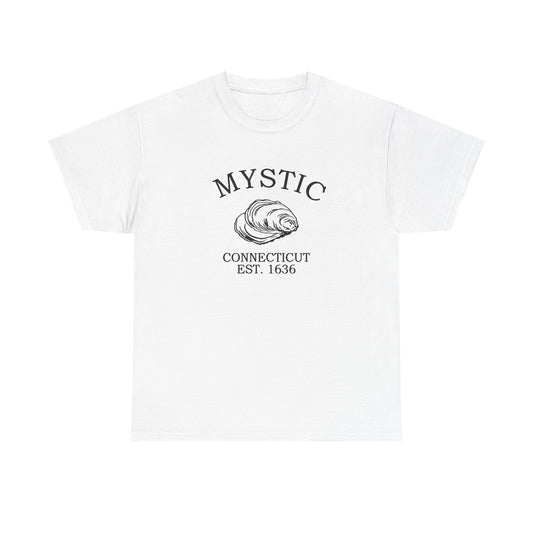
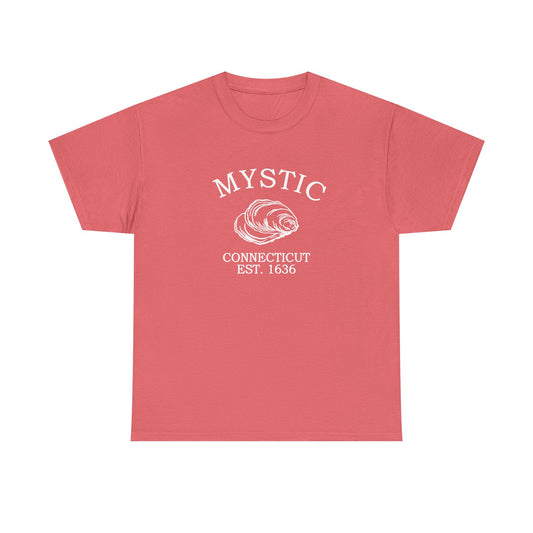
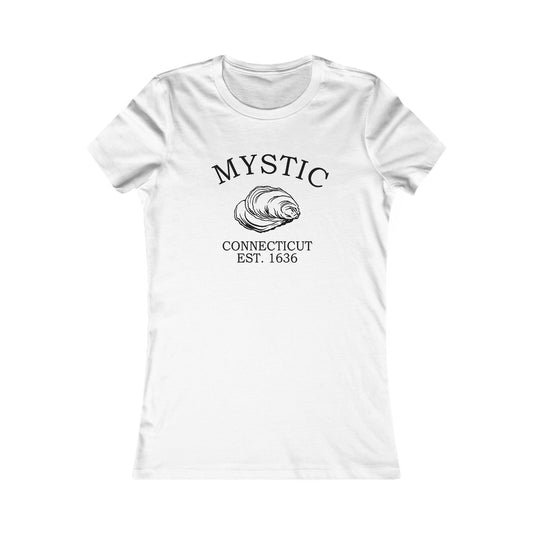
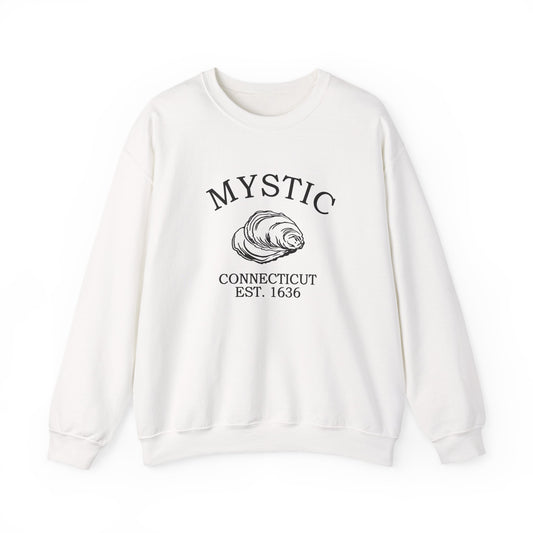
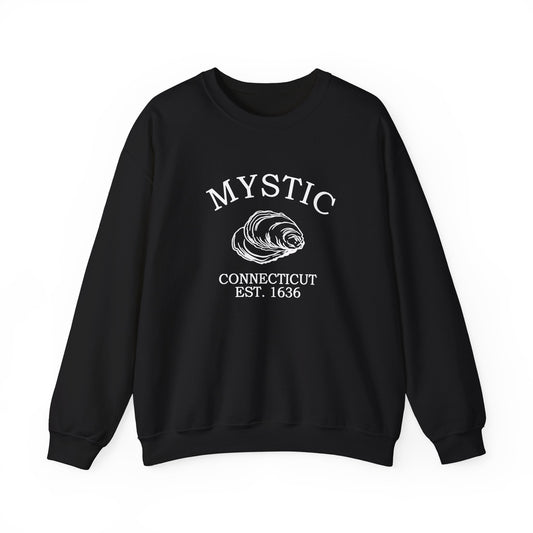
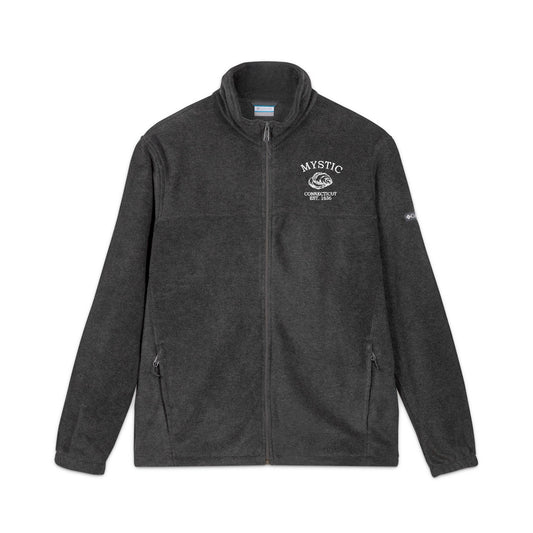
Our Mystic logo carries Connecticut's oyster shell over "Connecticut · Est. 1636," tying the village to the colonial founding of Connecticut — the shared emblem of every Merlin Classics Connecticut place. Printed black-and-white with the worn look of an old oyster-crate label, the shell reads as the shoreline in shorthand: tidal, maritime, salt-aired. What makes this one Mystic is the story behind it — the five yards, the six hundred ships, and the last wooden whaler in the world.
Mystic holds its history in the open: a river that outbuilt Boston, a drawbridge that still lifts, and a wooden whaleship that refuses to die. Our Mystic designs gather that identity — the masts, the river, the oyster-and-1636 emblem — into wearable form. Last wooden whaler since 1841.
Mystic Connecticut — Travel Guide
Visiting Mystic Connecticut Today
Mystic is a classic New England seaport known for maritime history, aquariums, and walkable riverfront streets. Shipbuilding heritage and family attractions make it an easy coastal getaway.
Harbors, History, and Attractions in Mystic Connecticut
For visitors searching for things to do in Mystic Connecticut:
- Tour the Mystic Seaport Museum, with its historic vessels, working shipyard, and recreated 19th-century seaport village.
- Visit the Mystic Aquarium, with marine life, touch experiences, and research displays.
- See the Charles W. Morgan, the last wooden whaling ship in the world, moored on the Mystic River since 1941.
- Watch the Mystic River drawbridge, a 1922 bascule bridge that still lifts for boats along Main Street.
- Walk Main Street, the riverfront shopping village, and the surrounding historic neighborhoods.
- Relax at Mystic River Park, a riverside boardwalk with passing boats.
- Stop at the Daniel Packer Inne in Old Mystic, a 1756 tavern still serving meals today.
Why People Visit Mystic Connecticut
Mystic blends living maritime history with family experiences. Walkable streets, river views, and hands-on exhibits keep visits engaging. It is picturesque and educational in equal measure. Travelers find year round appeal in parks, paths, and public spaces. The setting combines natural beauty with accessible neighborhoods and landmarks. History and everyday culture sit side by side in a welcoming way.
Wear the History
Where you're from. Where you love. Where you explored. Where you belong.
Kindred Cities
Welcome to visitors from Falmouth and Whitby, England — like-minded old harbours where the sea is the story.
Few places keep their maritime past as vividly as Mystic, and Falmouth and Whitby share the calling. Falmouth, on Cornwall's coast, holds the National Maritime Museum and one of the world's great natural harbours; Whitby sent its whalers and Captain Cook to sea from North Yorkshire; Mystic preserves a whole working seafaring village at Mystic Seaport, where tall ships and the last wooden whaleship still ride the river. Salt, sail and history kept alive, all three.
Mystic welcomes anyone who loves the age of sail: a living seaport of tall ships and shipwrights, a drawbridge over the river, sea captains' houses along the streets, and the salt-and-tar romance of a New England whaling town preserved whole. Come and visit us soon.
When you plan the trip, Connecticut's Mystic Country tourism office is the place to start.
Wear the History
Where you're from. Where you love. Where you explored. Where you belong.

For deeper reading on Mystic, Connecticut maritime history and the shipbuilding tradition described here, it may be useful to consult (1) William N. Peterson, Mystic Built: Ships and Shipyards of the Mystic River, Connecticut, 1784–1919, the definitive scholarly inventory of vessels launched on the river, (2) Carl C. Cutler, Greyhounds of the Sea: The Story of the American Clipper Ship, published by the United States Naval Institute in 1930 and reissued by Naval Institute Press, the foundational maritime historical work cited in this entry, (3) Connecticut Humanities and the ConnecticutHistory.org platform for primary-source articles on Mystic shipbuilding, the Civil War shipbuilding pivot, and the USS Galena, (4) the G. W. Blunt White Library for primary-source manuscripts, shipyard records, and the Mystic Pioneer newspaper archive, and (5) the Naval History and Heritage Command for Union Navy records on the USS Galena, USS Varuna, and the side-wheel steamer Escort. For deeper local and family history research in Mystic and surrounding Connecticut, it may be useful to reach out to (1) the Mystic River Historical Society at the Portersville Academy in downtown Mystic, (2) the Mystic and Noank Library local history room, (3) the Indian and Colonial Research Center in Old Mystic, (4) the Connecticut State Library and State Archives in Hartford, and (5) the New London County Historical Society. For travel and visitor information in Mystic, it may be useful to contact (1) the Greater Mystic Chamber of Commerce, (2) the Connecticut Office of Tourism, and (3) the Town of Stonington and Town of Groton offices, which together share municipal jurisdiction over the village of Mystic. Readers interested in the broader cultural reception of Mystic and its maritime tradition — the working preservation tradition of the Charles W. Morgan along the Greenmanville waterfront, the Connecticut shoreline aesthetic that runs from Stonington through Noank and Groton to New London, and the broader New England coastal heritage that has shaped American maritime identity — will find that the shipbuilding vocabulary studied here, particularly the named yards (George Greenman & Company, Charles Mallory & Sons, Maxson Fish & Company, Irons & Grinnell, and Hill, Grinnell & Company), the named vessels (USS Galena, USS Varuna, the side-wheel Escort, the David Crockett, the Andrew Jackson), and the named figures (Carl Cutler, the Mystic Pioneer editor, the shipwrights of the Greenmanville site), recur across all of these traditions as a shared visual and cultural grammar of American small-town shipbuilding accomplishment.
Shop the Mystic Connecticut collection
View full collection-
Mystic Connecticut Vintage Retro Premium Crewneck Sweatshirt - Black Logo
Regular price $48.00 USDRegular price -
Mystic Connecticut Vintage Retro Premium Crewneck Sweatshirt - White Logo
Regular price $48.00 USDRegular price -
Mystic Connecticut Vintage Retro Unisex Heavy Cotton Tee - Black Logo
Regular price $22.00 USDRegular price -
Mystic Connecticut Vintage Retro Unisex Heavy Cotton Tee - White Logo
Regular price $22.00 USDRegular price -
Mystic Connecticut Vintage Retro Womens Fitted Ringspun Cotton Tee - Black Logo
Regular price $28.00 USDRegular price -
-
Mystic Connecticut Vintage Retro Unisex Cotton Jersey Tank Top - Black Logo
Regular price $28.00 USDRegular price -
Mystic Connecticut Vintage Retro Unisex Cotton Jersey Tank Top - White Logo
Regular price $28.00 USDRegular price -
Mystic Connecticut Vintage Retro Back Printed Art Series Cotton Tee - Black Logo
Regular price $32.00 USDRegular price -
Mystic Connecticut Vintage Retro Unisex Heavy Cotton Hoodie - Black Logo
Regular price $56.00 USDRegular price -
Mystic Connecticut Vintage Retro Unisex Heavy Cotton Hoodie - White Logo
Regular price $56.00 USDRegular price -
Mystic Connecticut Vintage Retro Unisex Heavy Crewneck Sweatshirt - Black Logo
Regular price $44.00 USDRegular price -
Mystic Connecticut Vintage Retro Unisex Heavy Crewneck Sweatshirt - White Logo
Regular price $44.00 USDRegular price -
Mystic Connecticut Vintage Retro Unisex Embroidered Fleece Jacket - White Logo
Regular price $98.00 USDRegular price -
Mystic Connecticut Vintage Retro Unisex Embroidered Cotton Polo - Black Logo
Regular price $48.00 USDRegular price -
Mystic Connecticut Vintage Retro Embroidered Cotton Cap - Black Logo
Regular price $32.00 USDRegular price -
Mystic Connecticut Vintage Retro Embroidered Cotton Cap - White Logo
Regular price $32.00 USDRegular price -
Mystic Connecticut Vintage Retro Ceramic Mug - Black Logo
Regular price From $16.00 USDRegular price -
Mystic Connecticut Vintage Retro Cotton Canvas Tote Bag - Black Logo
Regular price $25.00 USDRegular price -
Mystic Connecticut Vintage Retro Cotton Canvas Tote Bag - White Logo
Regular price $25.00 USDRegular price -
Mystic Connecticut Vintage Retro Giclée Print Art Series Poster
Regular price From $38.00 USDRegular price -
Mystic Connecticut Vintage Retro Cotton Jersey Baby Bodysuit - Black Logo
Regular price $26.00 USDRegular price -
Mystic Connecticut Vintage Retro Thank You Card Set - Black Logo
Regular price From $25.00 USDRegular price