Fort Lauderdale Florida — Retro Vintage History
What's with the major who never stayed? The city carries a soldier's name, but the soldier barely set foot here. In 1838, during the Second Seminole War, a detachment of Tennessee Volunteers under Major William Lauderdale built a fort at a fork of the New River — one of three that would briefly bear his name along this stretch of coast. Major Lauderdale died within months and is said to have spent almost no time at the post, yet the name stuck to the river, the beach, and eventually the city. By 1842 the forts were abandoned, and the New River went quiet for fifty years. The town that finally grew here took the old military name — a fort that was gone long before Fort Lauderdale ever became a place to live.
Wear the HistoryLong before the forts, the New River belonged to the Tequesta, who lived along its banks for more than a thousand years before European contact; by 1763, after generations of disease introduced by the Spanish, only a few remained. In the early nineteenth century the Seminole lived and farmed in the region, and it was to seize that ground, during a war of removal, that the army built the New River forts in 1838. The conflict and the forts passed, but the river stayed — a dark, winding tidal channel running out of the Everglades to the sea, the feature around which everything here would eventually be built.
The modern city begins with a trading post. In 1893 Frank Stranahan arrived at the New River, ran a ferry across it, and opened a trading post that did business with the Seminole and served as post office and community hall for the handful of settlers nearby. When the Florida East Coast Railway reached the river in 1896, the settlement had a future. In 1901 Stranahan built the house that still stands on the river at Las Olas — the Stranahan House, the oldest surviving building in Broward County. His wife, Ivy Cromartie Stranahan, had become the area's first schoolteacher in 1899 and spent her long life as an advocate for the Seminole; she is remembered as the “Mother of Fort Lauderdale.”

Fort Lauderdale incorporated as a city on March 27, 1911, a small riverfront town of a few hundred people. What transformed it came in the 1920s, when developers dredged the low, wet land behind the beach into a lattice of canals and finger islands, selling waterfront lots where there had been mangrove and marsh. The dredging gave the city its identity and its nickname — the “Venice of America,” a place where the streets were matched by water and nearly every house could keep a boat at its back door. The 1926 hurricane and the collapse of the Florida land boom ended the frenzy, but the canals remained.
The water has defined the city ever since. Fort Lauderdale grew through a Second World War naval-air era and a postwar tourism boom into the place it is now: a major Atlantic beach destination, a great cruise port at Port Everglades, and a center of the yachting world, host to one of the largest boat shows anywhere. The New River still runs through downtown past the Riverwalk and Las Olas Boulevard, and the roughly 165 miles of canals that thread the city remain its signature — liquid streets that earned the Venice of America its name.
For all the growth, the old riverfront heart is still legible. The Stranahan House keeps watch on the New River at the foot of Las Olas, the historic village by the river preserves the town's earliest buildings, and the water that drew the Tequesta, frustrated the army, and made the developers rich still organizes everything. Fort Lauderdale wears its history lightly, but it is all there, just below the bright surface of the canals.
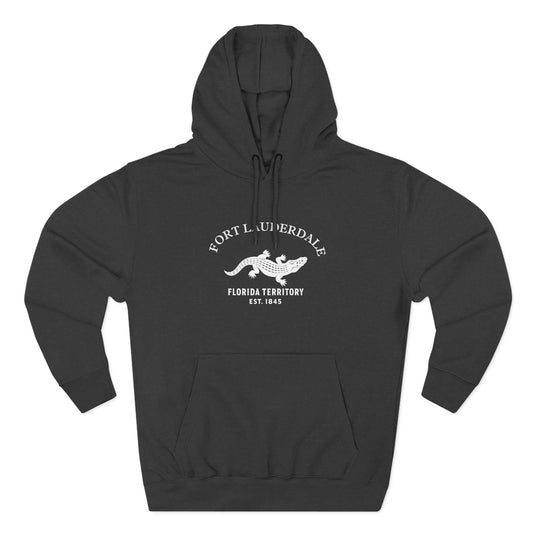
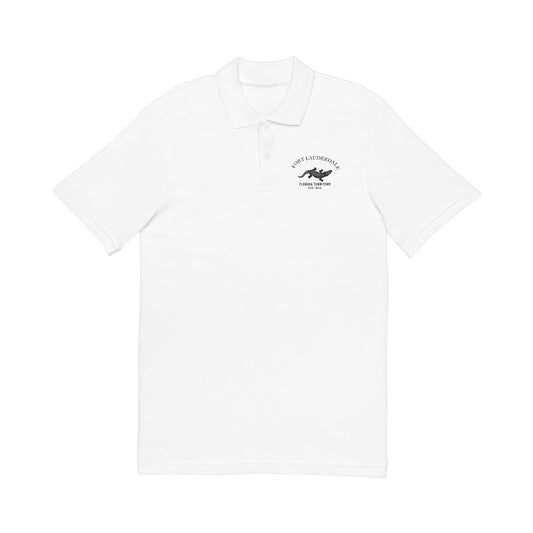
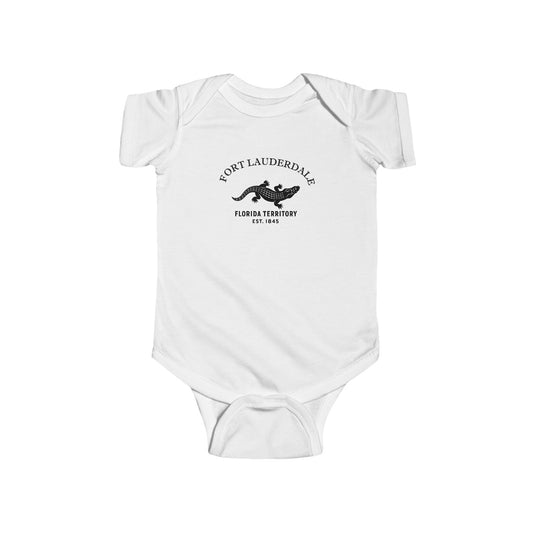
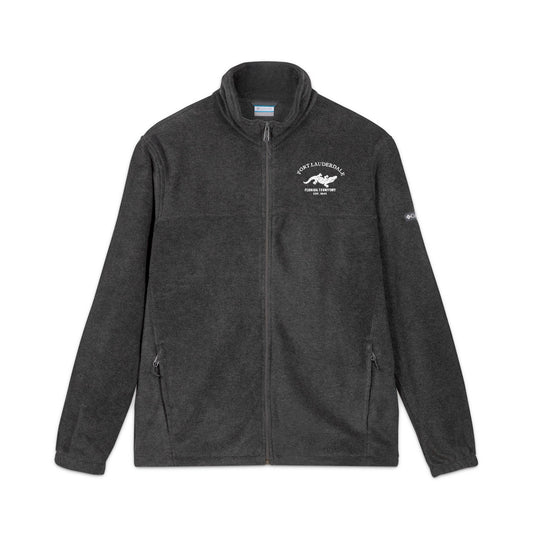
Our Fort Lauderdale logo carries Florida's alligator, above “Est. 1845,” the year of Florida statehood — the shared emblem of every Merlin Classics Florida place. Printed in a worn black-and-white that recalls an old crate stamp, the alligator is Florida in shorthand: tough, native, and at home in the water. The alligator is the through-line that links Fort Lauderdale to every other Florida town we make. What makes this one Fort Lauderdale is everything around it — the New River, the 165 miles of canals, Las Olas, and the Venice of America.
Today Fort Lauderdale is the Venice of America — a city of canals and yachts, a great beach and a busy river, with a frontier fort and a trading post somewhere underneath it all. Its story runs from a Tequesta river and an 1838 Seminole-War fort, through Frank Stranahan's 1893 trading post and the 1920s canal boom, to the yachting and cruise capital it is now. Our Fort Lauderdale designs gather that identity into wearable form — the alligator emblem, the New River, and the canals. Fort Lauderdale, Florida: the Venice of America, on the New River where the city began.

Fort Lauderdale, Florida — Travel Guide
Visiting Fort Lauderdale Today
Fort Lauderdale sits on the southeast Atlantic coast of Florida, in Broward County between Miami and Palm Beach, where the New River meets roughly 165 miles of canals and seven miles of barrier-island beach. It is the Venice of America — an easy, water-laced city of beaches and boats, a historic riverfront downtown along Las Olas, and the Riverwalk, with the warm Atlantic always close at hand.
The New River, Las Olas & the Beach
For visitors looking for things to do in Fort Lauderdale, Florida:
- See the Stranahan House (1901), the oldest surviving building in Broward County, on the New River at Las Olas.
- Take a water-taxi or river cruise along the New River and the canals that make Fort Lauderdale the Venice of America.
- Spend a day on the Atlantic beach and the A1A promenade, then stroll the shops and galleries of Las Olas Boulevard.
- Walk the Riverwalk arts-and-science district past the Museum of Discovery and Science and the performing-arts center.
- Visit Bonnet House Museum & Gardens, a preserved estate with subtropical grounds near the beach.
- Explore the historic village by the river, where the town's earliest buildings are preserved as a local-history museum.
Why People Visit Fort Lauderdale
Fort Lauderdale offers South Florida at its most nautical — a real beach city laced with canals, with a historic river downtown, a great cruise port, and the yachting world's calendar built around it. Visitors come for the water, the beaches, and the Venice-of-America canals, and stay for Las Olas, the Riverwalk, and the easy coastal pace. From the New River to the sand, it rewards a day or a week. It is bright, nautical, and genuinely South Florida.
Wear the History

For deeper reading on the Fort Lauderdale history described here — the Tequesta and Seminole presence on the New River, the 1838 Second-Seminole-War forts named for Major William Lauderdale, the fifty empty years that followed, Frank Stranahan's 1893 New River trading post and ferry, the 1896 arrival of the Florida East Coast Railway, the 1901 Stranahan House, the 1911 incorporation, and the 1920s canal-dredging that made it the Venice of America — it may be useful to consult (1) the Fort Lauderdale Historical Society and the Old Fort Lauderdale Village & Museum, (2) the State Library and Archives of Florida and the Florida Historical Society, (3) the Stranahan House museum and its archives, (4) the City of Fort Lauderdale and Broward County land and vital records, and (5) the Florida Division of Historical Resources. For travel and visitor information, it may be useful to contact (1) Visit Lauderdale, (2) Visit Florida and the state tourism office, (3) the City of Fort Lauderdale Parks and Recreation Department, (4) Florida State Parks for nearby coastal parks, and (5) the National Weather Service for South Florida marine and hurricane advisories.
Shop the Fort Lauderdale Florida collection
View full collection-
Fort Lauderdale Florida Vintage Retro Premium Crewneck Sweatshirt - Black Logo
Regular price $48.00 USDRegular price -
Fort Lauderdale Florida Vintage Retro Premium Crewneck Sweatshirt - White Logo
Regular price $48.00 USDRegular price -
Fort Lauderdale Florida Vintage Retro Womens Fitted Ringspun Cotton Tee - Black Logo
Regular price $28.00 USDRegular price -
Kiss at Still Water - Silhouette Art Giclée Unframed Art Print
Regular price From $34.00 USDRegular price -
Mare and Foal - Silhouette Art Framed Art Print
Regular price From $96.00 USDRegular price -
Fort Lauderdale Florida Vintage Retro Unisex Heavy Cotton Hoodie - White Logo
Regular price $56.00 USDRegular price -
Fort Lauderdale Florida Vintage Retro Unisex Embroidered Cotton Polo - Black Logo
Regular price $48.00 USDRegular price -
Between Horse and Hound - Silhouette Art Giclée Unframed Art Print
Regular price From $34.00 USDRegular price -
Whitewater Charge - Silhouette Art Framed Art Print
Regular price From $96.00 USDRegular price -
Fort Lauderdale Florida Vintage Retro Cotton Jersey Baby Bodysuit - Black Logo
Regular price $26.00 USDRegular price -
-
Whitewater Walk - Silhouette Art Giclée Unframed Art Print
Regular price From $34.00 USDRegular price -
Kiss for the Hound - Silhouette Art Framed Art Print
Regular price From $96.00 USDRegular price -
Fort Lauderdale Florida Vintage Retro Back Printed Art Series Cotton Tee - Black Logo
Regular price $32.00 USDRegular price -
Fort Lauderdale Florida Vintage Retro Giclée Print Art Series Poster
Regular price From $38.00 USDRegular price -
Whitewater Leap - Silhouette Art Giclée Unframed Art Print
Regular price From $34.00 USDRegular price -
Kiss at Low Tide - Silhouette Art Framed Art Print
Regular price From $96.00 USDRegular price -
Fort Lauderdale Florida Vintage Retro Unisex Heavy Cotton Hoodie - Black Logo
Regular price $56.00 USDRegular price -
Fort Lauderdale Florida Vintage Retro Unisex Embroidered Fleece Jacket - White Logo
Regular price $98.00 USDRegular price -
Mare and Foal - Silhouette Art Giclée Unframed Art Print
Regular price From $34.00 USDRegular price -
Whitewater Run - Silhouette Art Framed Art Print
Regular price From $96.00 USDRegular price -
Fort Lauderdale Florida Vintage Retro Vinyl Sticker - Black Logo
Regular price From $6.00 USDRegular price -
Fort Lauderdale Florida Vintage Retro Ceramic Mug - Black Logo
Regular price From $16.00 USDRegular price -
Whitewater Run - Silhouette Art Giclée Unframed Art Print
Regular price From $34.00 USDRegular price