Barrow (Utqiaġvik) Alaska — Retro Vintage History
What's with the whale fires of Barrow? In Utqiaġvik, darkness once ruled the calendar, and staying warm depended on what the sea could provide. Whale oil lamps were carefully tended, because one steady flame could make a room livable. The image that stuck is Whale Fires, glowing doorways that marked a safe house in the long night, the kind of light you could trust when the wind was loud and the horizon disappeared. Oil lamps and shared routines made heat and light possible long before modern fuel, and that practicality is the point. On the Arctic edge, a flame was never decoration, it was survival held steady in the hand.
Wear the HistoryWhere you're from. Where you love. Where you explored. Where you belong.
The northernmost city in the United States — and the oldest one most Americans have never heard of. Barrow, Alaska sits at 71°17' north — 320 miles above the Arctic Circle, on a thin tongue of tundra between the Chukchi Sea and the Beaufort Sea. The Iñupiat have lived continuously on this stretch of coast for more than 1,500 years. The Birnirk archaeological site just outside town, a National Historic Landmark, holds sixteen prehistoric dwelling mounds built up of driftwood, whalebone, and earth over centuries beginning around 500 CE — one of the oldest continuously inhabited places anywhere in what is now the United States. The Iñupiaq name for the settlement is Utqiaġvik, meaning "place for gathering wild roots" — from utqiq, the Iñupiaq word for Claytonia tuberosa, the small starchy tuber known in English as the Eskimo potato that grows in the brief summer tundra. When Commander Rochfort Maguire of the Royal Navy sailed past in 1853 he recorded the name as "Ot-ki-a-wing." It got renamed Barrow by English explorers after Sir John Barrow, an Admiralty geographer in London who never came within five thousand miles of the place. On October 4, 2016, the residents of the town voted in a referendum to take the Iñupiaq name back. The vote passed by six votes. On December 1, 2016 — 163 years after Maguire's notebook entry — Utqiaġvik became the official name again. Most signage now reads Utqiaġvik. The high school football team, the Whalers, kept the Barrow name. The airport code is still BRW. Both names are correct depending on who you ask and when. Travelers spell it every way — Utkiagvik, "Barrows, Alaska" — but the town answers to both of its true names. The town is also the northernmost city in the United States, full stop. Point Barrow, nine miles north, is the northernmost point of US land — the spot where the Chukchi and Beaufort Seas finally meet around the top of the continent. The sun does not rise here for 65 to 67 days every winter, from mid-November to late January. The sun does not set for more than 80 days every summer, from May into August. Two of the most extreme natural light cycles on the planet, in the same town, six months apart. A few miles inland a NOAA observatory records some of the world's most carefully kept Arctic climate data. A few miles offshore the bowhead whales pass, as they have for as long as anyone here can remember. The Iñupiat have been watching them go by for fifteen centuries.
QUICK FACTS — BARROW (UTQIAĠVIK), AK
Utqiaġvik — known for most of two centuries as Barrow — is the northernmost city in the United States: 71°17′ N, about 320 miles above the Arctic Circle.
Iñupiat people have lived here continuously for more than 1,500 years; the Birnirk site preserves dwelling mounds from around 500 CE.
In October 2016, residents voted — by six votes — to restore the Iñupiaq name Utqiaġvik, generally understood as "a place for gathering wild roots." One older tradition links the name to hunting snowy owls.
The polar night lasts about 65 days — the sun sets in mid-November and rises in late January; the midnight sun then runs about 80 days from May into August.
Point Barrow — Nuvuk — nine miles northeast of town, is the northernmost point of land in the United States, where the Chukchi and Beaufort Seas meet.
Iḷisaġvik College is the only tribally controlled college in Alaska and the northernmost accredited community college in the United States.
The city was named by the British Admiralty for Sir John Barrow — a geographer who never saw the place.
NOAA's Barrow Atmospheric Baseline Observatory, established in 1973, has kept one of the world's longest continuous Arctic climate records here.
The name that came home. People were living here a thousand years before anyone in Europe knew the coastline existed — the Birnirk mounds on the edge of town date to around 500 CE, and the Iñupiat have hunted the bowhead from this shore, under sanctioned subsistence tradition, ever since. The first written record of the community's own name came in 1853, when Commander Rochfort Maguire of the Royal Navy set it down from Iñupiaq speakers; the British Admiralty, meanwhile, had already fixed "Barrow" to the maps — honoring Sir John Barrow, the English promoter of Arctic exploration, who never came within a thousand miles of the place. An American whaler named Charles Brower arrived in the 1880s, built the Cape Smythe Whaling and Trading Station — still standing in the district that carries his name, Browerville — and the settlement grew around the meeting of two worlds. The City of Barrow incorporated on June 8, 1959, months after Alaska statehood. And then, in October 2016, the community voted — by exactly six votes — to restore its own name: Utqiaġvik, effective that December 1. Ask what it means and you'll hear the story locals tell: a place for gathering wild roots, though an older tradition says the name honors the hunting of snowy owls — either way, a name about what this land gives, restored by the people who have always known it.

Sixty-five nights, eighty days. The calendar here is unlike anywhere else in America. In mid-November the sun sets and does not rise again for about 65 days — the polar night, when the aurora owns the sky at noon and the town runs on its own rhythm under streetlights and starlight. In late January the sun returns for minutes, then hours; by May it refuses to set at all, and for roughly 80 days Utqiaġvik lives in continuous daylight — midnight softball, midnight fishing, the Arctic Ocean glittering at 2 a.m. Even football bends to the latitude: the Barrow Whalers play on a field a few dozen yards from the Arctic Ocean, the northernmost gridiron in the world, sometimes under the midnight sun and sometimes racing the coming dark.
Today Utqiaġvik is a city of about 4,900 — the borough seat of the North Slope and the cultural heart of the Iñupiat world. The Iñupiat Heritage Center holds the artifacts, art, and living traditions of 1,500 years on this coast; the whalebone arch on the beach frames the Arctic Ocean for every visitor's photograph; Iḷisaġvik College — the only tribally controlled college in Alaska — teaches from this shore; and NOAA's observatory east of town has been reading the Arctic atmosphere since 1973, making this small city one of the most scientifically watched places on Earth. Flights land at Wiley Post–Will Rogers Memorial Airport — code still BRW — and the road ends here: north of town there is only Point Barrow, and then the ice.
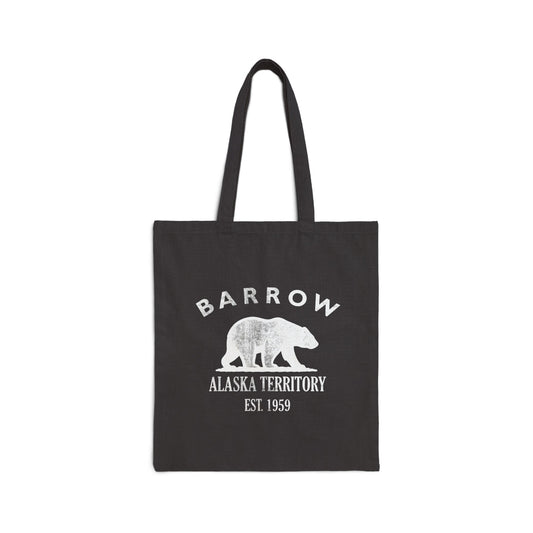
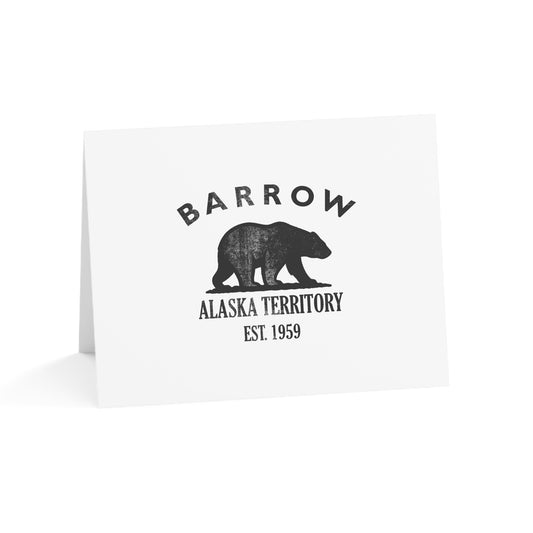
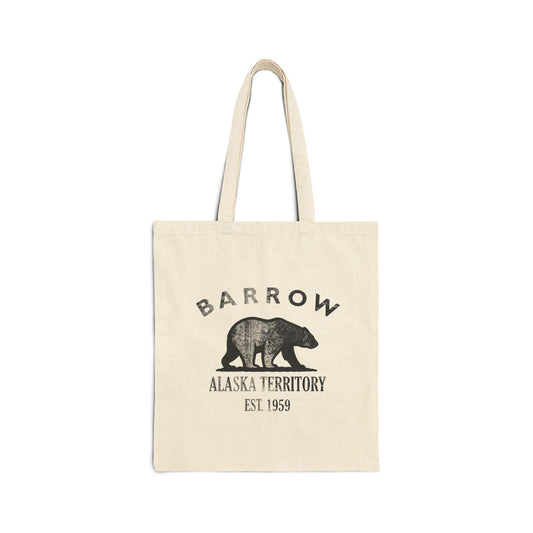
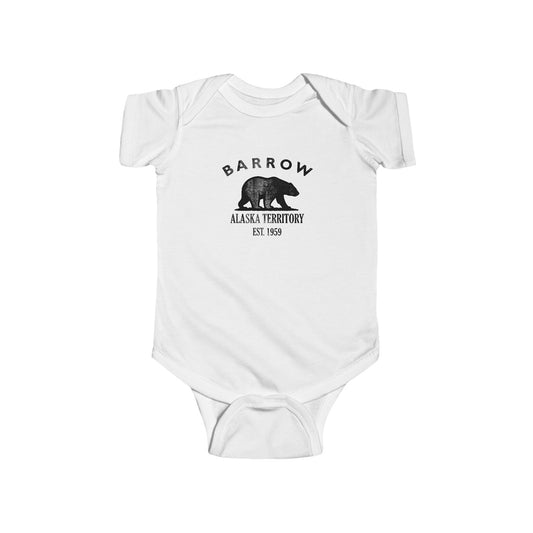
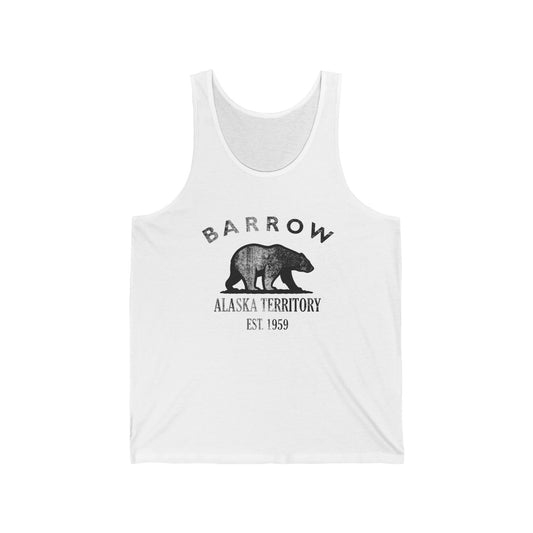
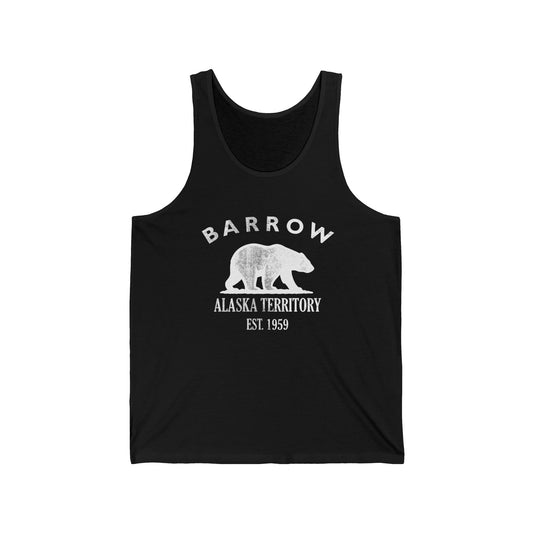
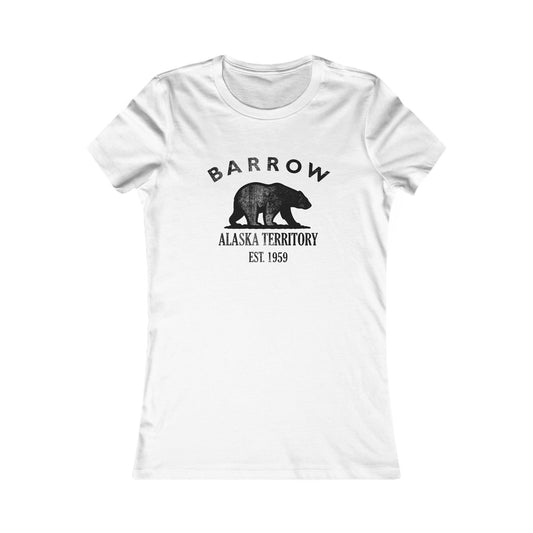
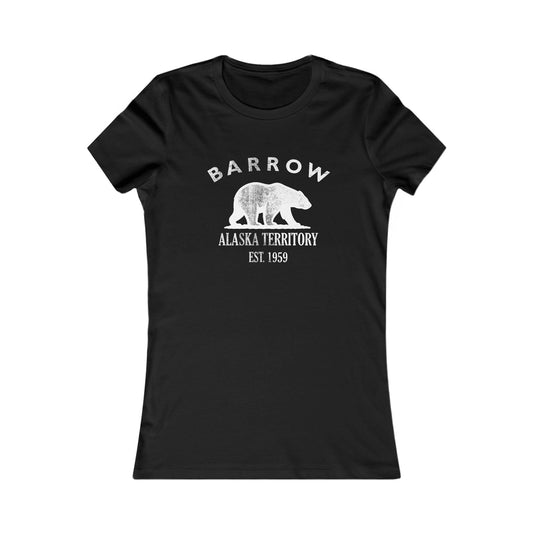
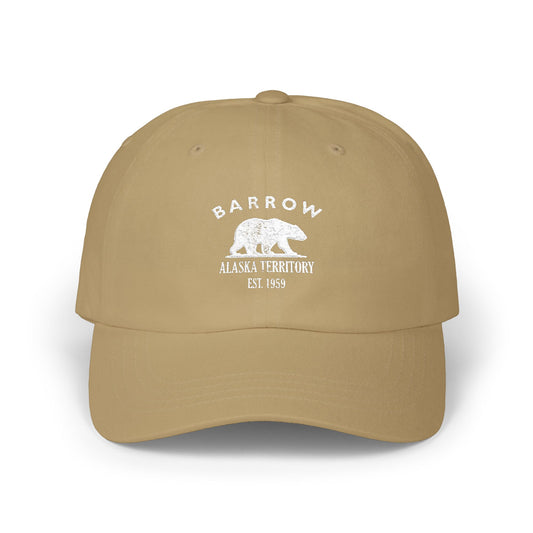
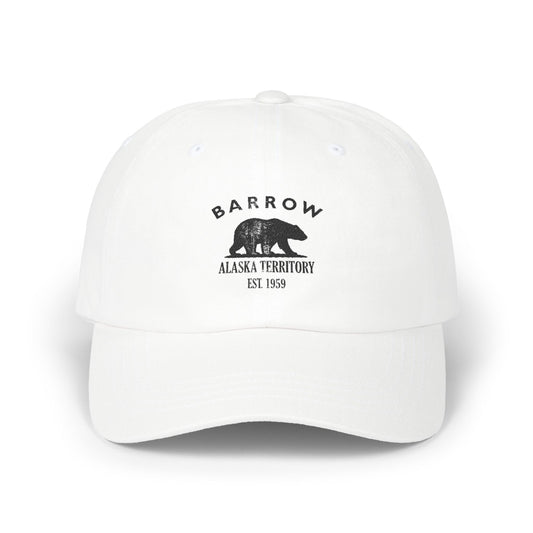
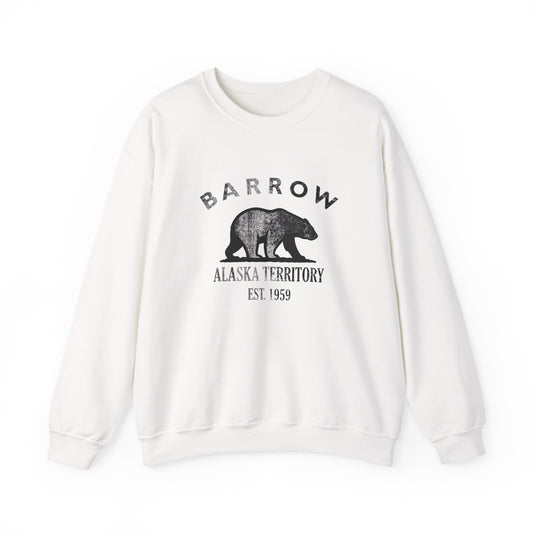
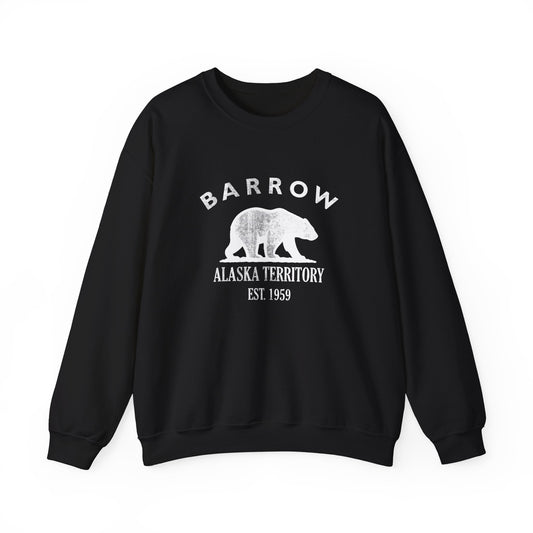
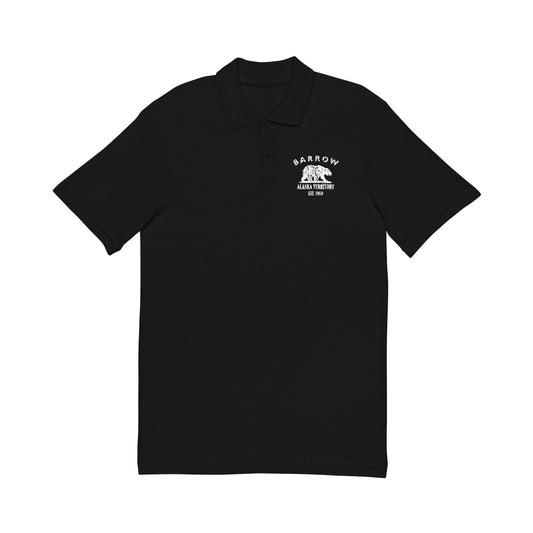
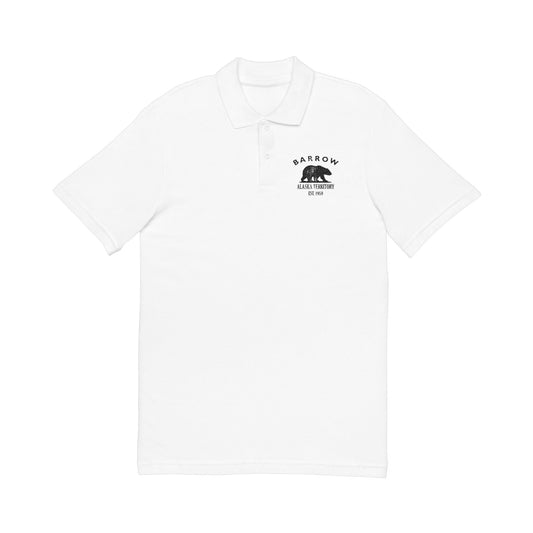
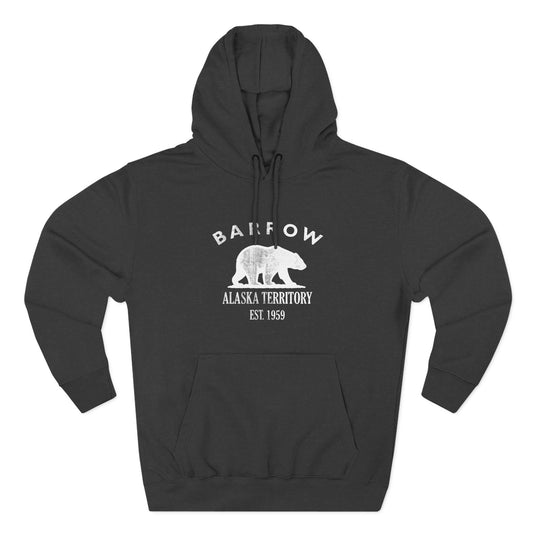
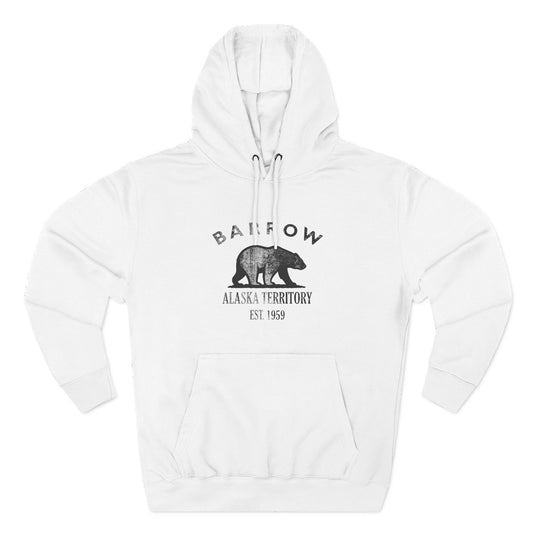
Our Barrow retro logo carries Alaska's distressed bear — the shared emblem of every Merlin Classics Alaska place — printed black-and-white with the worn look of an old trading-post crate label. The bear reads as the wild north in shorthand: strength, patience, survival. What makes this one Barrow is the story behind it — the northernmost city in America, the name that came home, and 1,500 years of people who never needed a map to know where they were.
Barrow — Utqiaġvik — wears the superlative lightly: the top of the world as a hometown, the polar night as a season like any other, the midnight sun as summer's ordinary miracle. Our Barrow designs gather that identity — the bear, the arch, the light that leaves and always returns — into wearable form. Above the Arctic Circle since time immemorial.

Barrow Alaska — Travel Guide
Visiting Barrow (Utqiaġvik) Alaska Today
Barrow, officially Utqiaġvik since 2016, is the northernmost city in the United States, with tundra horizons stretching south to the Brooks Range and the Arctic Ocean on three sides. Air access only — no road connects the town to the rest of Alaska. Summer brings 80+ days of midnight sun; winter brings 65-67 days of polar night.
Tundra, Coast, and Cultural Stops in Barrow Alaska
For visitors searching for things to do in Barrow Alaska:
- Visit the Iñupiat Heritage Center, the cultural museum holding exhibits on 1,500 years of Iñupiat history, whaling, and contemporary Iñupiaq community life.
- Drive to Point Barrow, 9-12 miles north of town, the northernmost point of US land where the Chukchi and Beaufort Seas converge — a major marine-mammal migration corridor.
- See the Whalebone Arch on the Arctic Ocean shore, the iconic bowhead-jaw landmark and photo stop.
- Tour the Birnirk archaeological site, a National Historic Landmark featuring 16 prehistoric Thule-culture dwelling mounds dating to roughly 500 CE.
- Walk the tundra boardwalk for migratory birds, snowy owls, and the brief summer wildflower bloom across the permafrost coastal plain.
- Visit the Will Rogers and Wiley Post Monument, marking the 1935 plane-crash site of the American humorist and pioneering aviator.
- Observe the aurora borealis from September through March on clear nights — the long polar darkness makes Barrow one of the best aurora-viewing locations in the world.
Why People Visit Barrow Alaska
Barrow offers Arctic culture, geography, and natural-light phenomena that few places on earth can match. Visitors come for the Iñupiat heritage, the tundra and Arctic Ocean horizons, the polar night and midnight sun, and the simple fact of standing in the northernmost city in the United States. It is remote, resilient, and unforgettable. History and everyday community life sit side by side at the top of the continent.
Wear the History
Where you're from. Where you love. Where you explored. Where you belong.
Kindred Cities
Welcome, friends from Tromsø (velkommen) and Inuvik — fellow towns at the top of the world, where the sun stays down for weeks and then refuses to set.
Past the edge of the tree line, three communities keep the same hard company: Utqiaġvik on the Arctic Ocean, Tromsø in Arctic Norway, Inuvik in the Canadian north. The sea freezes, the night runs for weeks, and people have made a home here for thousands of years — Iñupiat, Sámi and Norwegian, Inuvialuit and Gwich'in. The far north is a country of its own.
If the polar night and the midnight sun are already part of your year, you'll understand this place on sight: whales and walrus on the horizon, the aurora overhead in the dark months, and a community that has thrived here far longer than the maps. Come and visit us soon.
Planning a trip this far north starts with the North Slope Borough and the Travel Alaska visitor service.
Wear the History
Where you're from. Where you love. Where you explored. Where you belong.

For deeper reading on Barrow, Alaska, and Iñupiat history described here, it may be useful to consult (1) the Iñupiat Heritage Center in Utqiaġvik, the cultural museum and primary scholarly resource on 1,500-year continuous Iñupiat habitation on the Arctic coast, (2) the Tuzzy Consortium Library at Iḷisaġvik College for Iñupiaq language materials and North Slope cultural archives, (3) the Alaska State Library and Historical Collections in Juneau for territorial and statehood-era documents and the records of Roy Ahmaogak's 1946 work on Iñupiaq orthography, (4) the Smithsonian Arctic Studies Center at the National Museum of Natural History for archaeological materials from the Birnirk site and broader Thule-culture research, and (5) the National Park Service for documentation of the Birnirk National Historic Landmark and Cape Krusenstern National Monument resources. For deeper local and family history research in Barrow and surrounding North Slope communities, it may be useful to reach out to (1) the Iñupiat History, Language and Culture Department of the North Slope Borough, (2) the Alaska Native Language Center at the University of Alaska Fairbanks, (3) the Tuzzy Consortium Library at Iḷisaġvik College, (4) the Anchorage Museum at the Rasmuson Center for Alaska Native art and historical collections, and (5) the Smithsonian Arctic Studies Center for circumpolar Iñupiat and Inuit research materials. For travel and visitor information in Barrow, it may be useful to contact (1) the North Slope Borough visitor information office, (2) the Alaska Travel Industry Association, (3) the State of Alaska Department of Natural Resources Division of Parks and Outdoor Recreation, (4) the U.S. Fish and Wildlife Service for Arctic National Wildlife Refuge access information, and (5) the National Weather Service Alaska Region for polar night and midnight sun calendar resources. Readers interested in the broader cultural reception of Barrow and its history — the 1,500-year continuous Iñupiat presence, the 2016 referendum restoring the Iñupiaq name Utqiaġvik, the polar night and midnight sun cycle, the Birnirk archaeological tradition, and the convergence of Chukchi and Beaufort waters at Point Barrow — will find that the named places (Point Barrow, Browerville, the Birnirk site, Cape Smythe, the Whalebone Arch), the named figures (Sir John Barrow, Captain Frederick William Beechey, Commander Rochfort Maguire, Charles Brower, Will Rogers, Wiley Post, Roy Ahmaogak), and the named historical moments (the 1825 naming of Point Barrow by Beechey, Maguire's 1853 recording of the Iñupiaq name, the 1880s establishment of Cape Smythe Whaling and Trading Station, the August 1935 plane crash near Barrow, the 1959 city incorporation alongside Alaska statehood, the 1946 development of modern Iñupiaq orthography, and the October 2016 referendum restoring the name Utqiaġvik) recur across all of these traditions as a shared cultural grammar of foundational Arctic Alaska history grounded specifically on this stretch of North Slope coast.
Shop the Barrow (Utqiaġvik) Alaska collection
View full collection-
Barrow Alaska Vintage Retro Vinyl Sticker - Black Logo
Regular price From $6.00 USDRegular price -
Barrow Alaska Vintage Retro Ceramic Mug - Black Logo
Regular price From $16.00 USDRegular price -
Barrow Alaska Vintage Retro Unisex Heavy Cotton Tee - White Logo
Regular price $22.00 USDRegular price -
Barrow Alaska Vintage Retro Unisex Heavy Cotton Tee - Black Logo
Regular price $22.00 USDRegular price -
Barrow Alaska Vintage Retro Cotton Canvas Tote Bag - White Logo
Regular price $25.00 USDRegular price -
Barrow Alaska Vintage Retro Thank You Card Set - Black Logo
Regular price From $25.00 USDRegular price -
Barrow Alaska Vintage Retro Cotton Canvas Tote Bag - Black Logo
Regular price $25.00 USDRegular price -
Barrow Alaska Vintage Retro Cotton Jersey Baby Bodysuit - Black Logo
Regular price $26.00 USDRegular price -
Barrow Alaska Vintage Retro Unisex Cotton Jersey Tank Top - Black Logo
Regular price $28.00 USDRegular price -
Barrow Alaska Vintage Retro Unisex Cotton Jersey Tank Top - White Logo
Regular price $28.00 USDRegular price -
Barrow Alaska Vintage Retro Womens Fitted Ringspun Cotton Tee - Black Logo
Regular price $28.00 USDRegular price -
-
Barrow Alaska Vintage Retro Embroidered Cotton Cap - White Logo
Regular price $32.00 USDRegular price -
Barrow Alaska Vintage Retro Embroidered Cotton Cap - Black Logo
Regular price $32.00 USDRegular price -
Barrow Alaska Vintage Retro Back Printed Art Series Cotton Tee - Black Logo
Regular price $32.00 USDRegular price -
Barrow Alaska Vintage Retro Giclée Print Art Series Poster
Regular price From $38.00 USDRegular price -
Barrow Alaska Vintage Retro Unisex Heavy Crewneck Sweatshirt - Black Logo
Regular price $44.00 USDRegular price -
Barrow Alaska Vintage Retro Unisex Heavy Crewneck Sweatshirt - White Logo
Regular price $44.00 USDRegular price -
Barrow Alaska Vintage Retro Unisex Embroidered Cotton Polo - Black Logo
Regular price $48.00 USDRegular price -
Barrow Alaska Vintage Retro Premium Crewneck Sweatshirt - Black Logo
Regular price $48.00 USDRegular price -
Barrow Alaska Vintage Retro Premium Crewneck Sweatshirt - White Logo
Regular price $48.00 USDRegular price -
Barrow Alaska Vintage Retro Unisex Heavy Cotton Hoodie - White Logo
Regular price $56.00 USDRegular price -
Barrow Alaska Vintage Retro Unisex Heavy Cotton Hoodie - Black Logo
Regular price $56.00 USDRegular price