


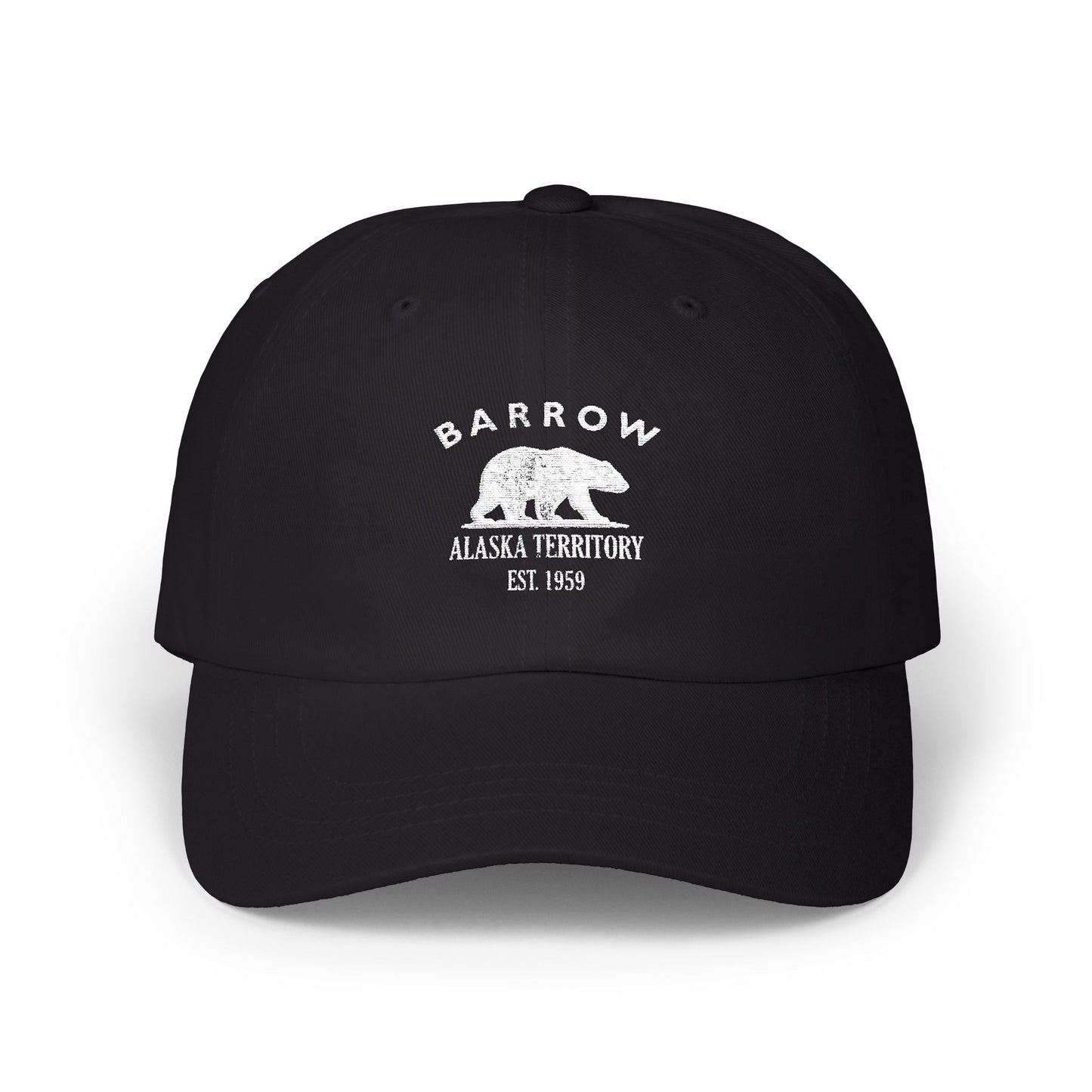
Barrow — Utqiaġvik — wears the superlative lightly: the top of the world as a hometown, the polar night as a season like any other, the midnight sun as summer's ordinary miracle. Our Barrow designs gather that identity — the bear, the arch, the light that leaves and always returns — into wearable form. Above the Arctic Circle since time immemorial.
The northernmost city in the United States — and the oldest one most Americans have never heard of. Barrow, Alaska sits at 71°17' north — 320 miles above the Arctic Circle, on a thin tongue of tundra between the Chukchi Sea and the Beaufort Sea. The Iñupiat have lived continuously on this stretch of coast for more than 1,500 years. The Birnirk archaeological site just outside town, a National Historic Landmark, holds sixteen prehistoric dwelling mounds built up of driftwood, whalebone, and earth over centuries beginning around 500 CE — one of the oldest continuously inhabited places anywhere in what is now the United States. The Iñupiaq name for the settlement is Utqiaġvik, meaning "place for gathering wild roots" — from utqiq, the Iñupiaq word for Claytonia tuberosa, the small starchy tuber known in English as the Eskimo potato that grows in the brief summer tundra. When Commander Rochfort Maguire of the Royal Navy sailed past in 1853 he recorded the name as "Ot-ki-a-wing." It got renamed Barrow by English explorers after Sir John Barrow, an Admiralty geographer in London who never came within five thousand miles of the place. On October 4, 2016, the residents of the town voted in a referendum to take the Iñupiaq name back. The vote passed by six votes. On December 1, 2016 — 163 years after Maguire's notebook entry — Utqiaġvik became the official name again. Most signage now reads Utqiaġvik. The high school football team, the Whalers, kept the Barrow name. The airport code is still BRW. Both names are correct depending on who you ask and when. Travelers spell it every way — Utkiagvik, "Barrows, Alaska" — but the town answers to both of its true names. The town is also the northernmost city in the United States, full stop. Point Barrow, nine miles north, is the northernmost point of US land — the spot where the Chukchi and Beaufort Seas finally meet around the top of the continent. The sun does not rise here for 65 to 67 days every winter, from mid-November to late January. The sun does not set for more than 80 days every summer, from May into August. Two of the most extreme natural light cycles on the planet, in the same town, six months apart. A few miles inland a NOAA observatory records some of the world's most carefully kept Arctic climate data. A few miles offshore the bowhead whales pass, as they have for as long as anyone here can remember. The Iñupiat have been watching them go by for fifteen centuries.
Why People Visit Barrow Alaska
Barrow offers Arctic culture, geography, and natural-light phenomena that few places on earth can match. Visitors come for the Iñupiat heritage, the tundra and Arctic Ocean horizons, the polar night and midnight sun, and the simple fact of standing in the northernmost city in the United States. It is remote, resilient, and unforgettable. History and everyday community life sit side by side at the top of the continent.
