-
Carmel California Vintage Retro Womens Fitted Ringspun Cotton Tee - Black Logo
Regular price $28.00 USDRegular price -
-
Carmel California Vintage Retro Unisex Heavy Cotton Hoodie - Black Logo
Regular price $48.00 USDRegular price -
Carmel California Vintage Retro Unisex Heavy Cotton Hoodie - White Logo
Regular price $48.00 USDRegular price -
Carmel California Vintage Retro Unisex Heavy Cotton Tee - Black Logo
Regular price $22.00 USDRegular price -
Carmel California Vintage Retro Unisex Heavy Cotton Tee - White Logo
Regular price $22.00 USDRegular price -
Carmel California Vintage Retro Unisex Embroidered Fleece Jacket - White Logo
Regular price $98.00 USDRegular price -
Carmel California Vintage Retro Back Printed Art Series Cotton Tee - Black Logo
Regular price $32.00 USDRegular price -
Carmel California Vintage Retro Embroidered Cotton Cap - Black Logo
Regular price $32.00 USDRegular price -
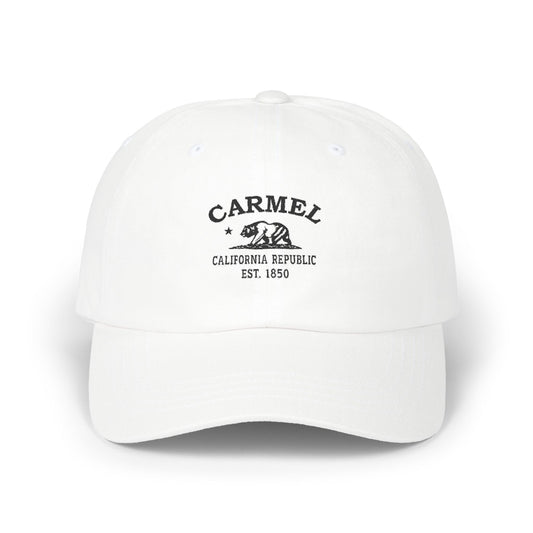
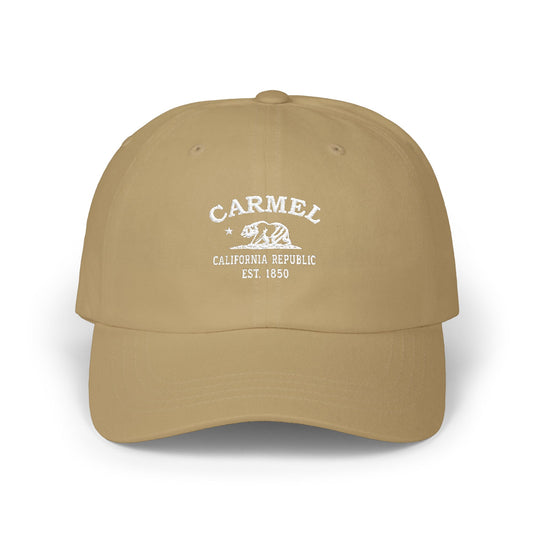
Carmel California Vintage Retro Embroidered Cotton Cap - White Logo
Regular price $32.00 USDRegular price -
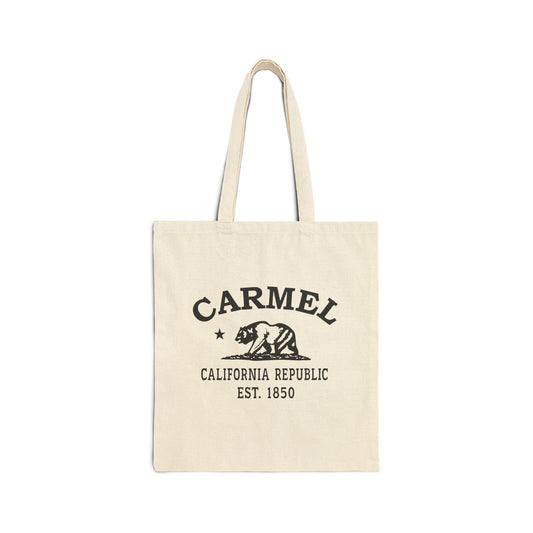
Carmel California Vintage Retro Cotton Canvas Tote Bag - Black Logo
Regular price $25.00 USDRegular price -
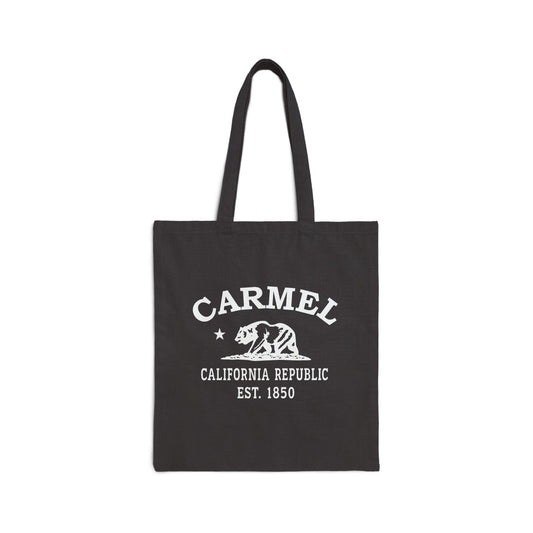
Carmel California Vintage Retro Cotton Canvas Tote Bag - White Logo
Regular price $25.00 USDRegular price -
Carmel California Vintage Retro Unisex Cotton Jersey Tank Top - Black Logo
Regular price $28.00 USDRegular price -
Carmel California Vintage Retro Unisex Cotton Jersey Tank Top - White Logo
Regular price $28.00 USDRegular price -
Carmel California Vintage Retro Cotton Jersey Baby Bodysuit - Black Logo
Regular price $26.00 USDRegular price -
Carmel California Vintage Retro Unisex Embroidered Cotton Polo - Black Logo
Regular price $48.00 USDRegular price -
Carmel California Vintage Retro Vinyl Sticker - Black Logo
Regular price From $6.00 USDRegular price -
Carmel California Vintage Retro Ceramic Mug - Black Logo
Regular price From $16.00 USDRegular price -
Carmel California Vintage Retro Thank You Card Set - Black Logo
Regular price From $25.00 USDRegular price -
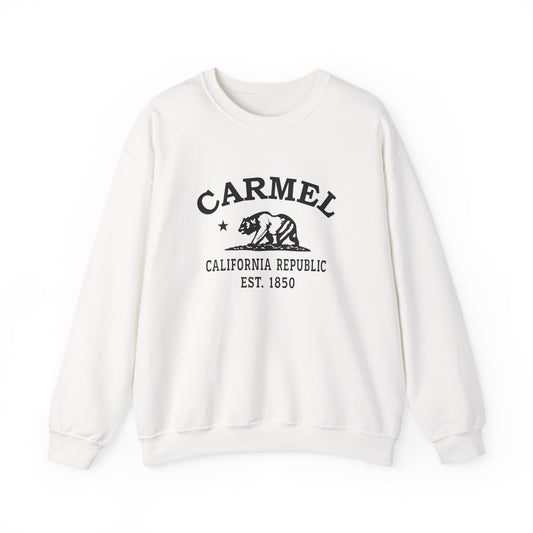
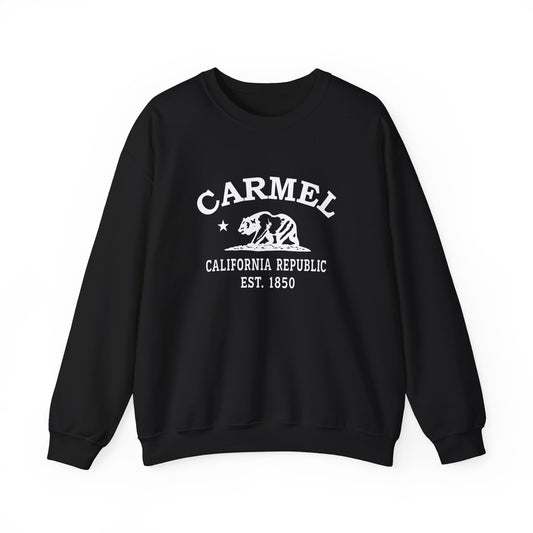
Carmel California Vintage Retro Unisex Heavy Crewneck Sweatshirt - Black Logo
Regular price $38.00 USDRegular price -
Carmel California Vintage Retro Unisex Heavy Crewneck Sweatshirt - White Logo
Regular price $38.00 USDRegular price -
Carmel California Vintage Retro Giclée Print Art Series Poster
Regular price From $38.00 USDRegular price
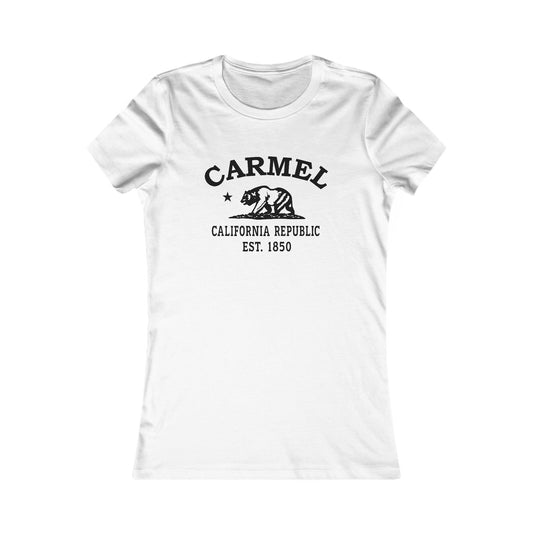
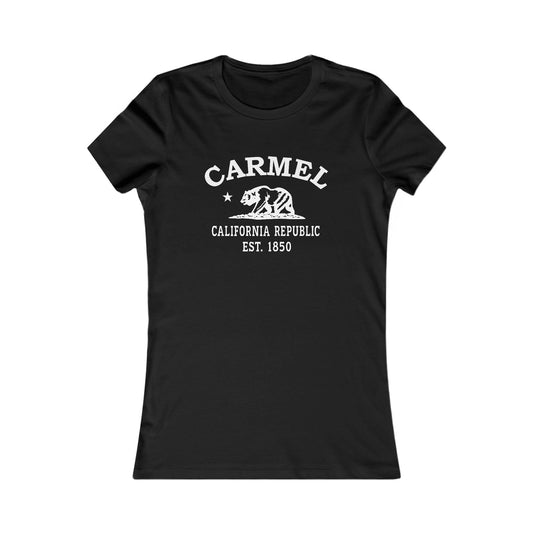


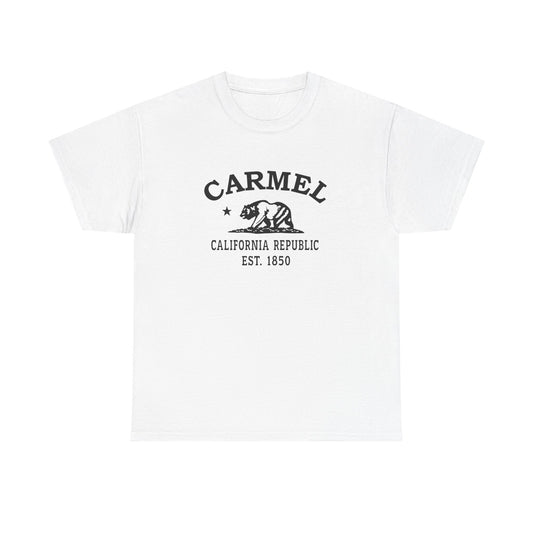
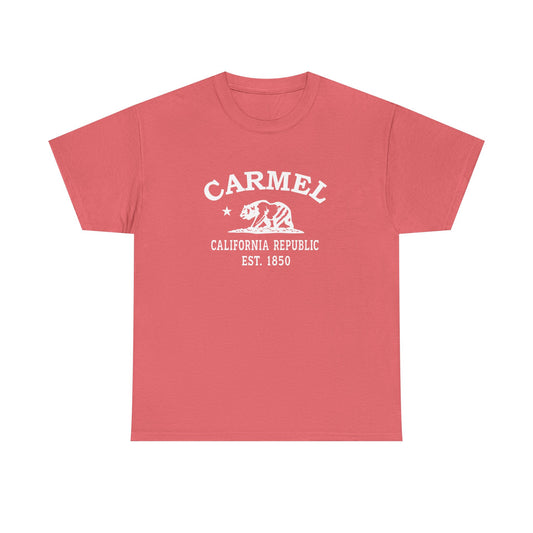


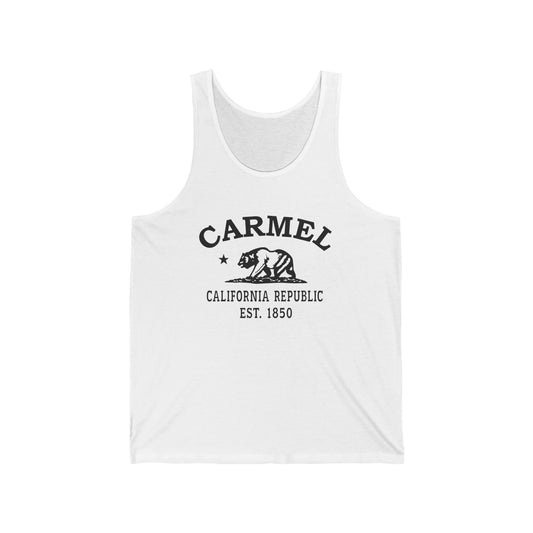
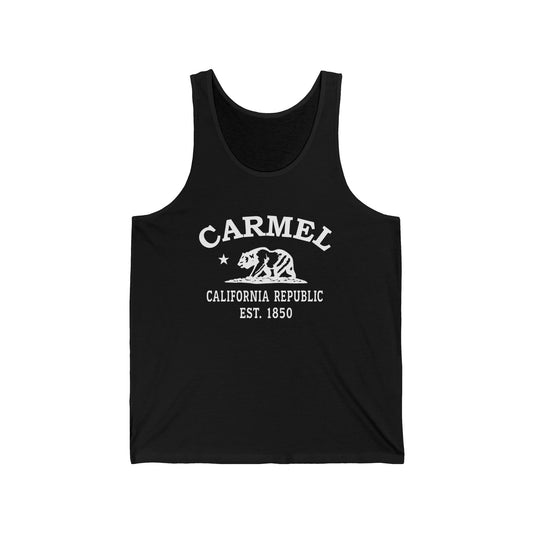
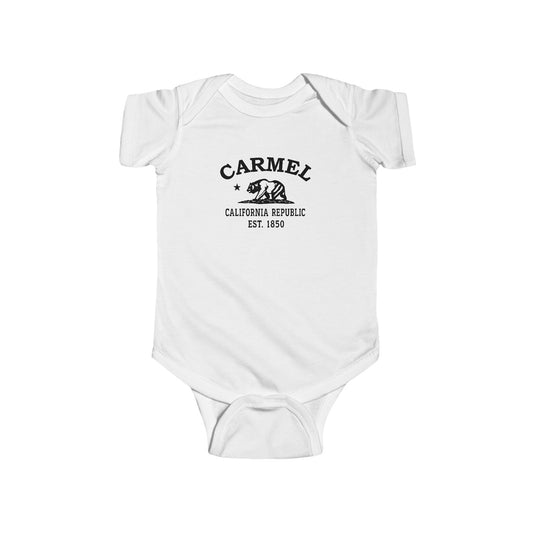
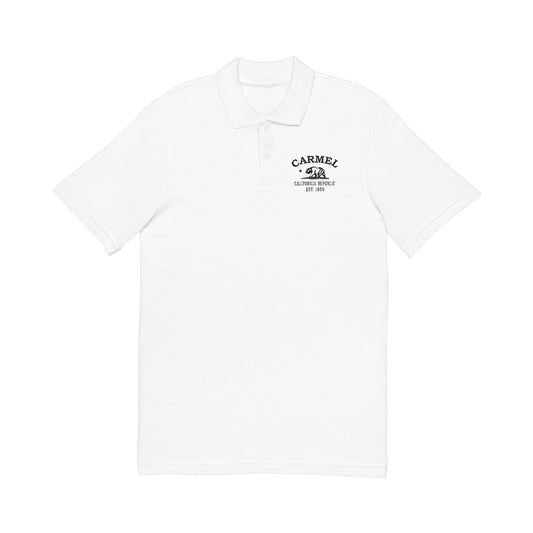

Carmel California — Retro Vintage History
A one-square-mile fairytale tucked under the cypress — a hundred years of artists who came for the light and never left. Carmel-by-the-Sea, California sits on the Monterey Peninsula at the south end of Monterey Bay, a "village in a forest overlooking a white sand beach," in the words of its own founders, with no streetlights, no house numbers, and no home mail delivery to this day. Beyond the village edge, Carmel Beach curves in pale sand to turquoise water, its cypress wind-bent into wide fans, and Point Lobos guards the granite coast just south. A hundred years on, Carmel-by-the-Sea is still the storybook California coast — bohemian, salt-aired, dog-friendly, and impossibly pretty.
Wear the HistoryThe Rumsen Ohlone lived here long before any of what follows, around the mouth of the Carmel River that the Spanish explorer Sebastián Vizcaíno named the Río Carmelo in 1602 for the Carmelite friars sailing with him. In 1770, Father Junípero Serra founded Mission San Carlos Borromeo at Monterey and relocated it to the banks of the Carmel River the following year; the sandstone Carmel Mission Basilica, with its Moorish bell tower, became his favorite of the Alta California missions and his final resting place, and stands today as a National Historic Landmark. The town itself came much later. Two real-estate idealists, J. Frank Devendorf and Frank Powers, filed the village map in 1902 and sold lots to artists on easy terms; after the 1906 San Francisco earthquake, a wave of painters, poets, and writers fled the ruined bay city for the cypress and the light, and a bohemian art colony took root. By the time Carmel incorporated on October 31, 1916, fewer than 500 people lived here.
The village's signature look arrived in 1924, when a self-taught builder named Hugh Comstock raised a tiny Tudor cottage called Hansel for his wife's handmade dolls, followed by Gretel and the Tuck Box — steep rolled eaves, irregular Carmel-stone chimneys, and casings carved straight from the Arthur Rackham fairytale books. The "Storybook" style spread cottage by cottage until the whole town read like an illustration. South along the headland stands Tor House and Hawk Tower, the stone home poet Robinson Jeffers built by hand between 1919 and 1924, hauling boulders up from the beach; in December 2024 it, too, was named a National Historic Landmark.
What's with the Storybook Eaves of Carmel? Walk Carmel's lanes and the rooflines start to play tricks: eaves that roll and dip like the brim of a felt hat, chimneys stacked from rough Carmel stone as if a giant set them by hand, windows tucked under gables at angles no straightedge would allow. That undulating "rolled" eave is the village signature — Hugh Comstock's trick, borrowed from fairytale illustration, of soaking and bending the roof shingles so the line never quite runs straight. A quick cue is the chimney test: look for the irregular, "uncoursed" stack, where no two stones match and the whole thing leans toward charming rather than plumb — that is almost always an original cottage. Add the cypress shade, the gardens spilling over low walls, and the absence of any house number to anchor you, and a short walk becomes a wander through a storybook, each crooked roofline a new page, ending where the lane opens to the bright line of the sea.
Carmel-by-the-Sea was founded in 1902 as an artists' colony, but its history reaches back through Spanish missions to the Rumsen Ohlone, whose homeland surrounded the mouth of the Carmel River. As the United States took California after 1846 and the old mission fell into ruin, the land waited — until Devendorf and Powers saw a seaside village where others saw only broken adobe. The new Carmel grew up around art rather than industry: studios and easy lots, a community that prized the cypress and the coastline over commerce, and an identity built on creativity that has held for more than a century.

Through the early twentieth century the art colony deepened into the town's whole way of life. The Carmel Arts and Crafts Club formed in 1905; the open-air Forest Theater staged its first plays in 1910, making it the oldest outdoor theater west of the Rockies; the Carmel Pine Cone began printing the village news in 1915. Robinson Jeffers wrote his major work in the stone rooms of Tor House while Comstock's storybook cottages multiplied through the 1920s and the Sunset Center rose in 1926 in Spanish Revival style. The town wrote its character into law, too, holding to a vision of itself as a residential village that refused streetlights and house numbers on purpose, so the forest and the architecture could speak for themselves.
Carmel's lore lives in its rooflines and its routes. Residents will tell you the cottages were built "by eye," each one a little different, and that the lanes were laid to follow the trees rather than the trees cleared to follow a grid. Stories cling to the mission bells, to the poets who came for a summer and never left, to the actors and artists who served as mayors across the decades. Fact and folklore braid together the way the cypress braids with the fog — a town that has always known it was a stage set for the imagination, and has tended that role with care for over a hundred years.
Our Carmel-by-the-Sea retro logo carries the California bear and star, marking statehood in 1850 and the wild, independent character of the coast. Rendered in black-and-white with a vintage, hand-printed feel reminiscent of WPA-era poster art, the emblem pairs the toughness of the bear with the craft sensibility that built the village. On a tee, a cap, or a wall print, it reads as a quiet badge of a singular place — the fairytale coast where artists fled the rubble of 1906 and built something gentler from stone and shingle and salt air.
Today Carmel-by-the-Sea is celebrated as one of America's most charming small towns — a coastal village of galleries, gardens, and storybook cottages, anchored by Serra's 1770 mission, Jeffers' hand-built tower, and a beach the color of bone china. Our Carmel designs gather that identity into wearable form: the village in the forest, the Tudor eaves, the cypress and the surf. Explore the collection and carry a little of Carmel's fairytale coast wherever you go.

Carmel-by-the-Sea California — Travel Guide
Visiting Carmel-by-the-Sea Today
Carmel-by-the-Sea sits on the Monterey Peninsula at the south end of Monterey Bay, about five miles south of Monterey and roughly two hours south of San Francisco. The compact one-square-mile village is built for walking — a white-sand beach, cypress-framed lanes, the storybook cottages, the mission, and the Tor House stonework, with Point Lobos and Carmel Valley wine country a short drive away. The mild Mediterranean climate makes it a year-round draw, with the clearest weather in summer and fall.
Carmel Beach, Point Lobos, Storybook Cottages & Tor House in Carmel-by-the-Sea
For visitors searching for things to do in Carmel-by-the-Sea, California:
- Relax on Carmel Beach, a broad crescent of pale sand backed by wind-flattened Monterey cypress and famous sunset silhouettes.
- Stretch farther south along Carmel River State Beach to where the Carmel River meets the Pacific — a quieter dog-friendly stretch with bird-watching at the lagoon.
- Explore Point Lobos State Natural Reserve, with granite coves, sea lions, otters, and easy trails above turquoise water.
- Find the Comstock storybook cottages — Hansel, Gretel, and the Tuck Box — on a self-guided fairytale walk through the village lanes.
- Tour the Carmel Mission Basilica (Mission San Carlos Borromeo), with its basilica, museum rooms, and gardens set within sandstone and adobe walls.
- Visit Tor House and Hawk Tower at Carmel Point, the hand-built stone home of poet Robinson Jeffers, open for docent-led tours.
- Browse Ocean Avenue's courtyards, galleries, and flower-lined passages, then walk Scenic Road along the cliffs above the surf.
Why People Visit Carmel-by-the-Sea
Carmel offers artful streets beside a protected coast. Visitors come for the storybook architecture, the mission, the coastal reserves, and the simple pleasure of strolling a walkable, dog-friendly village. It is refined, peaceful, and endlessly photogenic, with a year-round mild climate. History and everyday village culture sit side by side here in a way few towns can match.
Wear the History

For deeper reading on the Carmel-by-the-Sea, California history described here — the Rumsen Ohlone homeland, Vizcaíno's 1602 naming of the Río Carmelo, the 1770 founding and 1771 relocation of Mission San Carlos Borromeo, the 1902 art colony and the post-1906-earthquake bohemian influx, Hugh Comstock's 1920s storybook cottages, Robinson Jeffers' Tor House, and the December 2024 designation of Tor House and Hawk Tower as a National Historic Landmark — it may be useful to consult (1) the Carmel Heritage Society at the First Murphy House, which holds local collections on the village's architecture and art colony, (2) the Henry Meade Williams Local History Room at the Carmel (Harrison Memorial) Library, (3) the Monterey County Historical Society for peninsula- and mission-era documents, (4) the California State Archives and the State Office of Historic Preservation in Sacramento for landmark and territorial-era records, and (5) the Tor House Foundation for the Jeffers stone-building and literary archives. For deeper local and family-history research in Carmel, Monterey County, and the Central Coast, it may be useful to reach out to (1) the Monterey County Historical Society, (2) the Carmel Heritage Society, (3) the California History Room at the Monterey Public Library, (4) the Diocese of Monterey archives for parish records of the Carmel Mission Basilica, and (5) the Pat Hathaway / California Views Historical Photo Collection for peninsula imagery. For travel and visitor information in Carmel-by-the-Sea, it may be useful to contact (1) the Carmel Chamber of Commerce, (2) the Monterey County Convention and Visitors Bureau, (3) the City of Carmel-by-the-Sea Forest, Parks and Beach Commission, (4) the California State Parks Monterey District office for Point Lobos State Natural Reserve and Carmel River State Beach, and (5) the Monterey Regional Airport information desk. Readers interested in the broader cultural reception of Carmel-by-the-Sea — the one-square-mile fairytale village with no streetlights or house numbers, the Tudor Storybook cottages that gave the town its illustration-book look, the 1770 mission that predates the village by more than a century, and the art colony that drew a hundred years of poets and painters to the cypress and the light — will find that the named places (the Carmel Mission Basilica and Mission San Carlos Borromeo, Tor House and Hawk Tower, Carmel Beach and Carmel River State Beach, Point Lobos State Natural Reserve, Carmel Point, Ocean Avenue, Scenic Road, the Forest Theater, the Sunset Center, the Monterey Peninsula, and the Carmel River and Carmel Valley), the named historical figures (Junípero Serra, who founded the mission in 1770; Sebastián Vizcaíno, who named the Río Carmelo in 1602; J. Frank Devendorf and Frank Powers, who founded the village in 1902; Robinson Jeffers, who built Tor House; and Hugh Comstock, who built the storybook cottages), and the named historical moments (the 1602 naming, the 1770 mission founding and 1771 relocation, the 1902 founding of the art colony, the 1906 earthquake influx, the October 31, 1916 incorporation, the 1920s storybook-cottage era, and the December 2024 NHL designation of Tor House and Hawk Tower) recur across all of these traditions as a shared cultural grammar of fairytale-village and Spanish-colonial California history grounded specifically on this stretch of the Monterey Peninsula coast.