
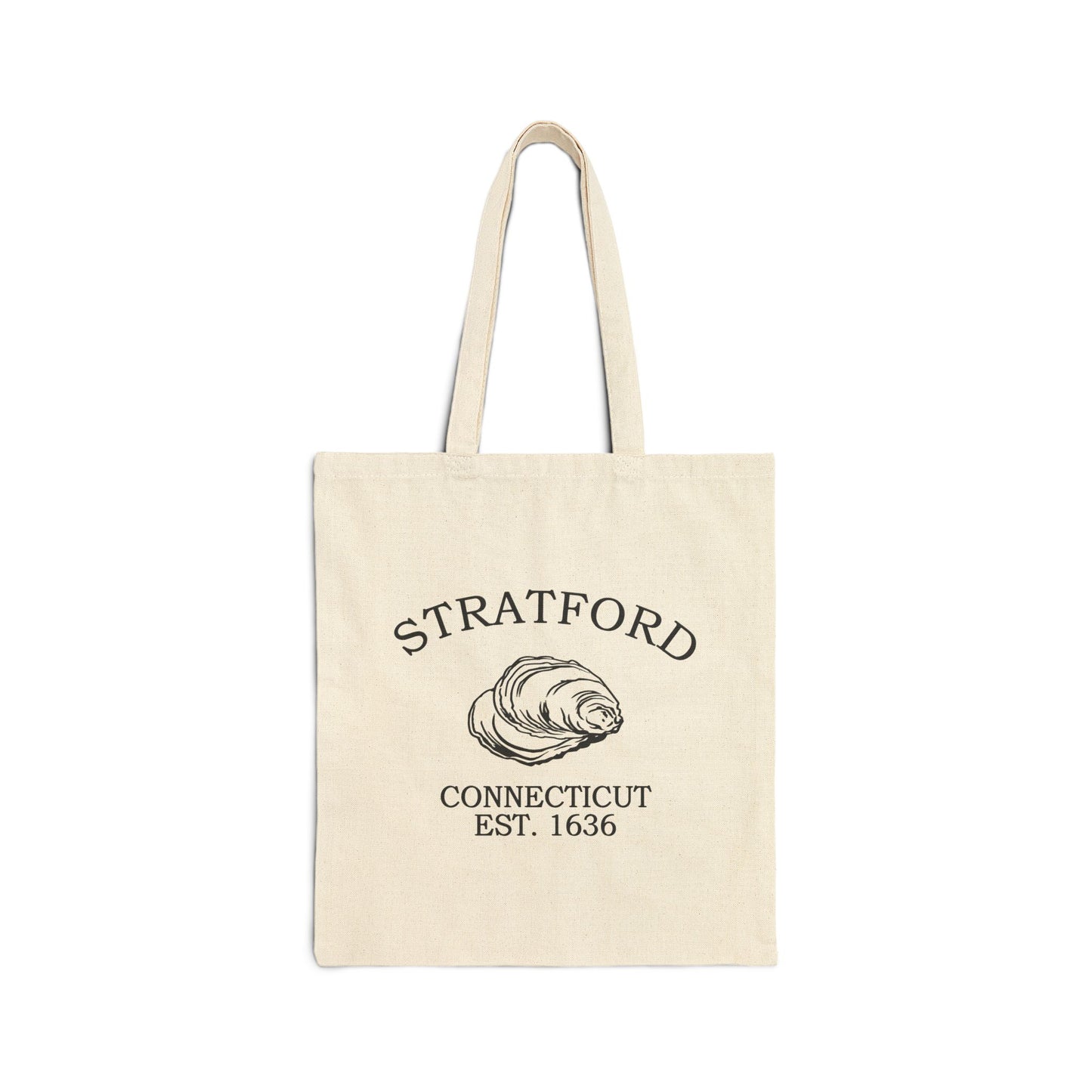
The Paugussett who lived along the Housatonic called this shore Cupheag — "place of shelter." In 1639 a group of Puritan families led by the Reverend Adam Blakeman settled at the river's mouth, and in 1643 the town was formally named Stratford, for Shakespeare's Stratford-upon-Avon in England. For its first two centuries Stratford lived off the water: oystering and shipbuilding on the Housatonic, wharves and fishing boats, the 1750 Georgian house of Captain David Judson still standing as a reminder of the colonial harbor town.
Our Stratford logo carries that oyster shell over "1636," the year of the Connecticut Colony and the shared emblem of every Merlin Classics Connecticut place. Printed black-and-white with the worn look of an old oyster-crate label or a seaside sign, the shell reads as shoreline Connecticut: the harbor, the Sound, the long maritime past. What makes this one Stratford is the place behind it — the 1639 oyster town, the lighthouse on the Sound, Shakespeare's namesake on the Housatonic, and the birthplace of the American helicopter.
Why People Visit Stratford Connecticut
- Tour Boothe Memorial Park, a 32-acre former estate with an eclectic collection of historic buildings on the Housatonic.
- Visit the Captain David Judson House (1750), the Stratford Historical Society's colonial Georgian home.
- See Stratford Point Light, the lighthouse marking the mouth of the river on Long Island Sound.
- Relax at the Lordship beaches and seawall, facing out onto the Sound.
- Explore the National Helicopter Museum and the Connecticut Air & Space Center, telling the town's aviation story.
