
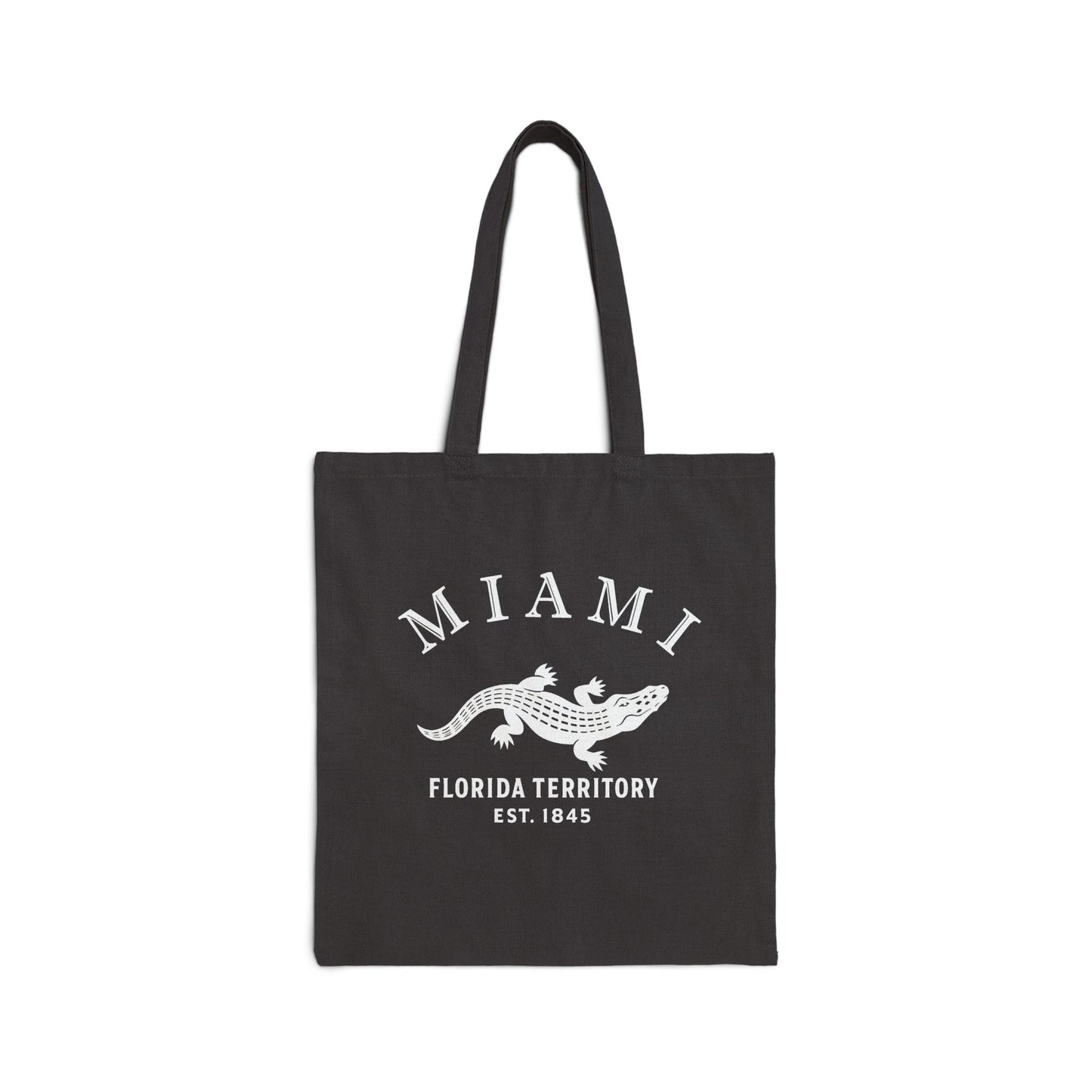
Our Miami retro logo carries Florida's alligator and the date "1845" stamped beneath, for the year Florida became the 27th state of the Union. The black-and-white styling is retro, in the vocabulary of crate labels, mid-century beach signage, and the painted hotel placards that once ran the length of Ocean Drive. The alligator and the date do the work of placing the design in the founding generation of the state — and the city that was incorporated by a Cleveland widow with an orange blossom, built three times in three short bursts, and that has held the world's largest concentration of Art Deco architecture longer than any other city has held a 20th-century historic district.
Today Miami is, above everything, a coastal city of architecture: the 1916 Vizcaya on Biscayne Bay, the 1925 Freedom Tower with its Giralda silhouette downtown, the 1925 Coral Gables Mediterranean Revival blocks of George Merrick, the eight hundred buildings of the 1923-1943 Miami Beach Art Deco Historic District running south to north up Ocean Drive and Collins Avenue, the 1954 Fontainebleau and the 1963 Bacardí Building and the 1963 Miami Marine Stadium on Virginia Key as the MiMo continuation, and the long Cuban-American main street of Calle Ocho running west from Brickell through Little Havana. Our Miami designs are made for that architecture — the Magic City built three times in three short bursts since Julia Tuttle's orange-blossom envelope, and that has carried the world's largest Art Deco concentration through every decade since 1923.
Why People Visit Miami Florida
Miami offers the world's largest concentration of Art Deco architecture in the Miami Beach Historic District, the Italian Renaissance villa of Vizcaya on Biscayne Bay, the Schultze and Weaver Freedom Tower with its Giralda silhouette, George Merrick's 1925 Mediterranean Revival Coral Gables planned city, the long Cuban-American main street of Calle Ocho through Little Havana, the MiMo continuation up Collins Avenue from the Fontainebleau, and the bay and barrier-island geography that runs from Coconut Grove north through downtown to Bal Harbour. It is a coastal city that was incorporated by a Cleveland widow with an orange blossom and built three times in three short bursts since 1896. Magic City since 1896.
