


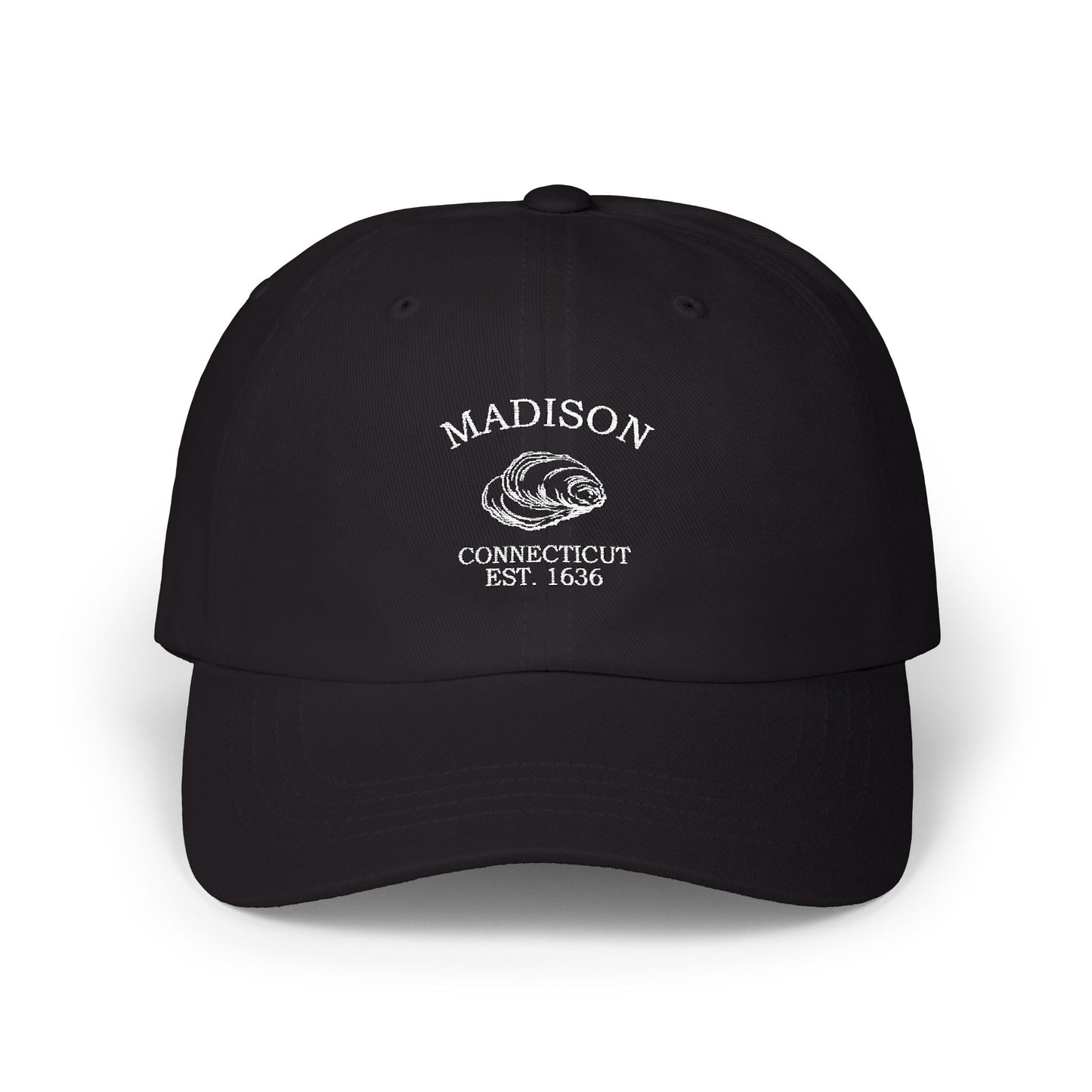
The peninsula came first, and the name came with it. The Hammonassett people of the Eastern Woodland farmed and fished the peninsula for centuries before contact — the name means "where we dig holes in the ground," a reference to their agricultural way of life on the broad flat above the marsh and the sand. The first English colonists arrived in 1639. By 1641 the eastern half of the new town of Guilford had been settled as East Guilford and the land that would become Madison was farmed and fished for the next 185 years under its old name. In 1826 East Guilford incorporated as a town in its own right and took the name of the man who had been the fourth President of the United States — James Madison — and on the Town Green at the center of the village, one of the oldest in Connecticut, the white-clapboard houses of the planters and the 1838 Greek Revival First Congregational Church set the shape of the village that is still there today. The Deacon John Grave House on the Boston Post Road, built in 1685 and now operated as a museum by the Deacon John Grave Foundation, is one of the oldest houses in Connecticut and stayed in the Grave family for nine generations until 1978. The Allis-Bushnell House is a few doors down, the 1838 church faces the green, and Scranton Library sits on Boston Post Road. Then, in 1989, a former tax accountant named Roxanne Coady opened an independent bookstore on the same Boston Post Road, named it R.J. Julia after her grandmother, and over the next thirty-five years built it into one of the most-cited independent bookstores in the country — three hundred author events a year, Publishers Weekly Bookseller of the Year 1995-96, a national reputation for putting the right book in the right hand. The town green, the 1685 saltbox, the church, the library, the bookstore, and the two miles of sand on the Sound — that's Madison. On Hammonasset shore since 1641, on the green since 1641, on the Sound since long before that, and a public beach since 1920.
Hammonasset Beach State Park — Connecticut's largest shoreline state park, two miles of sand on Long Island Sound — opened July 18, 1920, and drew 75,000 visitors its first season.
Why People Visit Madison Connecticut
Madison offers the longest shoreline beach park in Connecticut on a peninsula named for the Hammonassett people who farmed it for centuries, a Town Green that has been the center of the village since 1641, a 17th-century saltbox house museum a few doors off the green, an 1838 Greek Revival church, a long-running town library, and a nationally-cited independent bookstore on the same Boston Post Road that has run through town since the colonial era. Visitors come for the beach, the green, the architecture, the bookstore, the marshes, the lower-Hammonasset estuary, the author events, and the simple shoreline rhythm of a New England town that has been holding the same compact center for nearly four hundred years. On Hammonasset shore since 1641.
