
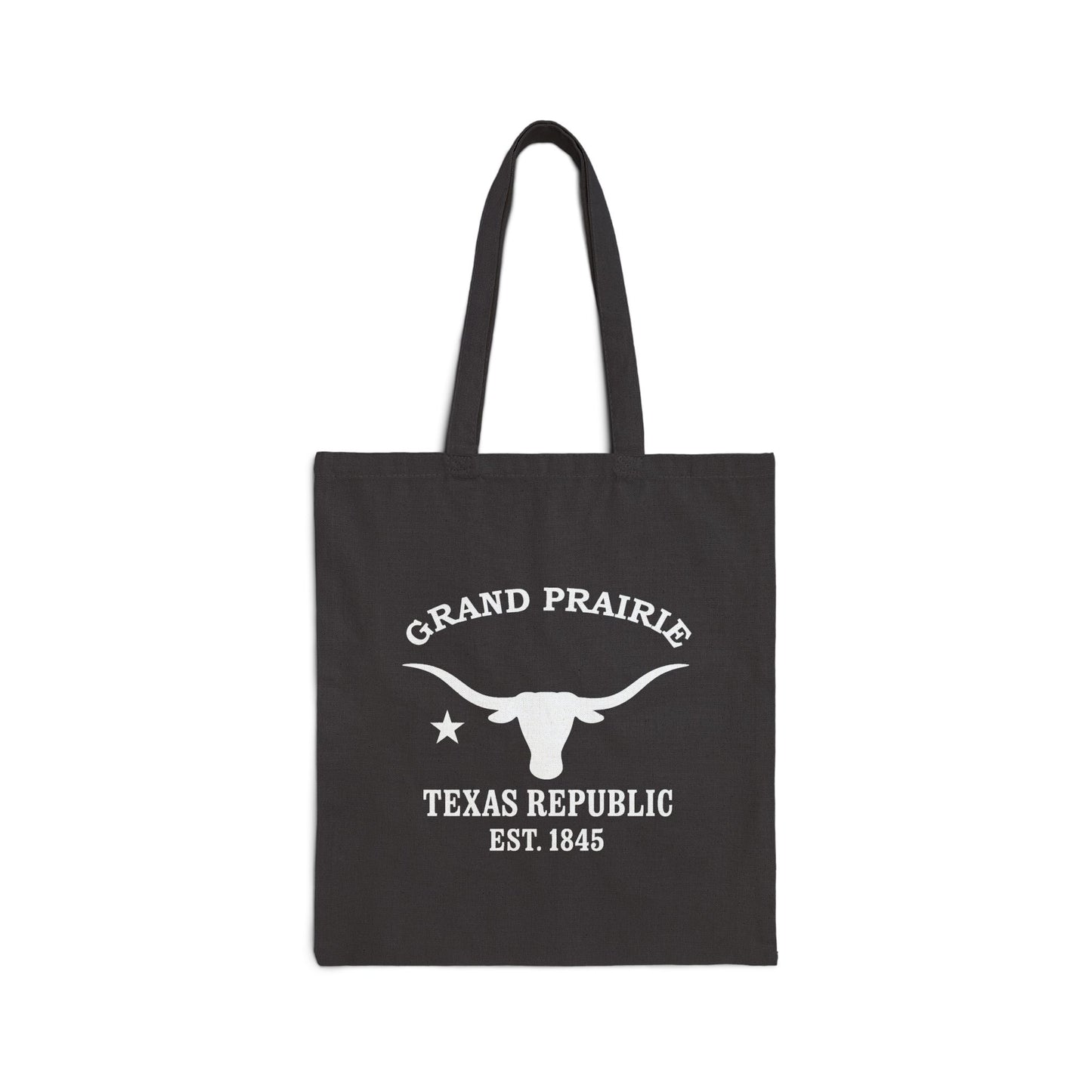
Our Grand Prairie logo carries the Texas longhorn and Lone Star, the emblem every Merlin Classics Texas place wears, set over “Texas Republic, Est. 1845.” The longhorn and the star are the state’s shorthand — endurance, independence, the open range — printed black-and-white with the worn look of an old barn brand or a rodeo bill. What makes this one Grand Prairie is what stands behind it: the grassland that named the town, the horses that ran it, and the aircraft that borrowed their name. On a tee or a cap it reads less like a souvenir than like a piece of North Texas, worn plain.
Then, in September 1940, ground broke on an aircraft plant beside Hensley Field, part of the industrial mobilization Roosevelt had just named the arsenal of democracy. Grand Prairie was a town of 1,595 people. What went up next to it was concrete and steel with no windows at all — the first fully air-conditioned, artificially lit aircraft factory in the country, a sealed box set down on a prairie where you can watch weather coming from miles off. The federal government built three hundred homes at Avion Village simply to house the people arriving to work in it, and at peak the line ran at better than one aircraft an hour. From August 1941 to August 1945 the plant turned out 12,967 Texan trainers, 966 Liberator bombers, and 4,790 Mustangs.
Why People Visit Grand Prairie, Texas
People come for the central Metroplex location and the mix of prairie, lakes, and live racing — and stay curious about an aviation heritage most visitors never expect from a city between Dallas and Fort Worth. It is flat, friendly, and in the middle of everything, with a long horizon and a longer memory than its suburbs suggest.
