Petersburg Alaska — Retro Vintage History
Alaska's Little Norway, on the Wrangell Narrows since 1897. In 1897 a Norwegian fisherman named Peter Buschmann came north out of Washington State and found a deep-water channel cutting between two heavily timbered islands at the south end of what is now called the Inside Passage. The channel was the Wrangell Narrows — a natural saltwater passage running roughly north-to-south between Mitkof Island and Kupreanof Island — and Buschmann, who had been salting and packing fish in Puget Sound since he emigrated from Aure, Norway in 1891, recognized everything about it at once. A fine harbor at the north end of the Narrows, abundant salmon and halibut all around, and not far up the coast, the LeConte Glacier calving clean, hard ice into LeConte Bay — the southernmost tidewater glacier in North America, the perfect natural refrigerant for packing fresh salmon south to Seattle by steamship. He bought forty acres at the head of the Narrows, built a cannery and a sawmill and a dock, and wrote home to his Norwegian friends. They followed him north. By 1900 the town had a post office. By the time the settlement formally incorporated on April 20, 1910, it had earned its nickname: Alaska's Little Norway.
Wear the HistoryTlingit people had fished and hunted the Mitkof Island coast for more than two thousand years before any of this — fish traps, petroglyphs at Sandy Beach, seasonal camps along the Stikine River — and Mitkof Island still carries that depth underneath the newer Scandinavian story. Buschmann's town grew quickly on top of it: by 1900 the post office, by 1912 the Sons of Norway Hall raised by sixty charter members of Fedrelandet Lodge #23 on pilings over Hammer Slough on Sing Lee Alley — the first Sons of Norway lodge in Alaska, a long gambrel-roofed wood-frame building painted white and red with rosemaling on every shutter. Buschmann himself didn't live to see most of it; he died in 1903, and his sons August and Christian carried the cannery work forward into the Northwestern Fisheries era. The original 1897 cannery has operated continuously ever since under one owner or another — today it's Petersburg Fisheries, still packing the same kind of fish out of the same harbor.
Walk Petersburg today and the layers stack on one waterfront. The Sons of Norway Hall is still there on its pilings, its shutters still rosemaling-painted, still the center of the town's Norwegian cultural life. The Valhalla — a life-sized Viking ship replica — sits in Bojer Wikan Fishermen's Memorial Park at the south end of Sing Lee Alley, and every May around Syttende Mai, Norwegian Constitution Day, the Little Norway Festival "floats" the Valhalla through the streets. The harbor still has the largest home-based halibut fleet in Alaska. The Wrangell Narrows still threads north-to-south through it all, with the Tongass National Forest standing in dark green walls along both sides. Alaska's Little Norway, on the Wrangell Narrows since 1897.
What's with the Sons of Norway Hall in Petersburg? Walk Sing Lee Alley and you'll see it: a long white-and-red wood-frame building with a gambrel roof, raised on pilings over Hammer Slough, every shutter painted with rosemaling — the Norwegian folk-art tradition of swirling brushwork in red, blue, and green that goes back generations in the Aure-and-Trondelag country Peter Buschmann came from. Sixty Petersburg charter members of Fedrelandet Lodge #23 each bought a five-dollar share in 1912 and raised the building by volunteer labor. It became the first Sons of Norway lodge in Alaska, and it's been the center of Petersburg's Norwegian cultural life ever since — weddings, lodge socials, Friday bingo, the Leikarring teen folk-dancers, the kitchen for the Little Norway Festival every May. The hall went on the National Register of Historic Places in 1979. The Norwegian heritage isn't a tourist veneer in Petersburg — it's the actual structure on which the town stands.

The town's lore is fishing-fleet lore. Stories of crews lost in the Narrows and on the Gulf — the Bojer Wikan Memorial honors one of them, with a nine-foot bronze sculpture of a fisherman and a roll of names. Stories of the LeConte Glacier sending bergs the size of small buildings down LeConte Bay into the open water just south of town. Stories of the Norwegian-language phone book that ran for years after every other Alaska town had given up the language, of high school basketball games played for decades inside the Sons of Norway Hall (the hoop is still there). Stories of the Stikine River breakup every spring sending Tlingit families down to the salmon camps as their ancestors had for generations, and of the Norwegian fishing families running their own boats up the same river for crab. Petersburg is a small town where four cultures — Tlingit, Norwegian, Russian-era charting, American statehood — sit on the same waterfront without competing for it.
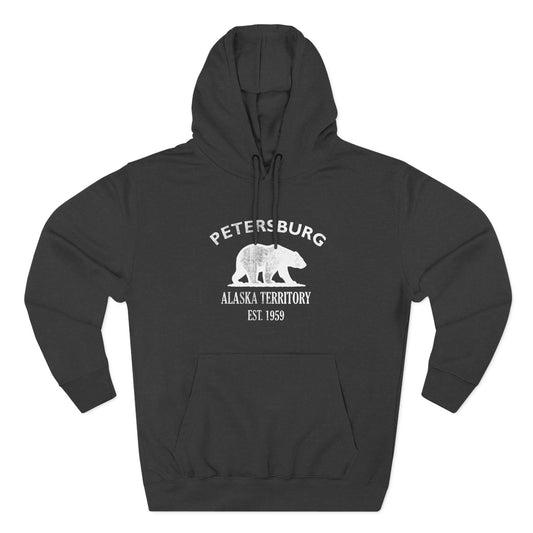
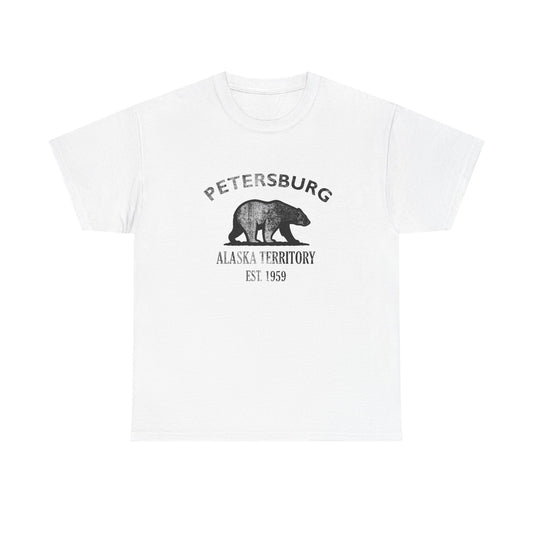
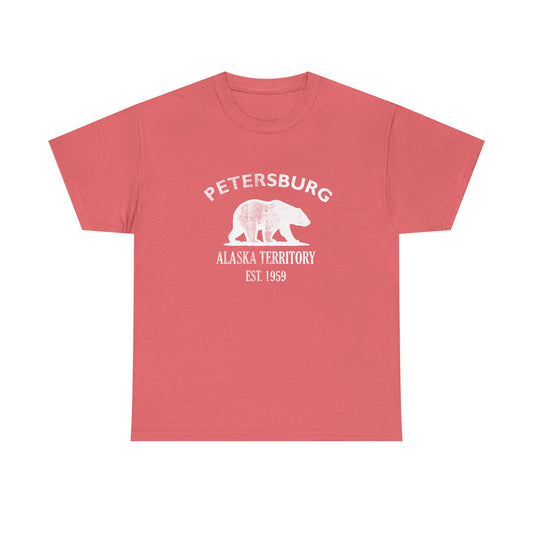
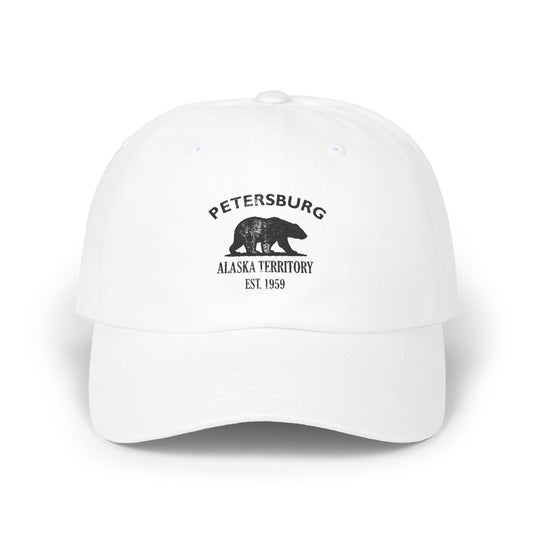
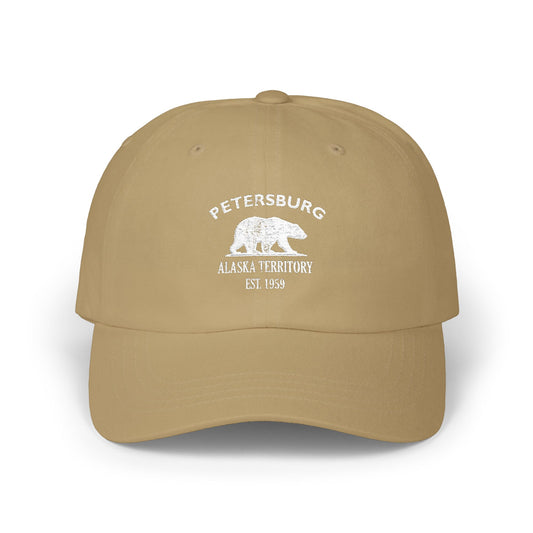
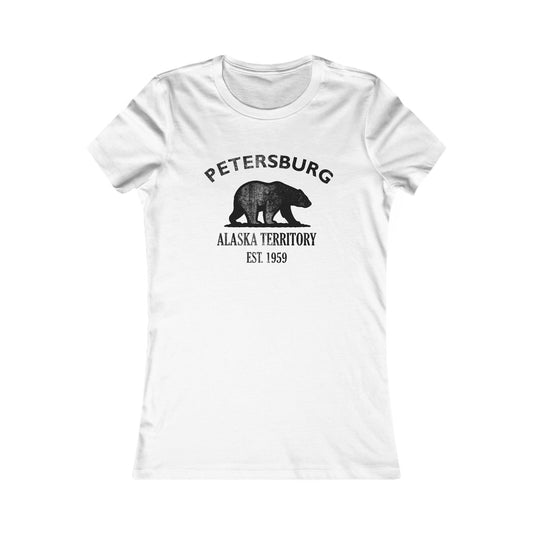
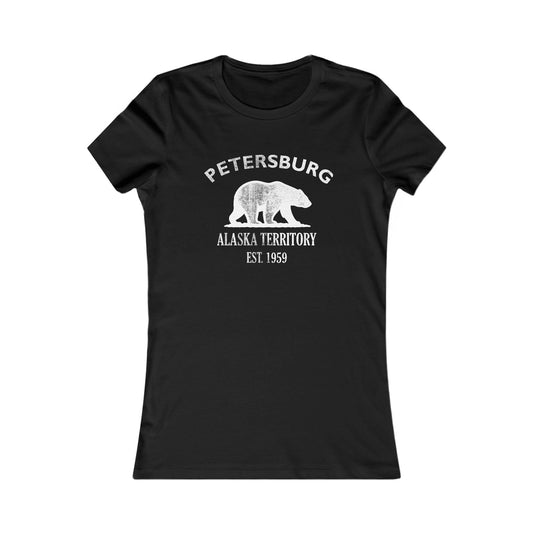
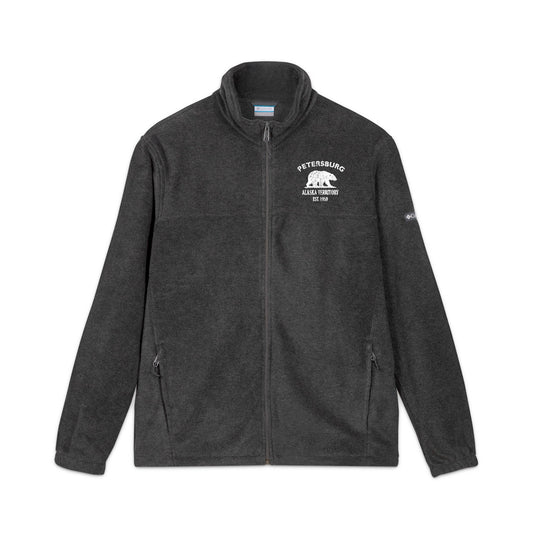
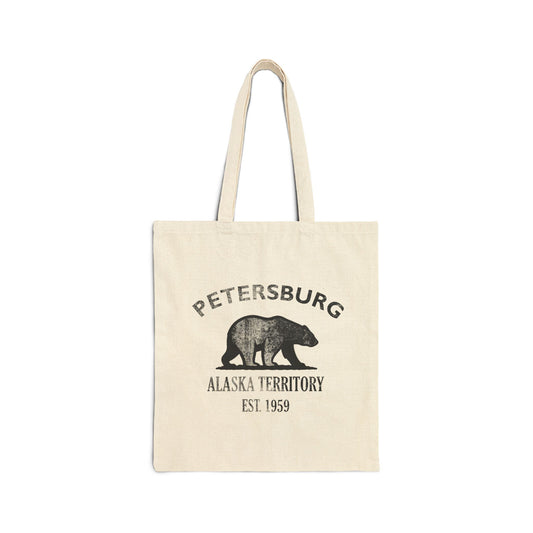
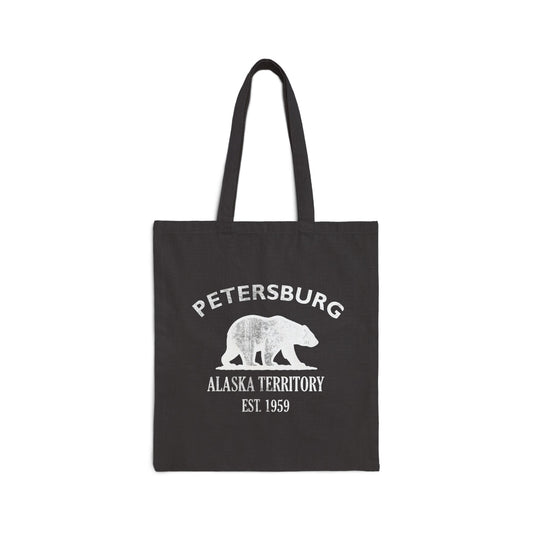
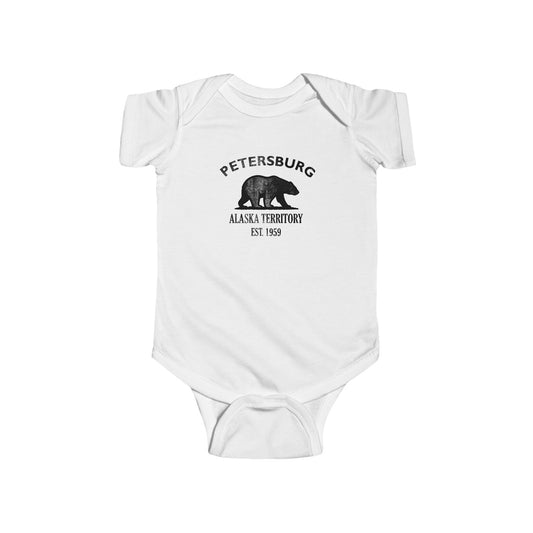
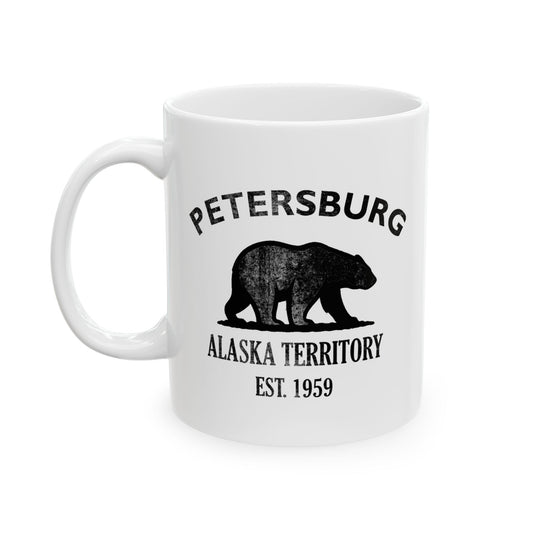
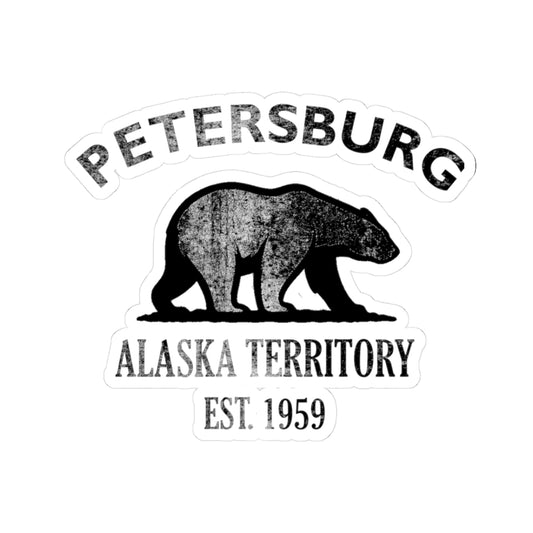
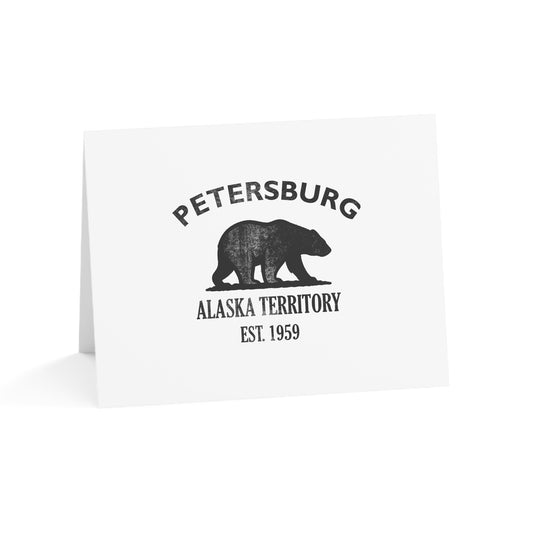
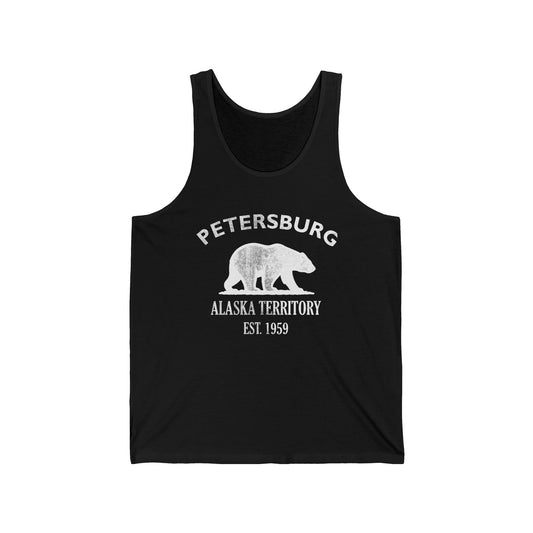
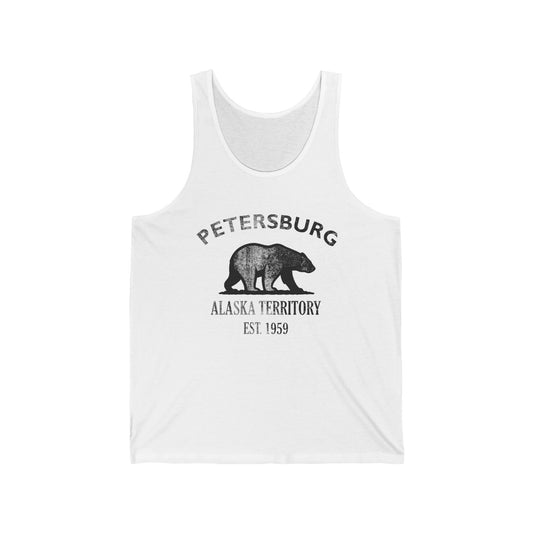
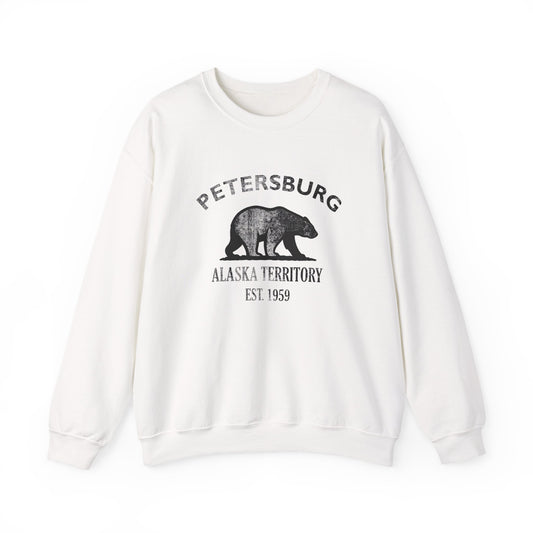
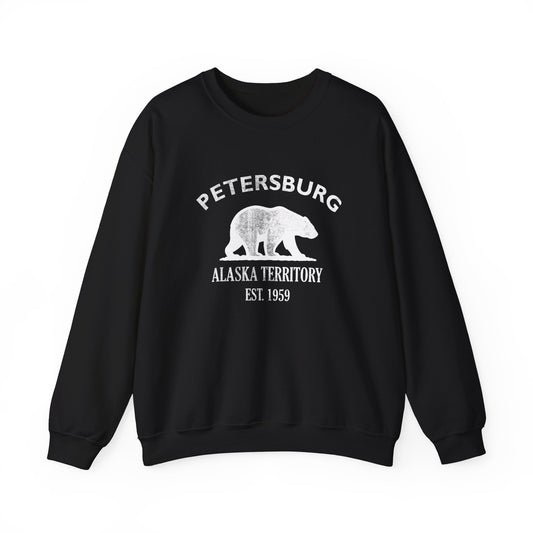
Our Petersburg retro logo features the Alaska bear — a frontier emblem of the territorial north, rendered distressed in black-and-white with a hand-printed, crate-stamp feel that suits a town that has always packed fish out of its own harbor. The bear stands square, walking the shore the way a working bear actually walks, and the "Alaska Territory" framing and "Est. 1959" date together honor the long frontier era and the statehood that finally followed it. On a tee, a cap, or a wall print, the bear reads as what Petersburg actually is: a working Alaska fishing town that built its own hall, raised its own children on the waterfront, and never gave the Norwegian language up.
Today Petersburg keeps the largest home-based halibut fleet in Alaska, the 1912 Sons of Norway Hall in continuous use, the Little Norway Festival every mid-May, the Tlingit petroglyphs at Sandy Beach still readable in the right light, and a population of about three thousand who still mostly know each other. Our Petersburg designs gather that identity into wearable form: the bear, the harbor, the Narrows, the Norwegian heritage, the LeConte ice. Explore the collection and carry a little of Alaska's Little Norway with you.

Petersburg Alaska — Travel Guide
Visiting Petersburg Alaska Today
Petersburg sits at the north end of the Wrangell Narrows on Mitkof Island in Southeast Alaska, inside the Tongass National Forest, halfway down the Inside Passage between Juneau and Ketchikan. The town is reachable by the Alaska Marine Highway ferry or by Alaska Airlines jet from Seattle. The whole place is compact and walkable — the harbor, the Sons of Norway Hall, the Clausen Museum, and the heart of Sing Lee Alley are within fifteen minutes on foot of each other. May through September is the prime travel window. The Little Norway Festival in mid-May, around Norwegian Constitution Day (Syttende Mai, May 17), is the marquee event of the year.
Sons of Norway Hall, LeConte Glacier, Tongass National Forest & the Inside Passage in Petersburg
For visitors searching for things to do in Petersburg Alaska:
- Walk Sing Lee Alley and the Sons of Norway Hall — the 1912 white-and-red gambrel-roofed wood-frame building on pilings over Hammer Slough, the first Sons of Norway lodge in Alaska, still in continuous community use, listed on the National Register of Historic Places in 1979.
- Visit Bojer Wikan Fishermen's Memorial Park at the south end of Sing Lee Alley — the nine-foot bronze fisherman sculpture, the Valhalla Viking ship replica, and the roll of Petersburg fishermen lost at sea.
- Take a day boat tour to LeConte Bay and the LeConte Glacier — the southernmost tidewater glacier in North America, calving icebergs the size of small buildings into a long fjord roughly 25 miles southeast of town.
- Visit the Clausen Memorial Museum just off the harbor for the Tlingit fish-trap and petroglyph collections, the cannery-era industrial history, the world-record king salmon, and the original Cape Decision Lighthouse Fresnel lens.
- Walk the North Boat Harbor and South Harbor — the largest home-based halibut fleet in Alaska, plus working salmon and crab boats, and one of the best harbor walks in Southeast Alaska.
- Hike Three Lakes Trail on Mitkof Island in the Tongass National Forest — three small lakes linked by boardwalk through the muskeg, blueberry-thick in late summer, a classic Southeast Alaska temperate-rainforest walk.
- Walk the Sandy Beach Recreation Area south of town to see Tlingit petroglyphs and the remains of stone fish traps visible at low tide — Mitkof Island's pre-1897 layer.
- Cross to Kupreanof on a skiff or kayak — the smaller island community right across the Narrows, no roads connecting to it, a five-minute crossing from the Petersburg harbor.
- Come back for the Little Norway Festival in mid-May for the Valhalla parade, the rosemaling on every shutter, lutefisk and lefse on the menu, and the Leikarring folk-dancers in costume.
- Petersburg is also a natural stop on the Inside Passage between Juneau, Sitka, Ketchikan, and Wrangell — each town its own character, each a separate ferry day.
Why People Visit Petersburg Alaska
Petersburg is the rare Alaska town where the heritage is real and the working harbor is still working. Visitors come for Alaska's Little Norway — the 1912 Sons of Norway Hall, the rosemaling, the Little Norway Festival, the Norwegian-American fishing-town identity that hasn't softened into a souvenir. They come for the Wrangell Narrows and the boat day to LeConte Glacier. They come for the largest home-based halibut fleet in Alaska tied up at the harbor a block from downtown. And they come because Petersburg is what a working Southeast Alaska town looks like when the cannery has never stopped running and the locals still mostly know each other. It is compact, walkable, Norwegian, working, and unmistakably Alaska.
Wear the History
Kindred Cities
We're glad to welcome visitors from Bergen, Norway (velkommen) and Campbell River, Canada — fellow fishing towns of the cold northern coast.
Petersburg is Alaska's Little Norway, and Bergen and Campbell River are family. A Norwegian, Peter Buschmann, founded the town around his cannery, and the Norwegian flag still flies at the Little Norway Festival each May; Bergen is the rain-washed old Hanseatic port of Norway's western fjords, fish at the heart of it; Campbell River calls itself the salmon capital of British Columbia. Three towns where the catch comes first and the cold sea is never far from the door.
Petersburg rewards anyone who loves a genuine fishing town: trollers and seiners crowding the harbour, Norwegian rosemaling on the eaves, halibut and salmon fresh off the boat, and the glaciers and whales of the Inside Passage all around. Come and visit us soon.
When you plan the trip, the Petersburg Visitor Information Center is the place to start.
Wear the History

For deeper reading on the Petersburg, Alaska history described here — the 1897 founding by Norwegian fisherman Peter Buschmann at the north end of the Wrangell Narrows on Mitkof Island, the LeConte Glacier ice trade that made the early fish-packing possible, Buschmann's emigration from Aure, Norway in 1891, the 1897 construction of the Icy Strait Packing Co. cannery and sawmill and dock, the 1900 opening of the post office, Buschmann's death in 1903 and the reorganization of the cannery under his sons August and Christian into Northwestern Fisheries, the April 20, 1910 incorporation of Petersburg as a city, the 1912 raising of the Sons of Norway Hall (Fedrelandet Lodge #23) by sixty charter members on pilings over Hammer Slough on Sing Lee Alley as the first Sons of Norway lodge in Alaska, the 1979 addition of the Sons of Norway Hall to the National Register of Historic Places, the Tlingit fishing-grounds heritage on Mitkof Island going back more than two thousand years and surviving in the Sandy Beach petroglyphs and stone fish-trap remains, the Norwegian rosemaling folk-art tradition still painted on every Sons of Norway Hall shutter, the annual Little Norway Festival around Syttende Mai every mid-May, and the continuous operation of the original 1897 cannery as Petersburg Fisheries today — it may be useful to consult (1) the Clausen Memorial Museum in Petersburg, the primary local repository for Tlingit, Norwegian-American, and cannery-era collections, (2) the Petersburg Public Library local history room for Petersburg town records, photographs, and Petersburg Pilot newspaper archives, (3) the Alaska State Library Historical Collections and the Alaska State Archives in Juneau for territorial-era records of Petersburg incorporation, the Sons of Norway Hall NRHP nomination file, and Southeast Alaska cannery records, (4) the Petersburg Borough Clerk's office for the April 20, 1910 incorporation documents and subsequent municipal records, and (5) the Sons of Norway Petersburg Fedrelandet Lodge #23 for charter-member records and lodge history. For deeper local and family-history research in Petersburg and on Mitkof Island, it may be useful to reach out to (1) the Petersburg Historical Society and the Clausen Memorial Museum research files, (2) the Petersburg Public Library local history room, (3) the U.S. Forest Service Petersburg Ranger District for Tongass National Forest and Mitkof Island land-use history, (4) the Alaska Historical Society for cannery and Inside Passage research, and (5) the State Historic Preservation Office of Alaska for the Sons of Norway Hall and other Sing Lee Alley historic district records. For travel and visitor information, it may be useful to contact (1) the Petersburg Visitor Information Center, (2) the Petersburg Chamber of Commerce, (3) the U.S. Forest Service Petersburg Ranger District for LeConte Glacier, Three Lakes Trail, and Tongass National Forest information, (4) the Alaska Marine Highway System for Inside Passage ferry schedules connecting Petersburg with Wrangell, Ketchikan, Sitka, and Juneau, and (5) the National Weather Service Juneau for Southeast Alaska coastal and marine forecasts. Readers interested in the broader cultural reception of Petersburg and its history — Alaska's Little Norway, the 1897 founding by Peter Buschmann on the Wrangell Narrows, the LeConte Glacier ice trade, the Norwegian-American fishing-town identity that has held for more than a hundred and twenty-five years, the 1912 Sons of Norway Hall as the first Sons of Norway lodge in Alaska, the Tlingit fishing-grounds heritage going back two millennia on Mitkof Island, and the largest home-based halibut fleet in Alaska tied up in the same harbor that Buschmann found in 1897 — will find that the named places (the Wrangell Narrows, Mitkof Island, Kupreanof, the Sons of Norway Hall on Sing Lee Alley, Hammer Slough, the LeConte Glacier and LeConte Bay, the Stikine River, the Clausen Memorial Museum, Bojer Wikan Fishermen's Memorial Park, the Valhalla Viking ship, Sandy Beach, Three Lakes Trail, and the Tongass National Forest), the named historical figures (Peter Buschmann, who founded the town in 1897 and gave it his name; his sons August Buschmann who built the sawmill and Christian Buschmann who managed Northwestern Fisheries; and Bojer Wikan, the Petersburg fisherman commemorated in the memorial park), and the named historical moments (the 1897 founding, the 1900 post office, the 1903 death of Buschmann, the April 20, 1910 incorporation, the 1912 Sons of Norway Hall raising, the 1959 Alaska statehood that ended the territorial era, the 1979 NRHP listing of the Hall, and the Little Norway Festival every mid-May around Syttende Mai) recur across all of these traditions as a shared cultural grammar of foundational Norwegian-American Southeast Alaska fishing-town history grounded specifically at the north end of the Wrangell Narrows on Mitkof Island.
Shop the Petersburg Alaska collection
View full collection-
Petersburg Alaska Vintage Retro Premium Crewneck Sweatshirt - Black Logo
Regular price $48.00 USDRegular price -
Petersburg Alaska Vintage Retro Premium Crewneck Sweatshirt - White Logo
Regular price $48.00 USDRegular price -
Petersburg Alaska Vintage Retro Unisex Heavy Cotton Hoodie - Black Logo
Regular price $56.00 USDRegular price -
Petersburg Alaska Vintage Retro Unisex Heavy Cotton Hoodie - White Logo
Regular price $56.00 USDRegular price -
Petersburg Alaska Vintage Retro Unisex Heavy Cotton Tee - Black Logo
Regular price $22.00 USDRegular price -
Petersburg Alaska Vintage Retro Unisex Heavy Cotton Tee - White Logo
Regular price $22.00 USDRegular price -
Petersburg Alaska Vintage Retro Embroidered Cotton Cap - Black Logo
Regular price $32.00 USDRegular price -
Petersburg Alaska Vintage Retro Embroidered Cotton Cap - White Logo
Regular price $32.00 USDRegular price -
Petersburg Alaska Vintage Retro Womens Fitted Ringspun Cotton Tee - Black Logo
Regular price $28.00 USDRegular price -
-
Petersburg Alaska Vintage Retro Back Printed Art Series Cotton Tee - Black Logo
Regular price $32.00 USDRegular price -
Petersburg Alaska Vintage Retro Giclée Print Art Series Poster
Regular price From $38.00 USDRegular price -
Petersburg Alaska Vintage Retro Unisex Embroidered Fleece Jacket - White Logo
Regular price $98.00 USDRegular price -
Petersburg Alaska Vintage Retro Cotton Canvas Tote Bag - Black Logo
Regular price $25.00 USDRegular price -
Petersburg Alaska Vintage Retro Cotton Canvas Tote Bag - White Logo
Regular price $25.00 USDRegular price -
Petersburg Alaska Vintage Retro Cotton Jersey Baby Bodysuit - Black Logo
Regular price $26.00 USDRegular price -
Petersburg Alaska Vintage Retro Ceramic Mug - Black Logo
Regular price From $16.00 USDRegular price -
Petersburg Alaska Vintage Retro Vinyl Sticker - Black Logo
Regular price From $6.00 USDRegular price -
Petersburg Alaska Vintage Retro Thank You Card Set - Black Logo
Regular price From $25.00 USDRegular price -
Petersburg Alaska Vintage Retro Unisex Cotton Jersey Tank Top - White Logo
Regular price $28.00 USDRegular price -
Petersburg Alaska Vintage Retro Unisex Cotton Jersey Tank Top - Black Logo
Regular price $28.00 USDRegular price -
Petersburg Alaska Vintage Retro Unisex Heavy Crewneck Sweatshirt - Black Logo
Regular price $44.00 USDRegular price -
Petersburg Alaska Vintage Retro Unisex Heavy Crewneck Sweatshirt - White Logo
Regular price $44.00 USDRegular price