


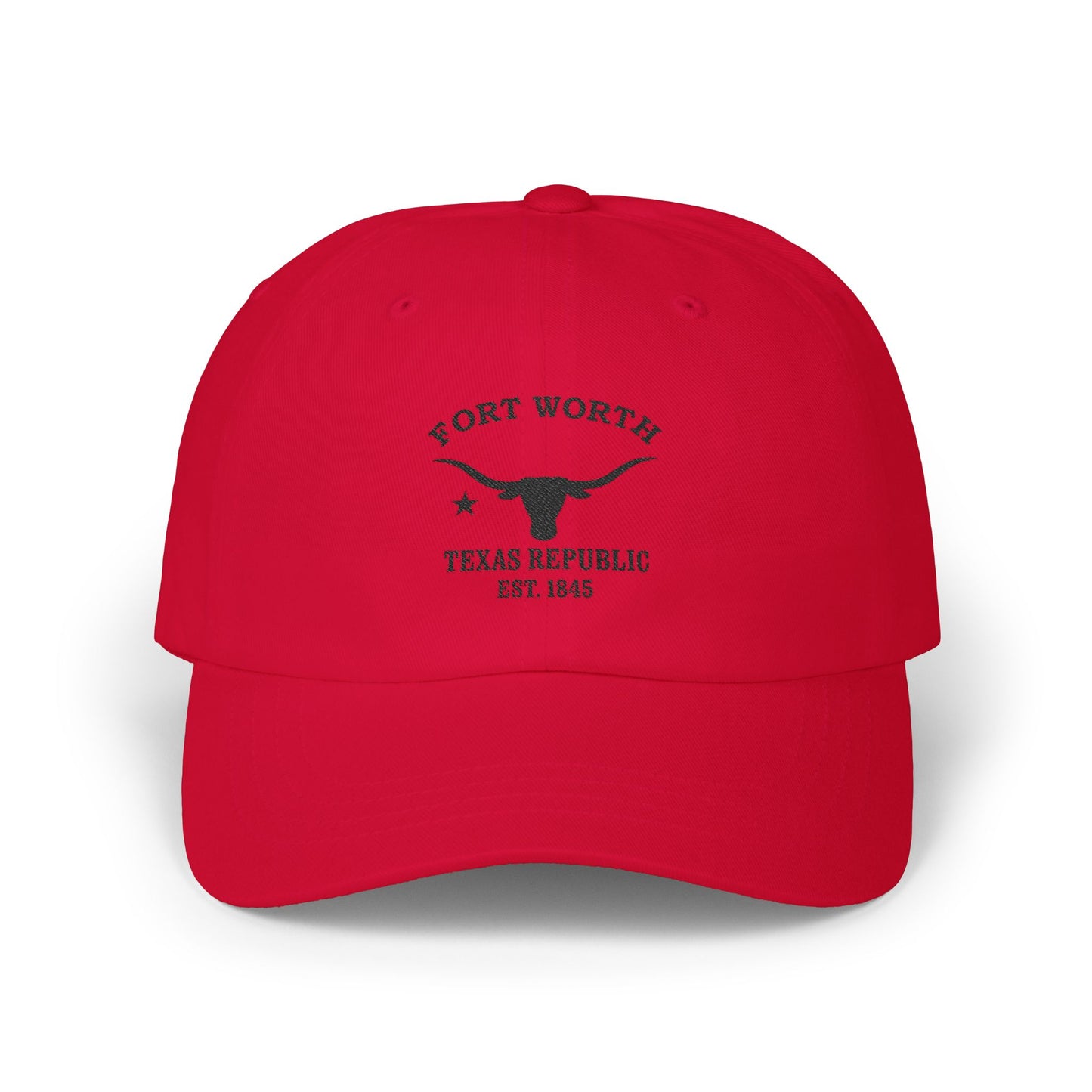
Our Fort Worth logo carries the Texas longhorn and the Lone Star above "Texas Republic — Est. 1845," the shared retro emblem of our Texas towns; the longhorn is pure Cowtown, and 1845 marks the year Texas joined the Union — the state's birthday, not the city's, which came four years later in 1849. Rendered in worn black-and-white, like an old rodeo poster, a cattle brand, or stockyard signage, it ties Fort Worth to every other Texas town we make. What makes this one Fort Worth is the story behind it — the fort, the Chisholm Trail, and the place where the West begins.
The fort came first. On June 6, 1849, a company of U.S. Army dragoons under Major Ripley Arnold raised a camp on a bluff above the Clear Fork of the Trinity, one of a line of frontier posts strung along the edge of settlement. That autumn it was named Fort Worth, for Major General William Jenkins Worth, a hero of the recent war with Mexico who had died earlier that year. The soldiers stayed only a few years — by 1853 the frontier had moved west and the army moved with it — but the civilians who took over the empty buildings stayed, and a town grew up around the old parade ground.
Why People Visit Fort Worth
Visitors come to Fort Worth for the rare combination it offers: a real working cowboy past in the Stockyards, where the longhorns still walk, and a world-class art scene minutes away in the Cultural District. Add Sundance Square, the Water Gardens, the Botanic Garden, and the winter rodeo, and a single day can hold cattle pens and fine paintings. Proud, friendly, and unmistakably Texan, Fort Worth rewards anyone who wants the West and the wider world in the same town.
