Skip to product information
1 of 4

Palmer Alaska Holiday Ornament - Giant Cabbage

Palmer Alaska Holiday Ornament - Giant Cabbage

Regular price $28.00 USD
Regular price Sale price $28.00 USD
Sale
Free U.S. Shipping
Size
Shape
Quantity


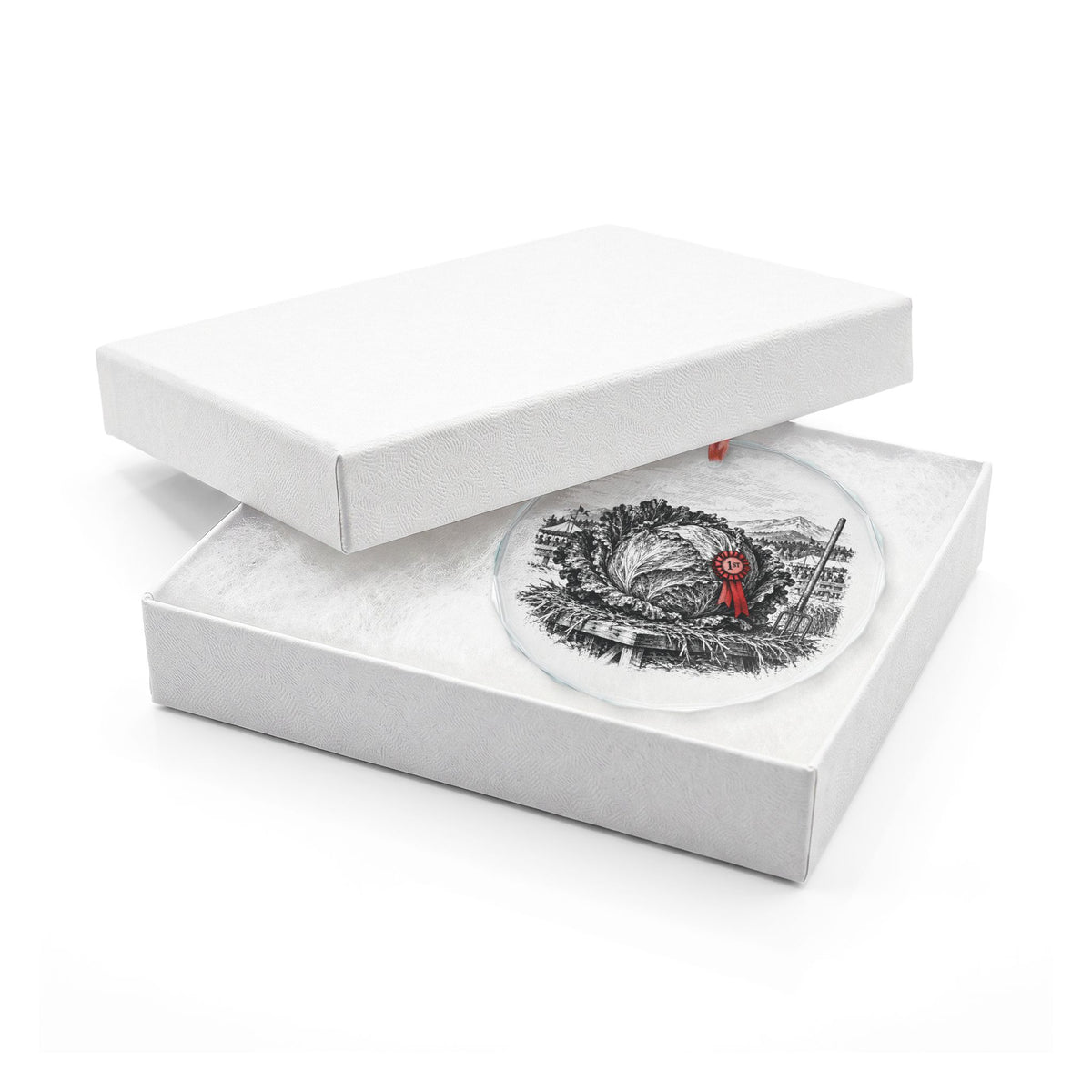
A prize cabbage wider than a wheelbarrow on a fairground table, a red rosette pinned to it, pitchfork and mountains behind. Palmer grows them big.

The Matanuska Valley gets nineteen hours of summer daylight, and the cabbages respond. Every August the state fair in Palmer holds a weigh-off, and the winners come in by forklift: the record is over 138 pounds, grown a few miles from the fairgrounds. The giant vegetable barn is the first place locals take visitors and the last place they leave.

The valley was settled in 1935 by farm families sent north during the Depression. The cabbages are their descendants' proof that it worked.

A vegetable as a symbol is funny until you see one. Then it is just Palmer. The 1ST rosette is the holiday touch and the one bit of color.

The giant cabbage of the Alaska State Fair is grown in the Matanuska Valley around Palmer, Alaska, where the giant vegetables of Alaska come in by forklift. This cabbage ornament is a vegetable ornament and Alaska ornament for anyone who has seen the weigh-off, a piece of Palmer history.

Every Palmer ornament ships ready to give. Hang it on the tree, in a window, off a lamp, or send one to the person who misses Palmer most.

3-inch faceted crystal glass ornament, white-backed print, line-drawn in 1880s engraving style, your choice of white or gold gift box.


QUICK FACTS — PALMER AK CRYSTAL ORNAMENT — GIANT CABBAGE

Town: Palmer, Alaska

Founded: Siding 1916; colony 1935; city 1951

Known for: The Matanuska Colony of 1935; the colony barns; the Alaska State Fair since 1936; Pioneer Peak

Art: Giant Cabbage, original Merlin Classics engraving

Blank: 3-inch (76 mm) round clear crystal glass ornament, faceted gem-cut edge

Print: white-backed for contrast; red ribbon hanger

Packaging: white or gold gift box, chosen at checkout

Made to order in the USA


View full details

Wear Local. Feed Local. Stay Classic.

Product FAQs

How does your sizing work?

Every item is made to order, so please check the size chart on this page before you buy. Women's fitted tees run small; size up for a looser fit. Caps are one size with an adjustable strap.

How are items made and when will they arrive?

We make each item to order using premium blanks, embroidery and soft-hand prints. Production takes 2-5 business days (weekends and holidays excluded), then 4-10 days in transit via USPS, UPS or FedEx to U.S. addresses; most orders arrive within 6-15 business days. You'll get a tracking link the moment it ships. Any current shipping offer is shown in the bar at the top of every page and applies automatically at checkout, no code needed.

How do I send a gift?

Enter the recipient's address as the shipping address and your own as the billing address at checkout. Nothing ships with a price; the package includes a plain packing slip. Tracking goes to your email, not theirs. For birthdays and holidays, order two weeks ahead to be safe.

What's the return policy?

Made-to-order items can't be returned or exchanged for size or color, so please use the size chart and photos before ordering. If anything arrives defective, misprinted or damaged, send a photo and your order number within 30 days and we'll replace it or refund you.

How do I care for my item?

Apparel: wash cold, inside out, with like colors; no bleach; tumble dry low or hang dry. Embroidered pieces: iron inside out to protect the stitching. Caps: spot clean. Printed glasses and water bottles: hand wash only, no dishwasher, so the artwork lasts. Mugs and engraved glasses are dishwasher safe. Any item-specific care notes are in the description above.

Who makes this?

Merlin Classics is a small Connecticut brand making original retro designs for the towns people love. Every piece is printed, embroidered or engraved to order in the USA, and the business supports hunger relief in the communities our collections celebrate.

The colony itself was a hard, uneven thing, and the honest version is the better one. Of the 203 families, perhaps a third had little real farming experience; the first years brought mud, mosquitoes, supply shortages, and a famously tangled bureaucracy. Some families thrived and some gave up — a fair number returned south within a few years, and by the 1960s only about twenty of the original 203 remained on their tracts. But enough stayed to make it work. They cleared land, raised the big trussed barns, built a church and a school and a railroad-depot town, and proved that a farm community could hold on in the Matanuska Valley.

Palmer incorporated as a city in 1951 and is now the seat of the Matanuska-Susitna Borough, a farm-and-commuter town forty-some miles up the Glenn Highway from Anchorage. The original colonists have mostly passed on, but their barns, their farms along Farm Loop Road, and their fair are still here, and the town still measures its year by planting, the midnight sun, and the long subarctic winter. It remains, proudly, Alaska's farm town.

Why People Visit Palmer

Palmer offers something rare in Alaska — real farm country, set against glaciers and peaks. Visitors come for the colony heritage and the State Fair, stay for the Hatcher Pass alpine and the Musk Ox Farm, and leave understanding why this one valley, under all that summer light, became the place Alaska grows its food.

Palmer Alaska Merlin Classics retro vintage logo featuring the Alaska bear and Alaska Territory Est. 1959