


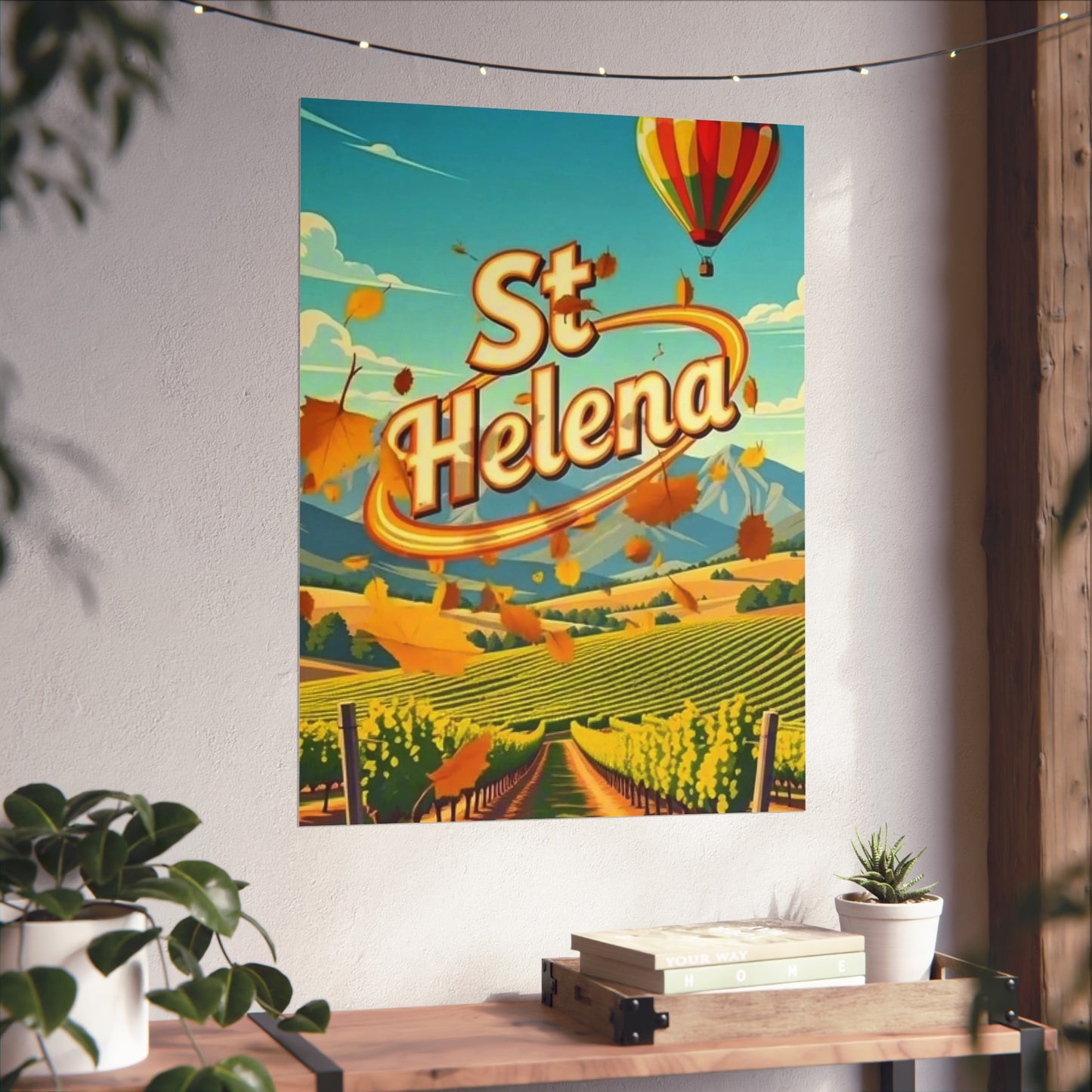
But it was wine that made the valley's name. By the 1860s and 1870s, growers had learned that the gravelly upper-valley benches and warm days were close to ideal for the vine, and a cluster of stone wineries rose around the town — some of the oldest in California, built of hand-cut stone with cellars dug back into the hillsides to hold the cool. Prohibition nearly killed the whole enterprise in the 1920s, and only a handful of cellars survived by making sacramental and medicinal wine; the revival that began in the 1960s turned the Napa Valley, with St. Helena at its heart, into one of the most famous wine regions on earth.
Today St. Helena is the quiet heart of the Napa Valley — a stone-built wine town between the Mayacamas and the Vacas, under the mountain that gave it its name. Its story runs from a Wappo homeland through a farm town's beginnings to the center of California wine, with Robert Louis Stevenson and a big red waterwheel along the way. Our St. Helena designs gather that identity into wearable form — the bear-and-1850 emblem, the mountain, and the vines. St. Helena, California: bottled poetry, worn plain.
Why People Visit St Helena
St. Helena offers Napa Valley at its most walkable and unhurried — a real town in the middle of the vineyards, with deep wine heritage, a literary past, and the mountain overhead. Visitors come for the tasting country and the scenery and stay for the small-town stone streets and the easy pace. It is refined without being precious, and beautiful in every season.
