


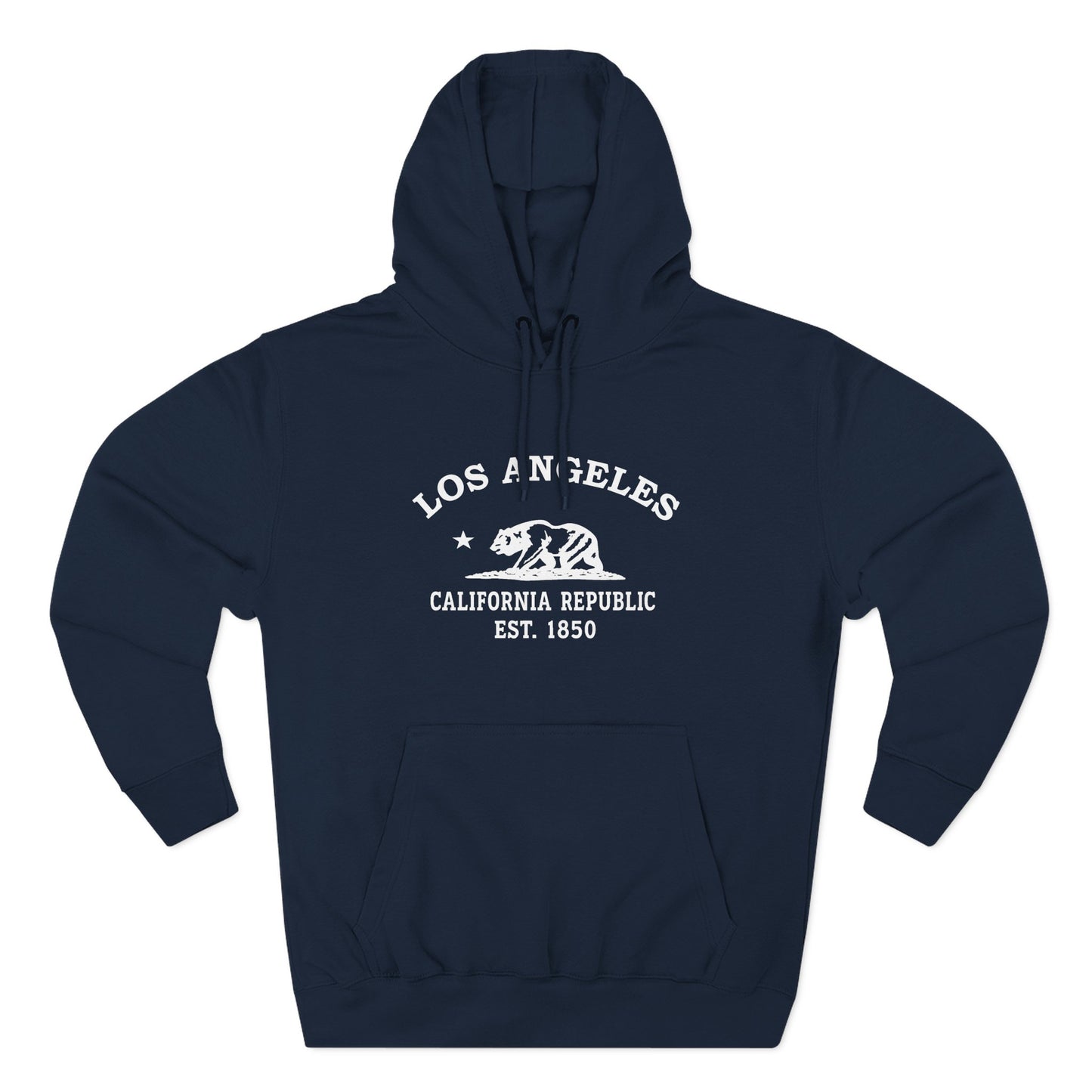
Our Los Angeles retro logo carries California's grizzly bear and lone star — the emblem of the old California Republic — set over “1850,” the year of statehood. Rendered black-and-white with the worn look of a vintage crate label or a roadside sign, it is rugged and authentic rather than glossy. The bear and star bridge the city's two stories: the adobe pueblo on the river and the state it helped build, a fitting mark for heritage worn rather than hung on a wall.
What grew around that block is a city built on arrival. Waves of newcomers — from Mexico, from China and Japan, from the American South and Midwest, from Korea, Armenia, Central America and beyond — each added a quarter of the map and a shelf of the pantry — a french dip downtown, taco trucks and birria after midnight, ramen in Little Tokyo, Korean barbecue west of it. The result is a metropolis measured in neighborhoods rather than a downtown: Boyle Heights and Highland Park on the east side, Leimert Park to the south, San Pedro at the harbor, Van Nuys and Sherman Oaks over the hill in the Valley. Mountains stand on three sides and the Pacific on the fourth, palms line the boulevards, and a river runs through the middle of it that most people forget is there. Angelenos navigate all of it by freeway, and they put a definite article in front of every one — the 405, the 110, the 10 — a habit no other American city shares. In late spring the coast disappears under a grey overcast they call June gloom, and it burns off by afternoon.
Why People Visit Los Angeles
Travelers come for the climate, the coast, and the culture, but the quietest surprise is the history: a two-hundred-and-forty-year-old pueblo tucked into the middle of a modern metropolis. History and everyday life sit side by side here in a way few American cities can match, and the founding block asks nothing but a walk.
