


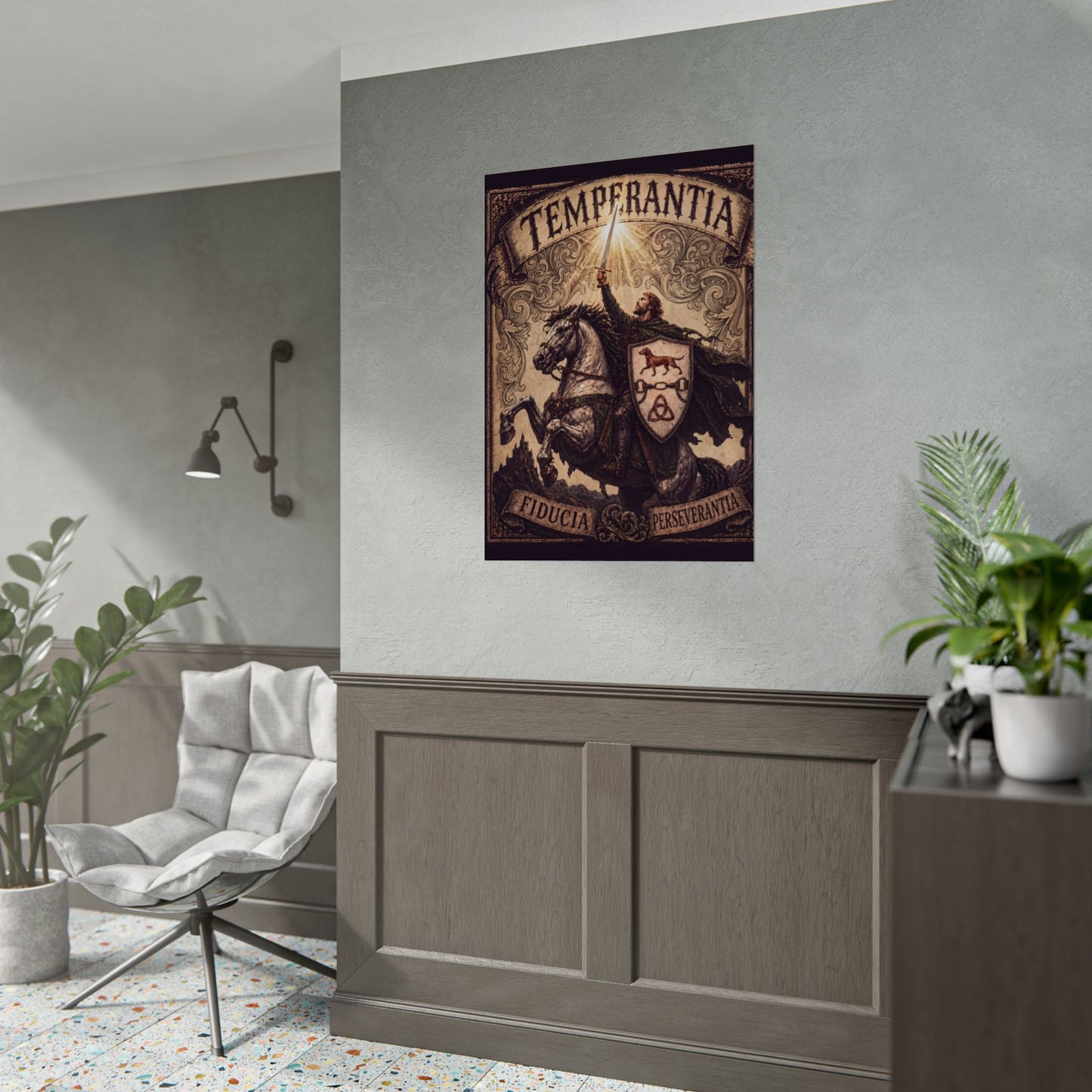
The bridle and bit at the heart of the shield is the canonical emblem of temperance. The image came from Aristotle's metaphor of reason as charioteer governing the horse of appetite, descended through Cicero's De Officiis of 44 B.C. and adopted into Christian moral theology by Aquinas. Giotto painted Temperantia on the wall of the Scrovegni Chapel in Padua in about 1305 with a bridle at her mouth and a sword bound into its scabbard. Cesare Ripa codified the iconography in his Iconologia of 1593, setting the bridle in Temperance's hand. Every educated medieval and Renaissance viewer would have read a bridle on a shield as Temperantia on sight. The vocabulary was that settled.
The order of the three words on the banner tells its own story. Read from the bottom up — Fiducia, Perseverantia, Temperantia — and you have the order of moral development as the late scholastics understood it. You begin in trust, in God or in lord or in the fellowship of arms. Trust held against time becomes perseverance. Perseverance refined by judgment becomes temperance, the governing virtue that keeps the other two from curdling into credulity and obstinacy. The crowning word sits on top because it is, in the medieval mind, the word that crowns the soul. There is a story, possibly apocryphal, that the English mercenary captain Sir John Hawkwood, who fought across Italy from the 1360s until his death in Florentine service in 1394, kept three words burned into the inside of his shield where only he could see them: fides, durare, modus — faith, endure, measure. Trust, hold, govern. The order finds its way to the men who need it.
Why the Three Together
- Hound passant at the head — fiducia, the faithful watcher, drawn from Isidore and the bestiaries.
- Bridle and bit at the fess point — temperantia, the governing hand, codified by Ripa in 1593.
- Triquetra at the base — perseverantia, the unbroken loop, descended from Insular and Norse craft.
- The motto banners — read bottom-left to bottom-right to top, the order of moral development.
- The cape and the rearing horse — context, the unbridled power that the shield's emblem governs.
