Valdez Alaska — Retro Vintage History
What's with the Little Switzerland of Alaska? Valdez sits at the head of a deep fjord on Prince William Sound, ringed by the Chugach Mountains and hung with tidewater glaciers and waterfalls — and that alpine setting is why Alaskans have long called it the Little Switzerland of Alaska. This is the Valdez of the glaciers and the gold rush, in Alaska — not the surname you may have in mind. It is the northernmost ice-free port in North America, the end of the pipeline and of Alaska's first road, and a town that literally moved itself to safer ground. Glaciers, gold, and snow — this page tells the story.
Wear the HistorySpanish ships charted these waters first: in 1790 the explorer Salvador Fidalgo named the port for Antonio Valdes y Basan, a Spanish naval minister. Long before that, the Chugach (Sugpiaq) and Ahtna peoples knew this coast as a trade crossroads at the edge of the Sound. The town itself was born of gold — founded in 1898 as a port of entry for prospectors bound for the Klondike, who climbed the brutal Valdez Glacier Trail toward the Interior. It was "Copper City" before it was Valdez, and it incorporated in 1901.
As the gold rush faded, Valdez became a supply port and transport hub. In 1919 the Richardson Highway — Alaska's first road — linked it to Fairbanks, and the deep, ice-free harbor kept the town working year round: it is the northernmost ice-free port in North America. The mountains that wall it in catch staggering snow, and the Sound beyond it fills with calving ice.
The town that moved. On Good Friday, March 27, 1964, the most powerful earthquake ever recorded in North America struck Prince William Sound. An underwater landslide and the wave that followed swept away the Valdez waterfront, with lives lost at the dock. The ground the old town stood on was judged too unstable to rebuild, so over the next few years Valdez did something few towns have ever done: it picked itself up and moved about four miles to firmer ground, where it stands today. The story of Valdez is not the disaster — it is the rebuilding.

The land around Valdez is the draw. The Columbia Glacier, the second-largest tidewater glacier in North America, calves icebergs into the Sound just west of town; glacier and wildlife cruises run beneath the peaks. Inland, Thompson Pass is one of the snowiest places in the United States — three hundred-plus inches a year — and a world-class heli-ski destination, while Keystone Canyon drops the threads of Bridal Veil and Horsetail Falls beside the old gold-rush trail. In 1977 the first tanker left the marine terminal here, the southern end of the Trans-Alaska Pipeline.
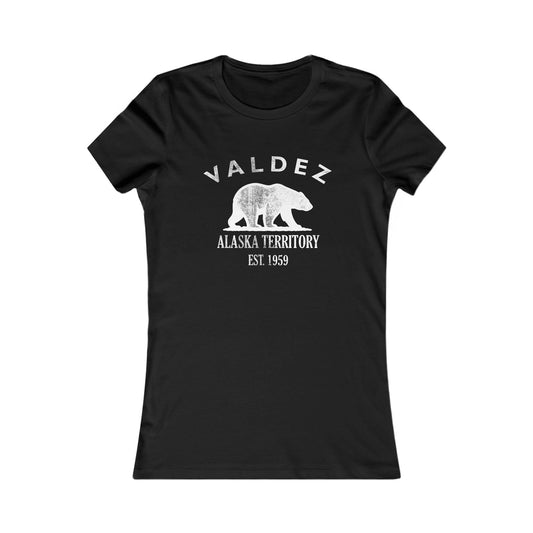
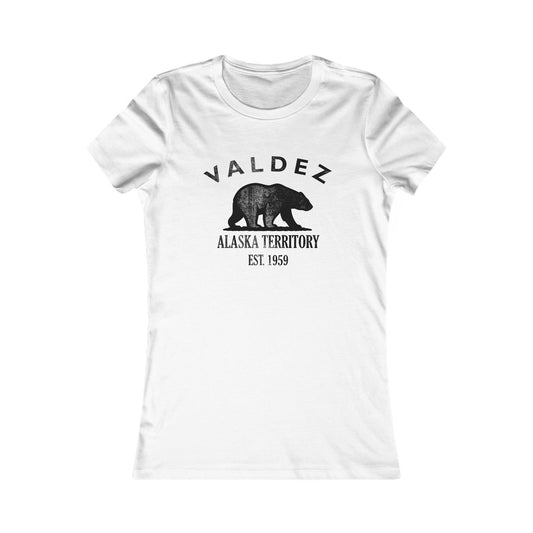
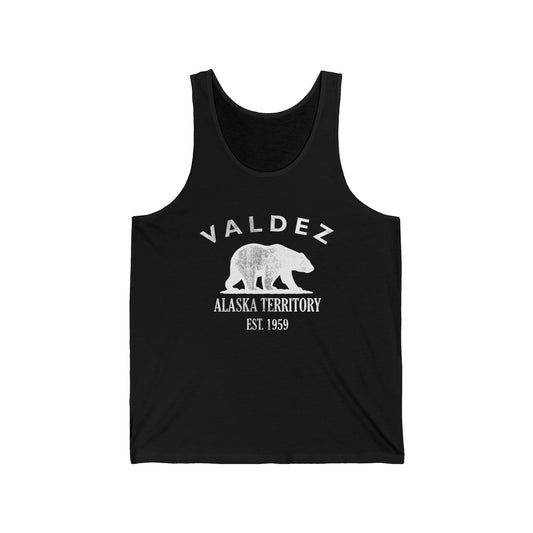
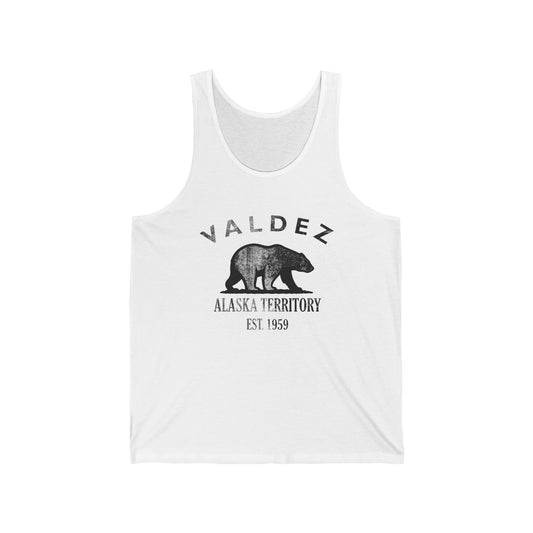
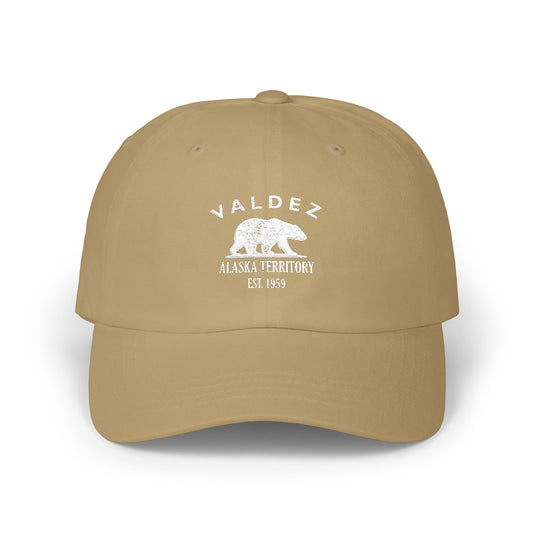
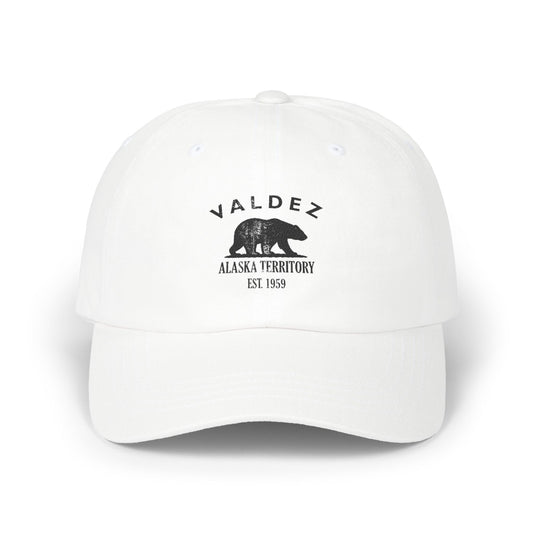
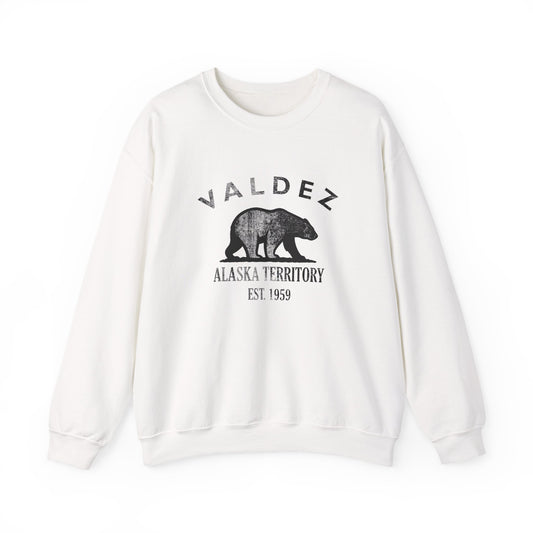
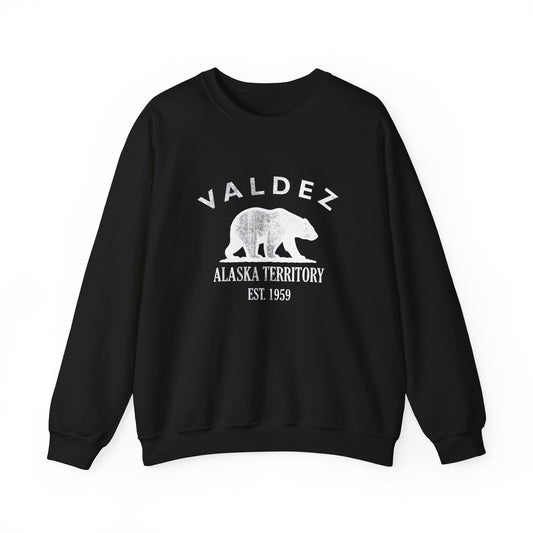
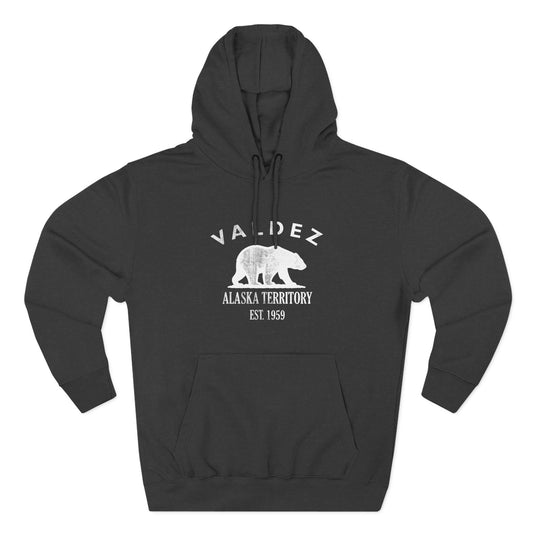
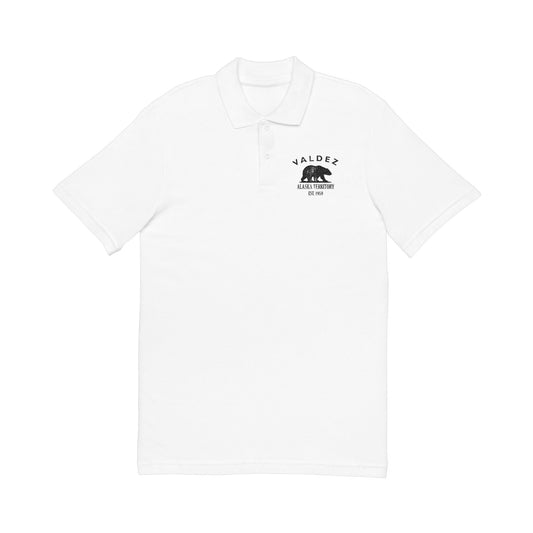
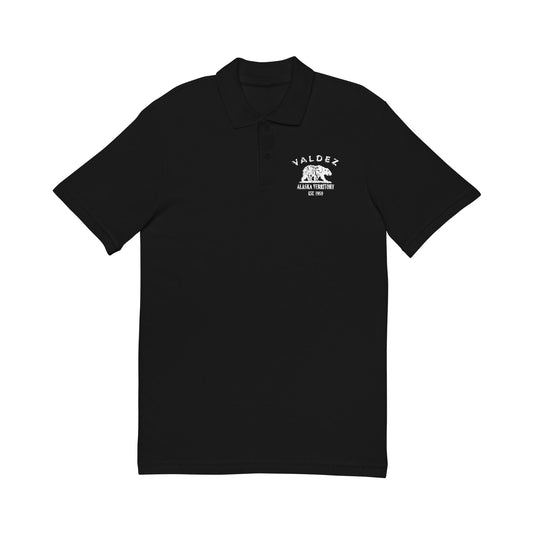
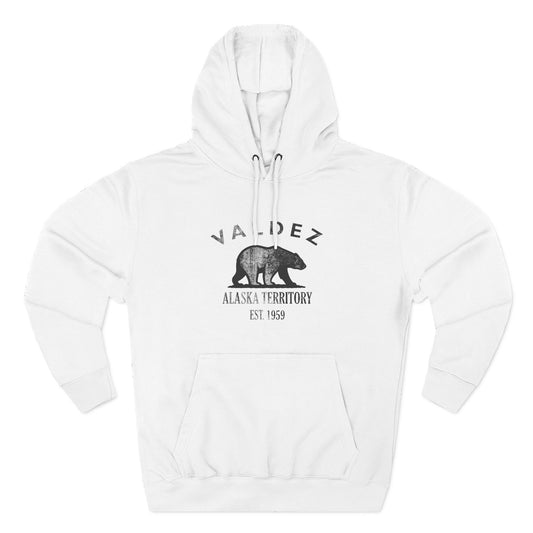
Our Valdez design carries a black bear beneath an arched VALDEZ and the line Alaska Territory · Est. 1959, printed in a worn, woodcut style. The bear is the Alaska of the backcountry — the wild, mountain-and-glacier country the town is set into — and the 1959 date marks Alaska statehood. It reads like an old outfitter's stamp: not a cruise-ship souvenir, but the mark of the glacier town at the end of the fjord, the Little Switzerland of Alaska.
Today Valdez is a working harbor and a glacier town — fishing boats and tankers, cruise decks and heli-ski runs, all under the Chugach peaks. Its story runs from the Spanish naming and the 1898 gold rush through the Richardson Highway, the 1964 quake and the move to firmer ground, and the pipeline years. Our Valdez, Alaska designs gather that identity into wearable form — the bear, the glacier, the gold-rush grit. Valdez, AK — the Little Switzerland of Alaska, at the head of the Sound.
Valdez, AK — Travel Guide
Visiting Valdez, AK Today
Valdez sits at the head of a deep fjord on Prince William Sound, ringed by glaciers, waterfalls, and the Chugach Mountains, with a working small-boat harbor at its heart. Visitors come for tidewater glaciers, gold-rush history, world-class snow, and some of the most dramatic coastal scenery in Alaska.
Glaciers, Gold Rush & Snow
For visitors planning things to do in Valdez, AK:
- Cruise Prince William Sound to the Columbia Glacier, the second-largest tidewater glacier in North America.
- Drive the Richardson Highway through Keystone Canyon past Bridal Veil and Horsetail Falls.
- See Thompson Pass — one of the snowiest places in the US and a world-class heli-ski destination.
- Visit the Valdez Museum for the gold-rush, pipeline, and 1964-relocation story.
- Walk the small-boat harbor and Dock Point for mountain-and-water views over the Sound.
Why People Visit Valdez, AK
People come to Valdez for the scale of it — tidewater glaciers calving into the Sound, peaks straight off the harbor, and snow measured in feet. It is a gold-rush town turned glacier port, the Little Switzerland of Alaska, rugged and beautiful and welcoming at the end of the road from Anchorage.
Wear the History

For deeper history research on Valdez, Alaska, useful contacts include (1) the Valdez Museum & Historical Archive, (2) the Valdez Consortium Library local-history collection, (3) the Alaska State Archives and Alaska State Library, (4) the City of Valdez clerk's records office, and (5) the Prince William Sound Science Center. For travel information, useful contacts include (1) the Valdez Convention & Visitors Bureau, (2) the Valdez Chamber of Commerce, (3) the City of Valdez Parks, Recreation & Cultural Services, (4) the Alaska State Parks office, and (5) the Valdez (VDZ) airport and Alaska Marine Highway ferry information desks.
Shop the Valdez Alaska collection
View full collection-
Valdez Alaska Vintage Retro Premium Crewneck Sweatshirt - Black Logo
Regular price $48.00 USDRegular price -
Valdez Alaska Vintage Retro Premium Crewneck Sweatshirt - White Logo
Regular price $48.00 USDRegular price -
Valdez Alaska Vintage Retro Vinyl Sticker - Black Logo
Regular price From $6.00 USDRegular price -
Valdez Alaska Vintage Retro Ceramic Mug - Black Logo
Regular price From $16.00 USDRegular price -
Valdez Alaska Vintage Retro Unisex Heavy Cotton Tee - White Logo
Regular price $22.00 USDRegular price -
Valdez Alaska Vintage Retro Unisex Heavy Cotton Tee - Black Logo
Regular price $22.00 USDRegular price -
Valdez Alaska Vintage Retro Cotton Canvas Tote Bag - White Logo
Regular price $25.00 USDRegular price -
Valdez Alaska Vintage Retro Cotton Canvas Tote Bag - Black Logo
Regular price $25.00 USDRegular price -
Valdez Alaska Vintage Retro Thank You Card Set - Black Logo
Regular price From $25.00 USDRegular price -
Valdez Alaska Vintage Retro Cotton Jersey Baby Bodysuit - Black Logo
Regular price $26.00 USDRegular price -
-
Valdez Alaska Vintage Retro Womens Fitted Ringspun Cotton Tee - Black Logo
Regular price $28.00 USDRegular price -
Valdez Alaska Vintage Retro Unisex Cotton Jersey Tank Top - White Logo
Regular price $28.00 USDRegular price -
Valdez Alaska Vintage Retro Unisex Cotton Jersey Tank Top - Black Logo
Regular price $28.00 USDRegular price -
Valdez Alaska Vintage Retro Embroidered Cotton Cap - White Logo
Regular price $32.00 USDRegular price -
Valdez Alaska Vintage Retro Embroidered Cotton Cap - Black Logo
Regular price $32.00 USDRegular price -
Valdez Alaska Vintage Retro Back Printed Art Series Cotton Tee - Black Logo
Regular price $32.00 USDRegular price -
Valdez Alaska Vintage Retro Unisex Heavy Crewneck Sweatshirt - Black Logo
Regular price $44.00 USDRegular price -
Valdez Alaska Vintage Retro Unisex Heavy Crewneck Sweatshirt - White Logo
Regular price $44.00 USDRegular price -
Valdez Alaska Vintage Retro Giclée Print Art Series Poster
Regular price From $38.00 USDRegular price -
Valdez Alaska Vintage Retro Unisex Heavy Cotton Hoodie - White Logo
Regular price $56.00 USDRegular price -
Valdez Alaska Vintage Retro Unisex Embroidered Cotton Polo - Black Logo
Regular price $48.00 USDRegular price -
Valdez Alaska Vintage Retro Unisex Heavy Cotton Hoodie - Black Logo
Regular price $56.00 USDRegular price