Tallahassee Florida — Retro Vintage History
What's with the Trailblazing Champion? In 2025 the United States Mint closed its American Women Quarters program with its final coin — and the trailblazing champion on it learned her winning game in Tallahassee. Althea Gibson came to Florida A&M on an athletic scholarship in 1949 and graduated in 1953, sharpening the serve-and-volley game that would break tennis's color barrier: the 1956 French Championships title, then Wimbledon and the U.S. Nationals in 1957 — and a New York ticker-tape parade, only the second ever given to a Black American, after Jesse Owens. Eleven Grand Slam titles by the end of the 1950s, and later a second barrier broken as the first Black woman on the LPGA Tour. The quarter's reverse shows her by the net, racket in one hand and ball in the other, over one inscription: TRAILBLAZING CHAMPION.

Wear the History
Where you're from. Where you love. Where you explored. Where you belong.
What's with the Canopy Roads? Tallahassee has nine official canopy roads — seventy-eight miles where live oaks, sweet gums, and hickories lace moss-draped limbs into a green tunnel overhead. They began as footpaths worn by the Apalachee and the tribes after them; Old St. Augustine Road dates to the 1600s, when it linked the Spanish missions to St. Augustine, and Meridian Road follows a survey line chained through the forest in 1824. Drive Centerville, Miccosukee, or Old Bainbridge today and the canopy closes over you like a cathedral nave, the light going dim and dappled and old. It is the truest picture of Tallahassee: a capital city that grew up under the oaks.
The name means something close to ‘old town’ or ‘old fields’ in the Creek tongue, and it was old long before it was a capital. Tallahassee was chosen in 1824 as the seat of territorial Florida for a plain reason of geography: it sat roughly halfway between St. Augustine and Pensacola, the two old colonial capitals of East and West Florida that the United States had just joined together under the 1819 treaty with Spain. Surveyors laid out a grid in the Red Hills, the town incorporated in 1825, and a frontier capital took root in the Leon County woods.

But people had lived on this ground for thousands of years. The Apalachee built earthen mounds here — the great ceremonial center now preserved at Lake Jackson Mounds — and farmed the rich red soil. In the winter of 1539, Hernando de Soto's expedition seized the Apalachee town of Anhaica, on a site about half a mile east of today's Capitol, and kept what is often called the first Christmas in the continental United States. It is worth saying plainly that de Soto's march brought violence and disease to the Apalachee; the ‘first Christmas’ was also the opening of a long and ruinous contact.
QUICK FACTS — TALLAHASSEE, FL
Tallahassee has been Florida's capital since 1824, chosen as the midpoint between the old colonial capitals of St. Augustine and Pensacola.
Nine official canopy roads — seventy-eight miles — run under moss-draped live oaks; the name is Creek for 'old town' or 'old fields.'
De Soto's expedition wintered at the Apalachee town of Anhaica in 1539 — often called the first Christmas in the continental United States.
Mission San Luis, the western capital of Spanish Florida from 1656, is the only reconstructed Spanish mission in Florida.
The Old Capitol gained its candy-striped awnings and 1902 dome, and was saved from demolition in 1978 — now a museum.
On May 20, 1865, the Emancipation Proclamation was declared in effect at the Knott House; Tallahassee has kept May 20 as Emancipation Day since.
The Knott House itself was built in 1843, probably by George Proctor, a free Black builder.
Althea Gibson honed her game at Florida A&M (1949–1953); the 2025 quarter honoring her closed the American Women Quarters program.
The Spanish came back not with armies but with friars. Through the 1600s a chain of Franciscan missions ran across Apalachee country, and the largest, Mission San Luis, served from the 1650s as the western capital of Spanish Florida — a fortified hilltop town of Spanish colonists and Apalachee Christians, a council house and a church side by side. It was abandoned and burned around 1704 amid English-led raids from the north. Today San Luis is the only reconstructed Spanish mission in Florida, rebuilt on its original ground as a living-history site — the deepest layer of the city, walkable again.
The capital itself grew slowly into stone. The Old Capitol rose in the years around Florida's 1845 statehood, and over time gained its grand portico, its red-and-white striped awnings, and the 1902 dome that still marks the skyline; saved from the wrecking ball in 1978, it is now the Florida Historic Capitol Museum, standing in front of the plain 22-story New Capitol tower finished in 1977. The pairing — candy-striped Victorian dome against a modern slab — is the whole arc of the place in one view. And all of it sits in the Red Hills, the rolling, hardwood-covered ‘first high land’ that makes Tallahassee feel more like south Georgia than the Florida of the postcards.
The nineteenth century also wrote a harder chapter here, one the canopy roads themselves remember. Those high red-clay lanes were cut to haul Sea Island cotton from the Red Hills plantations down to the Gulf ports — a cotton economy built on the labor of enslaved people. That history is part of Tallahassee, and it is not glossed over: on May 20, 1865, General Edward McCook read the Emancipation Proclamation from the steps of the Knott House downtown, and the day is still marked every year as Emancipation Day. The same shaded streets carry both stories.
Today Tallahassee is a green capital that runs on government and learning. The Legislature meets under the dome; two universities — Florida State and the historic Florida A&M — fill the city with students and shade their campuses with the same oaks. Around them are camellias and reflecting pools at Maclay Gardens, fountains and an amphitheater at Cascades Park, studios and murals at Railroad Square, the Museum of Florida History downtown, and, a short drive south, the vast clear bowl of Wakulla Springs. For a state capital, it stays remarkably unhurried and leafy.

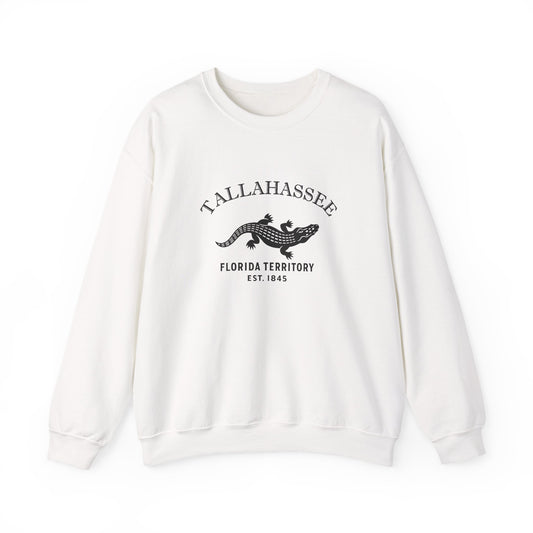
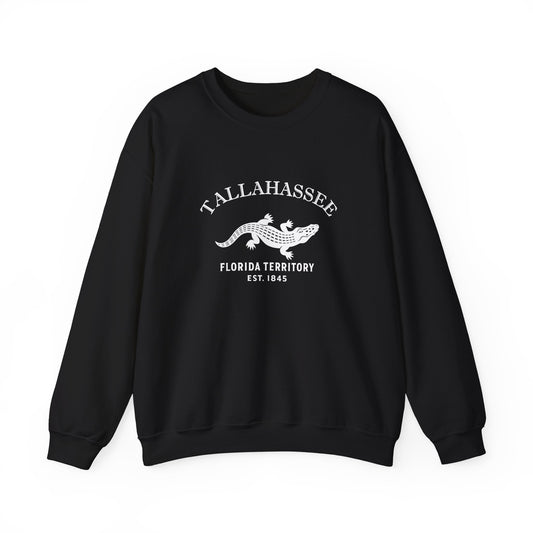
Our Tallahassee logo carries Florida's alligator above ‘Florida Territory — Est. 1845,’ the shared retro emblem of our Florida towns; the gator is the state's wild icon, and 1845 marks the year Florida joined the Union. Rendered in the black-and-white of an old crate stamp, it ties Tallahassee to every other Florida town we make. What makes this one the capital is the setting behind it — the canopy oaks, the candy-striped dome, and the Red Hills rolling away to the north.
So Tallahassee gathers more history under its oaks than almost anywhere in Florida: an Apalachee old town, a Spanish mission rebuilt on its hill, a candy-striped capitol, and nine roads roofed in moss. Our Tallahassee designs gather that into wearable form. Wear the history. This is the capital under the canopy oaks.
Tallahassee, Florida — Travel Guide
Visiting Tallahassee Today
Tallahassee is Florida's capital, set in the rolling Red Hills of the Big Bend rather than on any coast. It pairs the candy-striped Old Capitol and the modern Capitol tower with moss-draped canopy roads, a reconstructed Spanish mission, gardens and springs, and two lively university campuses, all within an easy walk or short drive of downtown.
The Canopy Roads, the Capitol & the Mission
For visitors looking for things to do in Tallahassee, Florida:
- Drive a canopy road — Old St. Augustine, Centerville, or Miccosukee — under the moss-draped live oaks.
- Tour the Old Capitol, now the Florida Historic Capitol Museum, then ride to the 22nd-floor observatory of the New Capitol.
- Walk Mission San Luis, the reconstructed 17th-century Spanish-Apalachee mission, on its original hilltop.
- Wander Maclay Gardens for camellias, reflecting pools, and forested paths.
- Stroll Cascades Park, with its fountains, amphitheater, and downtown lawns.
- Explore Railroad Square Art District's studios, murals, and galleries.
- Visit the Museum of Florida History and the Knott House Museum downtown.
- Day-trip south to Wakulla Springs, one of the world's largest and deepest freshwater springs.
Why People Visit Tallahassee
Tallahassee blends civic history with surprising green space. Visitors mix the capitol buildings and downtown museums with canopy-road drives, gardens, and easy urban trails. It is scholarly, calm, and quietly scenic, with year-round appeal in its parks, paths, and public spaces. This is Old Florida and the modern capital at once — history and everyday culture sitting side by side under the oaks in a welcoming way.
Wear the History
Where you're from. Where you love. Where you explored. Where you belong.
Kindred Cities
A warm welcome to visitors from Cambridge, England and Heidelberg, Germany (willkommen) — fellow towns of learning and leafy calm.
Tallahassee is a capital that runs on its universities, and Cambridge and Heidelberg are its scholarly kin. Cambridge has gathered its colleges along the Cam for eight centuries; Heidelberg cradles Germany's oldest university beneath a romantic castle on the Neckar; Tallahassee shades its own student city of Florida State and Florida A&M under live oaks and canopy roads, the seat of state government among the rolling hills of the Panhandle. Three towns where the young and the studious set the tone.
Tallahassee delights the visitor who likes a green and lively capital: oak-canopied roads and rolling hills, a couple of spirited university towns rolled into one, the old and new capitol buildings, and the wild springs and trails just beyond the city. Come and visit us soon.
When you plan the trip, Visit Tallahassee is the place to start.
Wear the History
Where you're from. Where you love. Where you explored. Where you belong.

For deeper reading on the Tallahassee history described here — the Apalachee and Lake Jackson Mounds, de Soto's 1539 winter at Anhaica, the 17th-century Mission San Luis and the Apalachee mound-builders of Lake Jackson, the choice of Tallahassee as Florida's capital in 1824, the 1845 Old Capitol, and the Red Hills cotton-and-emancipation story — it may be useful to consult (1) the Tallahassee Historical Society, (2) the Florida Historic Capitol Museum, (3) the Museum of Florida History and its Florida-history collections, (4) Mission San Luis de Apalachee, and (5) the State Archives of Florida and its Florida Memory program and the Florida Division of Historical Resources. For travel and visitor information, it may be useful to contact (1) Visit Tallahassee (Leon County Tourism), (2) VISIT FLORIDA, (3) the City of Tallahassee Parks & Recreation Department, (4) the Florida State Parks (Maclay Gardens and Wakulla Springs), and (5) Tallahassee International Airport (TLH).
Shop the Tallahassee Florida collection
View full collection-
Tallahassee Florida Vintage Retro Unisex Heavy Cotton Tee - Black Logo
Regular price $22.00 USDRegular price -
Tallahassee Florida Canopy Road Garment-Dyed Heavyweight Tee
Regular price $36.00 USDRegular price -
Tallahassee Florida Vintage Retro Unisex Heavy Cotton Tee - White Logo
Regular price $22.00 USDRegular price -
Tallahassee Florida Vintage Retro Premium Crewneck Sweatshirt - Black Logo
Regular price $48.00 USDRegular price -
Tallahassee Florida Vintage Retro Premium Crewneck Sweatshirt - White Logo
Regular price $48.00 USDRegular price -
Tallahassee Florida Vintage Retro Embroidered Cotton Cap - White Logo
Regular price $32.00 USDRegular price -
Tallahassee Florida Vintage Retro Embroidered Cotton Cap - Black Logo
Regular price $32.00 USDRegular price -
Tallahassee Florida Vintage Retro Vinyl Sticker - Black Logo
Regular price From $6.00 USDRegular price -
-
Tallahassee Florida Vintage Retro Womens Fitted Ringspun Cotton Tee - Black Logo
Regular price $28.00 USDRegular price -
Tallahassee Florida Vintage Retro Unisex Heavy Cotton Hoodie - White Logo
Regular price $56.00 USDRegular price -
Tallahassee Florida Vintage Retro Unisex Heavy Cotton Hoodie - Black Logo
Regular price $56.00 USDRegular price -
Tallahassee Florida Vintage Retro Unisex Embroidered Fleece Jacket - White Logo
Regular price $98.00 USDRegular price -
Tallahassee Florida Vintage Retro Ceramic Mug - Black Logo
Regular price From $16.00 USDRegular price -
Tallahassee Florida Vintage Retro Cotton Canvas Tote Bag - White Logo
Regular price $25.00 USDRegular price -
Tallahassee Florida Vintage Retro Cotton Canvas Tote Bag - Black Logo
Regular price $25.00 USDRegular price -
Tallahassee Florida Vintage Retro Thank You Card Set - Black Logo
Regular price From $25.00 USDRegular price -
Tallahassee Florida Vintage Retro Cotton Jersey Baby Bodysuit - Black Logo
Regular price $26.00 USDRegular price -
Tallahassee Florida Vintage Retro Unisex Cotton Jersey Tank Top - White Logo
Regular price $28.00 USDRegular price -
Tallahassee Florida Vintage Retro Unisex Cotton Jersey Tank Top - Black Logo
Regular price $28.00 USDRegular price -
Tallahassee Florida Vintage Retro Back Printed Art Series Cotton Tee - Black Logo
Regular price $32.00 USDRegular price -
Tallahassee Florida Vintage Retro Giclée Print Art Series Poster
Regular price From $38.00 USDRegular price -
Tallahassee Florida Vintage Retro Unisex Heavy Crewneck Sweatshirt - Black Logo
Regular price $44.00 USDRegular price -
Tallahassee Florida Vintage Retro Unisex Heavy Crewneck Sweatshirt - White Logo
Regular price $44.00 USDRegular price