Talkeetna Alaska — Retro Vintage History
What’s with the Cat Mayor? Since 1997 Talkeetna’s honorary mayor has been a cat — the town has no city hall and no human mayor. Talkeetna has never incorporated — no council, no human mayor to elect — so in 1997, as the story goes, the town settled the question its own way: a yellow cat named Stubbs took up the office of honorary mayor, and held it for twenty years. He kept hours at the general store, received constituents daily, drew press from around the world, and never raised taxes once. When he passed in 2017 the office stayed in feline hands — a successor named Denali, and today Mayor Aurora, who still governs from a log storefront on Main Street. It is the most Talkeetna thing about Talkeetna: a frontier town at the foot of the continent’s greatest mountain, entirely unbothered about doing things the usual way.
Wear the HistoryWhere you’re from. Where you love. Where you explored. Where you belong.
The name is older than the town. Talkeetna comes from the Dena’ina name K’dalkitnu — “river of plenty,” where the rivers join — for the spot where the Susitna, Chulitna, and Talkeetna rivers braid together. The Dena’ina Athabascan people gathered here seasonally for centuries before any prospector arrived, and they remain part of the valley’s life today. The written record starts with a trading post in 1896, and the Susitna gold rush of 1910 turned the confluence into a supply landing — pans, pack trains, and river scows working the gravel bars for color.
QUICK FACTS — TALKEETNA, AK
Talkeetna is Dena’ina — from K’dalkitnu, “river of plenty” — for the confluence of the Susitna, Chulitna, and Talkeetna rivers.
A trading post opened at the confluence in 1896; the Susitna gold rush boomed in 1910.
The Alaska Railroad made Talkeetna a district headquarters in 1915 and auctioned eighty town lots in 1919.
Talkeetna’s entire log downtown is listed on the National Register of Historic Places.
Walter Harper, an Alaska Native climber, was first to summit Denali — June 7, 1913.
Every climber attempting Denali — North America’s highest peak at 20,310 feet — registers in Talkeetna.
From 1997 to 2017 the honorary mayor was a cat named Stubbs; a cat holds the office still.
Talkeetna sits at the end of a 14-mile spur road, two and a half hours north of Anchorage.
The railroad made it a town: in 1915 the Alaska Railroad’s builders chose Talkeetna as a district headquarters, and by 1916 there was a post office, a sawmill, and even a cigar shop on the new Main Street. In 1919 the surveyors auctioned eighty lots, and the town that stands today took shape — a downtown of log buildings now listed, in its entirety, on the National Register of Historic Places: the 1917 roadhouse still serving breakfast at communal tables, the 1921 general store, the 1923 frontier inn, and the 1936–37 territorial schoolhouse that houses the town museum. Trains still stop; upriver, the flag-stop line still picks up anyone who waves.

And Talkeetna is the door to the mountain. Denali — 20,310 feet, the highest peak in North America, long mapped as Mount McKinley — fills the northern horizon on a clear day, flanked by Mount Hunter and Mount Foraker. Every climber who attempts Denali registers here, at the ranger station named for Walter Harper — the Alaska Native climber who, on June 7, 1913, became the first person to stand on the summit. In the 1940s and ’50s a Talkeetna bush pilot named Don Sheldon helped pioneer glacier landings, and ski-planes still lift off the village airstrip each spring for the Kahiltna Glacier base camp at 7,200 feet, carrying more than a thousand climbers a season from every continent on earth.
The geography keeps the town honest: fourteen miles up a spur road off the Parks Highway, two and a half hours north of Anchorage, with the Talkeetna Mountains to the east and the river confluence at the end of Main Street. Summer brings near-endless daylight and salmon in the Susitna; winter drops to forty below, and the aurora works the sky from September to March.
Talkeetna’s lore is river lore and pilot lore: gold colors flashing in the gravel bars, bush pilots who could set a plane down on a glacier shelf in weather that grounded everyone else, and a Main Street where climbers from every continent trade summit stories over sourdough. For thirty-seven years the town threw the Moose Dropping Festival — exactly what it sounds like, retired in 2009 at the height of its fame — and television once borrowed the town’s spirit outright: Talkeetna is widely cited as the inspiration for the fictional Alaska town in the 1990s series Northern Exposure. The town took the compliment and went back to breakfast.
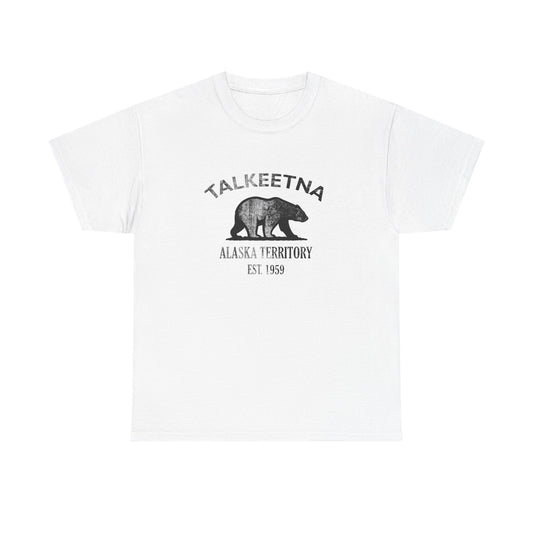
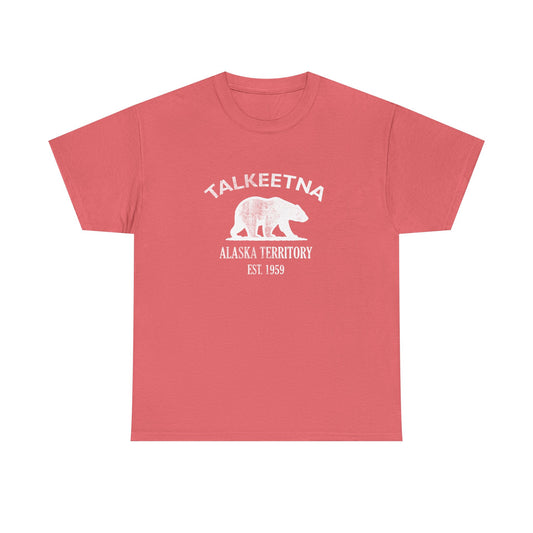
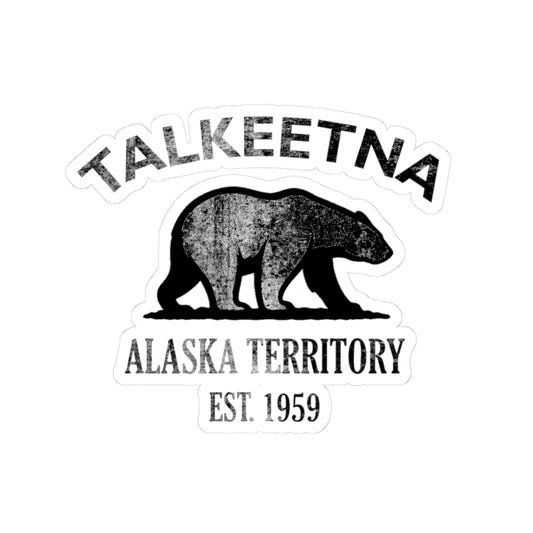
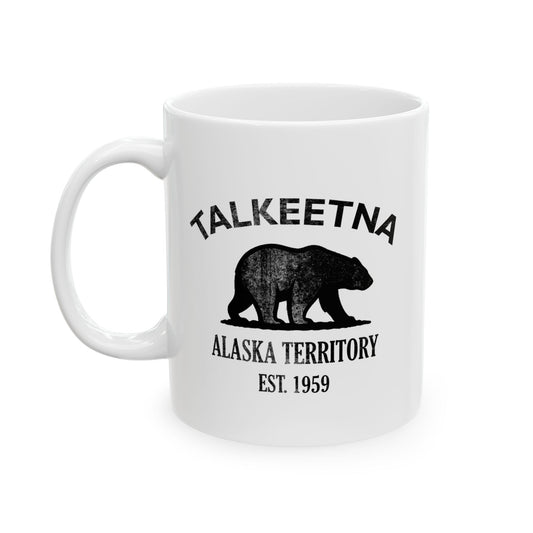
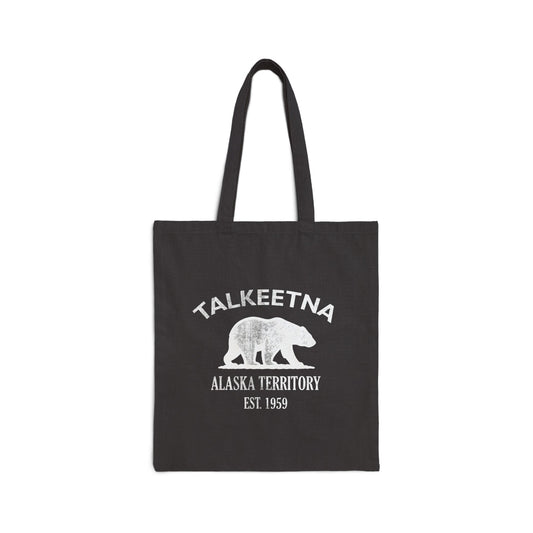
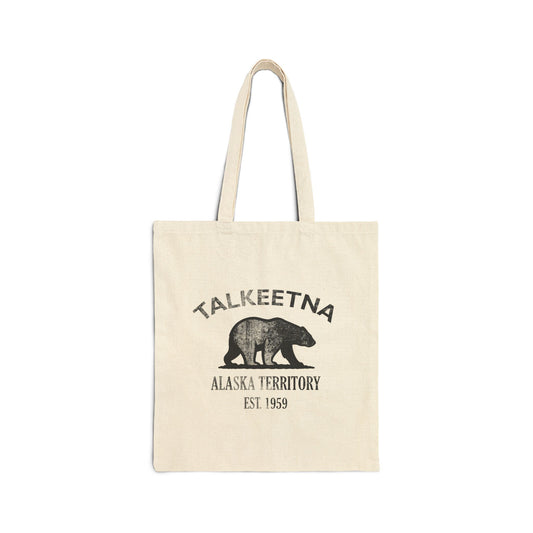
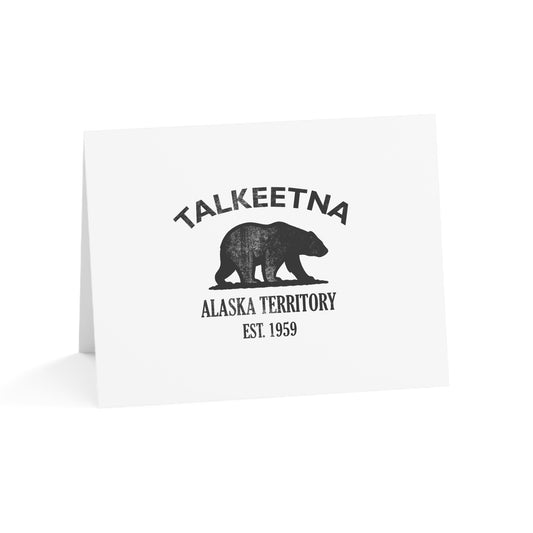
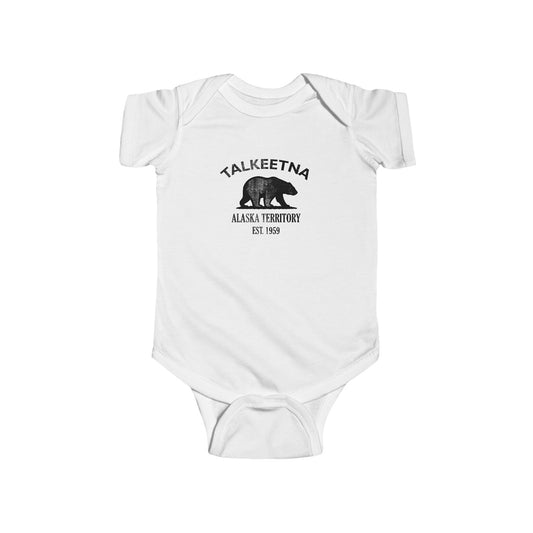
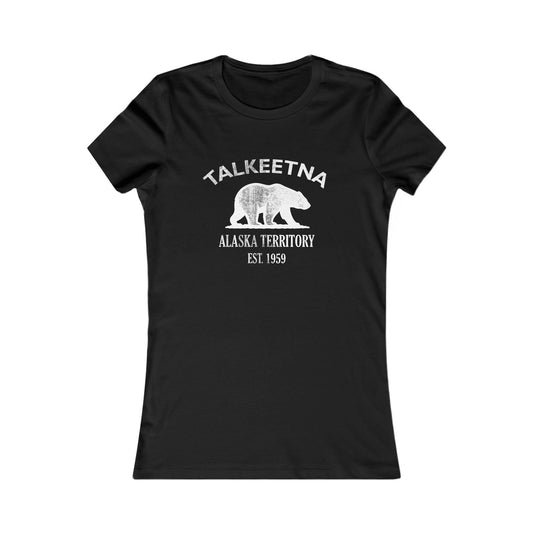
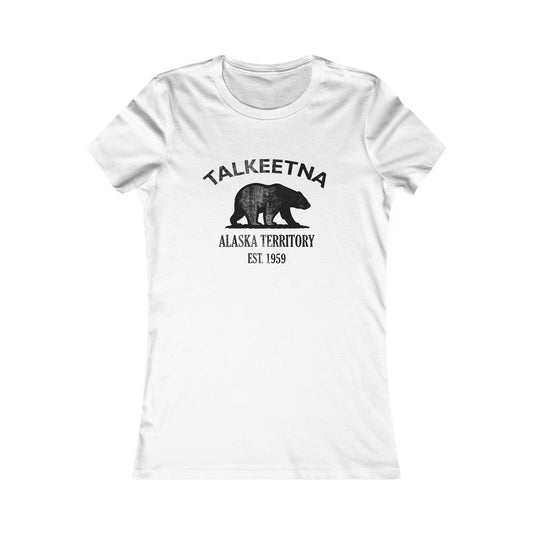
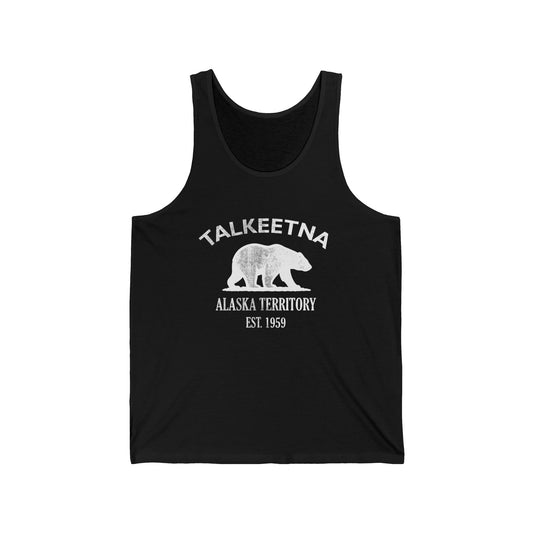
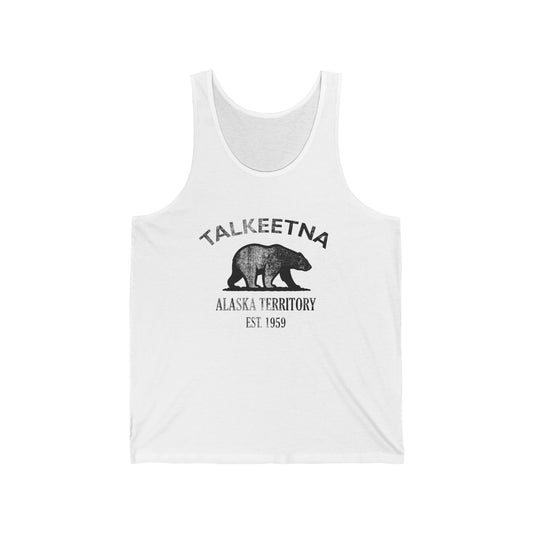
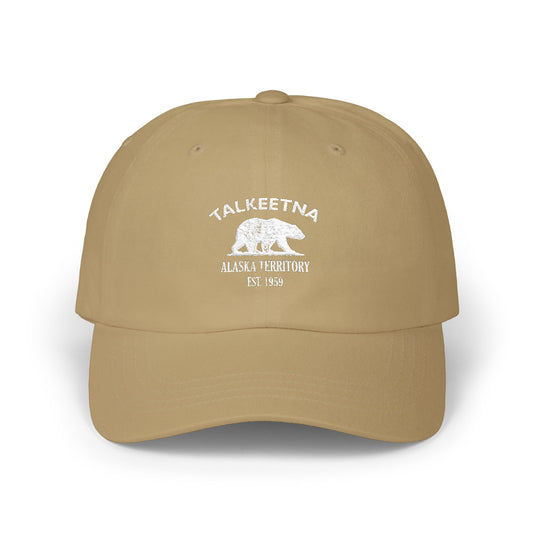
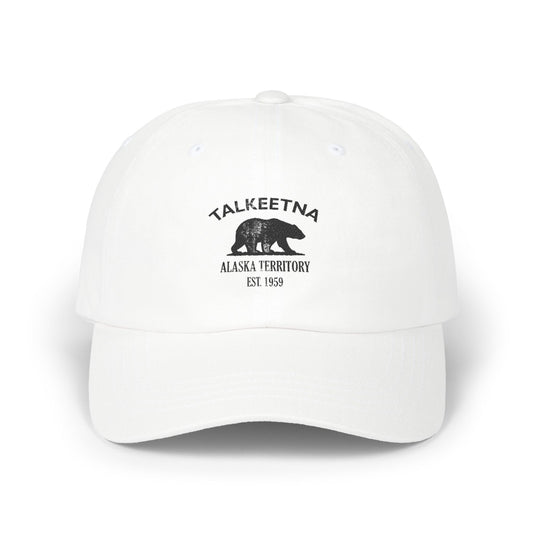
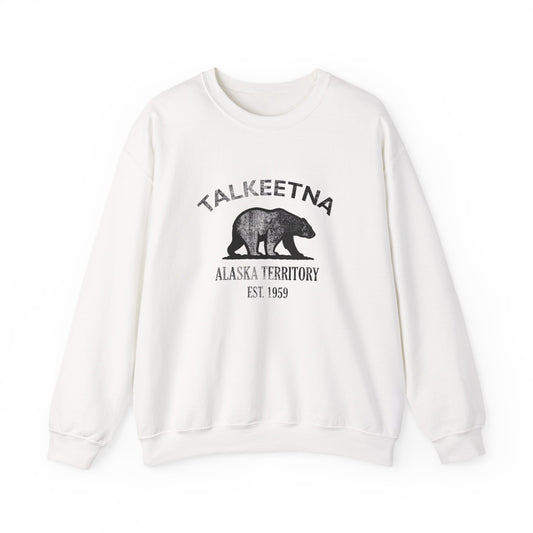
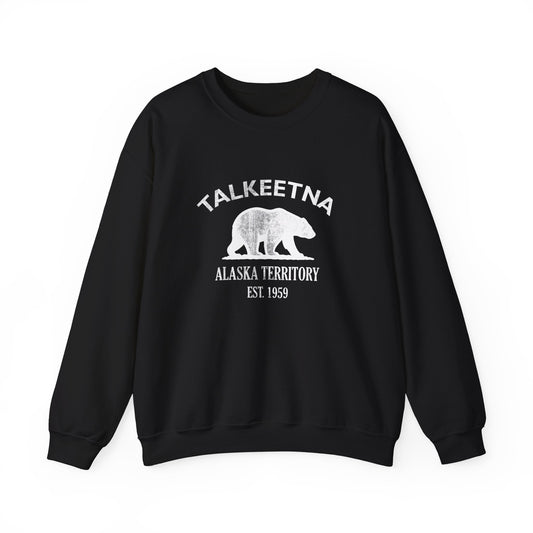
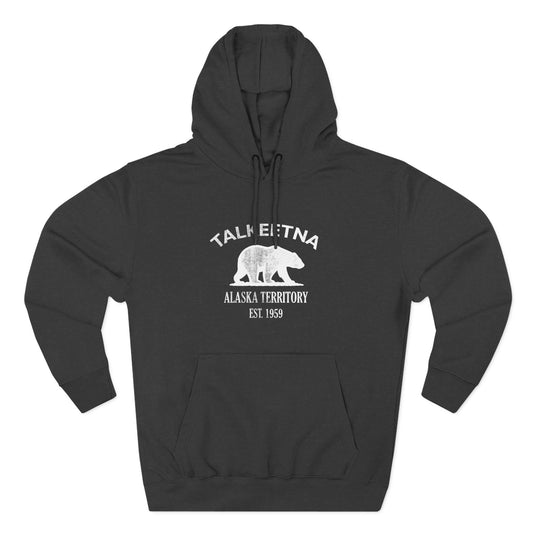
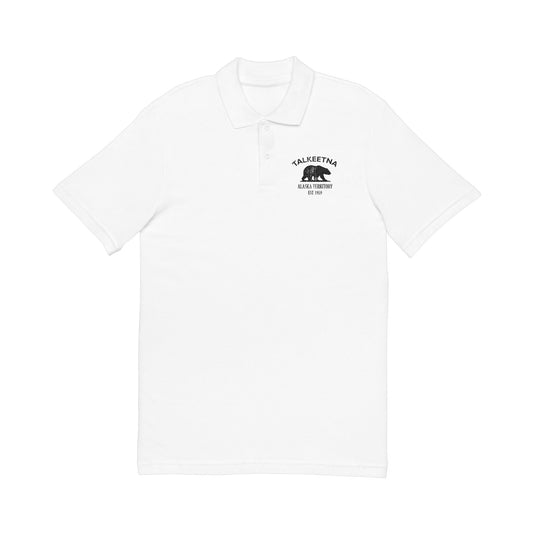
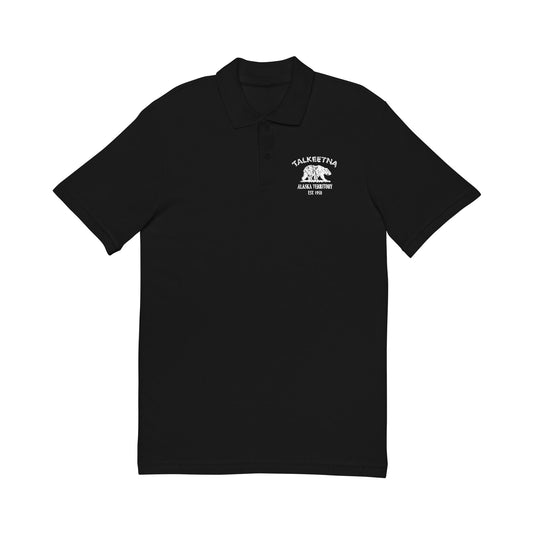
Our Talkeetna retro logo uses Alaska's distressed bear motif, representing toughness, wilderness, and endurance. The bear reflects both Indigenous reverence and frontier survival, while "1959" ties the design to Alaska's statehood. Its black-and-white styling is rugged and retro, resembling crate stamps or outfitter branding. The motif bridges Talkeetna's dual identity: Native heritage and frontier railroad town. On merchandise, it conveys authenticity and pride, retro vintage in tone. The bear emblem honors Talkeetna's layered story, making it a vintage symbol of Alaska resilience. It reflects survival, community, and heritage, capturing Alaska's story of continuity and pride.
So Talkeetna gathers a Dena’ina name for joining rivers, a gold-rush landing, an eighty-lot railroad auction, a log Main Street on the National Register, the ranger station where every Denali expedition begins, ski-planes bound for a glacier, and a mayor who purrs — and our Talkeetna designs pack all of it into wearable form. Whether Talkeetna is your hometown, your basecamp, your flag-stop, or the town you promised yourself you’d get back to, wear the history. Below Denali since 1896.

Talkeetna Alaska — Travel Guide
Visiting Talkeetna Alaska Today
Talkeetna is a small unincorporated town in the Matanuska-Susitna Borough about 2.5 hours north of Anchorage on the Parks Highway and the 14-mile Talkeetna Spur Road. It sits at the confluence of the Susitna, Chulitna, and Talkeetna rivers, on the south side of Denali about 115 miles from the summit, with the bulk of the Alaska Range visible to the north on clear days. The peak visitor window is May through August — Denali climbing season runs May to July, summer general tourism peaks June and July with nearly 24-hour daylight in midsummer, and salmon fishing on the Susitna confluence runs through August. Winters are subarctic and long, with the Hurricane Turn flag-stop train still running and aurora viewing September through March.
The Three-Rivers Confluence, the Denali Gateway, and the Historic District in Talkeetna
For visitors searching for things to do in Talkeetna Alaska:
- Walk the Talkeetna Historic District on Main Street, the entire downtown of log buildings dating from the 1910s-1930s, listed on the National Register of Historic Places.
- Visit the Talkeetna Historical Society Museum, housed in the 1936-37 Territory of Alaska schoolhouse, for the bush-pilot, climbing, and Alaska Railroad archives — including Bradford Washburn's twelve-by-twelve-foot scale model of Denali on the floor of the main gallery.
- Walk to the Walter Harper Talkeetna Ranger Station at the south end of Main Street, the Denali National Park climbing-registration office where every Denali expedition still checks in before flying to Kahiltna Glacier Base Camp — and where the rangers' interpretive program runs through the summer climbing season.
- Walk down to the Talkeetna riverfront at the end of Main Street, the gravel beach where the Susitna, Chulitna, and Talkeetna rivers meet — the three-rivers confluence the Dena'ina name K'dalkitnu describes — with the Alaska Range visible north on a clear day.
- See the 1917 Talkeetna Roadhouse on Main Street, the log roadhouse that has been continuously serving climbers, miners, railroad workers, and travelers since the year it opened — one of the last original gold-rush-era Alaska roadhouses still operating.
- See the 1921 Nagley's General Store, the original log-cabin trading post on the corner of Main and C Street, still operating as the town's general store.
- See the 1923 Fairview Inn on Main Street, the Prohibition-era frontier bar still anchoring the downtown's evening rhythm.
- Catch the Alaska Railroad's Denali Star train at the Talkeetna Depot — the year-round Anchorage-to-Fairbanks service stops here daily; the Hurricane Turn flag-stop service still picks up homesteaders north of town.
- Drive to Denali Viewpoint South, twenty minutes north on the Parks Highway, for the long view of Denali, Mount Hunter, and Mount Foraker rising above the Susitna lowlands.
- Plan a clear-weather day in May, June, or July to watch the bush planes leave the Talkeetna Airstrip for the Kahiltna Glacier and the Ruth Glacier — the small-plane glacier landings the Talkeetna pilots pioneered in the 1940s and still fly today.
- Time a winter visit for the aurora on clear nights September through March — or ride the flag-stop train upriver, waving it down from the trackside the way homesteaders here have for a century.
Why People Visit Talkeetna Alaska
Talkeetna offers the three-rivers confluence the Dena'ina have gathered at for centuries, the National Register downtown with the Roadhouse and Nagley's and the Fairview Inn intact and operating, the Walter Harper Ranger Station that every Denali climber walks through, the long view of the highest mountain in North America rising at the head of the Susitna Valley, the Alaska Railroad Denali Star at the depot daily, and the small-plane glacier-landing tradition that opened the mountain to the world. It is a small town at the end of a fourteen-mile spur road, and almost every climber on Denali has stood on its one main street first. Below Denali since 1896.
Wear the History
Where you’re from. Where you love. Where you explored. Where you belong.
Kindred Cities
Welcome to visitors from Zermatt (willkommen) and Banff — kindred basecamp towns beneath the great peaks.
Talkeetna lives in the shadow of the highest mountain in North America, and Zermatt and Banff keep the same company. Zermatt sits at the foot of the Matterhorn, the classic Alpine mountaineering town; Banff is the storybook resort at the heart of the Canadian Rockies; Talkeetna is the funky little town where climbers stage their assaults on Denali and flightseers lift off for the glaciers. Three small towns that the biggest mountains made famous.
Talkeetna suits the adventurer and the curious alike: ski-planes bound for Denali's glaciers, climbers swapping tales on Main Street, a row of quirky log shops and cafés, and a mountain so big it makes its own weather on the horizon. Come and visit us soon.
When you plan the trip, the Talkeetna Chamber of Commerce is the place to start.
Wear the History
Where you’re from. Where you love. Where you explored. Where you belong.

For deeper reading on Talkeetna, Alaska history — the Dena’ina name K’dalkitnu and the centuries of seasonal gathering at the three-rivers confluence; the 1896 trading post and the 1910 Susitna gold rush; the Alaska Railroad district headquarters of 1915 and the eighty-lot auction of 1919; the National Register historic district and its log buildings of 1917–1937; the 1913 first ascent of Denali and Walter Harper’s summit of June 7; the glacier-flying era that began in the 1940s and the ski-plane traffic to the Kahiltna base camp; and the honorary cat mayoralty that began in 1997 — it may be useful to consult the Talkeetna Historical Society and its museum in the 1936–37 territorial schoolhouse, the Denali National Park and Preserve archives, the Matanuska-Susitna Borough records, and the Alaska State Library’s historical collections. For travel and visitor information, the Talkeetna Chamber of Commerce is the place to start.
Shop the Talkeetna Alaska collection
View full collection-
Talkeetna Alaska Vintage Retro Unisex Heavy Cotton Tee - Black Logo
Regular price $28.00 USDRegular price -
Talkeetna Alaska Cat Mayor Garment-Dyed Heavyweight Tee
Regular price $36.00 USDRegular price -
Talkeetna Alaska Vintage Retro Unisex Heavy Cotton Tee - White Logo
Regular price $28.00 USDRegular price -
Talkeetna Alaska Vintage Retro Premium Crewneck Sweatshirt - Black Logo
Regular price $48.00 USDRegular price -
Talkeetna Alaska Vintage Retro Premium Crewneck Sweatshirt - White Logo
Regular price $48.00 USDRegular price -
Talkeetna Alaska Vintage Retro Back Printed Art Series Cotton Tee - Black Logo
Regular price $32.00 USDRegular price -
Talkeetna Alaska Vintage Retro Giclée Print Art Series Poster
Regular price From $38.00 USDRegular price -
Talkeetna Alaska Vintage Retro Vinyl Sticker - Black Logo
Regular price From $6.00 USDRegular price -
Talkeetna Alaska Vintage Retro Ceramic Mug - Black Logo
Regular price From $16.00 USDRegular price -
Talkeetna Alaska Vintage Retro Cotton Canvas Tote Bag - White Logo
Regular price $25.00 USDRegular price -
Talkeetna Alaska Vintage Retro Cotton Canvas Tote Bag - Black Logo
Regular price $25.00 USDRegular price -
Talkeetna Alaska Vintage Retro Thank You Card Set - Black Logo
Regular price From $25.00 USDRegular price -
Talkeetna Alaska Vintage Retro Cotton Jersey Baby Bodysuit - Black Logo
Regular price $26.00 USDRegular price -
-
Talkeetna Alaska Vintage Retro Womens Fitted Ringspun Cotton Tee - Black Logo
Regular price $28.00 USDRegular price -
Talkeetna Alaska Vintage Retro Unisex Cotton Jersey Tank Top - White Logo
Regular price $28.00 USDRegular price -
Talkeetna Alaska Vintage Retro Unisex Cotton Jersey Tank Top - Black Logo
Regular price $28.00 USDRegular price -
Talkeetna Alaska Vintage Retro Embroidered Cotton Cap - White Logo
Regular price $32.00 USDRegular price -
Talkeetna Alaska Vintage Retro Embroidered Cotton Cap - Black Logo
Regular price $32.00 USDRegular price -
Talkeetna Alaska Vintage Retro Unisex Heavy Crewneck Sweatshirt - Black Logo
Regular price $44.00 USDRegular price -
Talkeetna Alaska Vintage Retro Unisex Heavy Crewneck Sweatshirt - White Logo
Regular price $44.00 USDRegular price -
Talkeetna Alaska Vintage Retro Unisex Heavy Cotton Hoodie - White Logo
Regular price $56.00 USDRegular price -
Talkeetna Alaska Vintage Retro Unisex Embroidered Cotton Polo - Black Logo
Regular price $48.00 USDRegular price