Southport Connecticut — Retro Vintage History
It rose from the ashes. In July 1779 British and Hessian troops burned this little harbor village to the ground. The people rebuilt it house by house — and the Greek Revival captain's homes they raised still line Harbor Road today. By the 1890s their rebuilt harbor was shipping a hundred thousand barrels of onions a year to New York and the southern ports. A burned village, an onion port, and one of the most intact streetscapes on the Connecticut shore — this is Southport, the harbor village of Fairfield, and this page tells its story.
Wear the HistoryLong before it had an English name, the shore here was Sasqua — an Indigenous village of Quiripi-speaking people, part of the Paugussett and Pequot world of the Connecticut coast. In 1639 it became the western edge of the new town of Fairfield, known simply as "Mill River" for the grist mill turning on its banks by 1662. A wharf went in by 1769, and the little river mouth on Long Island Sound began its long life as a working harbor.
Then came the war. In July 1779, the day after British forces burned Fairfield, they put Mill River to the torch as well — a raid carried out by British regulars, Hessian jägers, and Loyalist troops that left almost nothing standing. Only one house, the Meeker House of about 1766, survived. What makes Southport remarkable is what happened next: instead of fading, the village rebuilt itself from the waterline up, in the crisp Greek Revival and Federal styles of the new republic. The district you can walk today is almost entirely a post-1779 creation — a town that turned its own destruction into one of the finest harbor-village streetscapes in Connecticut.
What's with the onions? Here's the part that surprises people about this polished shoreline village: Southport was once the onion capital of the Connecticut coast. Through the middle and late 1800s the rebuilt harbor shipped the famous Southport Globe onion — a hard, round, long-keeping variety — by sloop and schooner to New York City and as far as the southern ports, peaking near a hundred thousand barrels a year by the 1890s. Onions, carrots, and oysters moved out; merchant and banking wealth came back in and built the houses. The yacht harbor you see now was, not so long ago, a produce port that ran on onions.

When the railroad arrived in 1848-49 and Bridgeport's deeper harbor took over the coastal trade, Southport's shipping slowly wound down — and that, in a way, is why it survived so intact. The village settled into a quiet, prosperous residential life and never tore its old houses down. The Pequot Library, a stone Richardsonian-Romanesque landmark, opened in 1894. Southport-raised Joseph Earl Sheffield — who went on to found a railroad and endow Yale's Sheffield Scientific School — was one of many whose fortunes traced back to this harbor. Captain's houses, a stone library, a working yacht club, Long Island Sound at the end of the street.
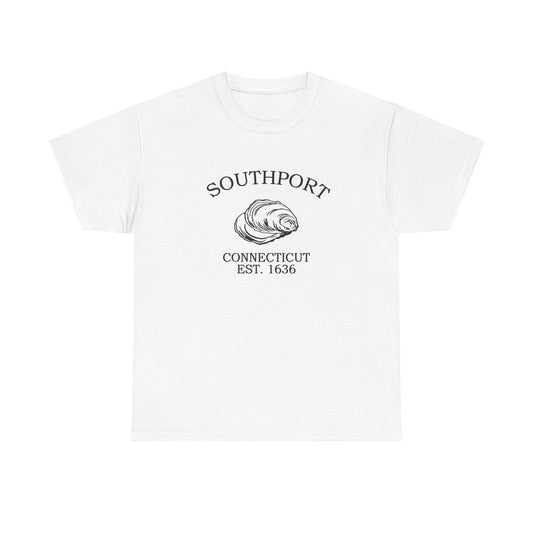
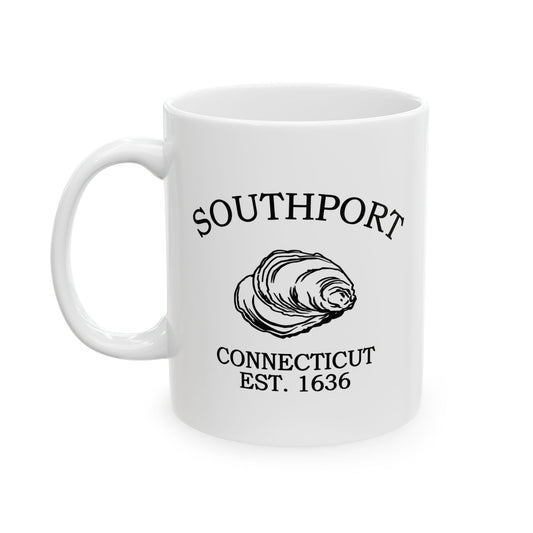
Our Southport logo carries an oyster over "Connecticut · Est. 1636" — the shared shoreline emblem of every Merlin Classics Connecticut town, marking the founding of the Connecticut Colony. Printed black-and-white with the worn look of an old oyster-crate label or shoreline signage, the oyster reads as the Connecticut shore in shorthand: the Sound, the harbors, the shellfish beds. It suits Southport especially well — this was a working harbor that shipped oysters right alongside its famous onions.
Today Southport is one of the most beautiful intact village streetscapes on the Connecticut shore — a small, refined harbor village of Fairfield on the Gold Coast, its Greek Revival houses and stone library looking out over the same Long Island Sound that built it. Our Southport designs gather that quiet heritage into wearable form — the harbor, the onion port, the rebuilt village, the oyster-and-1636 emblem. From the burned village of 1779 to the masts at the yacht club — wear a little of the Connecticut shore.

Southport Connecticut — Travel Guide
Visiting Southport Connecticut Today
Southport is a compact, refined harbor village of the Town of Fairfield, on Long Island Sound between the Mill River and Sasco Brook. Its appeal is its intactness: a 19th-century streetscape of Greek Revival captain's houses, a stone library, and a small working harbor, all within a few walkable blocks.
The Harbor, the Library & the Historic District in Southport Connecticut
For visitors searching for things to do in Southport, Connecticut:
- Walk the Southport Historic District along Harbor Road and Pequot Avenue, lined with post-1779 Greek Revival and Federal captain's houses.
- Visit the Pequot Library (1894), a stone Richardsonian-Romanesque landmark with reading rooms and cultural programming.
- Look out over Southport Harbor at the mouth of the Mill River, with sailboats and the Pequot Yacht Club.
- Relax at Southport Beach, a small cove looking toward the harbor mouth on Long Island Sound.
- Find the Meeker House (about 1766), the lone survivor of the 1779 burning.
Why People Visit Southport Connecticut
People come to Southport for one of the best-preserved harbor villages on the Connecticut shore: Greek Revival houses built by shipping and banking wealth, a stone library, and a quiet yacht harbor on Long Island Sound. It's small, refined, and walkable — a village that rebuilt itself after 1779 and has kept its 19th-century streetscape intact ever since.
Wear the History

For deeper reading on the Southport, Connecticut history described here — the Sasqua, Paugussett, and Pequot heritage of the shore, the 1639 Mill River settlement within Fairfield, the July 1779 British and Hessian burning and the Greek Revival rebuild, the Southport Globe onion-shipping port, the 1831 borough incorporation, the Pequot Library, and the Southport Historic District — it may be useful to consult (1) the Fairfield Museum and History Center, (2) the Pequot Library and the Fairfield Historical Society, (3) the Connecticut State Library and the Connecticut State Historic Preservation Office, (4) the Town of Fairfield town clerk's records office, and (5) the local-history collections of the Fairfield and regional libraries. For travel and visitor information, it may be useful to contact (1) Visit Fairfield and the regional convention and visitors bureau, (2) the Connecticut Office of Tourism (CTvisit), (3) the Fairfield Parks and Recreation Department, (4) the Connecticut State Parks office, and (5) the regional Metro-North and visitor information desks.
Shop the Southport Connecticut collection
View full collection-
Southport Connecticut Vintage Retro Premium Crewneck Sweatshirt - Black Logo
Regular price $48.00 USDRegular price -
Southport Connecticut Vintage Retro Premium Crewneck Sweatshirt - White Logo
Regular price $48.00 USDRegular price -
Southport Connecticut Classic Cotton Cap - White Logo
Regular price $32.00 USDRegular price -
Southport Connecticut Classic Cotton Cap - Black Logo
Regular price $32.00 USDRegular price -
-
Southport Connecticut Vintage Retro Womens Fitted Ringspun Cotton Tee - Black Logo
Regular price $28.00 USDRegular price -
Southport Connecticut Vintage Retro Unisex Heavy Cotton Hoodie - White Logo
Regular price $56.00 USDRegular price -
Southport Connecticut Vintage Retro Unisex Heavy Cotton Hoodie - Black Logo
Regular price $56.00 USDRegular price -
Southport Connecticut Vintage Retro Minuteman Holiday Cotton Tee - White Logo
Regular price $36.00 USDRegular price -
-
Southport Connecticut Vintage Retro Unisex Heavy Cotton Tee - White Logo
Regular price $22.00 USDRegular price -
Southport Connecticut Vintage Retro Unisex Heavy Cotton Tee - Black Logo
Regular price $22.00 USDRegular price -
Southport Connecticut Vintage Retro Unisex Embroidered Fleece Jacket - White Logo
Regular price $98.00 USDRegular price -
Southport Connecticut Vintage Retro Cotton Canvas Tote Bag - White Logo
Regular price $25.00 USDRegular price -
Southport Connecticut Vintage Retro Cotton Canvas Tote Bag - Black Logo
Regular price $25.00 USDRegular price -
Southport Connecticut Vintage Retro Cotton Jersey Baby Bodysuit - Black Logo
Regular price $26.00 USDRegular price -
Southport Connecticut Vintage Retro Unisex Embroidered Cotton Polo - Black Logo
Regular price $48.00 USDRegular price -
Southport Connecticut Vintage Retro Vinyl Sticker - Black Logo
Regular price From $6.00 USDRegular price -
Southport Connecticut Vintage Retro Ceramic Mug - Black Logo
Regular price From $16.00 USDRegular price -
Southport Connecticut Vintage Retro Thank You Card Set - Black Logo
Regular price From $25.00 USDRegular price -
Southport Connecticut Vintage Retro Unisex Cotton Jersey Tank Top - Black Logo
Regular price $28.00 USDRegular price -
Southport Connecticut Vintage Retro Unisex Cotton Jersey Tank Top - White Logo
Regular price $28.00 USDRegular price -
Southport Connecticut Vintage Retro Back Printed Art Series Cotton Tee - Black Logo
Regular price $32.00 USDRegular price