Sacramento California — Retro Vintage History
What's with the End of the Line in the City of Trees? Twice over, Sacramento was where the country's fastest thing ran out of track. In 1860 it was the western finish of the Pony Express, the 1,900-mile relay from St. Joseph, Missouri that promised mail in ten days; riders changed horses every fifteen miles and aimed for the J Street terminus, where a dust cloud on the eastern horizon meant a rider was close. The service lasted eighteen months and the telegraph killed it. Then, almost at once, Sacramento became the start of the next thing: in 1863 the Central Pacific broke ground here for the western half of the transcontinental railroad. End of one line, beginning of another — and all of it under the densest canopy of street trees in California, the reason locals call this the City of Trees.
Wear the HistoryThe confluence of the Sacramento and American Rivers had been Nisenan (Maidu) homeland for thousands of years. In 1839 a Swiss emigrant, John Sutter, built a fort he called New Helvetia near the rivers and ran a private agricultural colony on Nisenan land — the settlement that became Sacramento began at his gate. The Gold Rush that followed brought enormous wealth and, for the Nisenan and other Native peoples of the valley, displacement, disease, and violence; the fort still stands as a state historic park, a record of where the city started and at what cost.
The gold itself was found upriver. In January 1848 James Marshall spotted flakes in the tailrace of a sawmill at Coloma, and within a year the world arrived. Sacramento, sitting at the head of river navigation where the goldfields met the water, became the great supply hub of the Rush — the Embarcadero port, the wholesale houses, the wagon roads up into the Sierra. The city was platted at the end of 1848 and incorporated in 1850, the oldest incorporated city in California, a boomtown built to outfit a gold rush.
It nearly washed away more than once. The rivers that made Sacramento a port also flooded it — catastrophically in 1850 and again in 1862 — and rather than move, the city raised itself, jacking up buildings and filling the streets a full story higher. That is why Old Sacramento has an "underground": the original ground floors are now basements. The levees and the raised grade held, and in 1854 the young river city won the prize that fixed its future — it became the capital of California, and the domed State Capitol rose over Capitol Park by 1874.

The Pony Express made Sacramento famous for eighteen months. The relay reached its western end at the J Street terminus and the B.F. Hastings Building, and a tired rider clattering in off the plains was the closest thing the 1860 West had to instant news. On October 24, 1861, the transcontinental telegraph line was joined, and two days later the Pony Express folded — wire could now carry a message coast to coast in minutes. Frontier ambition outpaced by faster technology: the pattern that would run through the whole of Sacramento's story.
The next line started where the last one ended. Four Sacramento merchants — Leland Stanford, Collis Huntington, Mark Hopkins, and Charles Crocker, the "Big Four" — backed Theodore Judah's scheme for a railroad over the Sierra, and in 1863 the Central Pacific broke ground in Sacramento. Crews blasted and bored east through the mountains until, in 1869, the line met the Union Pacific at Promontory, Utah, and the country was bound together by rail. The roundhouses and shops stayed in Sacramento; today the California State Railroad Museum, the largest in the United States, anchors the Old Sacramento waterfront.
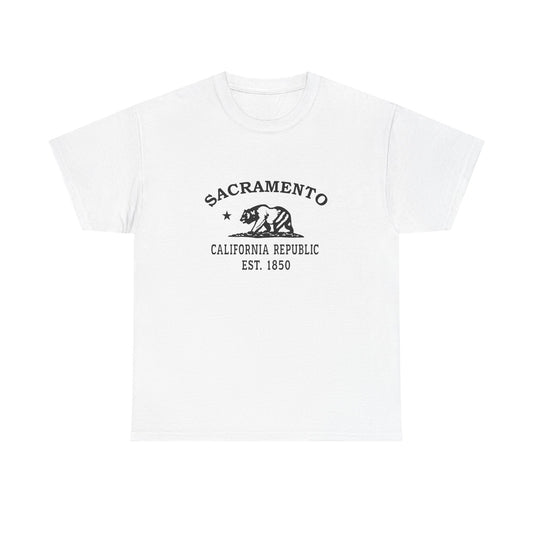
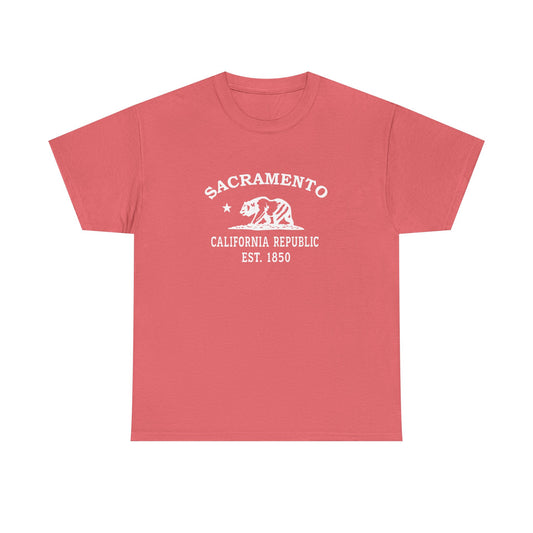
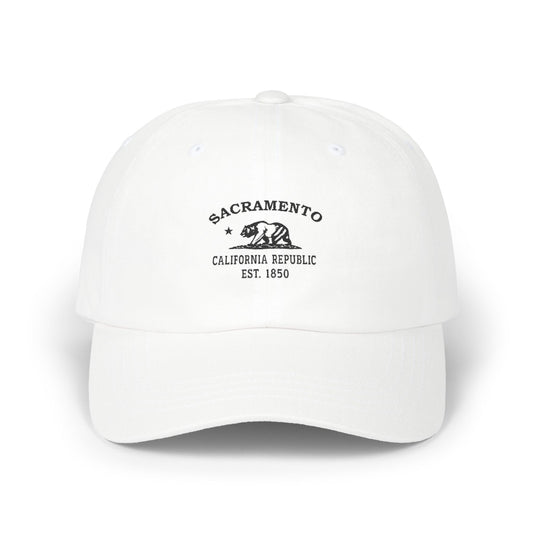
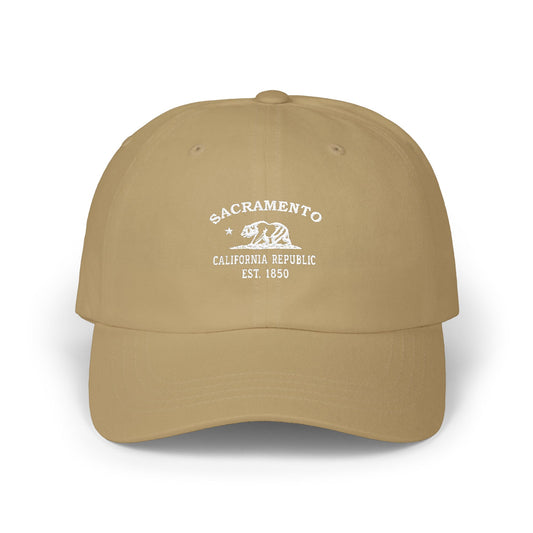
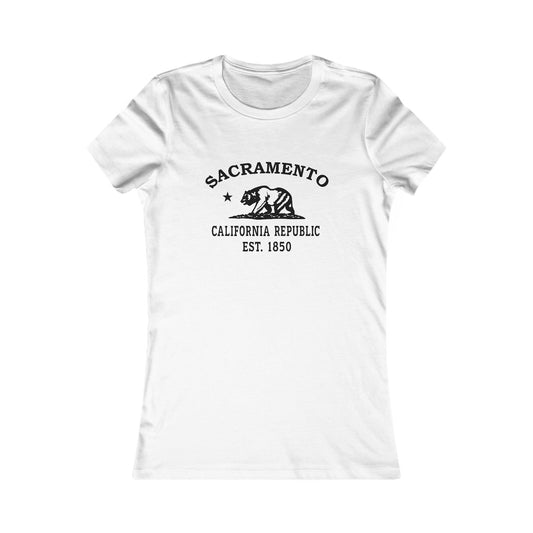
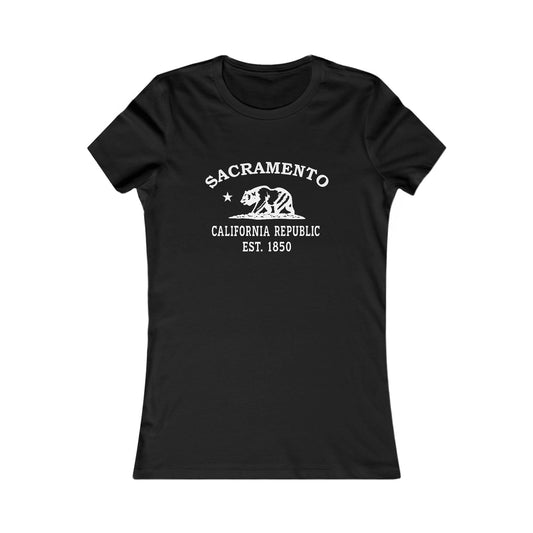
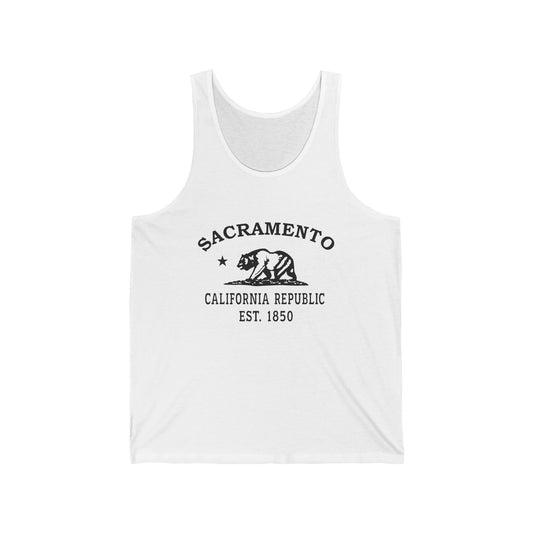
Our Sacramento logo carries the California bear and star above "Est. 1850," the shared retro emblem of our California towns, drawn in worn black-and-white like a WPA poster or an old crate label. The 1850 date marks both California statehood and the year Sacramento incorporated, and the bear of the California Republic is the through-line that links Sacramento to every other California town we make. The detail that makes this one Sacramento is the river city itself — the Gold Rush cobblestones of Old Sac, the gold Tower Bridge over the river, and the City of Trees that grew up around the capitol.
Sacramento is the End of the Line and the start of the next one — the Gold Rush's supply town, the Pony Express finish, the place the transcontinental railroad began, California's capital under a canopy of trees at the meeting of two rivers. Our Sacramento designs gather that into wearable form. Wear the Gold Rush capital. Wear the City of Trees. City of Trees. Capital since 1854.

Sacramento, California — Travel Guide
Visiting Sacramento Today
Sacramento sits at the confluence of the Sacramento and American Rivers, the capital of California and the heart of the Sacramento Valley. Expect the Gold-Rush cobblestones and wooden sidewalks of Old Sacramento, the domed State Capitol and its park, the gold Tower Bridge over the river, world-class history museums, and a flat, tree-shaded grid made for walking and biking. It is sunny and easygoing, hot in summer, with mild river-valley winters.
Old Sacramento, the Capitol & the Rivers
For visitors looking for things to do in Sacramento, California:
- Walk the Old Sacramento Waterfront — cobblestone streets, wooden sidewalks, and Gold-Rush-era storefronts along the river.
- Tour the California State Railroad Museum, the largest railroad museum in the United States.
- Visit the California State Capitol and stroll the gardens of Capitol Park.
- See the Pony Express monument near 2nd and J and the 1860 B.F. Hastings Building, the route's western terminus.
- Explore Sutter's Fort State Historic Park, the restored adobe where the settlement began.
- Cross or photograph the gold Tower Bridge, the city's most-photographed landmark.
- Take in the Crocker Art Museum, the oldest art museum in the West.
- Bike the American River Parkway and wander Midtown's tree-lined streets — the City of Trees up close.
Why People Visit Sacramento
Sacramento rewards travelers who want history, rivers, and shade rather than a beach — the Gold-Rush waterfront, the railroad that started here, the capitol, and a walkable grid under a famous tree canopy. People come for Old Sacramento and the Railroad Museum, for the Capitol and the gold bridge, and for an easy California day where frontier history and a leafy capital city sit side by side at the meeting of two rivers.
Wear the History

For deeper reading on the Sacramento history described here — the Nisenan (Maidu) homeland at the river confluence, Sutter's Fort and New Helvetia, the 1848 gold discovery at Coloma and the 1849 supply-hub boom, the 1850 and 1862 floods and the raised streets of Old Sacramento, the Pony Express western terminus, and the Big Four and the transcontinental railroad — it may be useful to consult (1) the Center for Sacramento History, (2) the Sacramento Room of the Sacramento Public Library, (3) the California State Library, (4) the California State Archives, (5) the California State Railroad Museum and California State Parks (Old Sacramento and Sutter's Fort), and (6) the Sacramento History Museum and the Wells Fargo History Museum in Old Sacramento. For travel and visitor information, it may be useful to contact (1) Visit California, (2) Visit Sacramento, (3) the City of Sacramento, (4) the California State Parks office, and (5) the Sacramento International Airport visitor desk.
Shop the Sacramento California collection
View full collection-
Sacramento California Vintage Retro Premium Crewneck Sweatshirt - Black Logo
Regular price $48.00 USDRegular price -
Sacramento California Vintage Retro Premium Crewneck Sweatshirt - White Logo
Regular price $48.00 USDRegular price -
Sacramento California Vintage Retro Unisex Heavy Cotton Tee - Black Logo
Regular price $22.00 USDRegular price -
Boy and Hound - Silhouette Art Giclée Unframed Art Print
Regular price From $34.00 USDRegular price -
Shoreline Trio - Silhouette Art Framed Art Print
Regular price From $96.00 USDRegular price -
Sacramento California Vintage Retro Unisex Heavy Cotton Tee - White Logo
Regular price $22.00 USDRegular price -
Sacramento California Vintage Retro Embroidered Cotton Cap - Black Logo
Regular price $32.00 USDRegular price -
Whitewater Run - Silhouette Art Giclée Unframed Art Print
Regular price From $34.00 USDRegular price -
Whitewater Leap - Silhouette Art Framed Art Print
Regular price From $96.00 USDRegular price -
Sacramento California Vintage Retro Embroidered Cotton Cap - White Logo
Regular price $32.00 USDRegular price -
Sacramento California Vintage Retro Ceramic Mug - Black Logo
Regular price From $16.00 USDRegular price -
Horse at Low Tide - Silhouette Art Giclée Unframed Art Print
Regular price From $34.00 USDRegular price -
Boy and Hound Portrait - Silhouette Art Framed Art Print
Regular price From $112.00 USDRegular price -
Sacramento California Vintage Retro Vinyl Sticker - Black Logo
Regular price From $6.00 USDRegular price -
Sacramento California Vintage Retro Cotton Canvas Tote Bag - Black Logo
Regular price $25.00 USDRegular price -
Shoreline Trio - Silhouette Art Giclée Unframed Art Print
Regular price From $34.00 USDRegular price -
Mare and Foal - Silhouette Art Framed Art Print
Regular price From $96.00 USDRegular price -
Sacramento California Vintage Retro Cotton Canvas Tote Bag - White Logo
Regular price $25.00 USDRegular price -
Sacramento California Vintage Retro Womens Fitted Ringspun Cotton Tee - Black Logo
Regular price $28.00 USDRegular price -
Companion in Still Water - Silhouette Art Giclée Unframed Art Print
Regular price From $34.00 USDRegular price -
Nuzzle in Shallow Water - Silhouette Art Framed Art Print
Regular price From $96.00 USDRegular price -
-
Sacramento California Vintage Retro Unisex Cotton Jersey Tank Top - Black Logo
Regular price $28.00 USDRegular price -
Small Steps - Silhouette Art Giclée Unframed Art Print
Regular price From $44.00 USDRegular price