Old Greenwich Connecticut — Retro Vintage History
What's with the woman who bought the point? In 1640, Elizabeth Fones Feake took title to the beach peninsula now called Tod's Point — in her own name. It surprises almost everyone who walks the beach: the most loved ground in the village was first bought by a woman, three and a half centuries before that was ordinary. Elizabeth, a niece of the Massachusetts Bay governor John Winthrop, made a "particular purchase" of the long peninsula within the village's founding deal — among the earliest instances of a woman individually holding title to real property anywhere in the New World. The Siwanoy who lived along this shore knew the place as Monakewego — "shining sands" — and for more than a century afterward the maps and records called it Elizabeth's Neck. That 1640 purchase was the first settlement of what became Greenwich, and the village that grew up around it has been called the "Old Town" ever since. This quiet shoreline corner is, quite literally, where Greenwich began.
Wear the HistoryWhere you're from. Where you love. Where you explored. Where you belong.
Why was Old Greenwich once called Sound Beach? Because for fifty-nine years, it was. When the railroad put a station here in 1872, the village took the name of its shoreline and became "Sound Beach" — a summer-resort brand for a summer-resort age. It kept the name until 1931, when the village asked for its history back and was rechristened Old Greenwich, a plain statement of fact: this was the oldest part of the town, the founding ground everything else grew from. Three names in three centuries — the Old Town, Sound Beach, Old Greenwich — and all three describe the same few streets between the brooks and the Sound.
Old Greenwich is the original Greenwich. In July 1640, Robert Feake, Captain Daniel Patrick, and Elizabeth Fones Feake came ashore and purchased the land between the Asamuck and Tatomuck brooks from the Siwanoy people who lived along this shore — the founding transaction of the town, made here, on this beach-village ground. The settlers laid out farms and a landing on the sheltered coves, and around 1645 the Feake-Ferris House rose beside Greenwich Cove at the gateway to the point. Believed the oldest house in town and among the oldest in Connecticut, it has been carefully restored in recent years — and it is still standing, on the way to the beach, nearly four centuries on.

The remarkable line in the founding record is Elizabeth's. The surviving purchase notes her own "particular purchase" of the peninsula — not her husband's, hers — at a time when a married woman holding land in her own name startled her neighbors. The maps did not mind: for over a hundred years the point appeared in colonial records as Elizabeth's Neck. Her early village sat on a contested edge of the map, too — for a time in the 1640s this coast lay under Dutch New Netherland, the working border between New Amsterdam's world and New England's, before Connecticut's side of the line prevailed. Elizabeth herself eventually moved on, but her Neck stayed in village hands: the Ferris family held it for more than a hundred and fifty years.
QUICK FACTS — OLD GREENWICH, CT
The Siwanoy people knew the beach peninsula as Monakewego — "shining sands" — long before any colonist arrived.
In July 1640, Robert Feake, Daniel Patrick, and Elizabeth Fones Feake purchased the shore between the Asamuck and Tatomuck brooks — the founding of Greenwich, here.
Elizabeth Feake's "particular purchase" put the peninsula in her own name — among the earliest individual property titles held by a woman in the New World.
For more than a century, maps and records called the peninsula Elizabeth's Neck.
The Feake-Ferris House, built about 1645 beside Greenwich Cove, is believed the oldest house in town — restored and still standing.
The railroad arrived in 1872 and the village became Sound Beach; its 1894 depot still stands, on the National Register of Historic Places.
In 1931, Sound Beach was renamed Old Greenwich — reclaiming its place as the town's original settlement.
In 1945 the town acquired J. Kennedy Tod's Innis Arden estate, and Elizabeth's Neck became Greenwich Point Park — Tod's Point.
Through the colonial centuries this stayed a farming and fishing village on the Sound. Small wharves shipped produce and shellfish toward the New York markets; oystermen worked the coves; and during the Revolution the open water that made the village prosperous also made it vulnerable, as raiders crossed the Sound in shallow "wheelboats" between the Connecticut shore and Loyalist Long Island. It was a modest, hardworking shoreline community, shaped from the beginning by the tides, the coves, and the long peninsula reaching out into the Sound.
The railroad-era resort years gave the village its Victorian layer. Through the late nineteenth century the shore filled with summer hotels and seaside cottages, and city families discovered the coves and the sand. The handsome depot of about 1894 — now on the National Register — dates from those years, the tie that bound this quiet corner of the Sound to Manhattan forty-some miles down the line, and the reason the village center grew up along Sound Beach Avenue between the station and the water.

Two gifts shaped the village that visitors know today. In the 1880s the banker J. Kennedy Tod built his "Innis Arden" estate out on Elizabeth's Neck, with a stone mansion, a boathouse, and gardens along the peninsula; in 1945 the town acquired the property, and the point became Greenwich Point Park — the beloved town beach, with its tidal ponds, walled garden, and holly grove, that everyone simply calls "the Point," or Tod's Point. Inland, the pond and lawns of Binney Park were given to the village in 1928 by Edwin Binney, the co-inventor of the Crayola crayon, who summered nearby — the village's second great green space, known for its model-sailboat races and fall color.
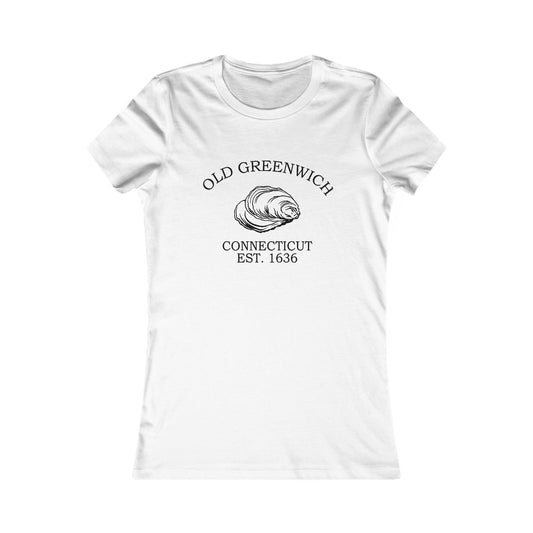
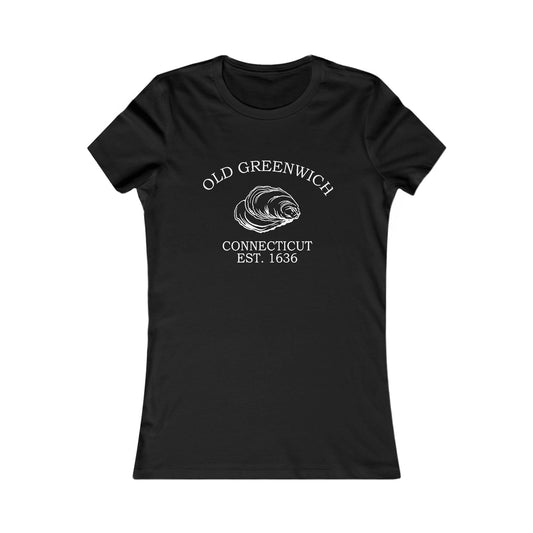
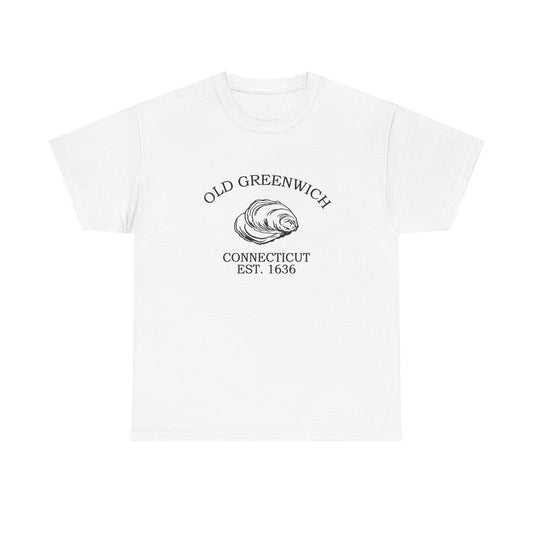
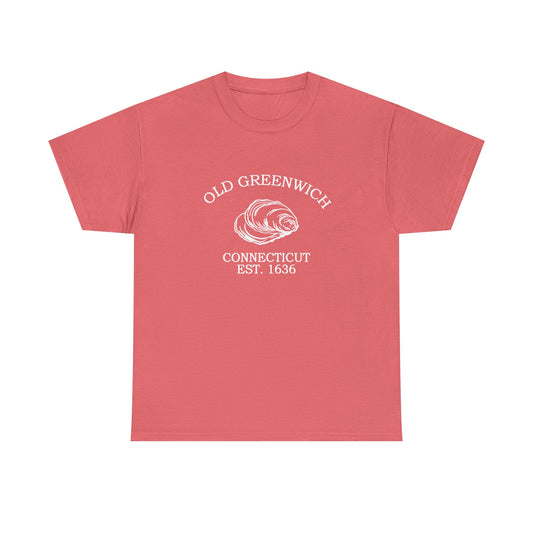
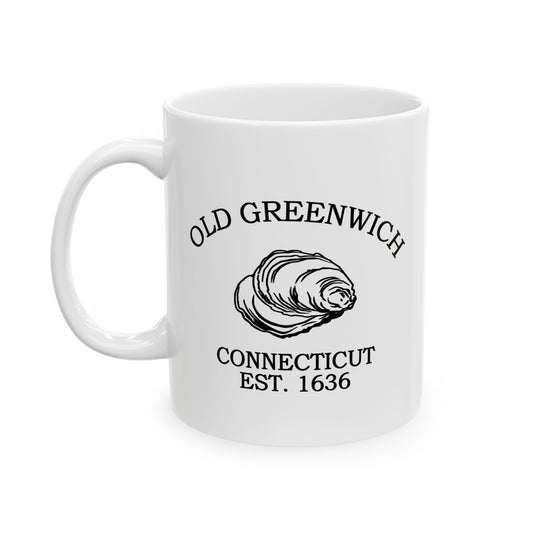
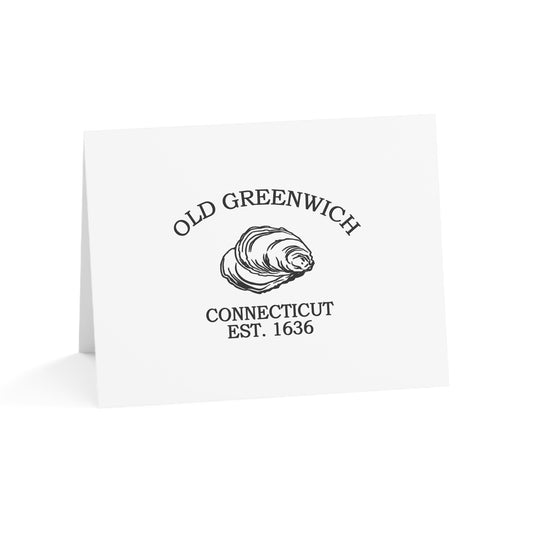
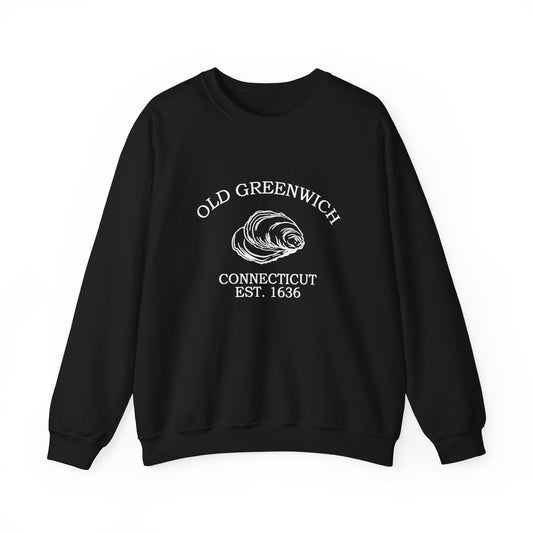
Our Old Greenwich logo carries Connecticut's oyster, above "Est. 1636," the founding era of the Connecticut Colony — the shared emblem of every Merlin Classics Connecticut shoreline place. Printed in a worn black-and-white that recalls an old oyster-crate label, the oyster is the shoreline in shorthand: briny, durable, and tied to the working water. The oyster is the through-line that links Old Greenwich to every other Connecticut town we make. What makes this one Old Greenwich is everything around it — the shining sands of Tod's Point, the pond at Binney Park, and the 1640 founding ground where Greenwich began.
Today Old Greenwich wears its history quietly but proudly — the original "Old Town" of Greenwich, a shore village of beaches and coves with four centuries of New England behind it. Its story runs from the Siwanoy shore and Elizabeth Feake's 1640 purchase of Elizabeth's Neck, through a colonial farming village and a railroad-era summer resort, to the gracious commuter village it is now. Our Old Greenwich designs gather that identity into wearable form — the oyster-and-1636 emblem, the Point, and the Sound. Old Greenwich, Connecticut: where Greenwich began in 1640, on the shining sands of Tod's Point.
Old Greenwich, Connecticut — Travel Guide
Visiting Old Greenwich Today
Old Greenwich sits at the southern, seaward edge of Greenwich, a small shoreline village gathered along Sound Beach Avenue between Long Island Sound and the Metro-North line — a village distinct enough to keep its own ZIP code, 06870, and its own Metro-North station. It is the original "Old Town" of Greenwich — an easy, walkable corner of beaches, coves, and a compact downtown, with the long peninsula of Tod's Point reaching out into the Sound at its edge.
Tod's Point, Binney Park & the Village
For visitors looking for things to do in Old Greenwich, Connecticut:
- Spend a day at Greenwich Point Park — Tod's Point — the village's beach peninsula, with sand, tidal ponds, a walled garden, and Long Island Sound views.
- Walk Binney Park, the pond-and-lawn landscape given to the village in 1928, known for its model-sailboat races and fall foliage.
- See the Feake-Ferris House (c. 1645) beside Greenwich Cove — believed the oldest house in town, tied to the village's 1640 founding, and recently restored.
- Browse the small downtown along Sound Beach Avenue, a compact New England village center.
- Admire the 1894 Old Greenwich Railroad Station, a well-kept Victorian depot on the National Register of Historic Places.
- Walk the shore at Greenwich Cove and watch the sailboats and shorebirds on the Sound.
Why People Visit Old Greenwich
Old Greenwich offers the Connecticut Gold Coast at its most low-key — a real shore village with a beach peninsula, a pond park, and a handful of streets of shops, plus the quiet distinction of being where Greenwich began. Visitors come for Tod's Point and the Sound, the founding history, and the unhurried village pace, and stay for the beaches, the coves, and the deep-rooted New England feel. It is refined, historic, and genuinely Connecticut.
Wear the History
Where you're from. Where you love. Where you explored. Where you belong.
Kindred Cities
Welcome to visitors from Greenwich-on-Thames and Rye — fellow old-world towns by the water.
Old Greenwich keeps the gentler, seaside half of its township's character, and Greenwich and Rye in England would recognise it. Greenwich-on-Thames lent the whole town its name, royal river and all; Rye is the cobbled, half-timbered old Cinque Port of East Sussex, a medieval harbour the sea slowly left behind. Old Greenwich answers with Tod's Point reaching into Long Island Sound, shingled cottages and a beach-village quiet the busier parts of Greenwich gave up.
Old Greenwich repays the visitor who likes the shore leisurely: a long sandy point out into the Sound, a walkable village of a few blocks, and the salt-air calm of old New England a short train ride from the city. Come and visit us soon.
When you plan the trip, the Greenwich Chamber of Commerce and the Connecticut Office of Tourism are the place to start.
Wear the History
Where you're from. Where you love. Where you explored. Where you belong.

For deeper reading on the Old Greenwich history described here — the Siwanoy homeland and the "Monakewego" shore, the 1640 founding purchase between the Asamuck and Tatomuck brooks, Elizabeth Fones Feake's "particular purchase" and individual title to Elizabeth's Neck, the Feake-Ferris House of about 1645 and its recent restoration, the Revolutionary-era Sound raids, the railroad-era renaming as Sound Beach in 1872 and the 1894 depot, the Tod "Innis Arden" estate that became Greenwich Point Park in 1945, Binney Park's 1928 gift, and the 1931 renaming as Old Greenwich — it may be useful to consult (1) the Greenwich Historical Society and the Greenwich Library's local-history collections, (2) the Greenwich Point Conservancy for the Feake-Ferris House and the Point's landmark buildings, (3) the Connecticut State Library and the Connecticut Historical Society, (4) the National Register of Historic Places file for the Old Greenwich (Sound Beach) Railroad Station, and (5) the Town of Greenwich land and vital records. For travel and visitor information, it may be useful to contact (1) the Greenwich Chamber of Commerce, (2) the Connecticut Office of Tourism, (3) the Greenwich Department of Parks and Recreation for Greenwich Point and Binney Park, and (4) the National Weather Service for Long Island Sound marine advisories.
Shop the Old Greenwich Connecticut collection
View full collection-
Old Greenwich Connecticut Vintage Retro Premium Crewneck Sweatshirt - Black Logo
Regular price $48.00 USDRegular price -
Old Greenwich Connecticut Vintage Retro Premium Crewneck Sweatshirt - White Logo
Regular price $48.00 USDRegular price -
Old Greenwich Connecticut Vintage Retro Unisex Embroidered Cotton Polo - Black Logo
Regular price $48.00 USDRegular price -
Old Greenwich Connecticut Vintage Retro Embroidered Cotton Cap - Black Logo
Regular price $32.00 USDRegular price -
Old Greenwich Connecticut Vintage Retro Embroidered Cotton Cap - White Logo
Regular price $32.00 USDRegular price -
Old Greenwich Connecticut Vintage Retro Womens Fitted Ringspun Cotton Tee - Black Logo
Regular price $28.00 USDRegular price -
-
Old Greenwich Connecticut Vintage Retro Unisex Heavy Cotton Tee - Black Logo
Regular price $22.00 USDRegular price -
Old Greenwich Connecticut Vintage Retro Unisex Heavy Cotton Tee - White Logo
Regular price $22.00 USDRegular price -
Old Greenwich Connecticut Vintage Retro Unisex Heavy Cotton Hoodie - Black Logo
Regular price $56.00 USDRegular price -
Old Greenwich Connecticut Vintage Retro Unisex Heavy Cotton Hoodie - White Logo
Regular price $56.00 USDRegular price -
Old Greenwich Connecticut Vintage Retro Unisex Embroidered Fleece Jacket - White Logo
Regular price $98.00 USDRegular price -
Old Greenwich Connecticut Vintage Retro Back Printed Art Series Cotton Tee - Black Logo
Regular price $32.00 USDRegular price -
Old Greenwich Connecticut Vintage Retro Giclée Print Art Series Poster
Regular price From $38.00 USDRegular price -
Old Greenwich Connecticut Vintage Retro Cotton Canvas Tote Bag - Black Logo
Regular price $25.00 USDRegular price -
Old Greenwich Connecticut Vintage Retro Cotton Canvas Tote Bag - White Logo
Regular price $25.00 USDRegular price -
Old Greenwich Connecticut Vintage Retro Cotton Jersey Baby Bodysuit - Black Logo
Regular price $26.00 USDRegular price -
Old Greenwich Connecticut Vintage Retro Vinyl Sticker - Black Logo
Regular price From $6.00 USDRegular price -
Old Greenwich Connecticut Vintage Retro Ceramic Mug - Black Logo
Regular price From $16.00 USDRegular price -
Old Greenwich Connecticut Vintage Retro Thank You Card Set - Black Logo
Regular price From $25.00 USDRegular price -
Old Greenwich Connecticut Vintage Retro Unisex Cotton Jersey Tank Top - Black Logo
Regular price $28.00 USDRegular price -
Old Greenwich Connecticut Vintage Retro Unisex Cotton Jersey Tank Top - White Logo
Regular price $28.00 USDRegular price -
Old Greenwich Connecticut Vintage Retro Unisex Heavy Crewneck Sweatshirt - White Logo
Regular price $44.00 USDRegular price