New London Connecticut — Retro Vintage History
The Whaling City on the Thames — a deep-water port that once sent more whaleships to sea than almost anywhere, and today trains the officers of the U.S. Coast Guard. New London sits at the mouth of the Thames River where it opens into Long Island Sound, on one of the deepest harbors on the Atlantic coast. The Pequot lived and fished on this water long before John Winthrop the Younger founded the town in 1646; by the mid-1800s it had grown into the second-busiest whaling port in the world, and in the next century it became the home of the U.S. Coast Guard Academy and its tall ship, the Eagle. Whaling wealth, Revolutionary fire, and the Coast Guard — this page tells the story.
Wear the HistoryThe water came first. The Pequot people lived and fished at the mouth of the Thames, and the settlement John Winthrop the Younger began here in 1646 was called Pequot until it was renamed New London in 1658 — for the city in England, on a river the colonists renamed the Thames to match. With one of the best deep-water harbors on the coast, New London became a shipbuilding and shipping town, and in the Revolution a base for privateers who captured hundreds of British vessels. That made it a target: on September 6, 1781, a British force led by the turncoat Benedict Arnold — born just up the river in Norwich — burned much of the city and stormed Fort Griswold across the Thames in Groton. New London rebuilt; chartered as a city in 1784, it turned back to the sea.
What it turned to was whaling. New London had chased whales since the early 1700s, but the trade peaked in the 1840s: in 1847 the port passed Nantucket to stand second only to New Bedford, and by mid-century it was the second-busiest whaling port in the world. The fortunes that came home built the Greek Revival mansions of Whale Oil Row, and in 1833 — at the height of that wealth — the city raised a Custom House on Bank Street designed by Robert Mills, architect of the Washington Monument; it is the oldest U.S. Custom House still in operation, and when the schooner Amistad was towed into the harbor in 1839, it was this waterfront that received her.
As whaling faded, the harbor found new work. The Coast Guard's officer school — afloat since 1876 — moved ashore to Fort Trumbull in 1910, was renamed the U.S. Coast Guard Academy in 1915, and in 1932 built its permanent campus on land New London citizens gave up the Thames. Since 1946 the academy's training barque Eagle has sailed from New London: a 295-foot square-rigger built in Germany in 1936 and taken as a war reparation, today the only active square-rigger in U.S. service. The city kept a literary fame, too — the playwright Eugene O'Neill spent his boyhood summers at the cottage on Pequot Avenue he later set on the stage, down to the moan of the harbor foghorn that runs all through Long Day's Journey Into Night.
What's with the Whaling City? It's New London's oldest nickname, and it was once literally true: in the whaling heyday of the 1840s and '50s, this small Connecticut port stood second only to New Bedford, sending fleets to sea on voyages that could last three or four years. Whaling was hard, dangerous work, and it reads very differently today than it did then — but the heritage is real, and it explains why a town this size has the deep harbor, the merchant houses, and the salt-and-rope identity of a great seaport. The Whaling City is New London's name for that past, and the deep water that made it possible is still there at the foot of the Thames.

New London keeps two seafaring identities at once. There is the whaling city — Whale Oil Row, the old harbor, the 1833 Custom House, and the lights that still guide ships in: New London Harbor Light, raised in 1801 and the oldest and tallest lighthouse in Connecticut, and the offshore Ledge Light of 1909, square on its house out in the channel. And there is the Coast Guard city — the academy on the Thames, the cadets, and the Eagle standing out under sail, one of the last great square-riggers flying the American flag. Between them runs the Thames itself, with the ferries pulling out for Orient Point and Block Island, the Amtrak trains along the waterfront, and the working harbor that has defined the place since 1646.
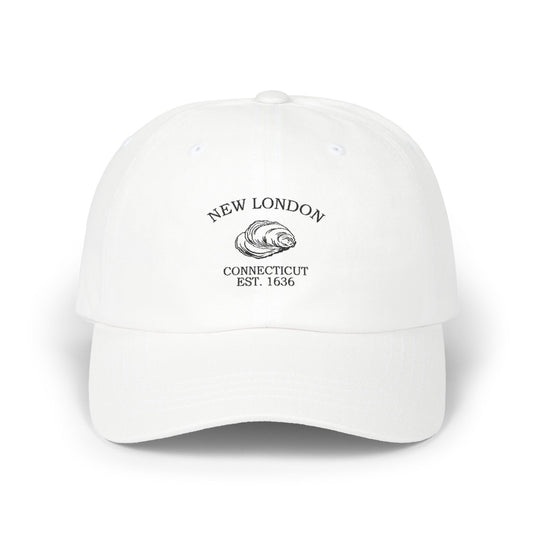
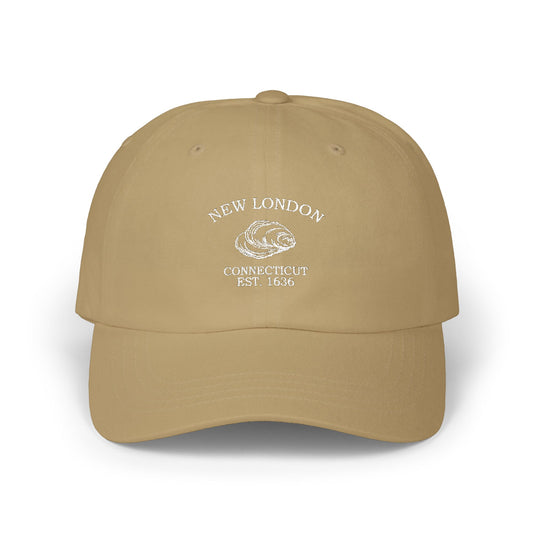
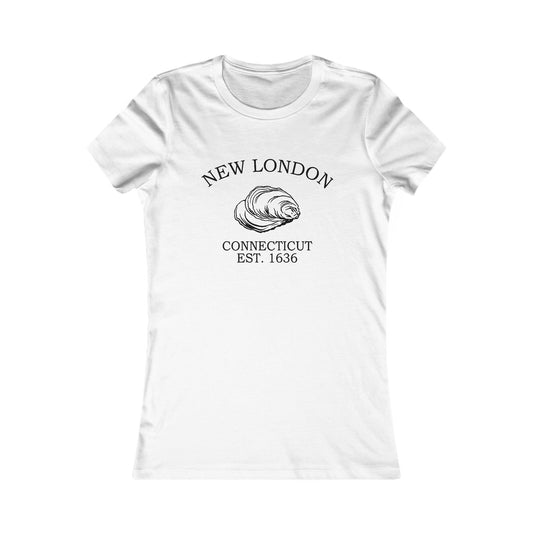
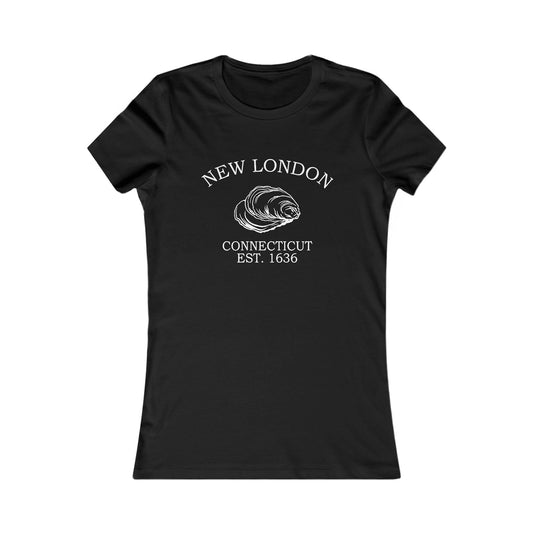
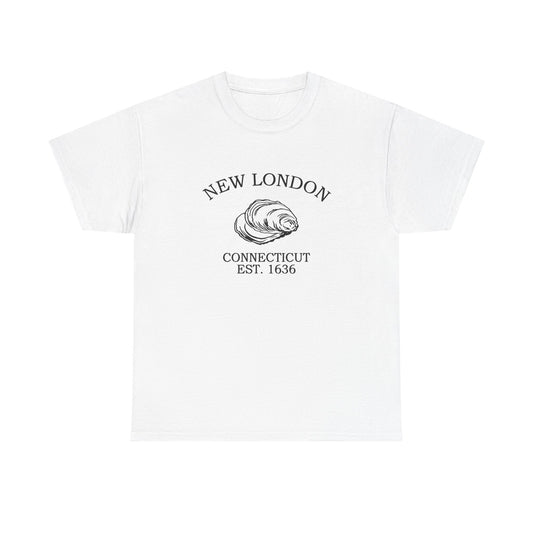
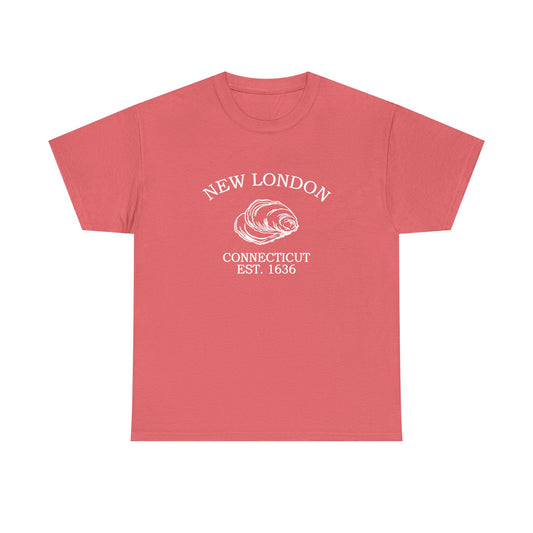
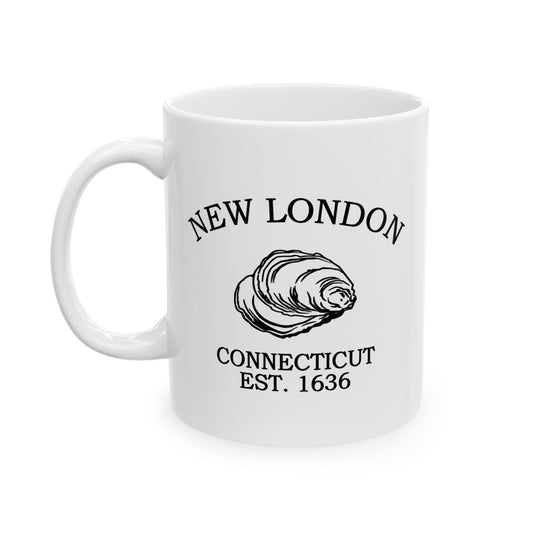
Our New London logo carries Connecticut's oyster shell over “1636” — the shared emblem of every Merlin Classics Connecticut town, marking the founding year of the Connecticut Colony. The oyster shell is the state's maritime shorthand: abundance, the shoreline, the working coast. Printed black-and-white with the worn look of an old oyster-crate label or a piece of coastal signage, it reads as vintage New England. What makes this one New London is the place behind it: the Whaling City, the Coast Guard Academy, the deep harbor on the Thames. On a tee or a cap it reads less like a souvenir and more like a piece of the Connecticut shoreline — worn plain.
Today New London is a working harbor city and a college and Coast Guard town, proud of its whaling past, its academy, and its place at the mouth of the Thames on Long Island Sound. Its story runs from the Pequot shore and Winthrop's 1646 founding through the 1781 burning, the whaling boom that made it the world's second-busiest whaling port, and the arrival of the Coast Guard Academy and the Eagle. Our New London designs gather that identity into wearable form — the whaleship, the oyster shell, the Coast Guard, the deep harbor. New London, Connecticut — the Whaling City on the Thames.

New London Connecticut — Travel Guide
Visiting New London Connecticut Today
New London sits at the mouth of the Thames River on Long Island Sound, an easy stop on the Connecticut shoreline between Mystic and the Rhode Island line. It pairs a working waterfront — ferries, trains, and the Coast Guard Academy — with whaling-era architecture, lighthouses, forts, a summer beach, and a downtown arts scene.
The Harbor, the Academy & the Whaling City
For visitors searching for things to do in New London, Connecticut:
- Visit the U.S. Coast Guard Academy and, when she's in port, the barque Eagle.
- Tour Fort Trumbull State Park, the granite fort with harbor views and coastal-defense exhibits.
- See New London Harbor Light — the oldest lighthouse in Connecticut — and the offshore New London Ledge Light.
- Walk Whale Oil Row and the historic downtown around Bank Street and the 1833 Custom House.
- Spend a summer day at Ocean Beach Park, or catch a show at the Garde Arts Center.
- Ride the Cross Sound Ferry across to Orient Point, or sail for Block Island.
Why People Visit New London Connecticut
People come to New London for its deep maritime history and its working-harbor life — the whaling heritage, the Coast Guard Academy, the lighthouses and ferries, the literary thread of Eugene O'Neill. It is a real seaport, not a recreated one: a small Connecticut city with a great harbor and a long view down the Thames toward the Sound.
Wear the History
Kindred Cities
Greetings to visitors from London and Portsmouth, England — fellow ports on the Thames and the sea.
New London carries the old country in its very name and geography: founded by English settlers, it set its harbour on a river they called the Thames, to make a New London complete. London is the namesake on the original Thames; Portsmouth is England's great naval port; New London answers as a Connecticut seafaring city — a whaling capital in its day, now home to the Coast Guard Academy and, across its Thames, the submarine yards of Groton. Salt water and service, on both sides of the Atlantic.
New London welcomes anyone from an old port: a deep harbour on its own Thames, a whaling past written into the waterfront, the Coast Guard's tall ship Eagle at the dock, and the submarine yards just across the river. Come and visit us soon.
When you plan the trip, the City of New London and the Connecticut Office of Tourism are the place to start.
Wear the History

For deeper reading on the New London, Connecticut history described here — the Pequot homeland and the place first called Pequot, John Winthrop the Younger's 1646 founding, the 1658 renaming and 1784 city charter, the Revolutionary privateer port and the 1781 burning by Benedict Arnold, the 1840s whaling boom that made New London the world's second-busiest whaling port, and the arrival of the U.S. Coast Guard Academy (1910) and the barque Eagle (1946) — it may be useful to consult (1) the New London County Historical Society (Shaw Mansion), (2) the New London Maritime Society at the 1833 Custom House, (3) the New London Public Library's local-history room, (4) the Connecticut State Library and the Connecticut Historical Society, and (5) the New London City Clerk's records office. For travel and visitor information, it may be useful to contact (1) the City of New London and its visitor information, (2) the Connecticut Office of Tourism, (3) the New London Parks and Recreation department (Ocean Beach Park), (4) Connecticut State Parks (Fort Trumbull), and (5) the Cross Sound Ferry and Amtrak/Union Station visitor desks.
Shop the New London Connecticut collection
View full collection-
New London Connecticut Vintage Retro Premium Crewneck Sweatshirt - Black Logo
Regular price $48.00 USDRegular price -
New London Connecticut Vintage Retro Premium Crewneck Sweatshirt - White Logo
Regular price $48.00 USDRegular price -
New London Connecticut Vintage Retro Embroidered Cotton Cap - Black Logo
Regular price $32.00 USDRegular price -
New London Connecticut Vintage Retro Embroidered Cotton Cap - White Logo
Regular price $32.00 USDRegular price -
New London Connecticut Vintage Retro Unisex Heavy Cotton Hoodie - Black Logo
Regular price $56.00 USDRegular price -
New London Connecticut Vintage Retro Unisex Heavy Cotton Hoodie - White Logo
Regular price $56.00 USDRegular price -
New London Connecticut Vintage Retro Womens Fitted Ringspun Cotton Tee - Black Logo
Regular price $28.00 USDRegular price -
-
New London Connecticut Vintage Retro Unisex Heavy Cotton Tee - Black Logo
Regular price $22.00 USDRegular price -
New London Connecticut Vintage Retro Unisex Heavy Cotton Tee - White Logo
Regular price $22.00 USDRegular price -
New London Connecticut Vintage Retro Cotton Canvas Tote Bag - Black Logo
Regular price $25.00 USDRegular price -
New London Connecticut Vintage Retro Cotton Canvas Tote Bag - White Logo
Regular price $25.00 USDRegular price -
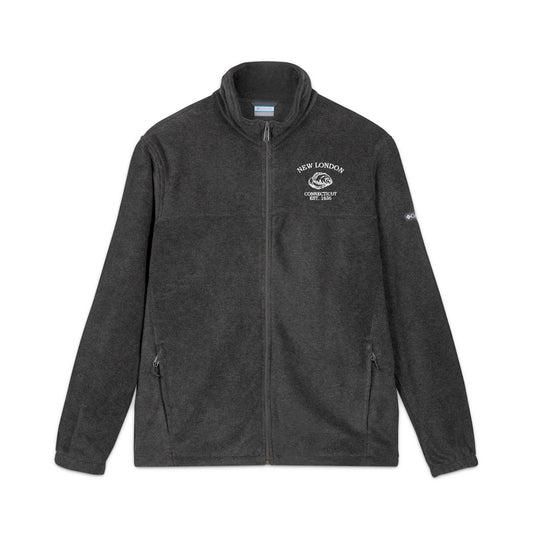
New London Connecticut Vintage Retro Unisex Embroidered Fleece Jacket - White Logo
Regular price $98.00 USDRegular price -
New London Connecticut Vintage Retro Vinyl Sticker - Black Logo
Regular price From $6.00 USDRegular price -
New London Connecticut Vintage Retro Ceramic Mug - Black Logo
Regular price From $16.00 USDRegular price -
New London Connecticut Vintage Retro Thank You Card Set - Black Logo
Regular price From $25.00 USDRegular price -
New London Connecticut Vintage Retro Cotton Jersey Baby Bodysuit - Black Logo
Regular price $26.00 USDRegular price -
New London Connecticut Vintage Retro Unisex Cotton Jersey Tank Top - Black Logo
Regular price $28.00 USDRegular price -
New London Connecticut Vintage Retro Unisex Cotton Jersey Tank Top - White Logo
Regular price $28.00 USDRegular price -
New London Connecticut Vintage Retro Back Printed Art Series Cotton Tee - Black Logo
Regular price $32.00 USDRegular price -
New London Connecticut Vintage Retro Unisex Heavy Crewneck Sweatshirt - White Logo
Regular price $44.00 USDRegular price -
New London Connecticut Vintage Retro Unisex Heavy Crewneck Sweatshirt - Black Logo
Regular price $44.00 USDRegular price -
New London Connecticut Vintage Retro Giclée Print Art Series Poster
Regular price From $38.00 USDRegular price -
New London Connecticut Vintage Retro Unisex Embroidered Cotton Polo - Black Logo
Regular price $48.00 USDRegular price