Lake Tahoe California — Retro Vintage History
Big Blue — a glacier-carved cobalt lake, a mile and a quarter high and a third of a mile deep. Lake Tahoe sits on the crest of the Sierra Nevada, on the line between California and Nevada, the highest large alpine lake in North America at about 6,225 feet and one of the deepest, near 1,645 feet. Its water is famous the world over for its clarity and its impossible cobalt blue. Long before any of the names on today's maps, this was Daaw — "the lake" — the sacred center of the Washoe people, who have lived in this basin for more than ten thousand years. This page tells the California-shore story of Big Blue: the lake, Emerald Bay, and the castle within it.
Wear the HistoryThe Washoe (Wasiw) gathered at the lake each summer for thousands of years, and Tahoe remains central to their culture today. The first U.S. survey party to record the lake was General John C. Fremont's expedition in 1844, and within two decades the Comstock silver boom in Nevada had stripped much of the basin's timber to shore up the Virginia City mines. It was in those years, the early 1860s, that a young Samuel Clemens — Mark Twain — camped on the shore and later wrote it into Roughing It, calling Lake Tahoe "the fairest picture the whole Earth affords." The grand-estate era followed: by 1929 Lora Knight had built Vikingsholm, a Scandinavian stone castle, at the head of Emerald Bay.
The twentieth century made Tahoe a playground. Steamers gave way to highways, lodges to ski resorts, and in 1960 the Winter Olympics came to nearby Olympic Valley — today Palisades Tahoe — launching the modern ski era that fills the basin every winter. Summer brought boating, hiking, and the beaches; winter brought the snow that lingers on the peaks into May. Through all of it, the clarity of the water became the thing worth protecting: the "Keep Tahoe Blue" conservation movement grew up to defend exactly the cobalt depth that made the lake famous. Big Blue is still, first and last, the lake itself.
What's with the castle on Emerald Bay? Tahoe's most photographed spot is Emerald Bay — a glacier-scooped cove of granite cliffs and green-blue water, a National Natural Landmark, and the only place on the lake with an island. On that island, Fannette, sits a little stone tea house; at the head of the bay sits a full Scandinavian castle. That's Vikingsholm, built in 1929 by Lora Knight, who wanted a Norse manor and got one: hand-hewn timbers, sod roofs, and stonework modeled on centuries-old Scandinavian halls, considered one of the finest examples of Scandinavian architecture in the country. And the bay has a ghost to match the castle — Captain Dick Barter, the "Hermit of Emerald Bay," who lived alone on the shore in the 1870s, rowed miles for his mail and his whiskey, and carved his own tomb into the rock of Fannette Island before he was lost on the lake. A castle, an island, a hermit's tomb, and the bluest water in the West: that's why Emerald Bay is the picture everyone takes home.

Tahoe's stories run as deep as the lake. They'll tell you that on a still day you can see a dinner plate sixty feet down, and that the water is so cold and deep it barely freezes. They'll tell you the Washoe came here for ten thousand summers before anyone wrote a word about it, and that Mark Twain thought the air alone was worth the trip. And they'll point across the water to Emerald Bay — the castle, the island, the hermit's tomb — as if to say the strangest, finest things at Tahoe all gather in one cove. It is a place of contrasts: sacred and scenic, wild and built, summer-warm and snow-capped at once.
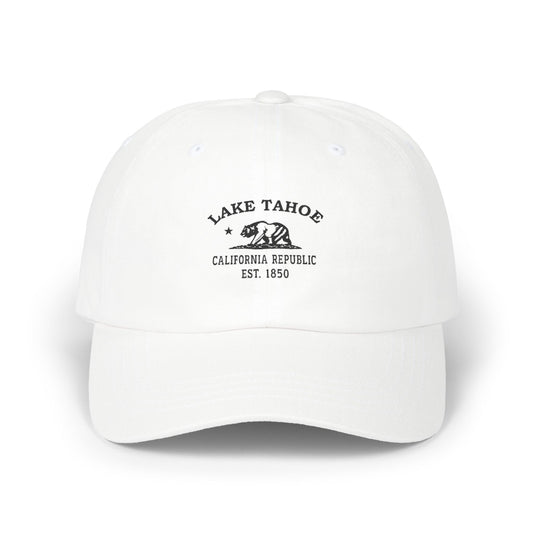
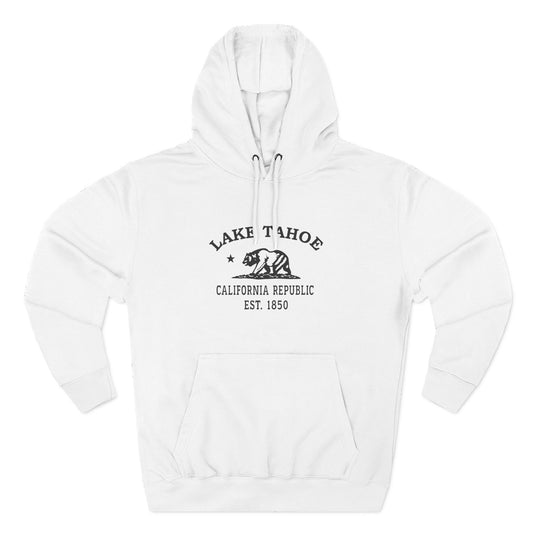
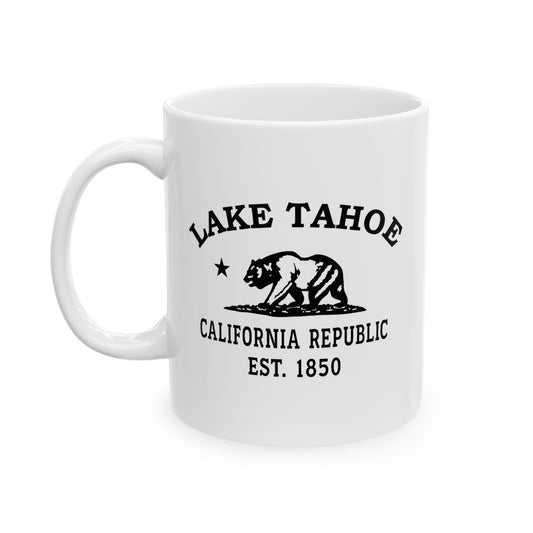
Our Lake Tahoe logo carries the same emblem every Merlin Classics California place wears — the grizzly bear and lone star of the state flag, above "California, Est. 1850," the year of statehood, rendered in hand-printed black and white with a worn, vintage feel. The bear is California's mark, the through-line that ties Tahoe to every other California place we make. What makes this one Tahoe is everything around it: the cobalt depth, the granite shore, the castle on Emerald Bay. On a tee or a cap it reads less like a souvenir and more like a small piece of the High Sierra — Est. 1850, worn plain.
Today Lake Tahoe is one of the West's great year-round destinations — winter ski and summer water, ringed by Sierra peaks. Its story blends ten thousand years of Washoe presence, a frontier of logging and steamers, a castle on Emerald Bay, an Olympic ski era, and a modern fight to keep the water blue. Our Tahoe designs gather that identity into wearable form — Big Blue, Emerald Bay, the Sierra shore. Explore the collection and carry a little of Big Blue with you.

Lake Tahoe California — Travel Guide
Visiting Lake Tahoe California Today
Lake Tahoe straddles the California-Nevada line in the Sierra Nevada; the California shore runs from South Lake Tahoe up the west side past Emerald Bay toward Tahoe City. It is a true four-season destination — winter for the ski resorts and the snow that lasts into May, summer for the cobalt water, the beaches, and Emerald Bay. Drive times from Sacramento, Reno, and the Bay Area are short enough for a weekend. (Yes, the lake is in both states; Emerald Bay and Vikingsholm are on the California side.)
Emerald Bay, Vikingsholm & the Big Blue Shore
For visitors searching for things to do at Lake Tahoe, California:
- Overlook Emerald Bay and hike down to Vikingsholm, the 1929 Scandinavian castle, with Fannette Island and its tea house out in the cove.
- Climb to Eagle Falls above the bay for the classic Big Blue panorama.
- Swim or paddle the clear granite-bottomed coves; Sand Harbor on the east shore is famous for its boulders.
- Tour the Tallac Historic Site estates from Tahoe's early resort era near South Lake Tahoe.
- Visit the Gatekeeper's Museum in Tahoe City for the lake's early history and Washoe heritage.
- Ski the Sierra in winter and hike or boat the shore in summer — Tahoe is a genuine year-round lake.
Why People Visit Lake Tahoe California
Lake Tahoe draws people who love mountains and water in the same view. It is Big Blue — the highest, deepest, clearest alpine lake in the West — with a National Natural Landmark bay, a Scandinavian castle, a ten-thousand-year Washoe heritage, and ski slopes and beaches a few hours from the city. Visitors come for the rare combination: cobalt water you can see straight down into, granite peaks above it, and a shore that's beautiful in snow and sun alike.
Wear the History

For deeper reading on the Lake Tahoe, California history described here — the more than ten thousand years of Washoe (Wasiw) presence at Daaw, the 1844 Fremont expedition, the Comstock-era logging of the basin, Mark Twain's early-1860s sojourn recorded in Roughing It, the 1929 building of Vikingsholm at Emerald Bay, the 1960 Winter Olympics at Olympic Valley (Palisades Tahoe), and the modern "Keep Tahoe Blue" clarity-conservation effort — it may be useful to consult (1) the Washoe Tribe of Nevada and California cultural resources office, (2) the North Lake Tahoe Historical Society and the Gatekeeper's Museum in Tahoe City, (3) California State Parks for Emerald Bay, Vikingsholm, and Sugar Pine Point, (4) the UC Davis Tahoe Environmental Research Center, and (5) the League to Save Lake Tahoe ("Keep Tahoe Blue"). For travel and visitor information, it may be useful to contact (1) the Lake Tahoe Visitors Authority, (2) the North Lake Tahoe and Go Tahoe North visitor bureaus, (3) California State Parks for Emerald Bay and the Tallac Historic Site, (4) the U.S. Forest Service Lake Tahoe Basin Management Unit, and (5) the California Office of Tourism.
Shop the Lake Tahoe California collection
View full collection-
Lake Tahoe California Vintage Retro Premium Crewneck Sweatshirt - Black Logo
Regular price $48.00 USDRegular price -
Lake Tahoe California Vintage Retro Premium Crewneck Sweatshirt - White Logo
Regular price $48.00 USDRegular price -
Lake Tahoe California Vintage Retro Vinyl Sticker - Black Logo
Regular price From $6.00 USDRegular price -
Shoreline Trio II - Silhouette Art Giclée Unframed Art Print
Regular price From $34.00 USDRegular price -
Kiss for the Hound - Silhouette Art Framed Art Print
Regular price From $96.00 USDRegular price -
Lake Tahoe California Vintage Retro Womens Fitted Ringspun Cotton Tee - Black Logo
Regular price $28.00 USDRegular price -
Lake Tahoe California Vintage Retro Unisex Heavy Cotton Hoodie - White Logo
Regular price $56.00 USDRegular price -
Horse at Low Tide - Silhouette Art Giclée Unframed Art Print
Regular price From $34.00 USDRegular price -
Between Horse and Hound - Silhouette Art Framed Art Print
Regular price From $96.00 USDRegular price -
Lake Tahoe California Vintage Retro Cotton Jersey Baby Bodysuit - Black Logo
Regular price $26.00 USDRegular price -
Lake Tahoe California Vintage Retro Embroidered Cotton Cap - Black Logo
Regular price $32.00 USDRegular price -
Mare and Foal - Silhouette Art Giclée Unframed Art Print
Regular price From $34.00 USDRegular price -
Companion in Still Water - Silhouette Art Framed Art Print
Regular price From $96.00 USDRegular price -
Lake Tahoe California Vintage Retro Unisex Heavy Cotton Hoodie - Black Logo
Regular price $56.00 USDRegular price -
Between Horse and Hound - Silhouette Art Giclée Unframed Art Print
Regular price From $34.00 USDRegular price -
Boy and Hound - Silhouette Art Framed Art Print
Regular price From $96.00 USDRegular price -
Lake Tahoe California Vintage Retro Ceramic Mug - Black Logo
Regular price From $16.00 USDRegular price -
Lake Tahoe California Vintage Retro Thank You Card Set - Black Logo
Regular price From $25.00 USDRegular price -
Kiss at Still Water - Silhouette Art Giclée Unframed Art Print
Regular price From $34.00 USDRegular price -
Kiss at Still Water - Silhouette Art Framed Art Print
Regular price From $96.00 USDRegular price -
Lake Tahoe California Vintage Retro Unisex Heavy Cotton Tee - White Logo
Regular price $22.00 USDRegular price -
Lake Tahoe California Vintage Retro Unisex Heavy Cotton Tee - Black Logo
Regular price $22.00 USDRegular price -
Nuzzle in Shallow Water - Silhouette Art Giclée Unframed Art Print
Regular price From $34.00 USDRegular price