Houston Texas — Retro Vintage History
What’s with the Eighteen Minutes? On April 21, 1836, the entire Texas Revolution came down to eighteen minutes. General Sam Houston’s Texian army — charging to cries of “Remember the Alamo!” — caught Santa Anna’s force at siesta on the plain of San Jacinto and routed it completely. Texas was free. Fought on the bayou prairie twenty-two miles east of today’s downtown, the battle created a republic in less time than a coffee break — and it gave the city that rose beside the battleground its name, its founding year, and its permanent taste for moving fast.
Wear the HistoryWhere you’re from. Where you love. Where you explored. Where you belong.
Houston was founded on August 30, 1836, four months after San Jacinto, when two real-estate-speculator brothers from upstate New York — Augustus Chapman Allen and John Kirby Allen — bought 6,642 acres along Buffalo Bayou, laid out a town grid, and named it for the general. Incorporated on June 5, 1837, Houston served as the capital of the Republic of Texas until President Mirabeau Lamar moved the government inland to Austin in 1839, and the Allen brothers’ bayou-side bet was on its own. Cotton came first, then railroads — early Houstonians liked to say the city sat “where seventeen railroads meet the sea,” an aspiration more than a fact, but the direction was right. The Karankawa and Atakapa peoples had lived along these bayous and the Gulf Coast for centuries before European contact; their descendants remain.
QUICK FACTS — HOUSTON, TX
The Battle of San Jacinto on April 21, 1836 lasted eighteen minutes and won Texas its independence.
Houston was founded on August 30, 1836, by Augustus Chapman Allen and John Kirby Allen, and named for General Sam Houston.
Houston served as the first capital of the Republic of Texas from 1837 to 1839.
Houston, incorporated June 5, 1837, remains the only major American city with no formal zoning code.
The Houston Ship Channel, opened November 10, 1914, was dredged fifty miles inland to make Houston a deep-water port.
Houston has been called Space City since September 1961, when the Manned Spacecraft Center made it home to Mission Control.
In the 1950s and 1960s Houston boomed on oil money, new freeways, and the space program, roughly doubling in population.
The first word spoken from the surface of the Moon, on July 20, 1969, was “Houston.”
The oil era arrived on January 10, 1901, when the Lucas No. 1 gusher at Spindletop blew in near Beaumont with a roar audible miles away. Within a year East Texas had more active wells than any field on earth, and Houston — the nearest city with a railroad, a port, and lawyers — became the place where oil got refined, financed, and shipped. The Houston Ship Channel, completed in November 1914 after decades of dredging fifty miles from downtown to the Gulf of Mexico, turned a slow inland bayou into one of the busiest deep-water ports in the world. Roughnecks and wildcatters, refineries and pipelines: the energy capital of the world had found its anchor. By the mid-century Houston was booming — suburban neighborhoods spreading outward, freeways threading in every direction, and the Texas Medical Center taking shape as what would become the largest medical complex on earth.

In September 1961 the federal government sited the new Manned Spacecraft Center twenty-five miles southeast of downtown Houston. From that moment, every American crewed mission to space was directed from Mission Control in Houston. On April 13, 1970, when the Apollo 13 oxygen tank ruptured 200,000 miles out, the call back to earth was “Houston, we’ve had a problem here.” The Apollo 11 lunar landing on July 20, 1969 had been acknowledged from the same building: “Roger, Tranquility, we copy you on the ground.” The first word spoken from the surface of the moon was Houston. That identity — Space City, Mission Control — is the one Houston carries globally above all others.
The Astrodome opened on April 9, 1965, as the first fully enclosed, air-conditioned multi-purpose stadium ever built. Engineers could not keep natural grass alive without sunlight, so they replaced the grass with an artificial playing surface — the first of its kind in major sports. The Astrodome sat 54,000, hosted rodeo, baseball, and football, and was promptly nicknamed the Eighth Wonder of the World — a phrase Houstonians apply with some pride and no shortage of irony. Houston has no zoning code, making it the only major American city where a refinery can sit next to a townhouse by right. That absence of zoning produced the sprawling, layered, improvised city that Houston is: some 670 square miles, the fourth-largest city in the United States, a port handling more foreign tonnage than any other in the country.
The food culture is its own argument. Kolache bakeries — a Czech-Texan tradition brought by Central European settlers in the 1800s — anchor strip-mall breakfasts across the metro. Vietnamese-Cajun crawfish, born on the southwest side in the 1980s when Vietnamese immigrants combined Gulf Coast seafood traditions with Cajun spices, became a Houston original. Tex-mex, breakfast tacos, queso: the Gulf Coast table is its own cuisine. The city’s international diversity — the most diverse large city in America by several measures — drives a food scene that can hold Viet-Cajun crawfish and Texas BBQ brisket and klobasnek pastries in the same zip code without anyone finding it unusual.
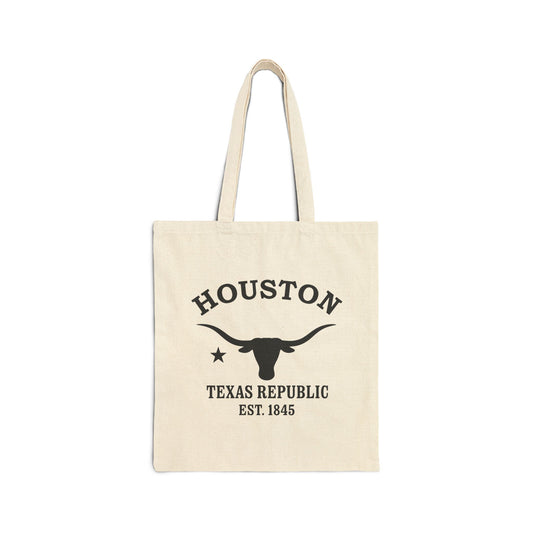
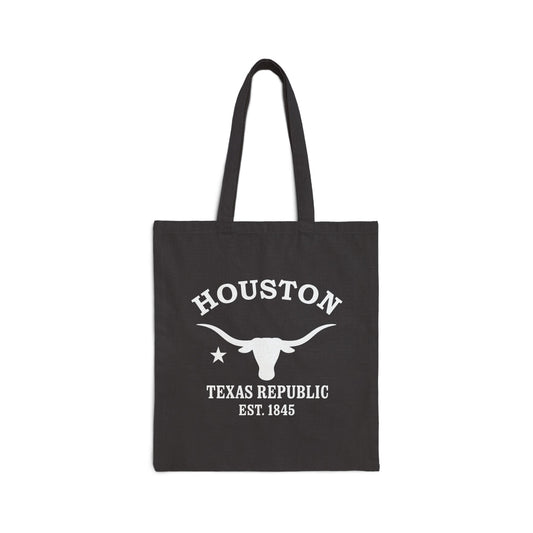
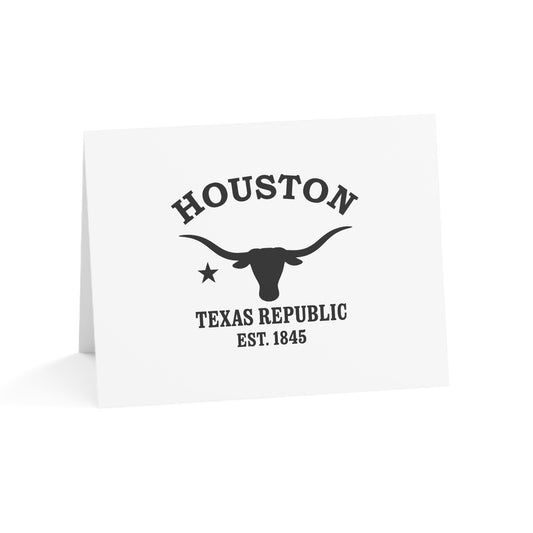
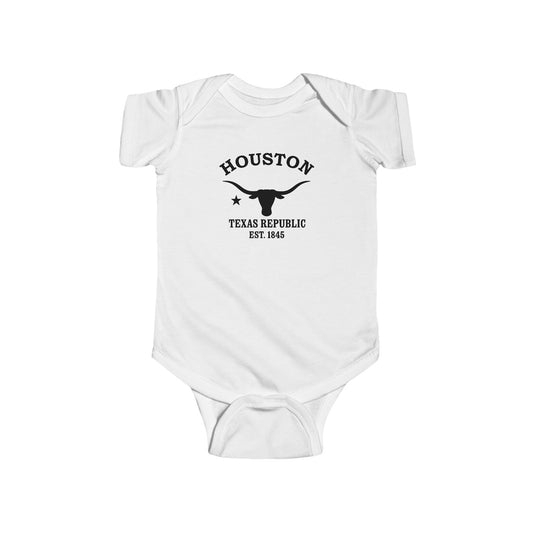
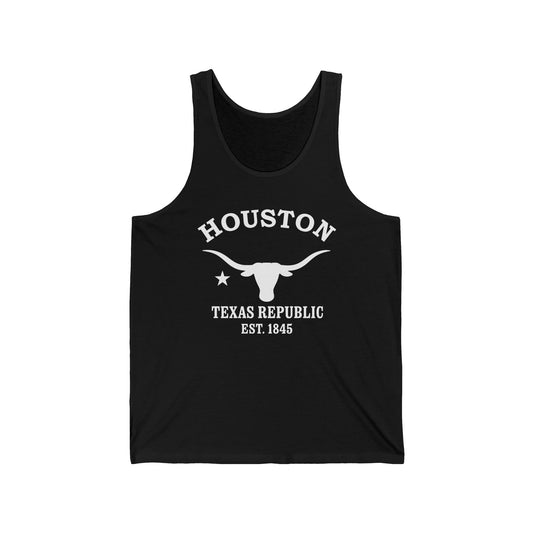
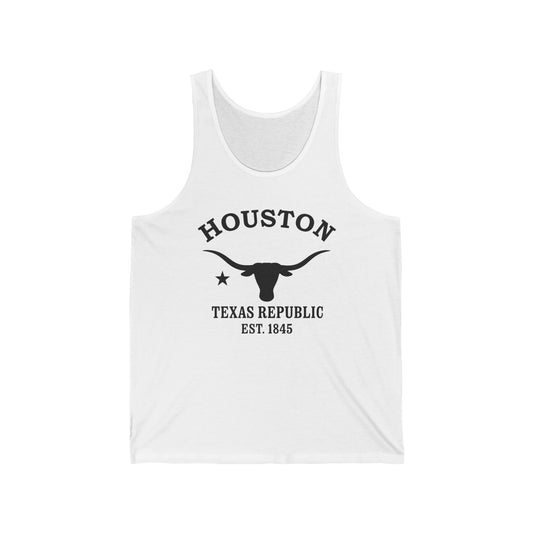
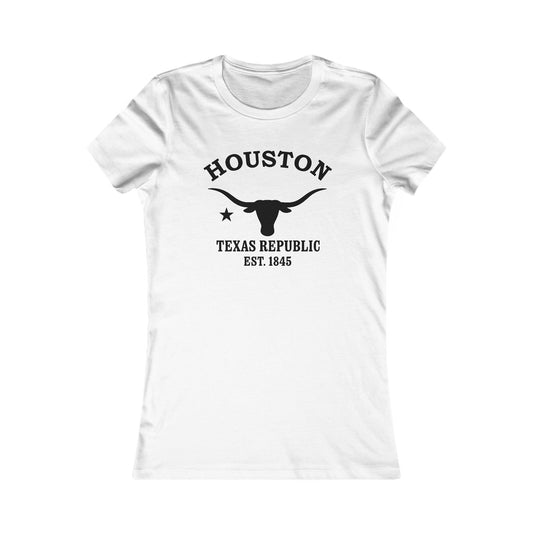
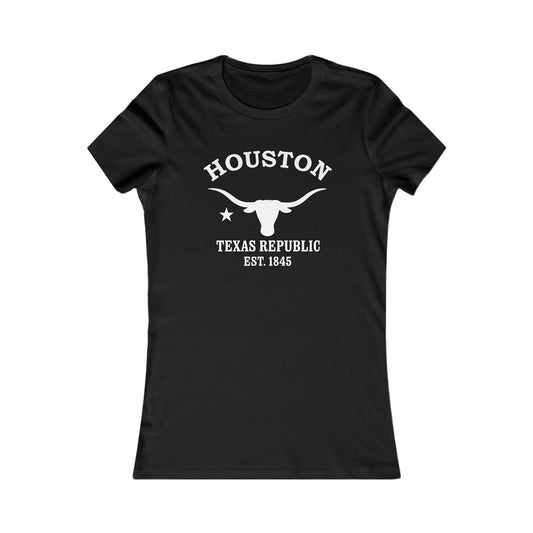
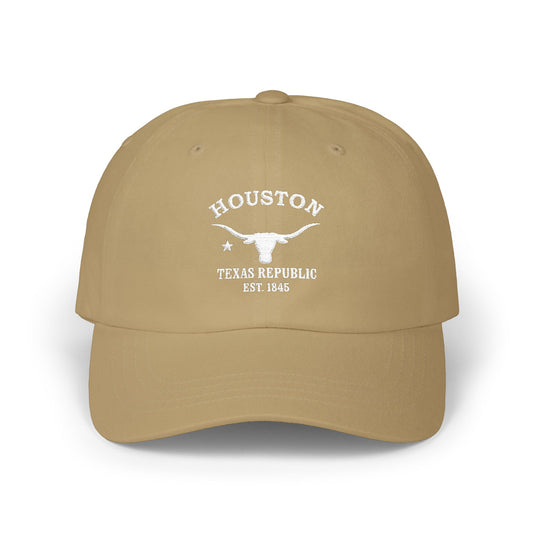
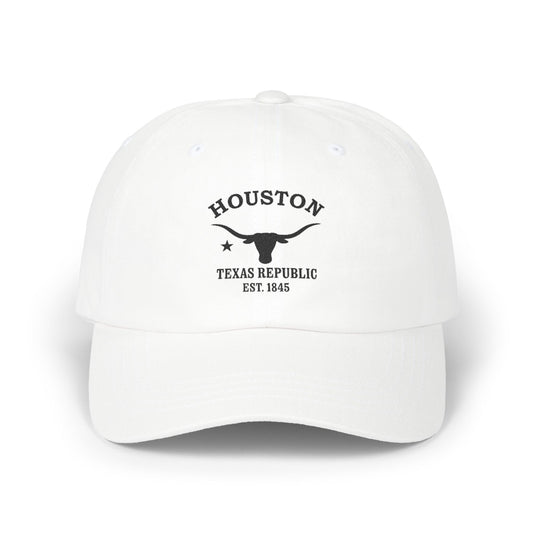
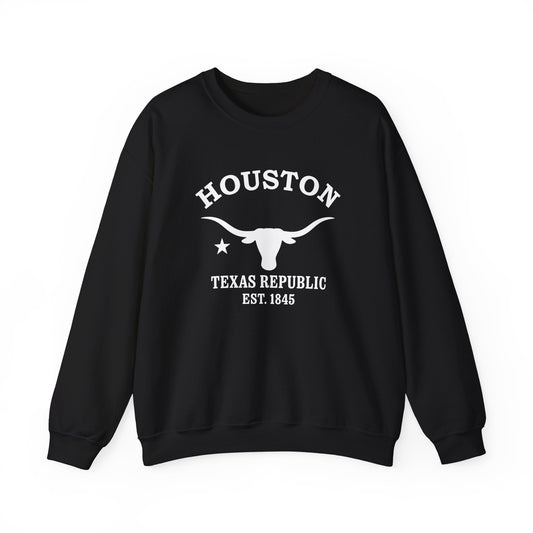
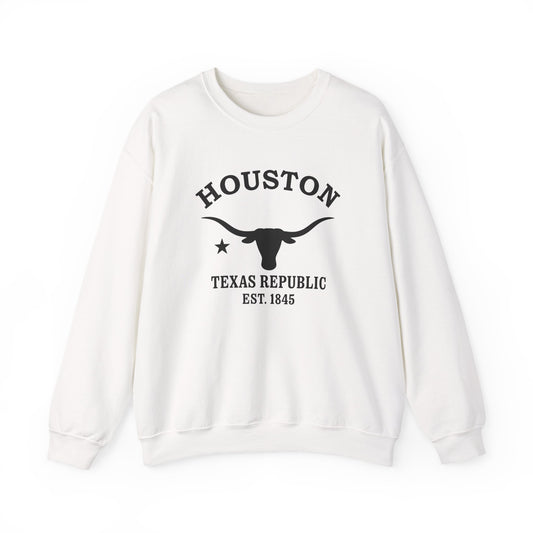
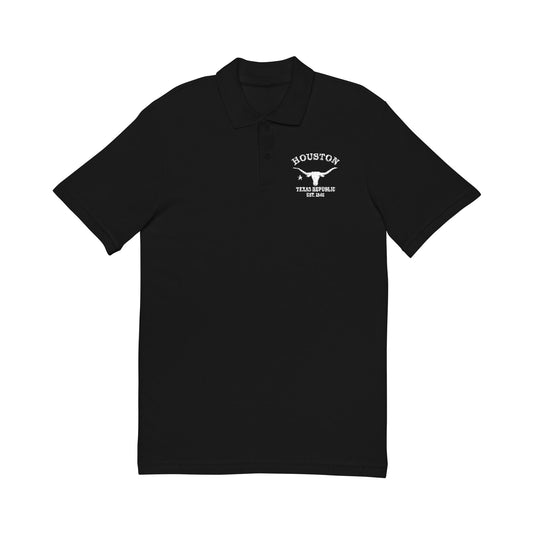
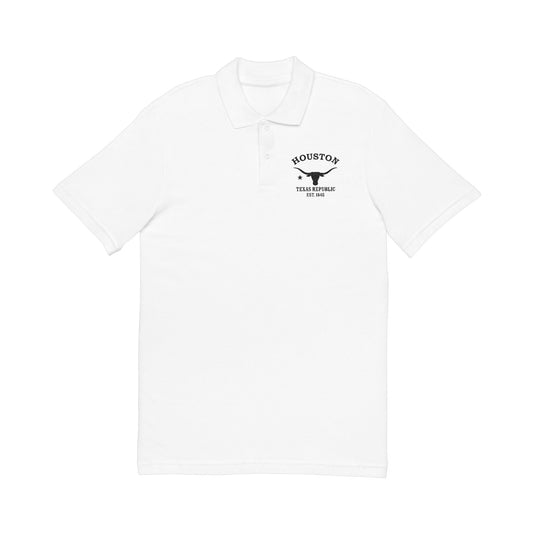
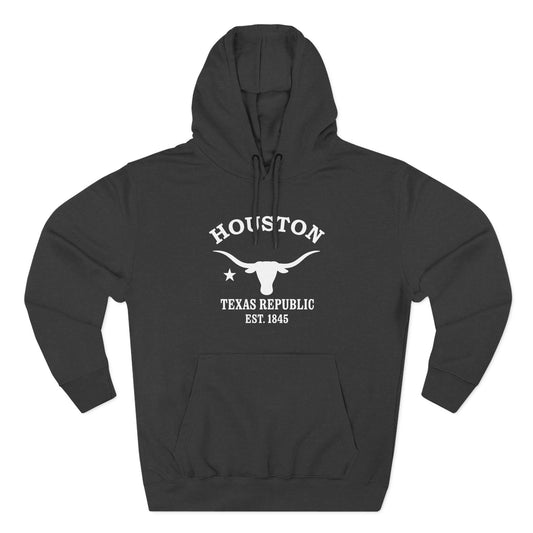
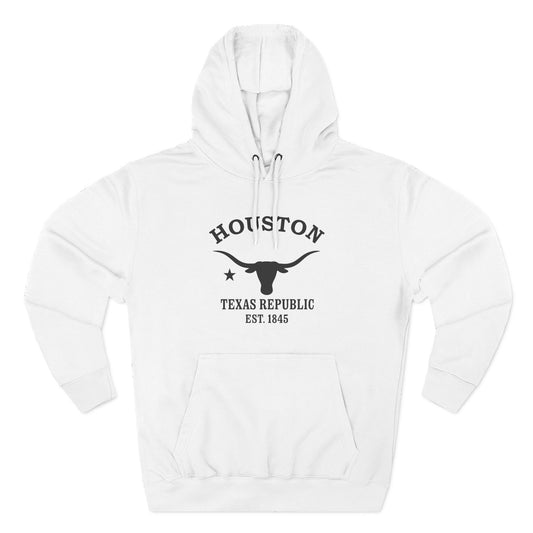
Our Houston retro logo uses the Texas longhorn motif over “Texas – Est. 1849,” emphasizing frontier grit and the cattle-and-cotton commerce that built the state. Black-and-white styling mirrors stockyard brands and railroad signage — rugged, timeless, retro in style — bridging Houston’s layered heritage: bayou trading post, Republic capital, oil port, Space City. On merchandise it reads authentic and vintage — an emblem of Texas Gulf Coast pride.
So Houston gathers an eighteen-minute battle, a bayou land deal, the gusher age, a fifty-mile ship channel, Mission Control, and the most diverse table in Texas into one sprawling Gulf Coast city — and our Houston designs gather that into wearable form. Whether Houston is your hometown, your launchpad, the skyline you grew up under, or the city you still mean to see, wear the history. Space City since 1961, on Buffalo Bayou since 1836.

Houston Texas — Travel Guide
Visiting Houston Texas Today
Houston is the fourth-largest city in the United States, some 670 square miles spread along the Texas Gulf Coast between Buffalo Bayou and Galveston Bay. The city has no zoning code — uniquely among major American cities — and is the headquarters of the American oil and energy industry, the world’s largest medical complex, and the Manned Spacecraft Center that made Houston synonymous with Mission Control. Hurricane season runs June through November; spring and fall are the most temperate travel windows.
Space, Bayous, and Texas Heritage in Houston
For visitors looking for things to do in Houston Texas:
- Tour Space Center Houston, with spacecraft, mission artifacts from the Apollo and Shuttle programs, and the historic Mission Control room.
- Walk Buffalo Bayou Park, the green corridor along the bayou with skyline overlooks, kayak access, and bridges from downtown to the Heights.
- Visit the San Jacinto Battleground State Historic Site twenty-two miles east of downtown — the 567-foot San Jacinto Monument is taller than the Washington Monument, and the battleground where Texas independence was won in eighteen minutes is open daily.
- Tour the Museum of Fine Arts Houston, with broad collections in the museum district.
- Visit the Houston Museum of Natural Science in Hermann Park, with dinosaurs, gems, and a planetarium.
- Walk through Sam Houston Park, preserving the city’s oldest surviving buildings on the original 1836 townsite.
- Relax at Discovery Green, the downtown park with lawns, public art, and water features.
- Visit the Menil Collection and the Rothko Chapel.
- Explore the Heights, the historic Victorian and Craftsman neighborhood northwest of downtown.
- Attend the Houston Livestock Show and Rodeo in February–March — the largest in the world, drawing more than 2.5 million attendees annually since 1932.
Why People Visit Houston Texas
Houston offers space heritage, Texas Revolution history, world-class museums, bayou parks, and one of the most diverse food scenes in the country. Visitors come for Mission Control and the San Jacinto battleground, the museum district and the bayou trails, the rodeo in March, and the simple scale of a city that runs from downtown skyline to ship channel to Gulf Coast. It is sprawling, layered, and unlike anywhere else in America.
Wear the History
Where you’re from. Where you love. Where you explored. Where you belong.
Kindred Cities
Welcome, friends from Chiba, Japan (ようこそ) and Ulsan, South Korea (환영합니다), and from Houston's other sister cities across Scotland, France, Germany, Spain and Mexico.
Houston twins by industry as much as friendship. Chiba, its sister since 1972, is a great Japanese port that mirrors Houston's own — petrochemicals, shipping, baseball and all. Aberdeen rhymes even more neatly: Scotland's North Sea oil capital, paired with the energy capital of the world. Ulsan in Korea adds shipyards and refineries, and the European and Mexican ties fill out a map drawn in oil, gas and trade.
Chiba and Houston, two of the world's busy port cities, have been sisters since 1972; their Youth Ambassador exchange has sent students across the Pacific every year since 1982. Aberdeen joined in 1979, oil capital to oil capital.
Come from Chiba or Ulsan and Houston will feel like familiar ground: a working port, an energy economy that speaks your industry's language, and one of America's most international tables waiting at dinner. Come and visit us soon.
When you plan the trip, Visit Houston — the city's official tourism bureau — is the place to start.
Wear the History
Where you’re from. Where you love. Where you explored. Where you belong.

For deeper reading on Houston, Texas history — the 1836 Battle of San Jacinto and Texas Revolution, the Allen Brothers’ founding of Houston, the Republic of Texas capital era 1837–1839, the 1914 opening of the Houston Ship Channel, the 1901 Spindletop strike and the Texas oil era, the Karankawa and Atakapa peoples of the upper Gulf Coast, and the 1961 establishment of the Manned Spacecraft Center that made Houston synonymous with Mission Control — it may be useful to consult the Texas State Historical Association (Handbook of Texas Online), the San Jacinto Museum of History, the Houston Metropolitan Research Center at the Houston Public Library, and the Texas State Library and Archives Commission. For travel and visitor information: Visit Houston (the city’s convention and visitors bureau), the Texas Historical Commission, and the National Park Service for the broader Texas national park system.
Shop the Houston Texas collection
View full collection-
Houston Texas Vintage Retro Vinyl Sticker - Black Logo
Regular price From $6.00 USDRegular price -
Houston Texas Vintage Retro Ceramic Mug - Black Logo
Regular price From $16.00 USDRegular price -
Houston Texas Vintage Retro Unisex Heavy Cotton Tee - White Logo
Regular price $22.00 USDRegular price -
Houston Texas Vintage Retro Unisex Heavy Cotton Tee - Black Logo
Regular price $22.00 USDRegular price -
Houston Texas Vintage Retro Cotton Canvas Tote Bag - Black Logo
Regular price $25.00 USDRegular price -
Houston Texas Vintage Retro Cotton Canvas Tote Bag - White Logo
Regular price $25.00 USDRegular price -
Houston Texas Vintage Retro Thank You Card Set - Black Logo
Regular price From $25.00 USDRegular price -
Houston Texas Vintage Retro Cotton Jersey Baby Bodysuit - Black Logo
Regular price $26.00 USDRegular price -
Houston Texas Vintage Retro Unisex Cotton Jersey Tank Top - White Logo
Regular price $28.00 USDRegular price -
Houston Texas Vintage Retro Unisex Cotton Jersey Tank Top - Black Logo
Regular price $28.00 USDRegular price -
Houston Texas Vintage Retro Womens Fitted Ringspun Cotton Tee - Black Logo
Regular price $28.00 USDRegular price -
-
Houston Texas Vintage Retro Embroidered Cotton Cap - White Logo
Regular price $32.00 USDRegular price -
Houston Texas Vintage Retro Embroidered Cotton Cap - Black Logo
Regular price $32.00 USDRegular price -
Houston Texas Vintage Retro Back Printed Art Series Cotton Tee - Black Logo
Regular price $32.00 USDRegular price -
Houston Texas Vintage Retro Giclée Print Art Series Poster
Regular price From $38.00 USDRegular price -
Houston Texas Vintage Retro Unisex Heavy Crewneck Sweatshirt - White Logo
Regular price $44.00 USDRegular price -
Houston Texas Vintage Retro Unisex Heavy Crewneck Sweatshirt - Black Logo
Regular price $44.00 USDRegular price -
Houston Texas Vintage Retro Unisex Embroidered Cotton Polo - Black Logo
Regular price $48.00 USDRegular price -
Houston Texas Vintage Retro Premium Crewneck Sweatshirt - Black Logo
Regular price $48.00 USDRegular price -
Houston Texas Vintage Retro Premium Crewneck Sweatshirt - White Logo
Regular price $48.00 USDRegular price -
Houston Texas Vintage Retro Unisex Heavy Cotton Hoodie - White Logo
Regular price $56.00 USDRegular price -
Houston Texas Vintage Retro Unisex Heavy Cotton Hoodie - Black Logo
Regular price $56.00 USDRegular price