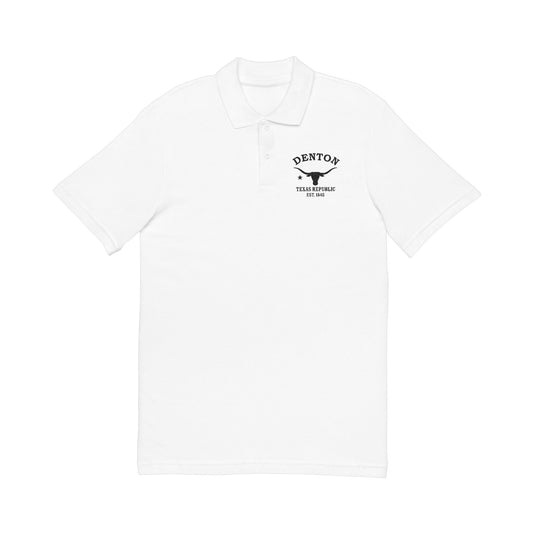
Denton Texas — Retro Vintage History
What's with the music? Denton is a small North Texas city that punches absurdly above its weight in music — the place people call “Little Austin” or “the Austin of the North.” The reason starts at the University of North Texas, whose College of Music opened the nation's first jazz degree program in 1947 and has been turning out world-class players ever since. Add a second university, a courthouse square ringed with clubs and record shops, and a festival the whole town turns out for, and you get a music town that wears its sound on its sleeve.
Wear the HistoryDenton sits at the northern apex of the Dallas–Fort Worth metroplex, where Interstate 35 splits to run toward the two big cities. Denton County was carved out in 1846 and named for John B. Denton, a frontier preacher and lawyer killed on the prairie in 1841; in 1857 the new county seat took the same name and was laid out around a central square. For its first decades Denton was a North Texas farm-and-trade town — a county seat on the blackland prairie — until the railroad arrived in the 1880s and the colleges came in the 1890s and changed everything.
What changed it were the schools. In 1890 the Texas Normal College — today the University of North Texas, one of the largest universities in the state — opened its doors, and in 1901 the Girls' Industrial College, now Texas Woman's University, followed. Two universities in a town this size set the tempo: tens of thousands of students, a year-round calendar of concerts and games and festivals, and a downtown that has been a college town's downtown for well over a century. UNT's music school alone grew into one of the largest in the nation.

The heart of Denton is the Courthouse-on-the-Square, a grand Romanesque-Revival pile of pink granite and limestone finished in 1896, set squarely in the middle of a classic Texas town square. It is the picture on every postcard: the clock tower, the lawn, and the ring of two- and three-story brick storefronts around it, today full of restaurants, bars, record shops, and live-music rooms. The county long ago outgrew it and built a newer courthouse, but the old one stayed on as the Courthouse-on-the-Square Museum — and the square around it stayed the center of town, just as it was laid out in 1857.
The music that UNT seeded spilled off campus long ago. By the late 2000s Denton's scene had a national reputation — its own festival on and around the square, a dense club circuit, and a stream of bands that drew comparisons to Austin in its scruffier days; in 2008 Paste magazine named it the best music scene in the United States. The Denton Arts & Jazz Festival fills the park with hundreds of thousands of people each spring, and on an ordinary weekend you can hear a One O'Clock-caliber big band, an experimental act, and a singer-songwriter within a few blocks of the courthouse. For a town this size, the range is the whole point; more than two dozen venues sit within walking distance of the square.
Beyond the music, Denton keeps the feel of a college town that never quite turned into a suburb. The square is lined with record stores and used-book shops, vintage-clothing racks and coffeehouses, and the 1949 Campus Theatre still lights its marquee on the corner. Two universities empty the place out every summer and fill it back up every fall, so the whole town tilts toward the rhythm of semesters and festivals. It is a North Texas county seat that reads, on a good night, more like a small Austin than a Dallas suburb.
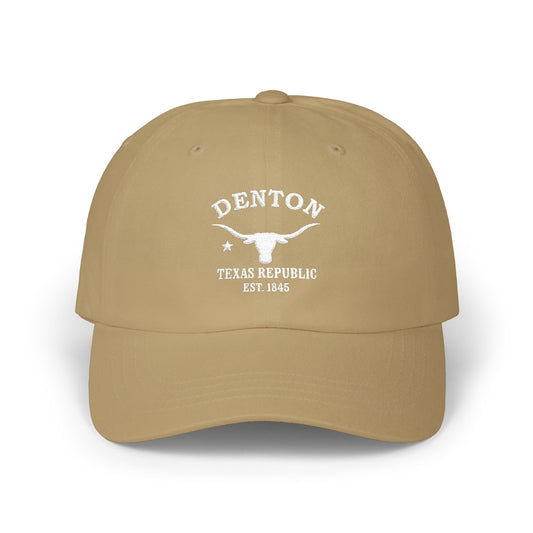
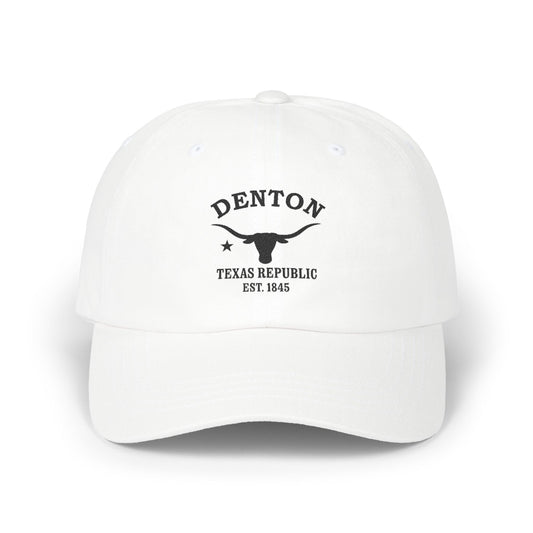
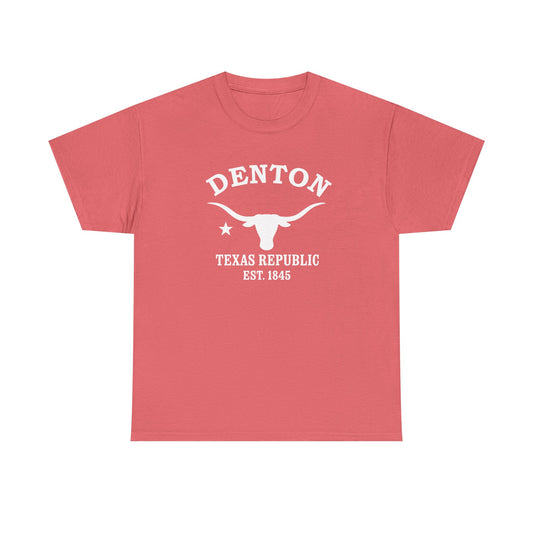
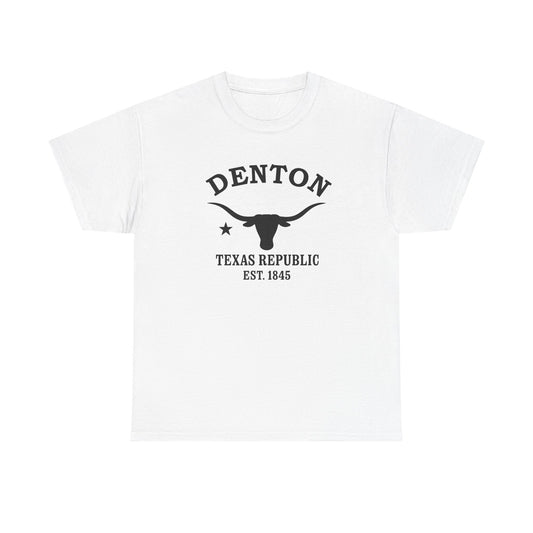
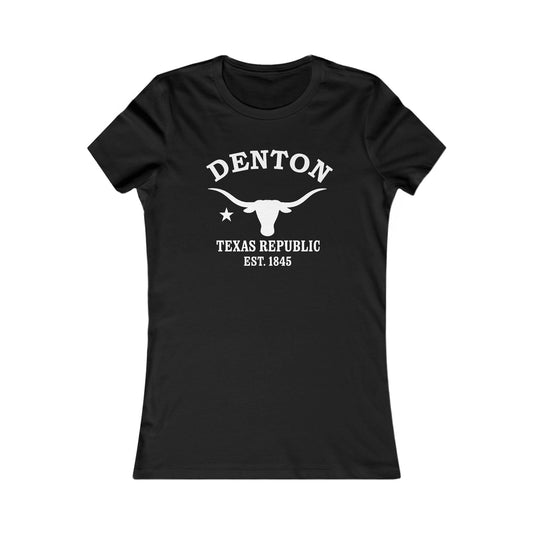
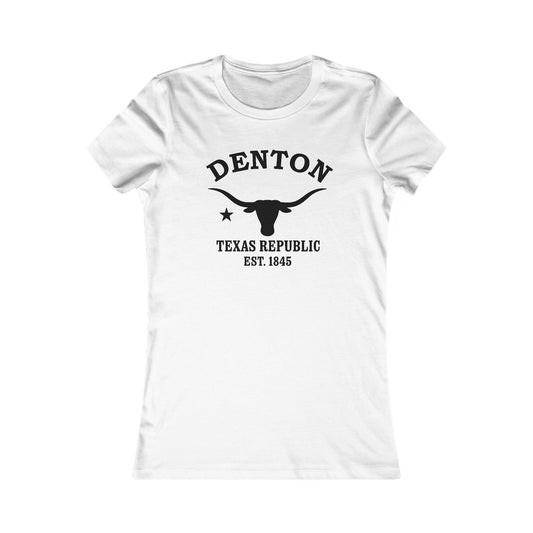
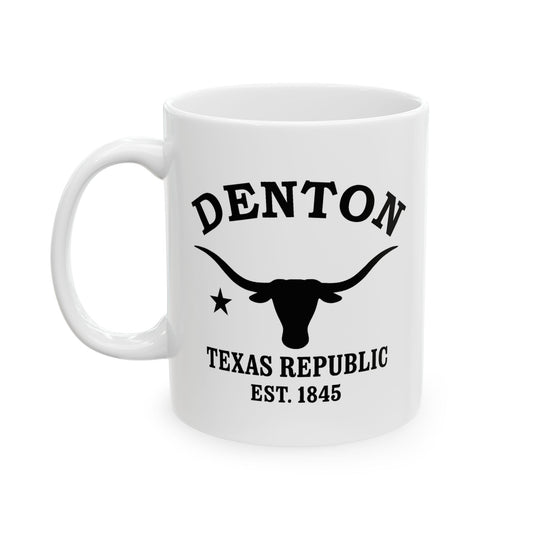
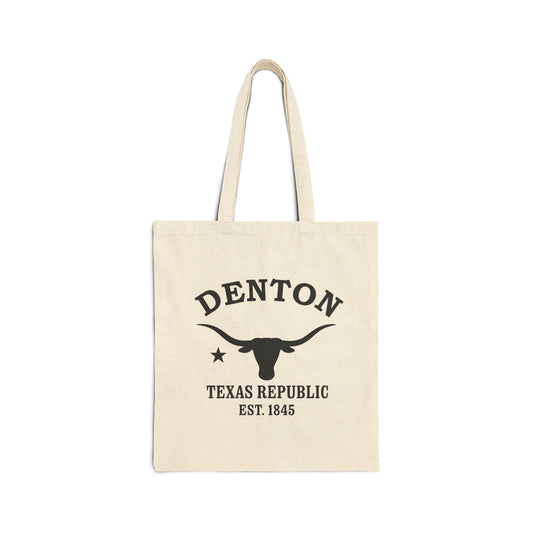
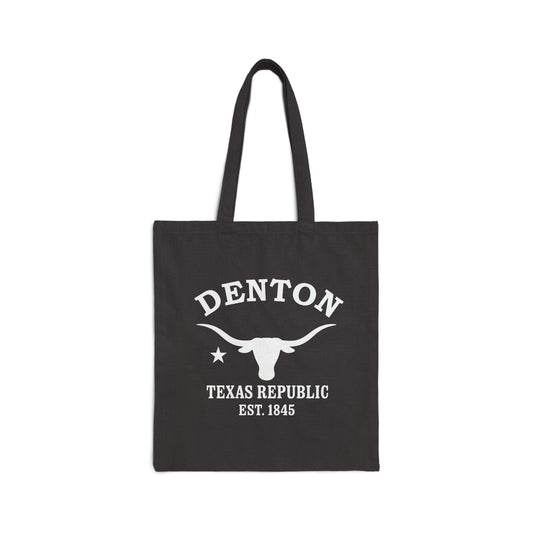
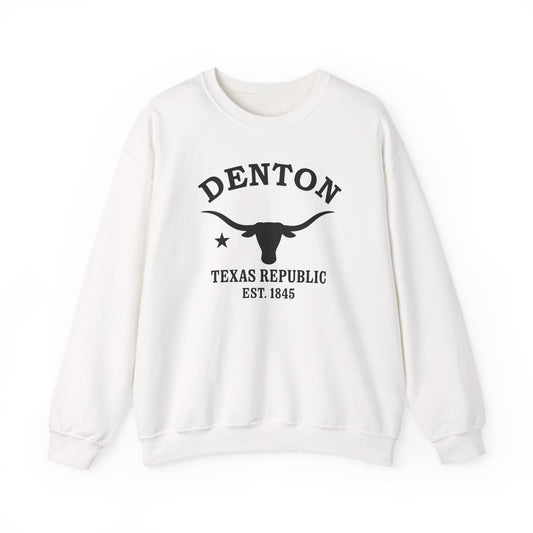
Our Denton logo carries the Texas longhorn and Lone Star over “Texas Republic · Est. 1845,” the year Texas joined the Union — the shared emblem of every Merlin Classics Texas place. Printed in a distressed black-and-white that reads like an old brand iron or a rodeo poster, the longhorn is Texas in shorthand: ranch country, independence, the Lone Star. What makes this one Denton is the town behind it — the courthouse square, the two universities, and the music that turned a North Texas county seat into “Little Austin.”
Today Denton is a college-and-music town that kept its courthouse square and its frontier name — the cultural capital of North Texas, equal parts students, musicians, and county-seat history. Our Denton designs gather that identity — the longhorn-and-star, the 1896 courthouse, the live-music square — into wearable form. Denton, Texas — Little Austin on the square, where the students set the tempo.

Denton, Texas — Travel Guide
Visiting Denton Today
Denton sits at the top of the DFW metroplex, an easy drive north of Dallas and Fort Worth — a college-and-music town built around a historic courthouse square, with live music most nights and two big universities setting the pace.
The Square, the Music & the Campuses
For visitors looking for things to do in Denton, Texas:
- Circle the Courthouse-on-the-Square and step into the Courthouse-on-the-Square Museum at its center.
- Browse the square's record stores, bookshops, and vintage racks, then catch a band at one of the downtown rooms.
- Time a visit for the Denton Arts & Jazz Festival, which fills the park with hundreds of thousands each spring.
- Catch a film or show at the 1949 Campus Theatre on the square.
- Wander the Fry Street district and the two university campuses.
- Walk the trails at the Clear Creek Natural Heritage Center on the edge of town.
Why People Visit Denton
Denton offers the energy of a music town and the ease of a small Texas city — a beautiful courthouse square, a deep live-music calendar, two universities, and a creative streak that earned it the nickname “Little Austin.” It's walkable, friendly, and unmistakably North Texas.
Wear the History
Kindred Cities
Welcome to visitors from Cambridge, England and Heidelberg, Germany (willkommen) — kindred university towns where the students set the tempo.
Cambridge and Heidelberg would recognise Denton's character at once — towns where the students set the tempo. Cambridge has centuries of spires and scholars; Heidelberg has Germany's oldest university and a romantic riverside old town; Denton has two universities of its own and a music scene loud enough to match. Bookstores, bands and the restless energy of a town that empties every summer.
Arrive from a city that lives by its semesters, and Denton will feel familiar: a courthouse square ringed with record shops and cafés, live music most nights, and a student crowd that keeps the place young. Come and visit us soon.
When you plan the trip, Discover Denton — the city's official tourism bureau — is the place to start.
Wear the History

For deeper reading on the Denton history described here — the frontier namesake John B. Denton and the 1857 founding of the county seat, the 1896 Courthouse-on-the-Square (now the Courthouse-on-the-Square Museum), the founding of the University of North Texas (1890) and Texas Woman's University (1901), and UNT's first-in-the-nation jazz degree (1947) and the music scene it seeded — it may be useful to consult (1) the Denton County Office of History and Culture and the Courthouse-on-the-Square Museum, (2) the Emily Fowler Central Library local-history collection, (3) the Texas State Library and Archives and the Texas Historical Commission, (4) the City of Denton clerk's records office, and (5) the Denton County Historical Commission. For travel and visitor information, it may be useful to contact (1) Discover Denton, the city's official tourism bureau, (2) the Denton Chamber of Commerce, (3) the City of Denton parks and recreation department, (4) the Texas state-parks office, and (5) regional transit and DFW-area visitor desks.
Shop the Denton Texas collection
View full collection-
Denton Texas Vintage Retro Premium Crewneck Sweatshirt - Black Logo
Regular price $48.00 USDRegular price -
Denton Texas Vintage Retro Premium Crewneck Sweatshirt - White Logo
Regular price $48.00 USDRegular price -
Denton Texas Vintage Retro Embroidered Cotton Cap - White Logo
Regular price $32.00 USDRegular price -
Denton Texas Vintage Retro Embroidered Cotton Cap - Black Logo
Regular price $32.00 USDRegular price -
Denton Texas Vintage Retro Unisex Heavy Cotton Tee - White Logo
Regular price $22.00 USDRegular price -
Denton Texas Vintage Retro Unisex Heavy Cotton Tee - Black Logo
Regular price $22.00 USDRegular price -
Denton Texas Vintage Retro Unisex Heavy Cotton Hoodie - White Logo
Regular price $56.00 USDRegular price -
Denton Texas Vintage Retro Unisex Heavy Cotton Hoodie - Black Logo
Regular price $56.00 USDRegular price -
Denton Texas Vintage Retro Unisex Embroidered Fleece Jacket - White Logo
Regular price $98.00 USDRegular price -
Denton Texas Vintage Retro Vinyl Sticker - Black Logo
Regular price From $6.00 USDRegular price -
-
Denton Texas Vintage Retro Womens Fitted Ringspun Cotton Tee - Black Logo
Regular price $28.00 USDRegular price -
Denton Texas Vintage Retro Back Printed Art Series Cotton Tee - Black Logo
Regular price $32.00 USDRegular price -
Denton Texas Vintage Retro Giclée Print Art Series Poster
Regular price From $38.00 USDRegular price -
Denton Texas Vintage Retro Ceramic Mug - Black Logo
Regular price From $16.00 USDRegular price -
Denton Texas Vintage Retro Cotton Canvas Tote Bag - Black Logo
Regular price $25.00 USDRegular price -
Denton Texas Vintage Retro Cotton Canvas Tote Bag - White Logo
Regular price $25.00 USDRegular price -
Denton Texas Vintage Retro Thank You Card Set - Black Logo
Regular price From $25.00 USDRegular price -
Denton Texas Vintage Retro Cotton Jersey Baby Bodysuit - Black Logo
Regular price $26.00 USDRegular price -
Denton Texas Vintage Retro Unisex Cotton Jersey Tank Top - Black Logo
Regular price $28.00 USDRegular price -
Denton Texas Vintage Retro Unisex Cotton Jersey Tank Top - White Logo
Regular price $28.00 USDRegular price -
Denton Texas Vintage Retro Unisex Heavy Crewneck Sweatshirt - Black Logo
Regular price $44.00 USDRegular price -
Denton Texas Vintage Retro Unisex Heavy Crewneck Sweatshirt - White Logo
Regular price $44.00 USDRegular price -
Denton Texas Vintage Retro Unisex Embroidered Cotton Polo - Black Logo
Regular price $48.00 USDRegular price