Dallas Texas — Retro Vintage History
What’s with the flying red Pegasus? Look up in downtown Dallas and you may catch a red horse with wings, glowing against the night. The flying red Pegasus has watched over the city since 1934, when an oil company raised a rotating neon “Flying Red Horse” atop the Magnolia Building — then the tallest tower west of the Mississippi — to welcome the oilmen of a national convention. It was visible for miles, bright enough that pilots are said to have steered by it, and it quickly became the thing Dallas loved most about itself. Nine decades on, taken down, rebuilt, and re-lit, the Pegasus still turns above the skyline — the unofficial mascot of Big D.
Wear the HistoryDallas almost shouldn’t be here. There was no harbor, no mountain pass, no obvious reason for a great city on this stretch of the Blackland Prairie — only a good place to cross the Trinity River. The Caddo had used that ford for generations when, in 1841, a Tennessee lawyer named John Neely Bryan built a trading post beside it and waited for a town to grow up around him. It did: Dallas became the county seat in 1846, took a town charter in 1856, and when the railroads crossed here in 1872 and 1873, the prairie outpost was suddenly a crossroads with somewhere to send its goods.
What followed was a boom the city more or less willed into being. Dallas made itself the largest inland cotton market in the country, then turned cotton money into banks, and banks into the financial capital of the East Texas oil fields — “Big D,” where the money was. Style came with the money: Neiman Marcus opened its doors in 1907 and gave the city a name for fashion and luxury it has never let go of. By the early twentieth century the prairie trading post had become one of the great commercial cities of the Southwest — glittering, ambitious, and a little theatrical about it.

The skyline tells that story. Reunion Tower — “the Ball,” a geodesic sphere on a slender stem, lit up at night — went up in 1978 and became an instant landmark. Out at Fair Park stands something rarer still: the largest collection of Art Deco exposition buildings in the world, raised for the 1936 Texas Centennial Exposition, all murals and statuary and grand promenades. Downtown, the Dallas Arts District grew into one of the biggest urban arts districts in the country, its concert halls and museums drawn by some of the most famous architects alive. Dallas has always liked to build big, and to be seen doing it.
Here is a small Dallas mystery: nobody is entirely sure who the city is named for. The usual answer is George Mifflin Dallas, the U.S. vice president of the 1840s, and it may well be him — but John Neely Bryan, who did the naming, never pinned it down, and historians have floated a half-dozen other Dallases over the years. The city has worn the uncertainty lightly. Long ago Dallasites shortened the whole question to two letters that settle nothing and say everything: Big D.
The land shaped the city as much as the people did. Dallas sits on the Trinity River — three forks of it — in gently rolling, near-treeless prairie, with no natural advantage but the crossing itself; everything else was made by rail and nerve. Early attempts to make the silty Trinity a navigable river failed, so Dallas bet on the railroads instead and won. White Rock Lake and the Great Trinity Forest give the city its green, and the wide prairie light gives the neon signs and glass towers room to show off. It is a city built on ambition rather than geography, and it has never pretended otherwise.
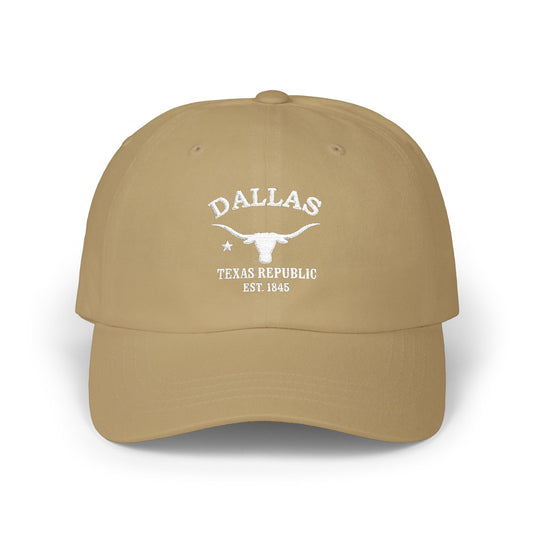
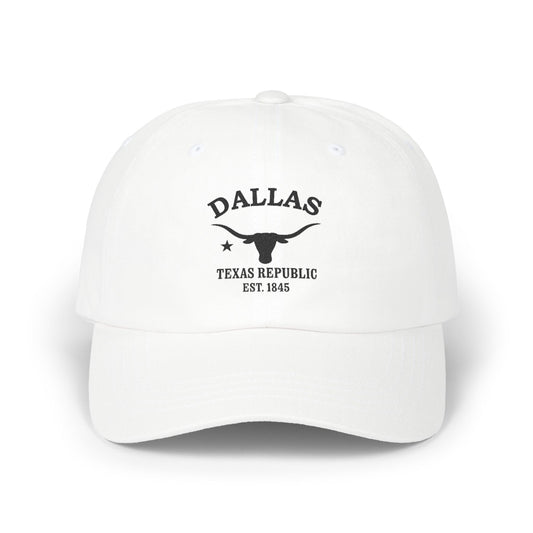
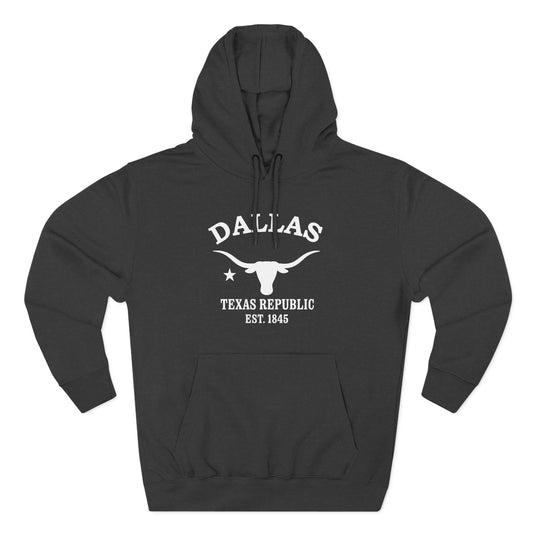
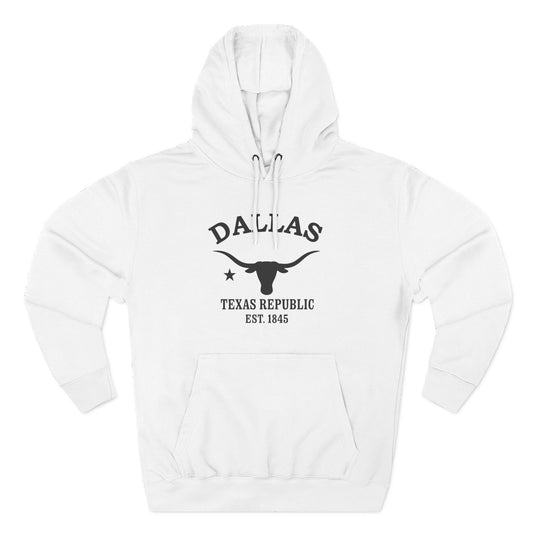
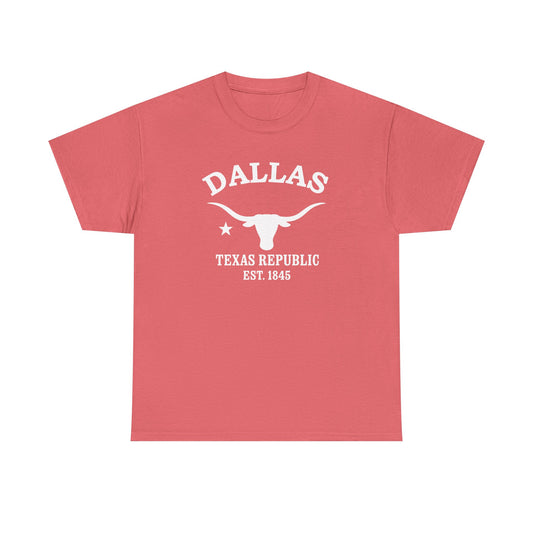
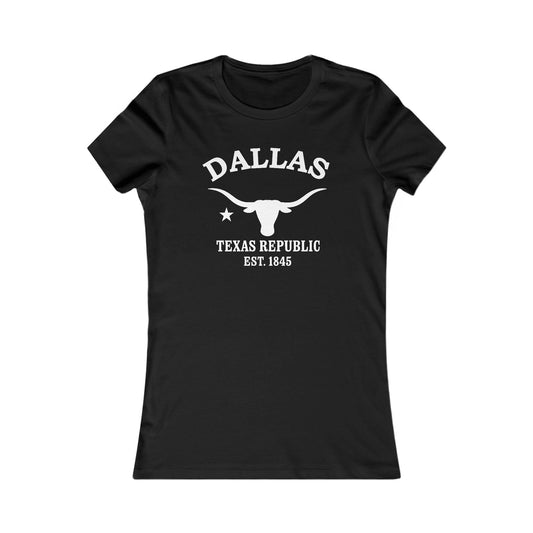
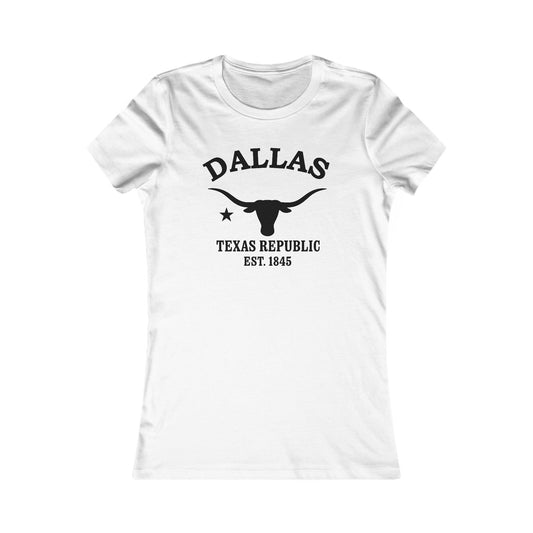
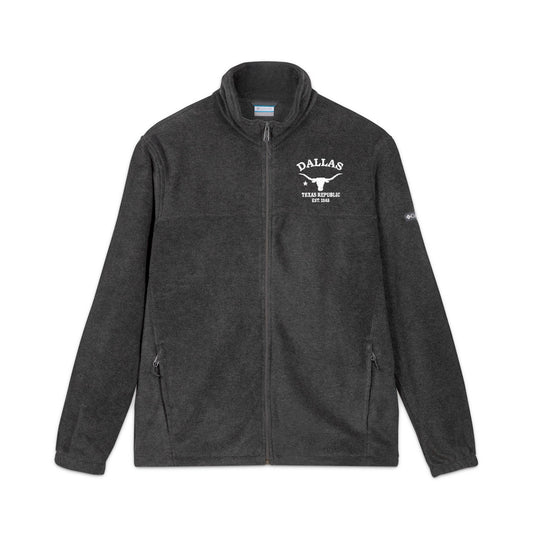
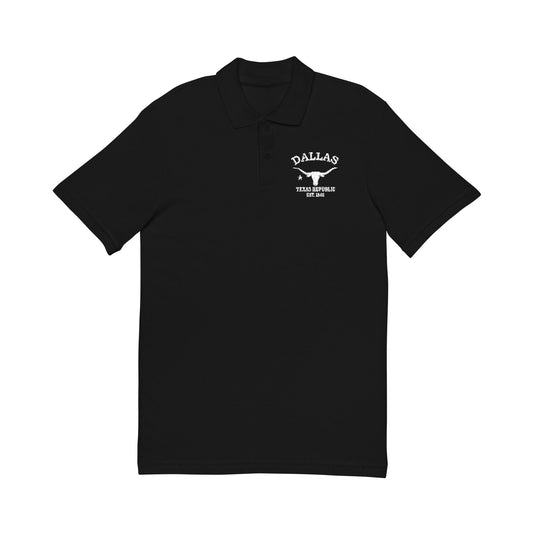
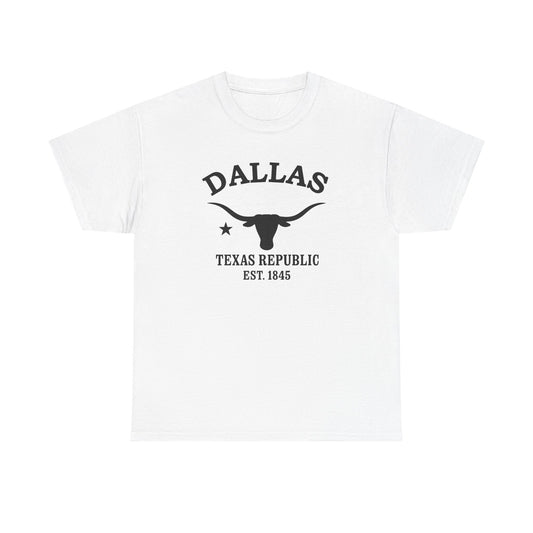
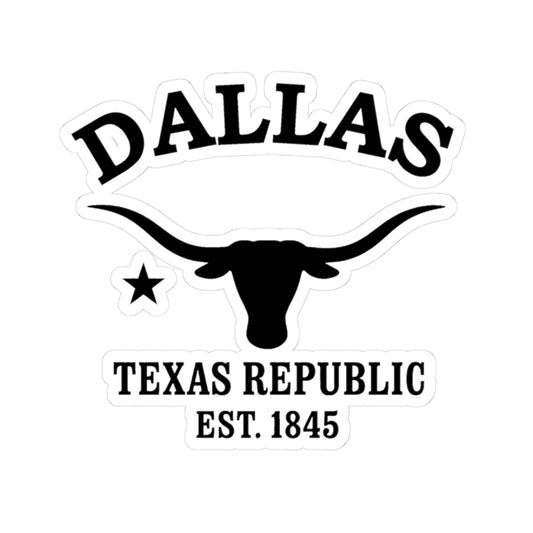
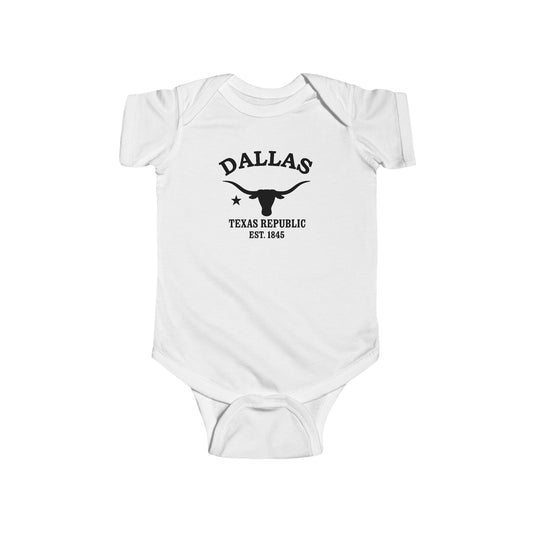
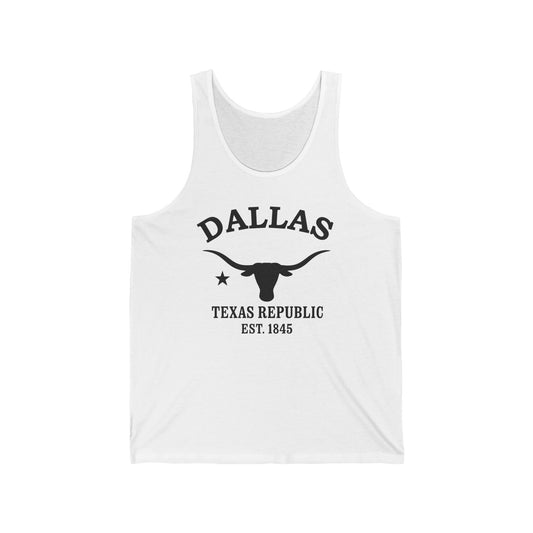
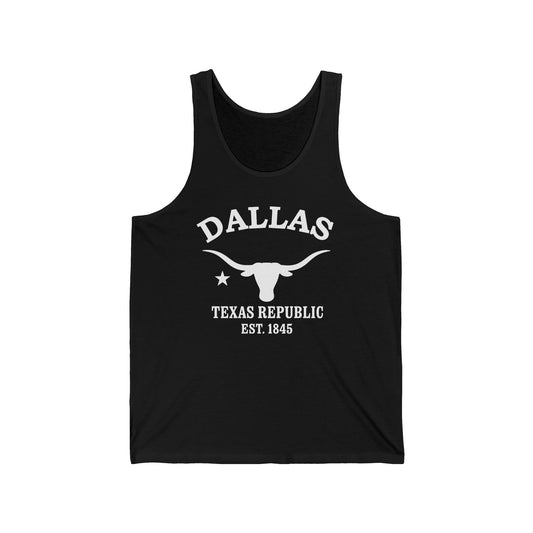
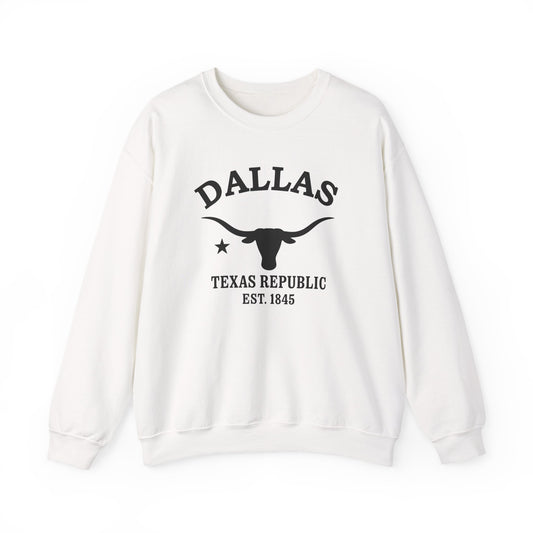
Our Dallas logo carries the Texas longhorn over “Texas Republic · Est. 1845,” the year Texas joined the Union — the shared emblem of every Merlin Classics Texas town. Printed in clean retro black-and-white that reads like an old rodeo poster or a brand burned into a fence rail, the longhorn and Lone Star stand for Texas as a whole; what makes this one Dallas is everything behind it — the flying red Pegasus, the lit-up Ball on the skyline, the Art Deco grandeur of Fair Park, and a prairie trading post that willed itself into Big D.
Today Dallas is skyline and prairie light, museums and neon, a flying red horse over a downtown that never stops building. Our Dallas designs gather that identity — the longhorn emblem, Big D confidence, the Pegasus and the skyline — into wearable form. It is a Texas city that made itself out of almost nothing and has been proud of it ever since. Dallas, Texas — Big D, where the red Pegasus still flies over a skyline a frontier trader started by a river ford.
Wear the History
Dallas, Texas — Travel Guide
Visiting Dallas Today
Dallas spreads across the North Texas prairie around a glittering downtown of glass towers, neon, and one beloved red horse. It is a city of big museums and big appetites — a serious arts district, a restaurant scene that takes itself seriously, and history at every turn, from a frontier river ford to a mid-century skyline.
The Skyline, the Arts & the History
For visitors looking for things to do in Dallas, Texas:
- Catch the flying red Pegasus turning above the Magnolia Building downtown.
- Ride up Reunion Tower — “the Ball” — for the full skyline and prairie horizon.
- Walk Dealey Plaza and the West End, the “birthplace of Dallas,” where the Sixth Floor Museum tells the history of President Kennedy’s 1963 assassination.
- Explore Fair Park’s Art Deco grounds, and time a visit for the State Fair of Texas, where Big Tex towers over the midway.
- Tour the Dallas Arts District — the Dallas Museum of Art, the Nasher Sculpture Center, and the performing-arts halls.
- Relax in Klyde Warren Park, the deck park built right over the freeway.
- Wander the Bishop Arts District and Deep Ellum for murals, shops, and live music.
- Stroll the Dallas Arboretum and the trails around White Rock Lake.
Why People Visit Dallas
Dallas rewards visitors who like a city with confidence: a skyline you can read like a history book, a world-class arts district, museums of real weight, and food worth crossing town for. Add the flying red Pegasus, the Art Deco of Fair Park, and Texas hospitality scaled up, and Big D makes a strong case for itself.
Wear the History
Kindred Cities
Welcome, friends from Sendai, Japan (ようこそ), Dijon, France (bienvenue) and Valencia, Spain (bienvenidos) — Dallas keeps cultured company abroad.
Dallas has long twinned through commerce and culture. The Dijon tie dates to 1957, struck by Stanley Marcus of Neiman Marcus, who wanted Dallas to share the French city’s eye for food and elegance. Sendai followed in 1997 by way of the business and arts community; Valencia rounds out a circle that runs to the refined and the international.
When the 2011 earthquake and tsunami devastated Sendai, Dallas rallied to help its sister city recover — the kind of bond that outlasts ceremony. The friendship, signed in 1997, still sends students and marathon runners across the Pacific each year.
Arrive from Sendai or Dijon, and Dallas plays to the same tastes: a serious arts district, a restaurant city that takes its food personally, and Texas hospitality scaled up. Come hungry and curious. Come and visit us soon.
When you plan the trip, Visit Dallas — the city’s official tourism bureau — is the place to start.
Wear the History

For deeper reading on the Dallas history described here — the Caddo crossing and the 1841 founding at John Neely Bryan’s Trinity ford, the railroad and cotton boom, the rise of “Big D” banking and the Neiman Marcus fashion legacy, the flying red Pegasus (1934), Reunion Tower (1978), and the Art Deco grandeur of Fair Park and the 1936 Texas Centennial — it may be useful to consult (1) the Dallas Historical Society, (2) the Dallas Public Library’s Dallas History & Archives Division, (3) the Texas State Library and Archives Commission, (4) Preservation Dallas and the city’s landmark office, and (5) the Old Red Museum of Dallas County History & Culture and the Sixth Floor Museum at Dealey Plaza. For travel and visitor information, it may be useful to contact (1) Visit Dallas, (2) the Dallas Regional Chamber, (3) the Dallas Park and Recreation Department, (4) the Texas state-parks office, and (5) regional visitor desks and the Dallas Love Field and DFW airport information desks.
Shop the Dallas Texas collection
View full collection-
Dallas Texas Vintage Retro Premium Crewneck Sweatshirt - Black Logo
Regular price $48.00 USDRegular price -
Dallas Texas Vintage Retro Premium Crewneck Sweatshirt - White Logo
Regular price $48.00 USDRegular price -
Dallas Texas Vintage Retro Embroidered Cotton Cap - White Logo
Regular price $32.00 USDRegular price -
Dallas Texas Vintage Retro Embroidered Cotton Cap - Black Logo
Regular price $32.00 USDRegular price -
Dallas Texas Vintage Retro Unisex Heavy Cotton Hoodie - White Logo
Regular price $56.00 USDRegular price -
Dallas Texas Vintage Retro Unisex Heavy Cotton Hoodie - Black Logo
Regular price $56.00 USDRegular price -
Dallas Texas Vintage Retro Unisex Heavy Cotton Tee - White Logo
Regular price $22.00 USDRegular price -
-
Dallas Texas Vintage Retro Womens Fitted Ringspun Cotton Tee - Black Logo
Regular price $28.00 USDRegular price -
Dallas Texas Vintage Retro Unisex Embroidered Fleece Jacket - White Logo
Regular price $98.00 USDRegular price -
Dallas Texas Vintage Retro Unisex Heavy Cotton Tee - Black Logo
Regular price $22.00 USDRegular price -
Dallas Texas Vintage Retro Unisex Embroidered Cotton Polo - Black Logo
Regular price $48.00 USDRegular price -
Dallas Texas Vintage Retro Vinyl Sticker - Black Logo
Regular price From $6.00 USDRegular price -
Dallas Texas Vintage Retro Ceramic Mug - Black Logo
Regular price From $16.00 USDRegular price -
Dallas Texas Vintage Retro Cotton Canvas Tote Bag - Black Logo
Regular price $25.00 USDRegular price -
Dallas Texas Vintage Retro Cotton Canvas Tote Bag - White Logo
Regular price $25.00 USDRegular price -
Dallas Texas Vintage Retro Thank You Card Set - Black Logo
Regular price From $25.00 USDRegular price -
Dallas Texas Vintage Retro Cotton Jersey Baby Bodysuit - Black Logo
Regular price $26.00 USDRegular price -
Dallas Texas Vintage Retro Unisex Cotton Jersey Tank Top - Black Logo
Regular price $28.00 USDRegular price -
Dallas Texas Vintage Retro Unisex Cotton Jersey Tank Top - White Logo
Regular price $28.00 USDRegular price -
Dallas Texas Vintage Retro Back Printed Art Series Cotton Tee - Black Logo
Regular price $32.00 USDRegular price -
Dallas Texas Vintage Retro Giclée Print Art Series Poster
Regular price From $38.00 USDRegular price -
Dallas Texas Vintage Retro Unisex Heavy Crewneck Sweatshirt - Black Logo
Regular price $44.00 USDRegular price