Arlington Texas — Retro Vintage History
What's with Vegas Before Vegas? On a hilltop above the old highway between Dallas and Fort Worth, a genteel tea garden once hid one of the South's most notorious illegal casinos. Top O' Hill Terrace ran high-stakes gambling behind a respectable front through the 1920s, '30s, and '40s — with a concealed basement and escape tunnels for when the law came up the hill — and it drew gamblers, oilmen, and celebrities from across Texas long before the Strip existed. They called it "Vegas before Vegas." The Texas Rangers spent years trying to shut it down and finally did; the estate is now Arlington Baptist University, and the tunnels are still there. It is the most Arlington story there is: a little hardscrabble prairie town with an outsized appetite for spectacle.
Wear the HistoryThe blackland prairie here was Caddo country long before the town. In 1841, in the Republic of Texas years, frontiersmen built Bird's Fort near present-day Arlington, and the Bird's Fort Treaty was signed in the area in 1843 — a frontier accord between the young republic and Native nations on land that had been inhabited for centuries. Settlement followed slowly, with scattered farms and the small community of Johnson Station out on the Cross Timbers.
The town itself began with the railroad. In 1876 a market stop was laid out along the new Texas & Pacific Railway and named Arlington, after the Arlington estate in Virginia; it incorporated in 1884. For its first half-century it was a quiet North Texas farm town — cotton, corn, and cattle hauled to the rail line — the kind of place that measured itself by gins and grain, not grandstands. Nothing about it yet suggested the spectacle to come.
Then Arlington discovered it had water worth selling. A downtown artesian well drilled in 1892 brought up mineral water, and for nearly sixty years the town marketed itself as a health resort, with a bathhouse and pavilion and visitors who came to "take the waters." The interurban electric railway that linked Dallas and Fort Worth ran right through town, carrying day-trippers to the wells. The well stayed at the center of downtown civic life until it was capped in 1951; a memorial plaza marks the spot today. The health-resort decades gave Arlington its first taste of being a destination rather than a way station.

The modern city is largely the work of one long-serving mayor, Tom Vandergriff, who set out at mid-century to turn a town of a few thousand into something far bigger. The pivotal stroke came in 1961, when the first of the regional theme parks in the United States opened in Arlington — the idea, as the story goes, of dropping a roller coaster in a cotton field and calling it the future. It worked. Major-league baseball followed, then professional football, and the stretch of ground between the old farm town and the highway became a national entertainment district. Arlington had reinvented itself as a place people drove to for a big weekend.
That reinvention is why Arlington calls itself "The American Dream City." Today it is the third-largest city in the Dallas-Fort Worth Metroplex, a city of nearly 400,000 sitting squarely between Dallas and Fort Worth, with a General Motors assembly plant, the University of Texas at Arlington, Lake Arlington, the Trinity River woods of River Legacy Parks, and an entertainment district that draws visitors from across the country. The prairie practicality is still there underneath the bright lights — a hardworking Texas city that also happens to throw a very large party.
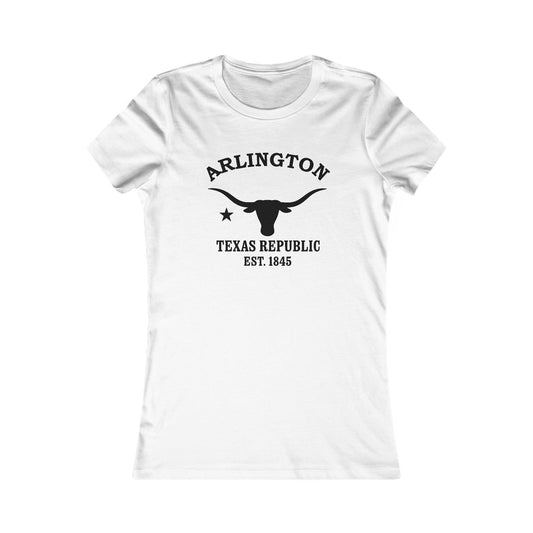
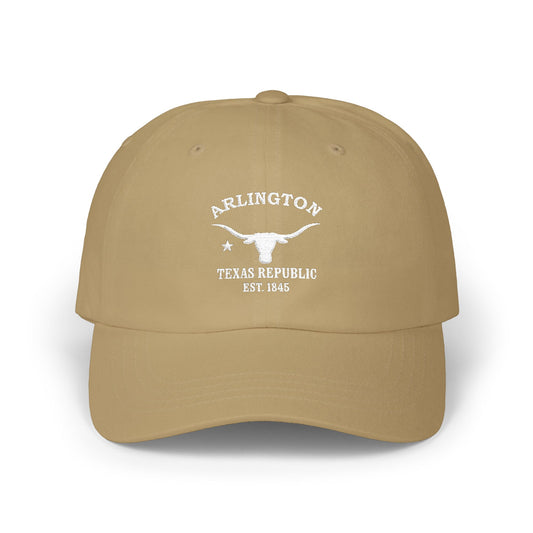
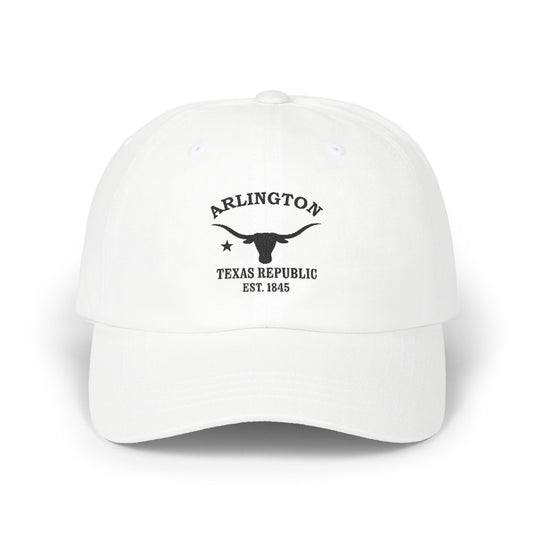
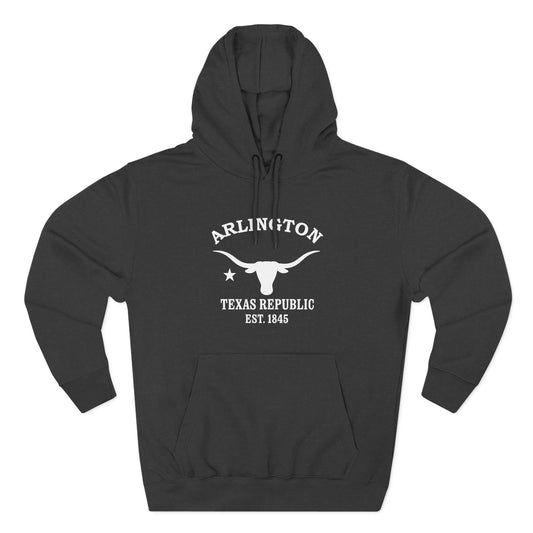
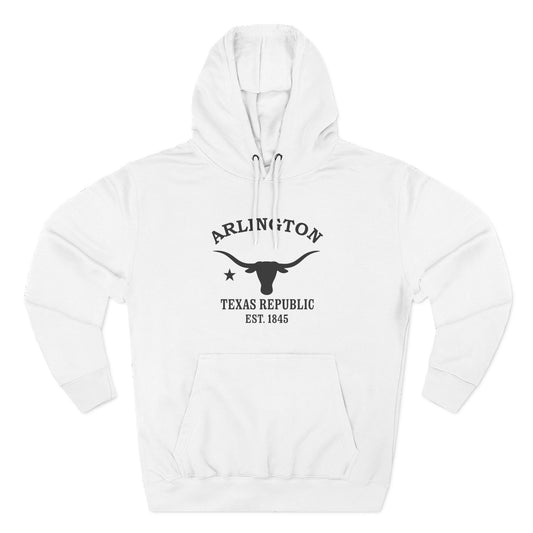
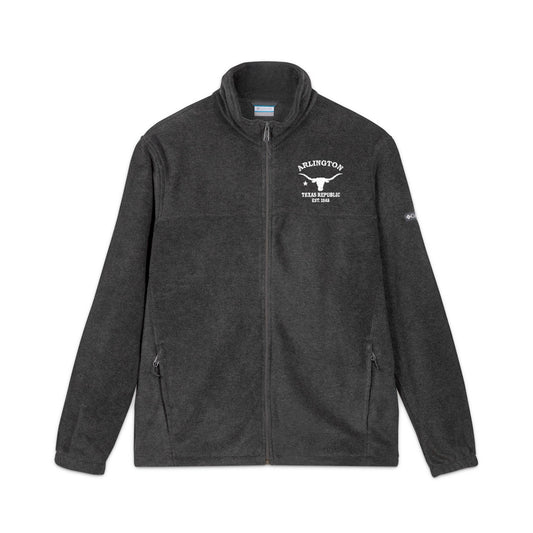
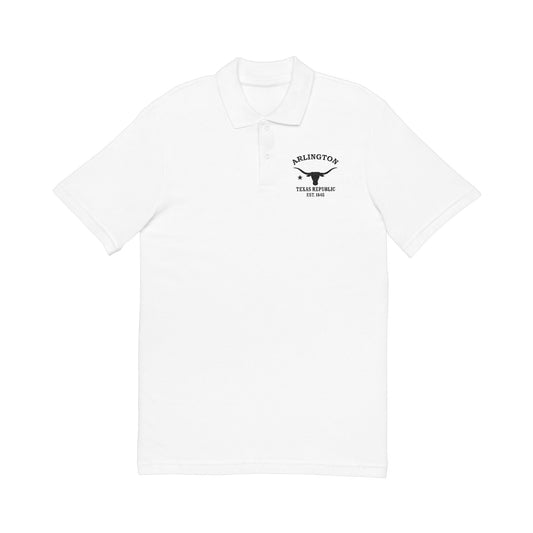
Our Arlington logo carries the Texas longhorn and a lone star above "Texas Republic — Est. 1845," the shared retro emblem of our Texas towns, drawn in worn black-and-white like an old woodcut crate label. The 1845 date marks Texas statehood, and the longhorn is the through-line that links Arlington to every other Texas town we make. The detail that makes this one Arlington is the American Dream City itself — the railway market town, the old mineral well, the Vegas-before-Vegas hill, and the entertainment capital it grew into between Dallas and Fort Worth.
Arlington is the American Dream City — a Texas & Pacific market town that went from cotton fields and mineral water to roller coasters and stadium lights, midway between Dallas and Fort Worth. Our Arlington designs gather that into wearable form. Wear the American Dream City. American Dream City. Built bold in Texas.

Arlington, Texas — Travel Guide
Visiting Arlington Today
Arlington sits squarely in the middle of the Dallas-Fort Worth Metroplex, the self-styled American Dream City and a national sports-and-entertainment destination. Expect a sprawling, sunny North Texas city of big venues and broad highways, balanced by lake and river parks, a revived downtown, and the curious heritage corners — a Prohibition casino estate, an old mineral-well plaza — that predate the bright lights. It is hot in summer, lively year-round, and busiest on game and event weekends.
The Entertainment District, Parks & Heritage
For visitors looking for things to do in Arlington, Texas:
- Take in the Entertainment District, where AT&T Stadium and Globe Life Field anchor one of the country's great sports-and-event hubs.
- Ride Six Flags Over Texas, the original park of its kind, opened in Arlington in 1961, and its companion water park.
- Tour Top O' Hill Terrace, the Prohibition-era casino estate with its tea-garden cover and escape tunnels, now on the Arlington Baptist University grounds.
- Walk and bike River Legacy Parks, miles of Trinity River woods and trails on the city's north side.
- Boat, paddle, or fish Lake Arlington, the city's 2,000-acre reservoir.
- See the downtown mineral-well memorial plaza, where the old health-resort well once stood.
- Visit the Arlington Museum of Art and the walkable downtown and UTA-area district.
- Catch a concert, convention, or festival in the Entertainment District any weekend of the year.
Why People Visit Arlington
Arlington rewards travelers who want big-event energy with Texas convenience — the stadiums and theme parks of the Entertainment District, set between Dallas and Fort Worth and easy to reach from either. People come for the games, the coasters, and the concerts, and stay for the river-and-lake parks and the offbeat heritage of a prairie town that talked itself into becoming the American Dream City.
Wear the History

For deeper reading on the Arlington history described here — the Caddo homeland and Bird's Fort, the 1876 Texas & Pacific Railway founding and the 1884 incorporation, the 1892-1951 downtown mineral well and health-resort era, the Top O' Hill Terrace casino years, and the mid-century rise of the American Dream City — it may be useful to consult (1) the University of Texas at Arlington Libraries Special Collections, (2) the George W. Hawkes Central Library of the Arlington Public Library system, (3) the Arlington Historical Society and Knapp Heritage Park, (4) the Texas State Library and Archives Commission, (5) the Texas State Historical Association, and (6) the Center for Transportation and Commerce / Texas & Pacific Railway historical collections. For travel and visitor information, it may be useful to contact (1) Travel Texas, (2) the Arlington Convention & Visitors Bureau, (3) the City of Arlington, (4) the Texas Historical Commission, and (5) the regional DFW transportation and visitor desks.
Shop the Arlington Texas collection
View full collection-
Arlington Texas Vintage Retro Premium Crewneck Sweatshirt - Black Logo
Regular price $48.00 USDRegular price -
Arlington Texas Vintage Retro Premium Crewneck Sweatshirt - White Logo
Regular price $48.00 USDRegular price -
Arlington Texas Vintage Retro Unisex Heavy Cotton Tee - White Logo
Regular price $22.00 USDRegular price -
Arlington Texas Vintage Retro Unisex Heavy Cotton Tee - Black Logo
Regular price $22.00 USDRegular price -
Arlington Texas Vintage Retro Vinyl Sticker - Black Logo
Regular price From $6.00 USDRegular price -
-
Arlington Texas Vintage Retro Womens Fitted Ringspun Cotton Tee - Black Logo
Regular price $28.00 USDRegular price -
Arlington Texas Vintage Retro Embroidered Cotton Cap - White Logo
Regular price $32.00 USDRegular price -
Arlington Texas Vintage Retro Embroidered Cotton Cap - Black Logo
Regular price $32.00 USDRegular price -
Arlington Texas Vintage Retro Unisex Heavy Cotton Hoodie - White Logo
Regular price $56.00 USDRegular price -
Arlington Texas Vintage Retro Unisex Heavy Cotton Hoodie - Black Logo
Regular price $56.00 USDRegular price -
Arlington Texas Vintage Retro Unisex Embroidered Fleece Jacket - White Logo
Regular price $98.00 USDRegular price -
Arlington Texas Vintage Retro Back Printed Art Series Cotton Tee - Black Logo
Regular price $32.00 USDRegular price -
Arlington Texas Vintage Retro Giclée Print Art Series Poster
Regular price From $38.00 USDRegular price -
Arlington Texas Vintage Retro Unisex Embroidered Cotton Polo - Black Logo
Regular price $48.00 USDRegular price -
Arlington Texas Vintage Retro Ceramic Mug - Black Logo
Regular price From $16.00 USDRegular price -
Arlington Texas Vintage Retro Cotton Canvas Tote Bag - White Logo
Regular price $25.00 USDRegular price -
Arlington Texas Vintage Retro Cotton Canvas Tote Bag - Black Logo
Regular price $25.00 USDRegular price -
Arlington Texas Vintage Retro Thank You Card Set - Black Logo
Regular price From $25.00 USDRegular price -
Arlington Texas Vintage Retro Cotton Jersey Baby Bodysuit - Black Logo
Regular price $26.00 USDRegular price -
Arlington Texas Vintage Retro Unisex Cotton Jersey Tank Top - Black Logo
Regular price $28.00 USDRegular price -
Arlington Texas Vintage Retro Unisex Cotton Jersey Tank Top - White Logo
Regular price $28.00 USDRegular price -
Arlington Texas Vintage Retro Unisex Heavy Crewneck Sweatshirt - Black Logo
Regular price $44.00 USDRegular price