


After the war the aerospace work stayed and the prairie filled in around it — subdivisions, shopping, the Metroplex closing over the open ground from both directions. Then in 1996 Lone Star Park opened its grandstand and the horses came back to the prairie, thoroughbreds and quarter horses running spring and fall, with the Breeders’ Cup brought to the grandstand in 2004. The quarter horse itself traces its foundation stock in part to the same Spanish animals that ran here before the fences, which makes the return less a coincidence than a long circle closing.
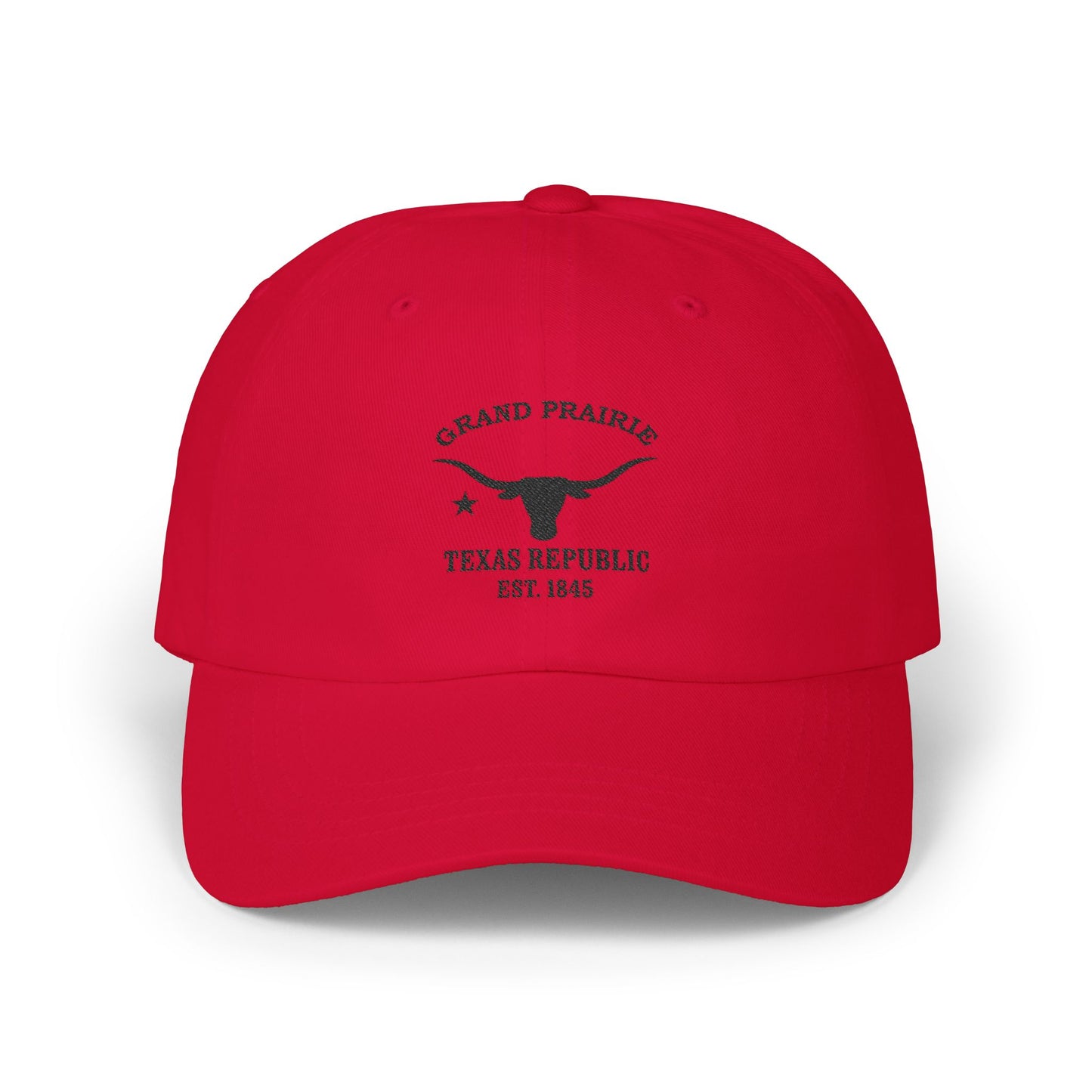
Our Grand Prairie logo carries the Texas longhorn and Lone Star, the emblem every Merlin Classics Texas place wears, set over “Texas Republic, Est. 1845.” The longhorn and the star are the state’s shorthand — endurance, independence, the open range — printed black-and-white with the worn look of an old barn brand or a rodeo bill. What makes this one Grand Prairie is what stands behind it: the grassland that named the town, the horses that ran it, and the aircraft that borrowed their name. On a tee or a cap it reads less like a souvenir than like a piece of North Texas, worn plain.
Why People Visit Grand Prairie, Texas
People come for the central Metroplex location and the mix of prairie, lakes, and live racing — and stay curious about an aviation heritage most visitors never expect from a city between Dallas and Fort Worth. It is flat, friendly, and in the middle of everything, with a long horizon and a longer memory than its suburbs suggest.
